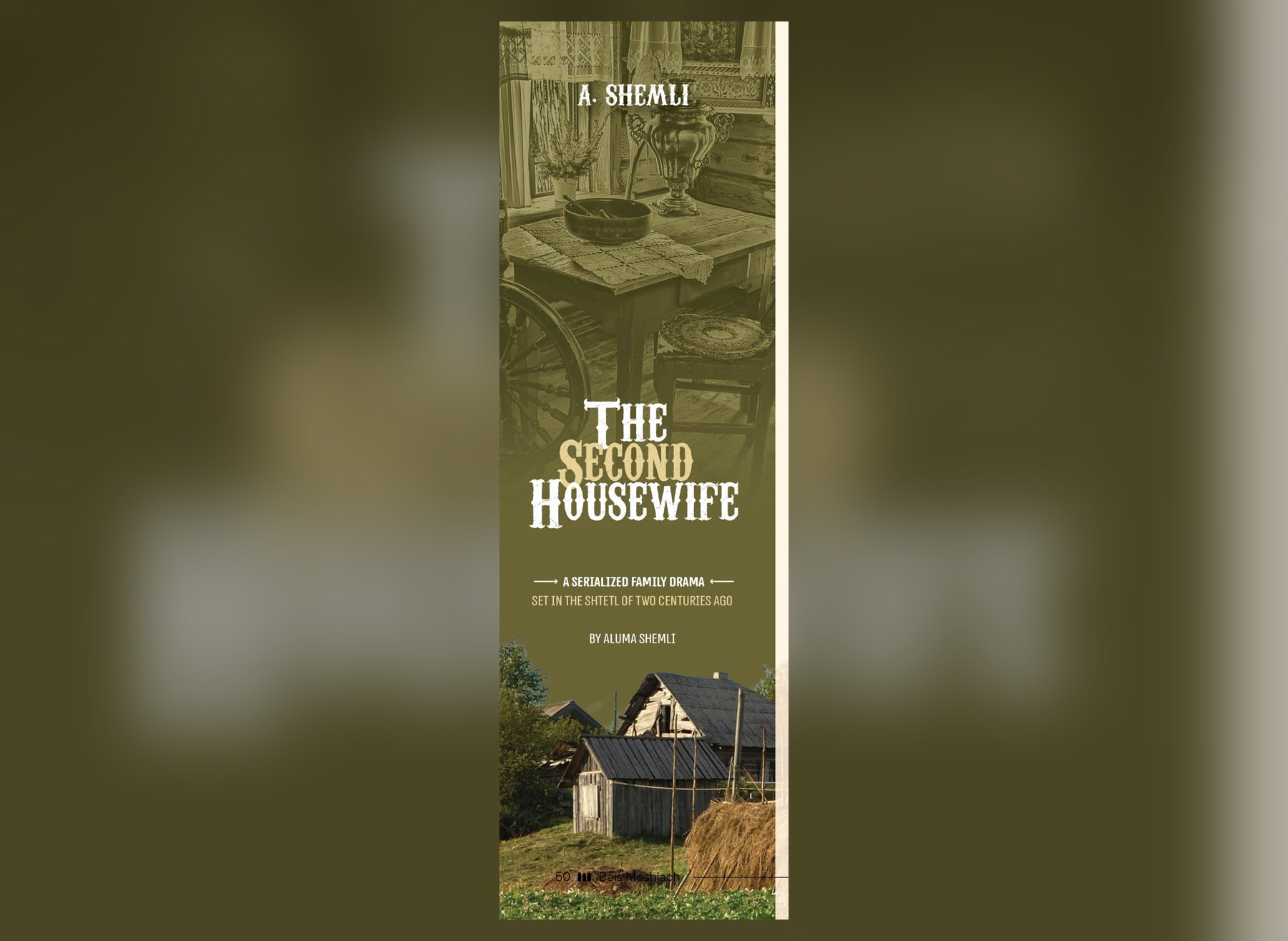
The Second Housewife – Chapter 92
92
Previously: Shmuel asked the Rebbetzin to prepare liver for Aidel. The Rav requested that he travel to the count, sign as a guarantor for his loan, and then ask him to convince Justice Pyotor Stanislavskito to cancel the edict.
Dinner is over. It was a dairy meal, served in the dining room without any tablecloth. Such is the custom here at the estate during the Nine Days. This is not the only thing they customarily do here, and Aidel senses that she never really felt the experience of mourning for the Beis HaMikdash to such an extent until now.
They’re also stringent not to light all the lamps in the same room at once and to remove the curtains. However, that’s nothing compared to the customs Shmuel himself keeps. On the night of Rosh Chodesh Av, Aidel was almost frightened out of her wits when she discovered him sleeping on the carpet, a stone under his head. At mealtime, he has only bread and water. She doesn’t want to think about how Shabbos Chazon will look like…
“Do you want to go out for a walk?” Shmuel asked her suddenly after bentching. “Do you have the strength?” His eyes were filled with concern.
Aidel was surprised, almost indifferent. “Now?”
“Why not?” He smiled weakly. “It’s too hot in the afternoon.”
“I mean,” she blushed, getting up from her place, “is it permissible during the Nine Days?”
“For the reason that we’re going, yes,” he declared matter-of-factly.
It took Aidel a few minutes to get organized, and soon afterwards they were on their way out onto the darkened street. They walked slowly and quietly. However, they weren’t alone, as it turned out that several more people felt hot and decided to go and air themselves out for a little while. Shmuel nodded in acknowledgement of those who greeted him in the street, placing his hands behind his back, looking at the dirt road. Near the great synagogue under a wind lantern, he sat down on a low stone fence, and he suggested with a smile that she take a seat as well.
“We haven’t gone out for a long time,” Shmuel said quietly. Aidel gave no response, looking at the stars. Any enjoyment from their evening out was muted by the overall feeling of mourning, along with a feeling that she didn’t know how to describe.
Shmuel looked at Aidel with a vague expression. “I am again forced to ask your permission to leave the house during our first year.” Aidel didn’t react. Shmuel continued: “The Rav has a strong basis for believing that Count von Sadislavski can help us in revoking this frightful edict. However, for this to happen, I’ll have to travel to him. I’ll also probably have to continue with him to Kiev to sign as a guarantor. This is what I refused to sign when he was here on Erev Shavuos.”
“You never told me what he wanted that day,” she said as if that was important.
“He asked me to sign to guarantee a loan from a bank in Kiev. I refused, because I didn’t want to leave you alone.”
“Thank you,” she said, stretching her legs forward and looking at them. “Why does a person like Count von Sadislavski need your signature?”
“And why do you make light of my signature without even knowing the extent of our properties?” he inquired with a smile.
Aidel’s eyes opened wide in shock. After a moment, she smiled awkwardly. “Our properties…”
“Our properties,” Shmuel repeated after her with resoluteness. “The fact that you have no idea how much they’re worth doesn’t make them any less yours.”
Aidel was silent, looking at him with uncertainty.
“The Rav asked me to tell you that as long as I haven’t returned safely home to the village, you should leave the door open and the bed is to be made at all times, day or night.” His voice cracked at the end of the sentence. “While this is reassuring, it seems to me that things have changed in our family, haven’t they? It’s hard for me to believe that you’ll need to use this option.” His eyes were beckoning, and he looked so wretched that she had to give him a comforting smile. “Everything will be all right, Shmuel. I’m not as green as I was at the beginning…”
Shmuel smiled, lowering his gaze with a sigh. They were both quiet for several minutes. Fewer people were now walking down the street. One lamp momentarily flickered, then went out. Aidel tried to find a more comfortable position for herself; something was irritating her back.
“You know,” Shmuel said softly, kicking a small stone and watching it roll down the road. “There’s one thought that has consumed me ever since this edict came upon us after Shavuos.” He looked heavenward for a moment. “I hadn’t considered sharing this with you, it’s just a thought.” He stroked his beard. “But now, it’s important for me to consult with you.”
Aidel stood up, shaking off her dress. She groaned as she supported her back with her hand, stretching herself out.
“Is it hard for you?” he asked with concern. “Do you want to go back?”
Aidel smiled, looking pale. “I’d like to speak with you until morning, but not here. It’s hard for me to sit on this rock.” Shmuel quickly stood up, giving her an apologetic look. “Is it all right to walk?”
Aidel nodded her head and began walking. “Would you like to go to the bridge?” Shmuel asked with a wink.
“To the bridge?” Her eyes lit up. This was the furthest spot from Lubianka to which she had ever come, as if she was entering another country. “At night?” she asked hesitantly.
“Definitely at night,” he smiled. “It’s most beautiful at night… Come and see.”
They quietly made their way towards the river. Shmuel watched her closely. She really did look pale, albeit standing erect. While it didn’t appear that it was hard for her to walk, it was impossible to know for certain… “Nu, enough already,” Aidel chuckled uncomfortably. “I’m all right!”
Shmuel shrugged his shoulders. “I hope so. You know, I’m really trying not to worry.”
“Why are you worried?” she smiled. “It’s all quite normal…”
“I don’t know,” he said quietly. “I have four children, Aidel, I know about this…”
“Long before you thought about being born…” she said, trying to mimic his deep voice.
Shmuel smiled in surprise. “Exactly…”
Aidel stopped suddenly, slightly embarrassed. “I still haven’t thanked you for the liver. It was excellent…”
“I’m pleased.” Shmuel gave a serious look. “The Rav ruled that you should continue eating the liver even during the Nine Days. Regarding Tisha B’Av, we’ll have to ask if you can fast.”
Aidel frowned. “On the 17th of Tammuz, when you stubbornly insisted that I eat, you promised that I could fast on Tisha B’Av and Yom Kippur!”
Shmuel shrugged again. “It doesn’t look that way for the moment…”
They continued walking quietly. The village was now behind them as they faced the bridge, illuminated with the light of the stars in the background. The path they now were following was totally dark, lit with some difficulty with the last lights shining from the village.
Shmuel walked at a moderate pace, looking at his steps in deep contemplation. Aidel followed alongside him, fearful of the darkness, lifting the hem of her wide dress, advancing carefully although she didn’t know why. She moved closer to him. Only when they reached the well-lit paved bridge did she heave a sigh of relief. “Are you all right?” he asked with concern. “Was it hard for you?”
Aidel felt that his worrying was already starting to be a burden on her. “I’m perfectly fine. I’m just a little afraid of the dark,” she said with embarrassment. Shmuel smiled as he went up to the highest spot on the bridge, leaning on the railing, looking down on the river. Aidel joined him, a bit anxious. “Wow!” she blurted, unable to find the words to express her excitement. The light of the bridge together with the flowing water created a spectacular vision of droplets, colors, and light. “Amazing, isn’t it?” he whispered.
After a few minutes of silence, Aidel said: “What thoughts did you want to share with me?”
Shmuel remained silent for a little longer, and then said quietly: “I sat with Zalman after Shavuos, and I discovered that we have the possibility of paying most of the fine imposed upon the village ourselves.”
“Fifty thousand gold ducats?” Aidel moaned, her eyes opened wide.
“Close to forty thousand,” he smiled. “However, Gedalia and Getzel will surely take responsibility for the remaining ten thousand through long-term loans.” He was quiet for a long moment, then continued speaking.
“If they would have given me four years to get organized, I could pay and still remain a gvir. If they would have given me two years, I might have been able to leave a sum of money for myself on the side. However, since we have less than six months, I’ll have to sell our assets for far less than their real value and break our savings accounts – and then we’ll literally be cleaned out of all our property.”
“The main issue,” he continued a moment later, “is that the more I think about it, I imagine myself getting up at the crack of dawn in a one-room rental dwelling in the poor part of town, drawing two buckets of water from the river for you. I then would go to learn in the Beis Medrash, return home at night for dinner comprised of kasha and beets. I don’t see this as a sacrifice on my part – just a glimpse of the Olam Haba, literally!”
His eyes sparkled as he smiled at her, slightly embarrassed.
Aidel looked at him with a twinkle in her eyes, wiping away a tear. “The dream of my life…”
“What do you say?” Shmuel whispered, his eyes aflame. “Should we do this?”
It was suddenly clear to Aidel that she could, and if necessary, she’ll find the strength to do it all. Nevertheless, she shook her head, crying. “Only as a last resort,” she replied softly, “and only if there’s still no other business deal that can solve the problem by Rosh Chodesh Kislev.”
Shmuel was stunned. “Why the hesitation?”
“Lubianka needs you as a gvir, Shmuel,” Aidel replied, her shoulders trembling. “We can’t think only about ourselves.”
Shmuel laughed in surprise. “You’re right…”
After thinking for another moment, he added quietly, “However, I’m pleased that we have the same aspirations…”
Shmuel stretched his muscles. “Very well, so you agree that I can make the journey immediately after Shabbos? I estimate that I’ll be gone for at least two weeks.”
“After Shabbos? These are times wrought with danger for the Jewish People, not a time to set out on a long journey…” she said with alarm.
“When an entire community, young and old, infants and the infirm, goes out into exile to wander in the depths of winter, this is a much greater danger – literal pikuach nefesh. Do you consent to let me make the trip?” He was determined to hear the consent come directly out of her mouth.
Aidel was quiet for a long while, staring down at the river. “Before you go, I want you to reach a decision on rebuilding the Tailors’ Shul.”
“What?” Shmuel was stunned, even angry. “It wouldn’t be proper to exploit this urgent journey in order to compel me to do something that I don’t agree with!”
“I’m not exploiting anything,” Aidel said quietly. “It’s just that it’s clear to me that this edict has come as a form of punishment because we haven’t rebuilt the shul.” She took a deep breath. “Hashem has no home, so we also have to look for another home for ourselves…
“If the shul remains here in ruins, this whole journey will be for nothing, Shmuel.” She placed her head on her hands, sobs racking her body. “I’m not taking advantage of this situation. I’m even prepared to remain alone for six months, if that’s what’s needed. You know that.” She sniffled. “But if we don’t fix the root of the problem, the entire trip won’t be worth the effort. Do you understand?”
Shmuel stretched out again, looking at the moon for a moment, a thin sliver like a hair. He then closed his eyes, feeling that it would be easier for him to give up all his property than agree to her request.
“Aidel,” he said, “so it will be. I won’t make the trip before coming to a clear decision to renovate the shul. If the seven community leaders won’t agree with me, I’ll accept the renovations upon myself.” ■
To be continued…
Beis Moshiach #1417 • pp. 50-53
© 2026 Beis Moshiach Magazine. All rights reserved.
This article originally appeared in Beis Moshiach #1417. You are welcome to share it with friends and family by email or in print, provided that you do not change, add to or omit any part of it, you credit the author and Beis Moshiach, and you include a link to archive.bmoshiach.org (written out in full in printed copies).
To republish this article in a newspaper, magazine, book or website, please request permission in advance at [email protected].