An Upshernish at Rashbi
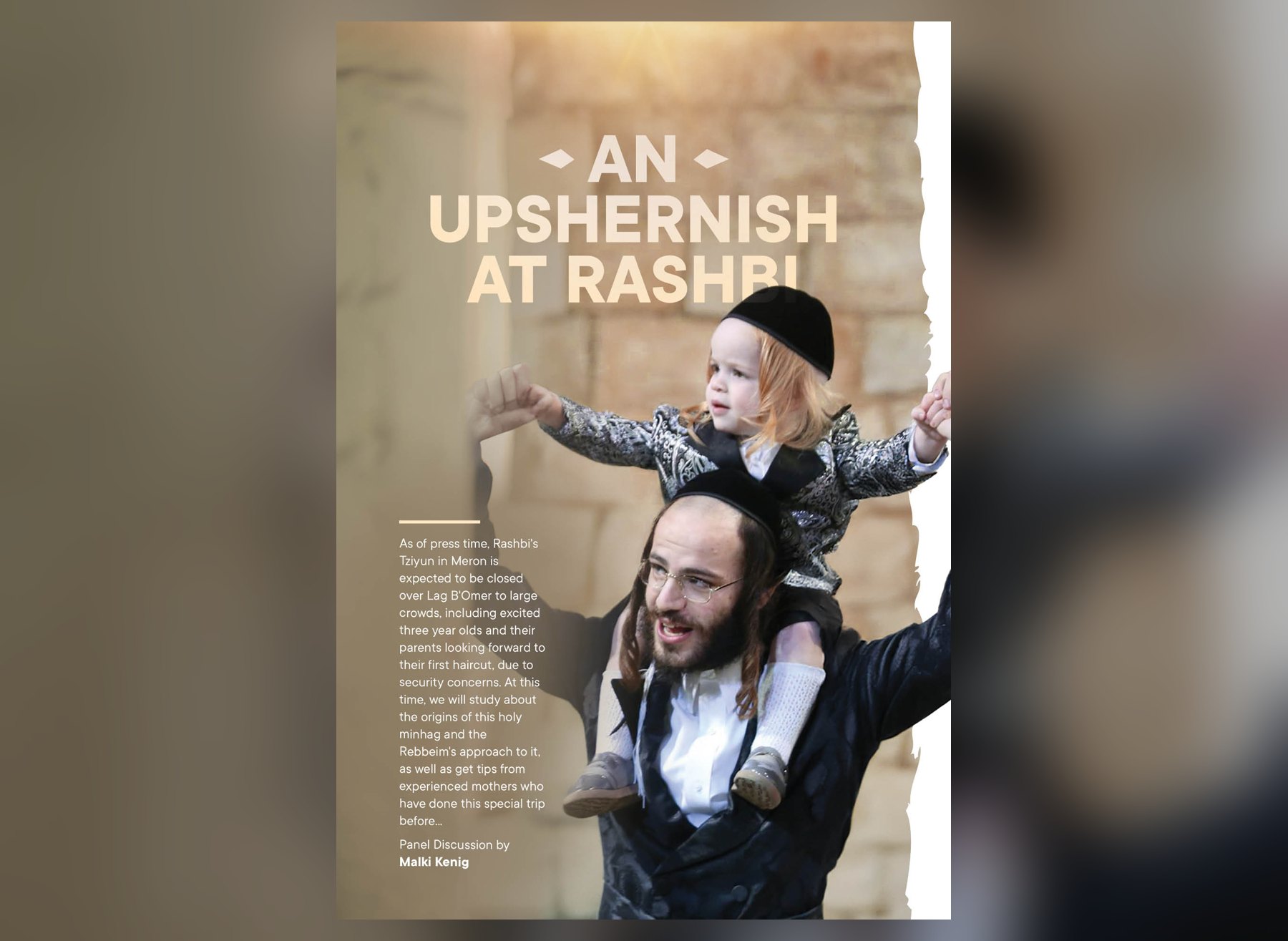
As of press time, Rashbi’s Tziyun in Meron is expected to be closed over Lag B’Omer to large crowds, including excited three year olds and their parents looking forward to their first haircut, due to security concerns. At this time, we will study about the origins of this holy minhag and the Rebbeim’s approach to it, as well as get tips from experienced mothers who have done this special trip before… ■ Panel Discussion
Malki Kenig
You’ll find all different types there on the way up to Meron. Jews come there from across the spectrum of world Jewry. This takes expression in the ancient traditional niggunim heard in every corner – from the lively ‘V’Amartem Ko L’Chai’ – a piyyut by the ‘Ben Ish Chai’, to the Alter Rebbe’s niggun sung before lighting the central bonfire.
Many of the customs of this animated day have gradually built up over the years. It started with kindling the traditional bonfire and the ascent to Mt. Meron by Jews from all over the country, and continued with a long list of traditions and customs in honor of the ba’al ha’hilula, Rabi Shimon bar Yochai.
One of the sources for going up to Meron on Lag B’Omer appears in the sefer of Rabbi Chaim Vital, the principal student of the AriZaL. “I saw my teacher, of blessed memory, who once went there on Lag B’Omer, he and the members of his household, and he dwelled there for the first three days of that week…when he brought his young son there with all the members of his household, and they shaved his head according to the well-known custom and he made there a day of feast and joy.”
While the AriZaL didn’t ‘invent’ the concept of the hilula, he’s the one who sanctified the day of Lag B’Omer and making a pilgrimage to the Rashbi’s Tziyun. He explained to us how much this was a day of joy and of Rabi Shimon bar Yochai. And since then, “Jewish custom is Torah.”
The Rebbe Melech HaMoshiach referred on several occasions to the custom of going up to the Tziyun. In 5750, a group of guests arriving from Tzfas were staying in “Beis Chayeinu – 770” On Erev Lag B’Omer, the Rebbe said the following:
“It was customary in previous generations — and it can be assumed that this custom is still followed today — that the Jews of Tzfas would travel to Meron to celebrate Lag B’Omer at Rabi Shimon’s gravesite with bonfires and the like. Indeed, in years when Lag B’Omer fell on Sunday, the custom was to spend the preceding Shabbos there, celebrating in the spirit of Lag B’Omer.
“Thus, the presence of a group of guests — men, women, and children — from Tzfas in the Previous Rebbe’s house of study emphasizes this custom. The Previous Rebbe spread the wellsprings of Rabi Shimon bar Yochai’s teachings outward throughout the entire world, preparing the world for the coming of Moshiach. This also relates to the Zohar’s statement that Rabi Shimon’s teachings will enable the Jews ‘to be redeemed from the exile with mercy.’ (Seifer HaSichos 5750, Vol. 2, pg. 460)
On the 11th of Iyar 5716, the Rebbe wrote in a letter to the Lubavitch Youth Organization in Yerushalayim (Igros Kodesh, Vol. 13, pg. 50):
“In response to their question regarding Lag B’Omer, it is quite clear that the relevant parties should arrange a trip to Meron, and bli neder, I will participate to a certain degree in the expenses involving the matter…”
In a letter to the administration of Yeshivas “Tomchei Tmimim” in Lod from the third of Sivan 5712, the Rebbe wrote: “I was most pleased to be informed in part regarding the matter of the trip to Meron on Lag B’Omer, and surely those traveling will write detailed correspondence.” (Igros Kodesh, Vol. 21, pg. 120)
Scissors, Child, and Curls
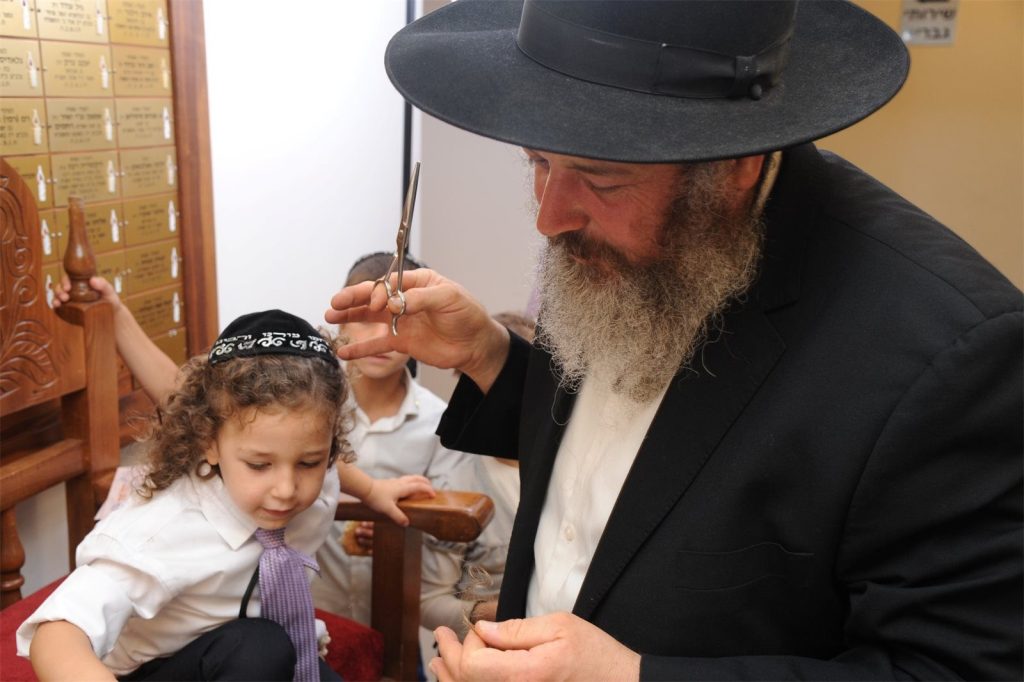
They go up the mountain, little children with their fathers, hand-in-hand or on their shoulders, some of them a little shocked, others busy sucking on a sticky lollipop. It’s enough to look at them to know that in another hour or so, they would all appear a bit older. Even here, there will be a variety of different customs on leaving the peyos. In the final analysis, however, this memory will be emblazoned in the child’s mind, including the message of simcha in fulfilling the cherished custom of leaving peyos for the first time.
“For my children, this was simply an amazing experience,” recalls Michal, a mother who knows. “They traveled with my husband in the morning hours; the roads were then relatively empty in Meron. They arrived around one o’clock, returning at four in the afternoon. It was quite an experience, and suddenly they meet an old friend or a cousin in the Rashbi’s courtyard, and each of them comes and cuts one of the boy’s curls.”
“Don’t compromise on anything,” claims Sheina. “Just have a lot of patience and don’t feel pressured if everything doesn’t go as planned. With regard to the roads, it’s really much easier to head out to Meron early, on the morning of Lag B’Omer, when the journey would be much shorter and with fewer traffic jams. There’s no need to feel anxious, as the whole area is filled with an uplifting atmosphere of simcha. Don’t forget to daven and be happy; the tefillos are accepted there on a direct line.
“I recall an upshernish celebration where the child was stunned by what was happening to his head. Just then, the grandmother arrived and pulled out a box of chocolates. In response to those young people present asking, ‘How did you know?’, she replied, ‘There’s no wisdom like experience.’”
Are There More Tips?
“It’s important to remember that the journey is for the child,” says Sheina, “and therefore, we should keep as far as possible from crowded places, so he won’t be alarmed. This isn’t the right time to go to the Tziyun itself, unless both parents are there. On recent occasions, I also joined the trip to Meron to take responsibility for the food and drink, etc., and naturally also to watch the boy when my husband went to daven Mincha at Rashbi’s tomb. You have to remember that all your efforts and the whole experience won’t be worth a thing if the boy gets lost for a couple of minutes and everyone gets stressed out.”
Michal says that a baby carriage is a most useful and necessary item. “On the other hand, if we decide to go up the mountain – it’s impossible to climb with it. We simply took a bicycle lock with us and tied the carriage to one of the electric poles alongside the hill. This way, we both had a carriage for moving up the mountain and we weren’t stuck with it the whole time.
“With regard to the tender young boy of three,” she continued, “dress him in a white shirt – and that’s it. You can add a light vest if you want, with a change of clothes, of course. On more than one occasion, I cringed at the sight of boys dressed for their upshernish in a tight three-piece suit drenched in sweat. Bring a sweater if necessary, especially if you’re traveling at night, and diapers for those boys still in need. Supply yourselves with plenty of cold water, and it would be appropriate to freeze a package of ice pops to give to the boy and his friends. You should also prepare some nourishing food for the journey, not just sweets.”
Sheina continued with some more tips: “It would be proper to tie the scissors to Tatty’s pocket, and bring a mirror. I hadn’t thought about the idea of bringing a mirror, and my son didn’t understand what was happening to him. So, I stopped near every car and showed him how he looked in the rearview mirror. It proved to be a total shock for him. Thus, it you come with a mirror, he can see the whole process as it happens. Last but not least, a package of baby wipes to remove the leftover traces of hair, so it won’t itch him on the way home.”
In Meron and Also at the Parade
“For our three children, we made the upshernish in Meron,” says Chaya. “Each one was at a different time of year. The least successful occasion was on Lag B’Omer… This was possibly because we were specifically dealing with an extremely shy child who really didn’t enjoy all the disorder and confusion around him. Despite the early preparations, he didn’t cooperate enough. It was very hot, and the boy was on the verge of dehydration. Although we set out for Meron at eight in the morning, we were there at one in the afternoon in the heat of the day.
If such a crowded environment is not suitable for the child, it’s definitely possible to do the haircut during the parade close to his home. The Rebbe said that Rabbi Shimon bar Yochai is at the parade. In any case, do what works best for you, and the main thing is to have a lot of Chassidishe nachas!”
“THE RASHBI’S CHASSANIM”
“On Lag B’Omer 5715, a haircut was arranged for the son of R’ Shalom Levertov. They honored the Rebbe with the ‘first cut’, and afterwards, he said, ‘In Eretz Yisrael, they customarily arrange the first haircut for three-year-old boys – on Lag B’Omer, the Rashbi’s hilula, at his Tziyun in Meron, and they call these children ‘the Rashbi’s chassanim.’
“After he blessed the child that he should grow up to be a Chassid of the Rashbi – a Chassid, yerei shamayim, and lamdan – in accordance with the concept of Rabi Shimon bar Yochai, who revealed the hidden teachings of Torah and also connected the hidden teachings with its revealed teachings, the Rebbe said: In Eretz Yisrael, after giving the child his first haircut, they customarily go out and dance with him. [He concluded:] Say a niggun and go out dancing.” (Toras Menachem 5715, Vol. 14, pg. 67).
“Regarding what he writes about the upshernish of his son, whose birthday takes place on the seventh day of Pesach, although according to what is written in the later commentaries about how we can find room for consent on making a haircut during the days of the Sefira, especially from Chol HaMoed, all this since I haven’t seen that they are so accustomed, and in particular with the well-known Jewish custom of making a haircut on Lag B’Omer, in my opinion, this should be done on the aforementioned day, and if possible in Meron, and may he and his wife raise him to Torah, chuppah, and good deeds.” (Igros Kodesh, Vol. 8, pg. 330)
Beis Moshiach #1410 • pp. 42-45
© 2026 Beis Moshiach Magazine. All rights reserved.
This article originally appeared in Beis Moshiach #1410. You are welcome to share it with friends and family by email or in print, provided that you do not change, add to or omit any part of it, you credit the author and Beis Moshiach, and you include a link to archive.bmoshiach.org (written out in full in printed copies).
To republish this article in a newspaper, magazine, book or website, please request permission in advance at [email protected].