From The Kibbutz To “Kibbutz Nitzuzot”
My dear friend Tiferet Toister, from the Lubavitch kehilla in Rechovot, an artist and an art teacher, shares her inspiring life story. She begins, “I grew up in Kibbutz Gal-On, a left-wing kibbutz near Kiryat Gat. We learned Tanach, but from a text that was rewritten, omitting any mention of Hashem. Every trace of kedusha was stripped away… My shlichus is just the opposite – to permeate my art, and everything else I do, with Elokus.”
Sara and Hagar
“My father Mordechai Derelfer ob”m was a Holocaust survivor, born in Poland in a family of Belzer Chasidim. He was very intellectual, spoke seven languages, and remembered all of the niggunim that he’d heard in his youth in the Ukraine. But he abandoned the religious lifestyle, joined a kibbutz and dedicated his life to working the land of Eretz Yisrael.
“My mother Yosefa ob”m grew up in Tel Aviv in a home that kept Jewish traditions. She was drawn to Yiddishkeit, but in an intellectual way rather than to practical observance. My mother was extremely idealistic and became a lawyer in order to bring justice to the world. She was so good, and had such innocence. I remember her collecting clothes and distributing them to poor Arab families in Gaza.
“My parents met after my mother came to volunteer at kibbutz Gal-On, and both of them were herding flocks of sheep in the fields nearby. They married shortly thereafter. My sister Sarah is two years older than me, and I was named Hagar. This was the fulfillment of my mother’s dream, Sara and Hagar living peacefully together as sisters.
“In my childhood in the kibbutz we were taught social values, such as equality, togetherness and helping others. There was also a rich cultural life. When I was nine I learned to play the piano, and there was a variety of art classes too. My mother always took me to galleries and museums and taught me to love art.
“When I was three years old my parents divorced, and I remained living in the children’s house on the kibbutz. We learned in an ‘open’ school, without grades, academic pressure, or preparation for the matriculation exams required for higher education and careers. Living with freedom to do whatever we wanted, it’s not surprising that the kibbutz eventually fell apart…
“When I was fifteen I went to Tel Aviv to live with my mother, and was in a high school for the arts. That’s where I met my future husband, Doron Toister, who was studying music. He became a lead cellist, musical arranger and composer who’s written well-known books with sheetnotes of niggunei Chabad.” (A feature about Doron was published in issue #1396 – Ed.)
A Wakeup Call
“It was a long process cleansing myself of the leftist political ideologies and stigmas that I was brainwashed into believing,” Tiferet continues her story. “When I served in the IDF I was with religious people for the first time. I often debated with them in an effort to help them become less ‘primitive.’ But I soon saw that they were the ones who were truly enlightened, not me.
“Doron and I were married by the military rabbi when we were both soldiers. We had a ‘kibbutz wedding,’ and were brought to our chuppa on a tractor. After our army service Doron wanted to study cello with Yanush Starker, a renowned teacher. Therefore we moved to Bloomington, Indiana, to attend the University of Indiana where he taught. At the time I received my bachelor’s degree in Fine Arts.
“It was during that period that I had a wakeup call from Hashem. I’d had several miscarriages and then, on Yom Kippur, a stillbirth. Doron and I were broken. I understood that it was time to start keeping taharas ha’mishpacha, Shabbos and everything else properly in order to have blessings in our lives. Afterwards Doron was offered a job in a prestigious orchestra in South Africa, but he refused because they performed on Shabbos.
“We happily returned to Eretz Yisrael and settled in Beer Sheva, where Doron became the lead cellist in the Symphony of Beer Sheva. At the airport there were Lubavitchers doing mivtzaim and I donated the change that I had to tzedaka. They encouraged me to write to the Rebbe, which I did, asking for a blessing for children.” Tiferet adds emotionally, “Boruch Hashem, we were blessed with eight more children.
“We got close with Rav Yechezkel Sofer who, at the time, was the Shaliach in Ben Gurion University in Beer Sheva. We began attending his Tanya shiur regularly. The esoteric concepts were all new to me, but fascinating, and I was immediately drawn to Chabad Chassidus. After the shiur everyone would sit and shmooze together. It was a warm atmosphere, and I knew that my place was in Chabad.
“Four years later Doron received a position as the lead cellist in the Symphony of Rishon L’Tziyon, and therefore we moved nearby, to Rechovot. We’ve been living there for thirty-five years. My children were zoche to have wonderful Chabad chinuch and are raising beautiful families devoted to the Rebbe.“
From Hagar to Tiferet
“When my oldest child, Yishai Shalom, was in kindergarten his friends would poke fun at my name, Hagar, and therefore I decided to add a second name. I made a list of possible names, most of which were very common, and put the name Tiferet on the list too. I brought the list to Rav Yehuda Machputz ztz”l and he picked the name Tiferet for me, which reflects my shlichus of illuminating the world through art that is connected to kedusha.
“For thirty years I was an art and handicrafts teacher in the Talmud Torah Chabad in Rechovot. Every art activity that I did with the children was infused with holiness. For example, when they drew the blessing for trees we would go outside, find two trees with new buds, and recite this blessing together.
“Presently I’m busy giving art classes and workshops. I go to senior centers regularly, and always connect my art projects to Torah – even though I was warned by the administration not to bring in any Yiddishkeit! Once a week I do handicrafts with women who are hospitalized with high-risk pregnancies, such as drawing colorful pictures with pesukim. My aim is to help people open up, share what they’re going through, and resolve their issues in an uplifting way, with emuna.” Tiferet showed me a photo of the women in the hospital holding up their pictures, each of them with a big smile. “I also give a course in Beis Rivka seminary to teachers titled “Art as a Didactic Tool.” But what I enjoy the most is leading tambourine decorating workshops in which we’re preparing for the Geula!”
Tiferet’s artistic talent is multifaceted, and she has developed her own techniques of therapeutic art. She says, “After learning the method of Eitan with Chana Rut Avraham, I created all kinds of sets of ‘therapeutic cards’ on different topics that can be used individually and in groups. My goal as a facilitator in workshops is for the participants to discover their inner treasures.” Tiferet showed me several sets of her original cards, with words, sentences and images. They are powerful tools for chizuk, self-awareness and healing.
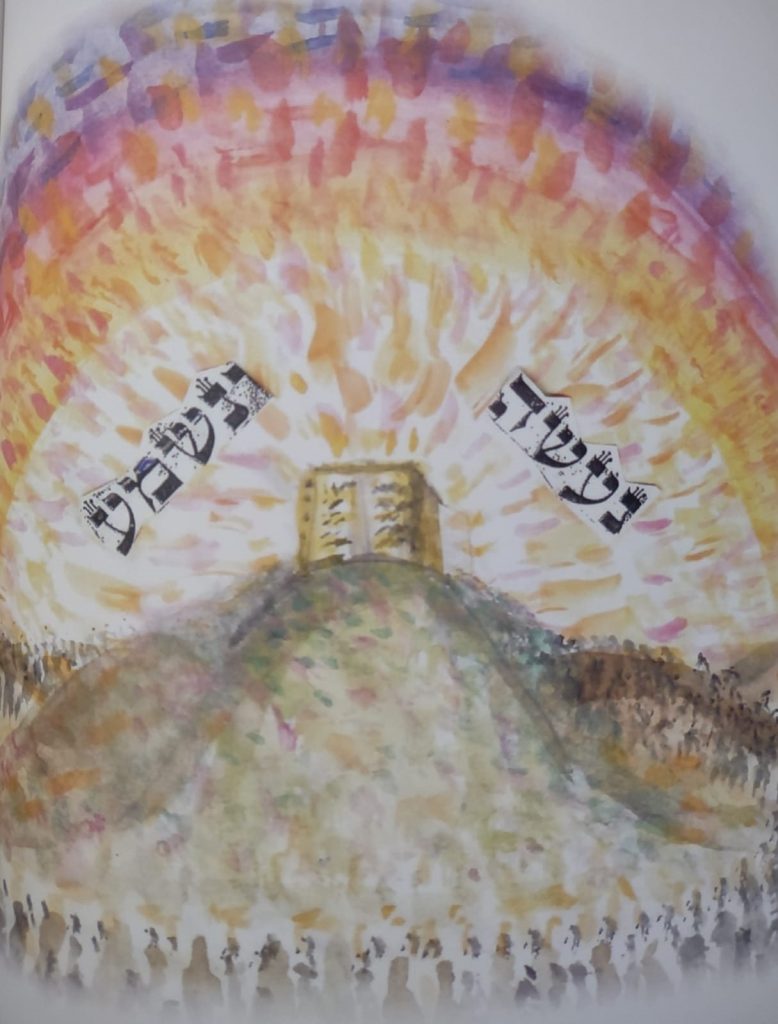
Tiferet’s artwork radiates kedusha. She’s painted the walls around the Talmud Torah in Rechovot with inspiring pictures of the Rebbe’s mivtzaim. The purity in the faces of the Chassidim that she draws is something I’ve never seen anywhere else. Tiferet has also recently published a storybook aשbout our yearly holiday cycle. It simultaneously gives an important message that there’s a time and place for everything, and everyone. She wrote it in uplifting rhymes and illustrated it too. It’s colorful and cheery, in the spirit of a Chabadnik!
“My byword is, ‘Know Him in all your ways,’” Tiferet concludes. “In everything we do we can connect to Hashem. For example, when making dough and saying the bracha of hafrashas challa the dough is elevated to kedusha. It’s our task to transform the gashmiyus into beautiful vessels of ruchniyus, turning this world into a dira b’tachtonim ready for our imminent Geula.”
Beis Moshiach #1418 • pp. 38-39, 43
© 2026 Beis Moshiach Magazine. All rights reserved.
This article originally appeared in Beis Moshiach #1418. You are welcome to share it with friends and family by email or in print, provided that you do not change, add to or omit any part of it, you credit the author and Beis Moshiach, and you include a link to archive.bmoshiach.org (written out in full in printed copies).
To republish this article in a newspaper, magazine, book or website, please request permission in advance at [email protected].