The Baal Teshuva from The Paris-Petersburg Express
The Rebbe Rayatz spent a lot of time traveling to help Jewish communities all over. On one such trip, he wrote the following story in his diary, the story of a person he only identified by his initials, Y. M.
Presented for the Rebbe Rayatz’s birthday and Chag HaGeula Yud-Beis Yud-Gimmel Tammuz.
* * *
It was late at night, on a cold, winter Motzoei Shabbos, when the Rebbe Rayatz boarded the Paris-Petersburg Express train after a visit to Paris, France. He hadn’t visited for a vacation, but to help the Yidden of Europe, as he often did.
Europe, and especially Russia, was full of people who were mean to the Yidden, which made it very hard to live life as a Jew. That’s why the Chabad Rebbeim spent so much time visiting different cities inside and outside of Russia, to influence people of power to pressure the government to stop hurting Yidden.
At that time, Rabbi Yosef Yitzchok was not yet a Rebbe; his father, the Rebbe Rashab, was still the Rebbe. As the train pulled out of Paris, it stopped sometime later in the city of Menton, which is also in France, where the Rebbe Rashab was staying at the time. He met his son at the station during a half-hour stop and gave over the next set of instructions for the Rayatz’s important work.
A short time after getting his new mission, the Rebbe Rayatz boarded the train again, and took out a small pile of important letters his father had handed him at the train station. He took a moment to look out the window. The train chugged slowly through beautiful, rolling hills, past castles, and over crystal blue waters. The Frierdiker Rebbe, in his private room, wanted to write more about the incredible view, but there was no time. On this train, all the rooms were private. There was a table, a chair, a bed, and a lamp – perfect for writing, the Rebbe thought to himself. But the train ride was too bumpy, so writing was very difficult.
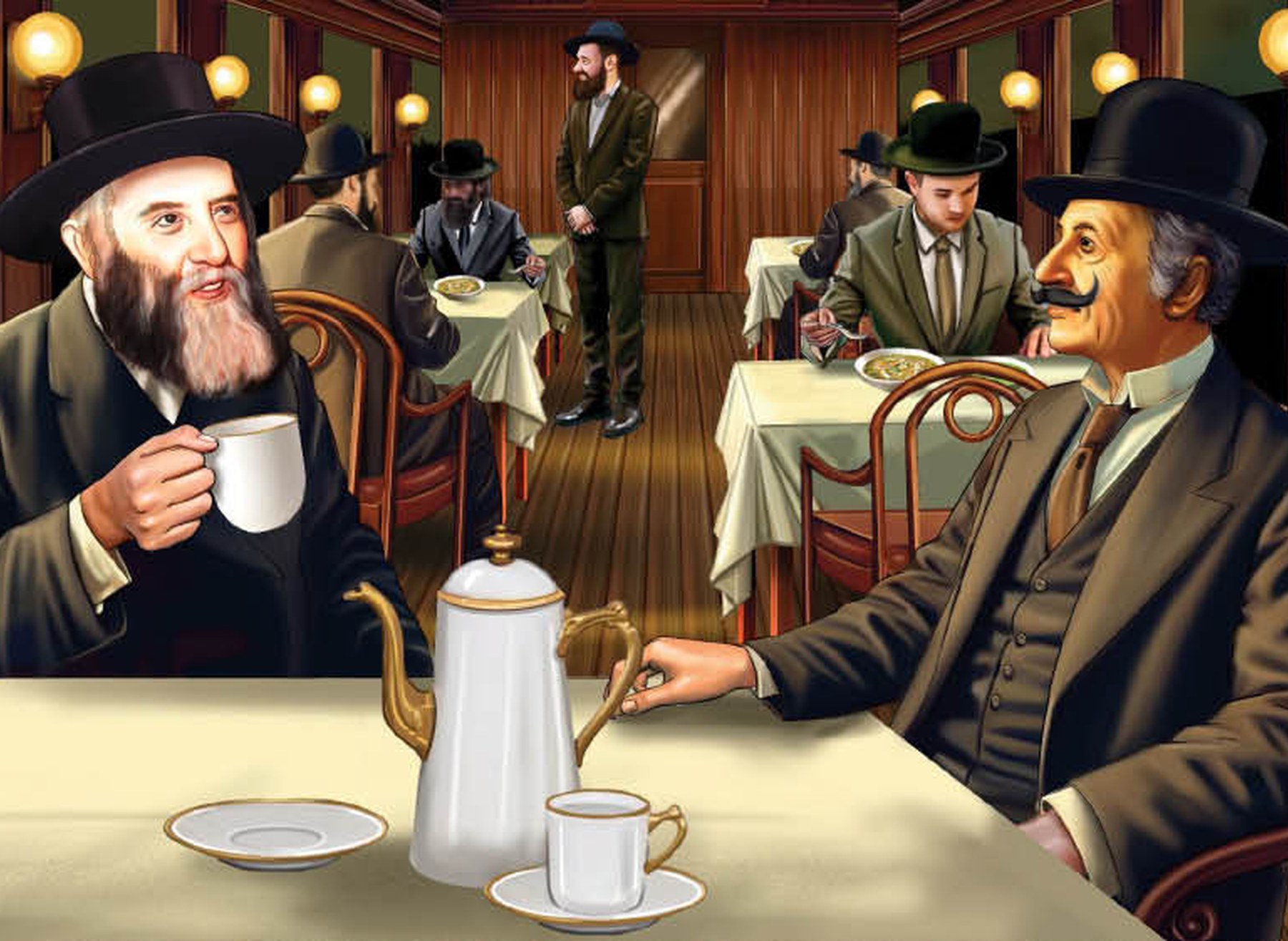
At 6:00, the Rebbe Rayatz went to the train dining room for a glass of tea. While there, he noticed a venerable man sitting nearby, eating the meal they offered, including treife meat and non-kosher wine. He was dressed in an expensive-looking suit, and had a fancy, curly mustache. He looked around 50 years old.
This man soon seemed to recognize the Rayatz. He put on his hat, stood up from his seat, came over to the Rebbe, and shook his hand.
“Shalom Aleichem!” he said, in perfect Yiddish. “Are you related to the Rebbe Maharash of Lubavitch?”
At first, the Rebbe was upset that this man had been eating treif, and didn’t want to answer him. But he seemed friendly, so he quickly changed his mind.
“Yes,” answered the Frierdiker Rebbe, “The Rebbe Maharash of Lubavitch is my grandfather.”
The man’s face turned bright red, and his eyes filled with tears. He left without saying anything else. He went back to his table, paid his bill without finishing his meal, and went on his way.
* * *
Later that night, at 11:00pm, the train stopped in Frankfurt, Germany, and the Rebbe Rayatz left the train to get a few minutes of fresh air. He noticed that the strange man from the dining car had also come out, and was heading towards him.
“I have… a very interesting story to tell you,” said the man. But he got too sad to speak again.
Soon, the time came for the train to move on, so Rayatz went back to his room, and the strange man to his.
* * *
The next morning, the train stopped in Berlin, Germany, and the man approached the Rebbe again.
“Good morning,” he greeted the Rebbe Rayatz. “I wasn’t able to sleep at all last night,” he complained. He didn’t say anything else, just heading back into the train with the other passengers when the stop came to an end.
* * *
Knock, knock, knock!
It was still early in the morning, and the Frierdiker Rebbe was about to begin Shacharis, when he was interrupted by one of the train stewards.
“Excuse me, sir, but there’s a man who would like to meet with you in your room.”
“Please tell him to come in half an hour,” answered the Rebbe. “And if you could apologize and tell him I’m sorry for the wait, that would be great. Thank you.”
And so, half an hour later, the Frierdiker Rebbe opened the door to the strange man. As he walked inside, his face showed that he had been crying. He looked very sad.
“I’m sorry,” he told the Rebbe. “I can’t speak. I’m too sad.” And with that, he began to cry, very loudly. Eventually, after some time, his whole body began shaking.
The Frierdiker Rebbe was unsure what to do. It looked like he’d gone crazy. Should he comfort the man, or leave him alone? Finally, the Rebbe decided he must do something, and he tried to comfort him.
Between the loud cries, the man finally spoke up. In a quiet, shaky voice, he said, “Do me a spiritual favor – please lend me your tefillin.” The Rebbe couldn’t believe his ears. “Oy! Hashem!” the man cried out in Yiddish. “I have no idea how many years it’s been since I last put on tefillin!”
Something is obviously going on inside this man’s neshama, the Frierdiker Rebbe understood, while the man continued crying non-stop.
The Rebbe quickly hurried to his suitcase and took out his Rashi tefillin and a siddur, handing it over to the poor Yid.
The Rebbe left his room, allowing the man to daven privately, and he did so for quite some time. When the Yid finished, the Rebbe went back inside.
“Thank you, so, so, so much,” said the man, handing back the Rebbe’s tefillin. “Would it be alright if I borrow the siddur? Assuming that the man wanted to say Tehillim and daven Mincha later, the Rebbe readily lent it to him. The man quietly left the room without telling the Rebbe who he was, or what had happened to him.
* * *
Knock, knock, knock!
It was 3:00 in the afternoon, and the steward had come to speak with the Rebbe Rayatz once again.
“The same man would like to visit,” he explained.
The man entered the room, looking even worse than before. His face was white. He didn’t look good at all. He opened his mouth to speak, and a soft, sick-sounding voice came forth.
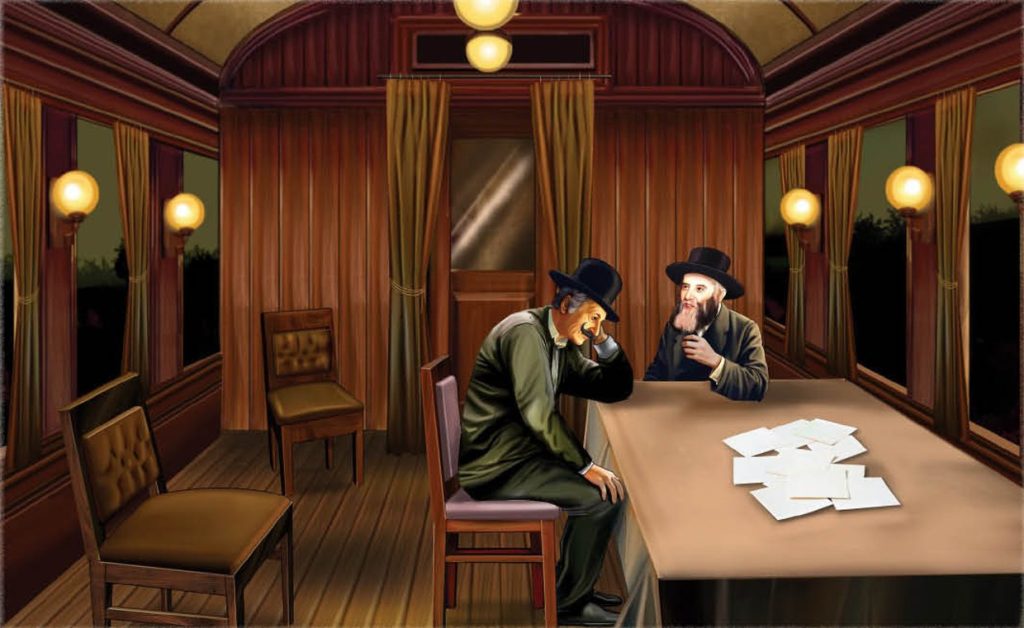
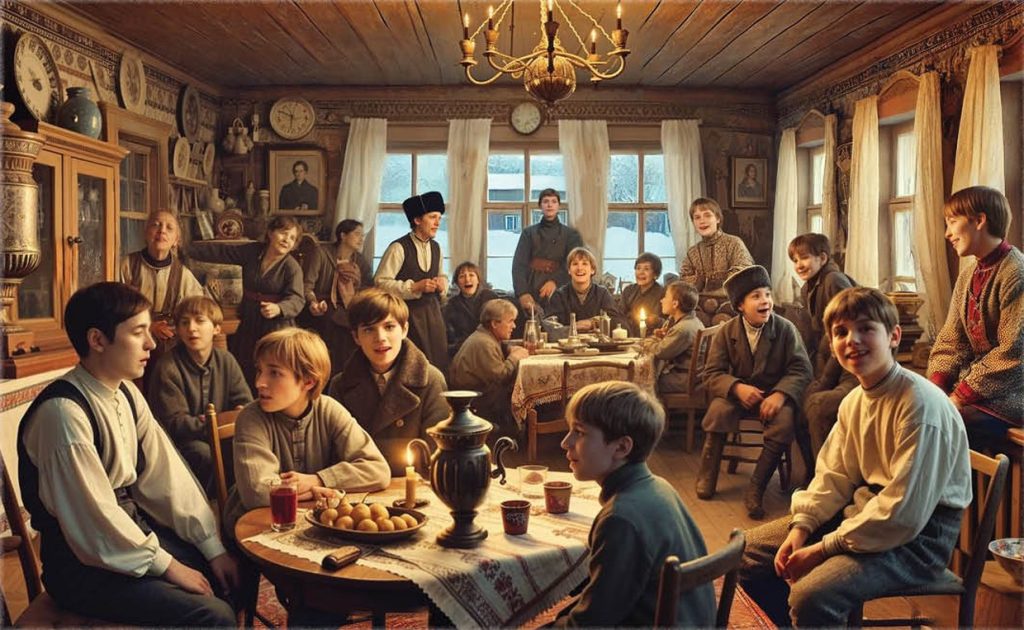
“My name is *Yisroel Mentkin. I’m the son and grandson of Chassidim of your grandfather, the Rebbe Maharash. I grew up in a Russian town, surrounded by great Chassidim who would come to our home often for Chassidishe farbrengens. I remember sitting at the farbrengens as if it were yesterday. My teachers would always come. My father would arrange the best melamdim for me.
“But one day, due to my father’s business dealings in diamonds and gemstones, we moved from our little, Chassidishe town to Petersburg, a huge Russian city. Although my father continued to live a Chassidishe life of Yiras Shomayim, I became friends with our new neighbors, who were very different from us, and became very interested in their way of life. It wasn’t like back home.
“Then, one summer, my father told me that he’d be taking me to Lubavitch for Rosh Hashana. Now, I had already been friendly with my neighbors for quite some time, and I really didn’t want to go on this trip. I wasn’t interested anymore. But I went, and surprisingly, I was glad I did.
Seeing your grandfather, the Rebbe Maharash’s – holy face inspired me. My father and I went in for a yechidus meeting, and the Rebbe blessed me with hatzlacha in everything I did, but also warned me that I am a Yid, and my new non-Jewish friends wouldn’t bring anything good my way.
“That trip to Lubavitch stayed with me. For an entire year, I didn’t hang out with my friends. Not until the next summer, in our vacation home, when I was getting ready to begin high school, did I begin spending time with them again. How bad could it be? I thought.
“One day, I remember coming home late, having missed Mincha and Maariv. Another day, I was in a rush to meet my friends for a swimming trip, and I missed Shacharis. Then one day, I ate with them. By the end of the summer, I was just like them. That Rosh Hashana, my father went to Lubavitch, but as for me, well, I stayed home. Shul just didn’t feel the same anymore.
“During the goyishe holiday season, I spent all my time celebrating with my friends. I came home only once to ask my mother for a few hundred rubles, and twice to my father’s office to ask for more money.
“When the holidays ended, I came home, and my father was waiting for me. He looked at me and said, I’ll give you as much money as you want, but you have to stop spending time with those friends. I couldn’t take it. I told him he had no right to get mixed up in my business.
“That was it. I packed my bags and left.
“I moved into an apartment with some friends, finished high school, eventually got married, and lived the life I wanted to. A life without Yiddishkeit.”
Yisroel lifted his eyes from the ground. They were full of tears, but he had more to share. So, he took a deep, heavy breath, and continued his story.
“At that time, I was a member of a group called The Young Progressives. We worked together to improve life for people in Russia, and part of our work was dedicated to helping Jews make enough money to support their families.
“One day, I heard that your grandfather, the Rebbe Maharash, was coming to Petersburg. I heard that the Rebbe helped Jews all the time through connections with government officials, but I wanted to hear what he was doing firsthand, so I visited the hotel he was staying in, hoping I’d get a chance to speak with him.
“When I arrived, I was completely surprised to see Chassidim I’d known since I was a young boy! I would have never thought they’d care to see me again after leaving my home and Yiddishkeit behind, but I was quite wrong! They were very excited to see me! We hugged, and they asked me how I was doing.
“I felt like it was too much to handle. Everyone was so kind to me there – they had such amazing Ahavas Yisrael. The love was unlike anything I’d ever felt. Then, as I walked further into the hotel lobby, I heard words I hadn’t heard in… decades. Baruch Ad-nai ha’mevorach l’olam va’ed! A minyan for Maariv had just begun. It happened to have been the yahrtzeit of the Alter Rebbe that day, and the Rebbe Maharash came out to say the last Kaddish.
“I began dreaming about my childhood in my little Chassidishe town, and thinking about my trip to Lubavitch. I left the hotel on such a high. I couldn’t calm down for three days! It was such a special part of my past. It felt so close… but so far away. I was so torn. I wanted to go back, but it was so far from who I was now. I was a different person.
“The next month, in January of 1882, we got wind of some terrible information. We had information that certain governors were planning attacks called pogroms against Jewish communities. They wanted to hurt Jews very badly, and it was all being done by the government. We also found out that the Rebbe Maharash would be coming to Petersburg yet again. This time, we needed to meet with him –
To be continued
Beis Moshiach #1418 • pp. 54-58
© 2026 Beis Moshiach Magazine. All rights reserved.
This article originally appeared in Beis Moshiach #1418. You are welcome to share it with friends and family by email or in print, provided that you do not change, add to or omit any part of it, you credit the author and Beis Moshiach, and you include a link to archive.bmoshiach.org (written out in full in printed copies).
To republish this article in a newspaper, magazine, book or website, please request permission in advance at [email protected].