Protecting Our Dearest Treasures Begins With Open Communication
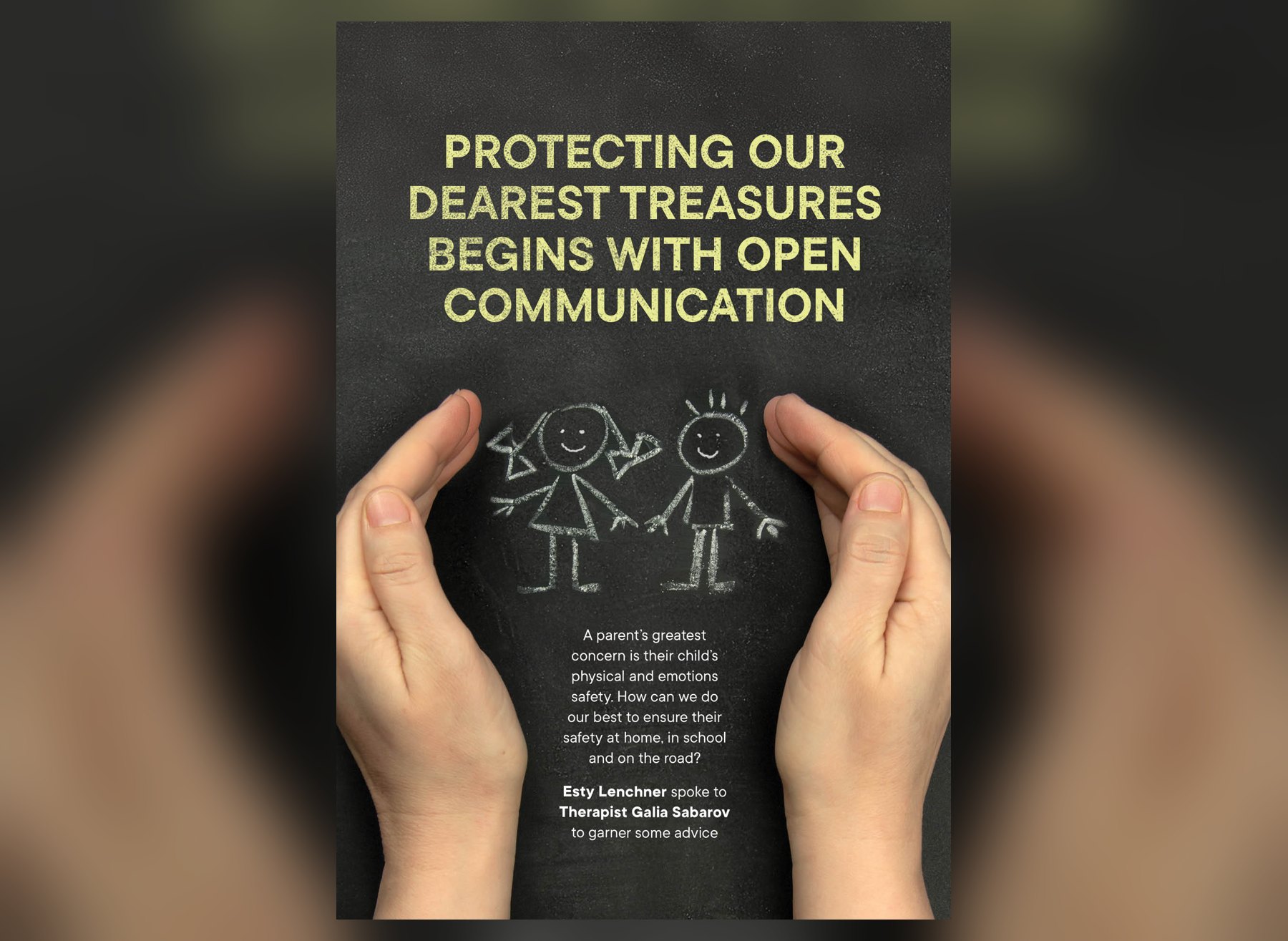
A parent’s greatest concern is their child’s physical and emotional safety. How can we do our best to ensure their safety at home, in school and on the road? Esty Lenchner spoke to Therapist Galia Sabarov to garner some advice
Our world consists of many languages, cultures and opinions, but one thing that we have in common is our concern for our children and our wanting to build a better future for them. We want to keep them happy, healthy and protected. One of the things that arouses great fear among parents is the chance that something not good will happen to their child and they won’t be able to prevent it or help him. When we speak about safety for our children, there are quite a few things we, as parents, can do to help our children safely navigate situations with potential for harm. I spoke with Galia Sabrasov, a therapist and marriage teacher to hear what she can tell us about this.
Fear Of Confrontation = Imminent Danger
“Before we start talking about our children and safety, we need to do work with ourselves. The way we operate is affected directly by the way we were raised. Inter-generational cycles are very common in abuse situations. A parent who grew up in a home in which abuse took place in the family, is exposed to a higher likelihood that history will repeat itself in his home, unless that parent does the work on his attitudes and way of thinking. Therefore, someone who experienced abuse as a child, must undergo therapy and psychological work for two reasons: 1) to work through the trauma, and 2) to stop the cycle and create a new and safe reality for his children.
“The most fertile breeding ground for abuse is fear of confrontation and blame. A person who can’t handle the possibility that they will be angry with him or blame him is a potential abuse victim,” Galia says confidently. “Abusers can identify easy prey. They identify the weakness of their victim and know how to exploit it. There are people who exercise their skill to identify weaknesses in others in order to help them and some use this ability to take advantage of them.
“A few years ago, someone who was abused contacted me. She was very afraid of sharing with her parents and family since the abuser was someone in the family and outing him would greatly upset her parents and the entire family. Likewise, she was afraid of the damage this could cause when she would be in shidduchim. As we spoke, I helped her understand that the reason that he preyed specifically on her was not because of her dominant personality but because he knew that she wouldn’t complain for all the reasons she just stated. Unfortunately, this is a common pattern among abusers. They identify a weak person, one who won’t dare complain or oppose them and who will enable them to continue abusing them without being punished for it.
“Here’s an analogy. We all know that parking in a no-parking area is prohibited, but if we know about a certain parking space where parking won’t interfere with traffic and no policemen ever go there, we will likely allow ourselves to park there. We know that Chazal say, ‘Pray for the welfare of the government for if not for fear of it, man would swallow his fellow alive.’ The absence of fear of punishment enables the crime to occur.
“Every person needs to work on his ability to handle confrontation and know that stopping criminal behavior might cause him to pay a price, socially and within the family. Above all, we need to remember that instances of abuse don’t stop on their own. Ignoring it, not stopping the abuser, and not treating the victim won’t only be a terrible crime, but can result in post-trauma and tough ramifications for the future quality of life of the victim.”
Finding The Way
“In every home, whether religious or not, conversations about the body, physical differences and tznius are likely to be uncomfortable. Often, children trip up their parents with questions that they don’t know how to properly answer.
These conversations aren’t always pleasant but they are necessary. First, we need to differentiate between the curiosity of adults and the curiosity of children. When a child asks his parents questions about private matters it’s important to realize that this is coming from a place of childish innocence.
“Despite knowing this, these kinds of questions are likely to catch parents by surprise. He knows the answer but he doesn’t know the right way to respond to his child. Many parents are so put off by these questions that without realizing it, they convey negative messages to their children about the body and everything associated with modesty. If a child is asking, it means he’s curious about it and better he should get the information from his parents in the way they want to present the information and not from other sources that won’t be appropriate.”
Without Pressure
“Before giving an answer, it pays to first find out what the child meant by his question because his question might be a lot more innocent and simple than you think. You can answer a question with a question: What do you mean? Where did you hear about that? Then you can say, ‘You asked a very important and serious question and I have to think about how to answer it.’ Then get back to him with an answer. Maybe you’ll ask for advice about what to say.
“Is it better not to answer altogether? Probably not. Research shows that awareness and candid conversations between parents and children can significantly lower the likelihood of abuse.
“The message that we as parents want to convey to our children is that we are the address. Parents who answer their children’s questions, but on one topic they react in a frightened, incoherent manner, are basically telling their kids, ‘We’re sorry but we aren’t the address for questions like these.’ Even if you’ve decided not to answer your child regarding a certain question, that’s okay, but the message needs to be affirming. You can say things like, ‘That’s something you will learn about when you are older,’ or ‘That’s something that’s not for children,’ without being tense.
“The most important thing is, it’s not terrible to make a mistake. Even if you think you gave an answer that wasn’t quite on the mark; don’t hesitate to fix it. You can go back to the child and say, ‘Remember you asked about such-and-such? I thought about it and have more to say.’ This is the best lesson you can give your children in humility. The message they get is: I also sometimes make mistakes and then I fix them.”
Attire Of Dignity
“The most important message we as parents can give our children about safety is that our body is sacred and important, and therefore we protect and respect it. We guard it from being exposed to others, according to the rules of tznius. We understand that the body and its more private parts are sacred. Therefore, nobody has permission to touch them. You protect something that is sacred, something that is very precious. Like precious pearls that are kept in a special box, so too, the body and the highly important gender-specific organs that we got from Hashem are precious. That’s why we protect them and cover them.
“It’s important to relate to the body and all its parts that we got as a gift from Hashem with respect. If the message children get about their bodies is negative and not respectful, they can be at higher risk of abuse. The body has to be assigned a place of value, respect and holiness, for which reasons it needs to be protected.”
2 SAFETY TOOLS
1. Explain To Children What Is And Isn’t Normal
Unfortunately, most children who are abused don’t know what is and isn’t allowed as far as a social and moral perspective. I very sadly say that the percentage of abuse within the family is at 80% of total abuse cases. That means that danger doesn’t lurk for our children in dark alleyways as much as it does at home. Research done with abused youth found that some of them didn’t suffer from harsh threats or complex emotional problems but simply didn’t know what was allowed and what was off-limits from a moral standpoint. Many of them didn’t know it was abuse. This is why it is vital to explain to children what is and isn’t permitted, what is normal among siblings, friends, etc. and what isn’t. An open conversation about this can significantly reduce the chances of abuse.
I recommend doing this in the context of an actual story. This invites children to talk and explains to them the possible dangers they can face. It’s important to emphasize the contextual moral of the story, “Always tell us and we will help you.” It’s also important to convey a reassuring message like, “Our world is full of good people but there are a few people who have bad intentions and you can’t tell by looking at them that they’re no good, which is why we have to follow the rules of being careful with all of them.” The message is we respect everyone but are also careful.
2. Train Children To Do What’s Right, Not To Please Adults At All Costs
It’s important to teach children to keep themselves safe before anything else. You would think this is natural but the truth is that most parents train their children to please others, without realizing that’s what they’re doing..
“Love your fellow as yourself” is sometimes perverted to mean that whatever anyone wants of you, is holy. To many children, it’s contextualized with emotional problems and fear of abandonment which leads them to develop a personality focused on pleasing others. It’s important to fill the love storage tanks of our children through the daily practice of loving actions toward our children. To teach ourselves to set proper boundaries, and to be role models to our children in setting healthy boundaries. This way, with Hashem’s help, we will teach them to be at peace with themselves and to protect themselves.
Beis Moshiach #1420 • pp. 46-49
© 2026 Beis Moshiach Magazine. All rights reserved.
This article originally appeared in Beis Moshiach #1420. You are welcome to share it with friends and family by email or in print, provided that you do not change, add to or omit any part of it, you credit the author and Beis Moshiach, and you include a link to archive.bmoshiach.org (written out in full in printed copies).
To republish this article in a newspaper, magazine, book or website, please request permission in advance at [email protected].