The Chuppah Chronicles

My name is Rabbi Mottel Kanelsy, and boy, do I have a story for you!
But first, let me tell you a little bit about myself. I’m proud to be a Shliach of the Lubavitcher Rebbe in New Jersey. My wife, Shterny, and I have been serving the Russian community here for about 40 years, and we haven’t rested a minute since then!
When it comes to Russian Jews and Yiddishkeit, there’s always lots of work to do. You see, unfortunately, Yidden in Russia weren’t allowed to keep mitzvos for many years, and would be punished very badly by the KGB, or the Russian police, when they tried to practice Yiddishkeit secretly.
My family, along with other families in our city, decided we wouldn’t stop living like Jews, no matter what the government said. And for that reason, life was very hard. My father would have to find new job after new job, just so he could keep Shabbos! And I, as an eight-year-old boy, sat in a dark, dusty cellar all by myself for a year and a half to avoid going to the Russian public schools.
Could you imagine not seeing daylight or any of your friends and family for a year and a half? And I was only eight! Those Russians were very evil – forcing Yiddishe children to do their schooling and homework on Shabbos, while learning their kefira – but even though I was young, I wouldn’t let them stop me from keeping Hashem’s holy Torah.
Looking back, I feel lucky that my family always taught me to be strong in my Yiddishkeit, but sadly, most Yidden in Russia weren’t taught that. Their parents had already forgotten about their Yiddishkeit, and mitzvos became a distant memory.
That’s why my wife and I had – and still do have – so much work to do! We have to teach our community about Yiddishkeit from the very beginning, starting from the Hebrew letter alef! It’s a big job, but we feel very privileged and happy to be doing the Rebbe’s work, here in New Jersey.
But let’s get on with the story…
It all started 40 years ago, in the winter of 5784 (1984) when I got an unexpected phone call.
* * *
Ring, ring, ring!!!
It was Rabbi Klein, one of the Lubavitcher Rebbe’s secretaries.
“Rabbi Chodakov says he needs to meet with you.”
Rabbi Chadakov was the Rebbe’s head secretary. When he needed to speak with you, you went right away! No questions asked.
Next thing I knew, I found myself in his tiny, cramped office, standing next to a desk piled to the sky with important papers. Rabbi Chodakov wasted no time. He looked at me from the other side of the desk, and said very seriously, “I got word that there are Yidden in New Jersey, living without a chuppah. They’ve never been married properly the Jewish way.”
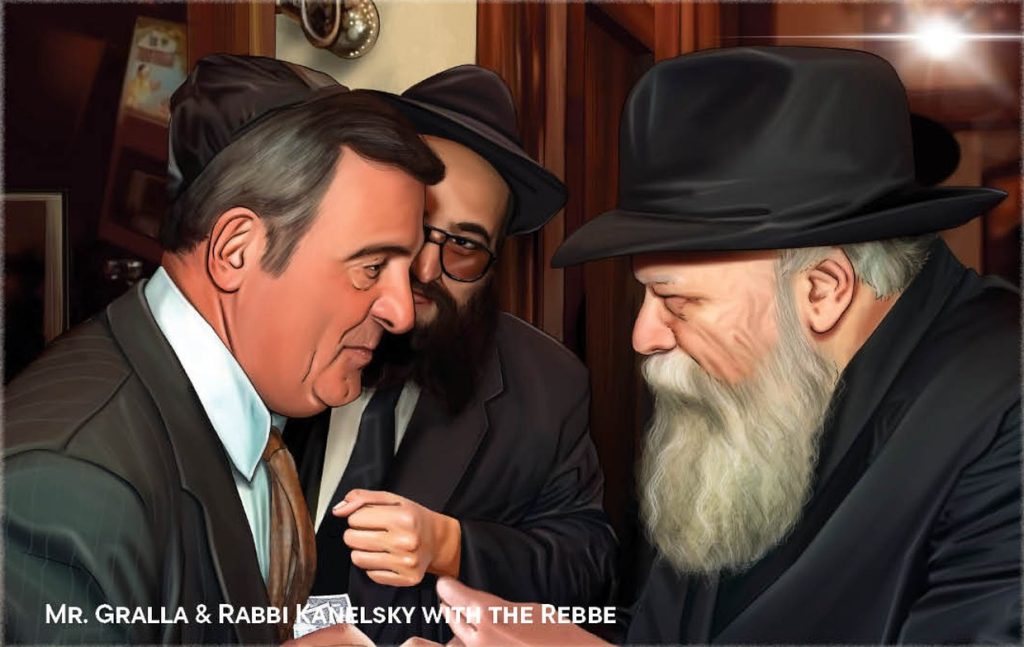
I must admit, I didn’t think that was what our meeting would be about. But these were serious words, so I thought about them for a second. “What should I do?” I asked. But he didn’t answer – he just repeated those same words.
“I got word,” he says, “that there are Yidden in New Jersey, living without a chuppah.”
So I asked again, “What should I do?” But Rabbi Chodakov simply repeated those same words a third time. It was all very strange.
“I’ll, uh… see what I can do,” I said, still unsure about the whole situation. We knew Rabbi Chodakov only ever said what the Rebbe told him. On my way out of 770, I first popped into Rabbi Klein’s office, with whom I was very close.
“What did Rabbi Chodakov tell you?” he asked me. I told him everything, including my confusion about the whole thing.
Rabbi Klein became serious. “These are the Rebbe’s words. You need to think about them carefully, and find a way to fix the problem on your own.”
Rabbi Klein’s thoughts changed everything. This was coming directly from the Rebbe. I needed to get to work on it… but how? How could I help people have a proper chuppah, years after they’d gotten married?
* * *
When I came home from that meeting, I told my wife about everything that had happened in 770. She understood how important this new mission was, but we still didn’t really know how we’d find people willing to remarry just to have a kosher chuppah.
So we did the only thing we could think of… make a lot of phone calls.
“Hello, Boris! This is Rabbi Kanelsky! I wanted to ask you an important question. When you got married, did you have a proper Jewish wedding, with a chuppah, witnesses, and a kesuba? No? Wonderful! I would like to arrange a Jewish wedding for you! It’ll bring many blessings to your – hello? …Boris? Hello?”
Oy – he hung up on me!
And that’s how most of the calls went. We weren’t having much hatzlacha. We wanted to please the Rebbe, but we still had the same question. How?
* * *
Rabbi Mottel Kanelsky doesn’t give up quickly. Let’s hear from him what happened next:
I stuck with it, call after call. But still, no success. Three months later, I was still at it, hoping and praying someone would say yes. And that was when I got another phone call from 770.
“Rabbi Chodakov wants to see you.” It was Rabbi Klein again, and this time, I already knew what he wanted to talk about. But I didn’t have any good news to report! I went anyway though, with my head held high, like a general reporting to office.
I once again found myself in that famous, tiny office, standing perfectly still, so I wouldn’t knock any of the wavering piles of papers over.
Rabbi Chodakov straightened out one of the piles on his desk and looked at me. “The Rebbe sent you to be a Shliach for Russian Jews in New Jersey. They didn’t have a proper chuppah because the government wouldn’t allow them to,” he explained. “Now, here in the free world, the Rebbe wants everyone to go to mikva and have a kosher chuppah! The Rebbe wants them to know that doing this right even once can fix a lifetime of not keeping the mitzva of Taharas HaMishpacha!”
Those were Rabbi Chodakov’s words, and I left his office feeling new energy, ready to continue my mission with an extra message.
So I got back to my phone calls, and called EVERYONE I knew!
But I still had no luck.
* * *
Six months later, the Rebbe farbrenged on Chof Menachem Av in 770 in honor of his father’s yahrtzeit, the tzaddik and mekubal, R’ Levi Yitzchok Schneersohn. There, the Rebbe shared an interesting message.
People nowadays don’t show older people the respect they deserve. Younger relatives try to force their older parents out of their businesses, out of their lives, and if they’re lucky, they’ll visit on Father’s Day. But this is totally opposite of what Shlomo HaMelech says in Mishlei – that people become wiser and smarter as they get older!
For this reason, the Rebbe told everyone gathered that there should be places for old people to learn Torah, where they can earn money for coming, just like young men in kollel. The Rebbe said anyone opening a kollel for old men, called “Kolel Tiferes Zkeinim,” or one for women, called, “Kolel Chochmas Noshim,” would receive $100 from the Rebbe towards the project.
This was a big deal. And I, Mottel Kanelsky, took the Rebbe’s words seriously. So, obviously, I got to work on this idea right away.
I have a friend, Rabbi Boruch Lepkivker, who I work with in my Shlichus. We were friends for years. Our parents were even friends back in Russia! He and I worked to open four senior kollels all over New Jersey, with a total of 200 people coming each week! We had incredible hatzlacha, B”H. We provided transportation for the elderly people to and from the program, we offered food, and Rabbi Lepkivker would teach our “students.” They would spend the first hour learning different topics in Yiddishkeit, and in the second hour, since many of them weren’t strong English speakers, they’d learn English.
One of our kollels was in a town called Teaneck, New Jersey, where Reb Boruch would teach evening classes. One day, Reb Boruch gave me a call.
“I’m so sorry, I can’t teach tonight,” he told me. “You’re going to need to teach the classes for me.”
“But I’ve got meetings today!” I cried.
“If you don’t teach those classes, then 20 people won’t put on tefillin today!”
And that was that. There is nothing more important to me than helping Yidden put on tefillin. I have a list of people I put tefillin on every day! I couldn’t let 20 people miss out. So, I canceled my meetings and headed off to Teaneck.
Things were going on as usual. After tefillin, we sat down to learn, and the group was listening carefully. But our lesson was interrupted by an unexpected visitor.
“Hi! My name is Alex, and I’m from The Bergen Record,” he said. (That’s a famous New Jersey newspaper, by the way.) “I heard there’s a group of people who learn here each week. Would I be able to take a photo of your program for the newspaper?”
“Sure! No problem,” I told him.
He took the photo, and I didn’t think much about it afterwards. The next day, it was on the front page.
* * *
All this happened in October of 1984. It was the next morning when my telephone rang. I was in a rush to meet the Mayor, who we’d be honoring at our fundraising dinner that coming Sunday. On my way out, the phone rang. Back then, we didn’t have cell phones… only phones on chords, plugged in at the office. I picked up, and my secretary told me that a Mr. Milton Gralla was on the phone for me.
Who is Milton Gralla? I thought to myself. But I had no time. I wrote down his number, and asked my secretary to let him know I’d call him back later.
While on my way to see the Mayor, I had to sit through a ton of New Jersey traffic. I turned on the radio to listen to the traffic report, but instead, the reporter had an announcement to make.
This just in, the reporter said. Mr. Milton Gralla has announced that he’s started a $100,000.00 fund to fight terrorism! He’ll be putting aside this very large amount of money in memory of Leon Klinghoffer, a Jewish man in a wheelchair that was recently murdered by Palestinian terrorists.
MILTON GRALLA? I thought aloud. But how could that be? He just called me!!!
It turned out Mr. Gralla was a very successful businessman who was an expert in marketing, which means he was very good at spreading news around and making sure people knew about important things. He owned more than 20 magazines!
I was very curious to know what he wanted from me, but this happened in the 80’s, before cell phones were around, and I had to meet with the Mayor before I could give Milton a call.
* * *
B”H, the meeting went well, and we were all ready for the dinner we were hosting. As soon as I got back to my office, I sat down at my desk to call Mr. Gralla.
“Yes, hello, Rabbi Kanelsky,” said the voice of a young man on the other line. “I saw your article in the Bergen Record, and I just loved it! Teaching Judaism to seniors! What an incredible thing!”
“Thank you, Mr. Gralla, I appreciate it.”
“I’d like to send you $1000, but I need your address.”
“Tizku l’mitzvos,” I told him.
“What does tizku l’mitzvos mean?” he asked me. So, I told him that when someone does a mitzva, like giving tzedaka, we don’t say “thank you,” because that would be taking away from the specialness of the mitzva. Instead, we say “tizku l’mitzvos,” which means you should merit a chance to do more mitzvos!
There was a short pause before Mr. Gralla answered. “I’m giving you $1000! So can you or can you not tell me thank you?”
“No,” I answered. “I cannot.”
“WOW! I love it! You’re a real honest guy! I’m sending you $2,000!!!”
What could I say? Oif emes shteit di gantze velt! The whole world stands on truth! But this, I did not expect. In fact, I didn’t really believe it. I thought Mr. Gralla was making a joke.
But come Monday, the day after our successful dinner with the Mayor, B”H, the check arrived in the mail.
I called up Mr. Gralla as soon as the check came through. “I want to meet you in person,” I told him.
“Sure,” he replied. We quickly set up a date. “I live in a penthouse apartment, overlooking the George Washington Bridge. When you arrive, just tell the valet parking guys that you’re coming to see me.”
* * *
Are you wondering what happened next? What does Mr. Gralla have to do with the Chuppahs of the Russian Jews? Excellent questions! Stay tuned for part 2 of this awesome story!
Beis Moshiach #1422 • pp. 55-59
© 2026 Beis Moshiach Magazine. All rights reserved.
This article originally appeared in Beis Moshiach #1422. You are welcome to share it with friends and family by email or in print, provided that you do not change, add to or omit any part of it, you credit the author and Beis Moshiach, and you include a link to archive.bmoshiach.org (written out in full in printed copies).
To republish this article in a newspaper, magazine, book or website, please request permission in advance at [email protected].