New Book: An End to Conflict
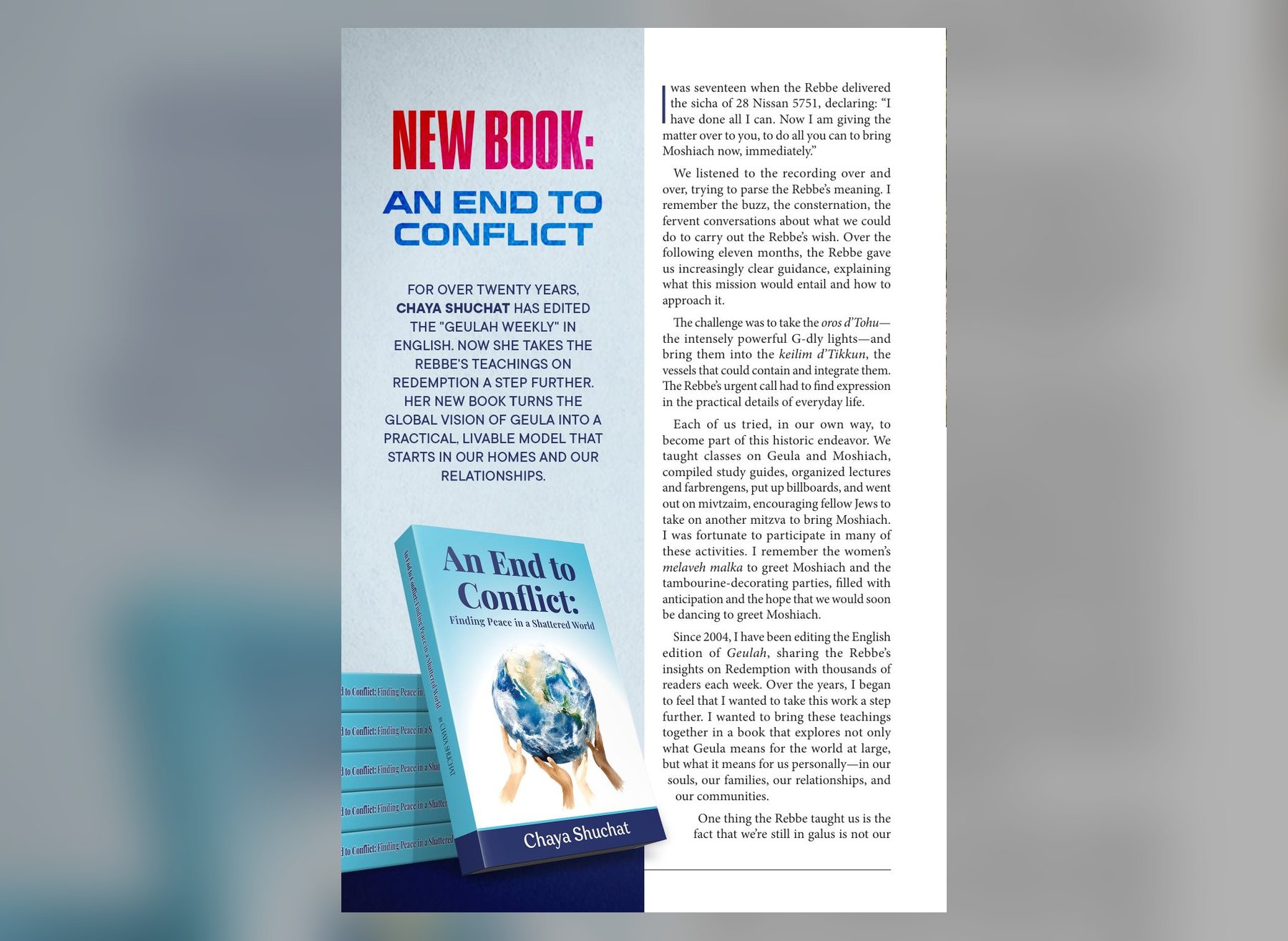
For over twenty years, Chaya Shuchat has edited the “Geulah Weekly” in English. Now she takes the Rebbe’s teachings on Redemption a step further. Her new book turns the global vision of Geula into a practical, livable model that starts in our homes and our relationships.
I was seventeen when the Rebbe delivered the sicha of 28 Nissan 5751, declaring: “I have done all I can. Now I am giving the matter over to you, to do all you can to bring Moshiach now, immediately.”
We listened to the recording over and over, trying to parse the Rebbe’s meaning. I remember the buzz, the consternation, the fervent conversations about what we could do to carry out the Rebbe’s wish. Over the following eleven months, the Rebbe gave us increasingly clear guidance, explaining what this mission would entail and how to approach it.
The challenge was to take the oros d’Tohu—the intensely powerful G-dly lights—and bring them into the keilim d’Tikkun, the vessels that could contain and integrate them. The Rebbe’s urgent call had to find expression in the practical details of everyday life.
Each of us tried, in our own way, to become part of this historic endeavor. We taught classes on Geula and Moshiach, compiled study guides, organized lectures and farbrengens, put up billboards, and went out on mivtzaim, encouraging fellow Jews to take on another mitzva to bring Moshiach. I was fortunate to participate in many of these activities. I remember the women’s melaveh malka to greet Moshiach and the tambourine-decorating parties, filled with anticipation and the hope that we would soon be dancing to greet Moshiach.
Since 2004, I have been editing the English edition of Geulah, sharing the Rebbe’s insights on Redemption with thousands of readers each week. Over the years, I began to feel that I wanted to take this work a step further. I wanted to bring these teachings together in a book that explores not only what Geula means for the world at large, but what it means for us personally—in our souls, our families, our relationships, and our communities.
One thing the Rebbe taught us is the fact that we’re still in galus is not our fault. It’s not a punishment or even a cleansing for our sins. That process ended a long time ago! The fact that we’re still in galus is a painful mystery, that should make us cry out to Hashem with the plea of Ad Mosai!, demanding that Hashem end this galus immediately.
And the same is true of conflict. All the strife and division in this world is not our fault. As long as the oneness of Hashem remains hidden, conflict is inevitable. When that oneness is fully revealed, we will see the G-dly spark in every person. We will recognize that each of us has a Divine purpose and mission, and that the person standing across from us is no less a part of Hashem’s unity than we are.
We experience Geula in our own lives when we stop focusing on who’s to blame and start asking how we can move forward. It’s a process of healing, one conflict, one layer at a time. Geula is not an all or nothing phenomenon. When I heal in one area, I discover a dozen other areas that I need to work on. But the good news is that this work is cumulative. When we find greater harmony within ourselves, it naturally spills over into our relationships, helping others feel more at peace as well. That’s how the Geula mindset spreads, one person at a time.
An End to Conflict: Finding Peace in a Shattered World draws on the Rebbe’s sichos, maamarim, and letters to explore how we can resolve conflicts in all areas of life. Even in the darkest parts of golah, the Alef of Hashem is always present. When we learn to recognize that oneness in ourselves and in others, we can begin to turn golah into Geula.
An End to Conflict is available for purchase at your local Jewish bookstore, or online at endtoconflict.org. For bulk orders or speaking engagements, contact [email protected].
Book Excerpt: The Great Ingathering
“It shall come to pass on that day, that a great shofar shall sound, and those lost in the land of Assyria and those exiled in the land of Egypt shall come. They shall prostrate themselves before the L-rd on the holy mount in Jerusalem”—Yeshaya 27:13
It’s time to bring it all home.
As Jewish people, we know exile and collective trauma. Our long, painful history left us deeply wounded, but perhaps because of it, we are uniquely prepared to help lead the world on its own healing process.
The ultimate return—kibbutz galuyot, the ingathering of the exiles—is more than just coming back to our physical land. It’s about each of us returning to our core, to the deepest truth of who we are. It’s a great stream of humanity, with all our varied traditions and viewpoints, flowing towards the same center, drawing insight and spiritual strength from one another.
Peace in the world begins with peace within. When we do the work to resolve our conflicts, we become agents of collective redemption. The coming of Moshiach is the culmination of this process: a world made whole because the people in it have learned how to become whole, connected to G-d and to one another.
The Hebrew terms for exile (golah) and redemption (geula) are nearly identical, distinguished only by the presence of the letter Alef, the first letter of the Hebrew alphabet. By drawing the Alef, a symbol of G-d’s Oneness, into every aspect of life, we transform our state of exile into one of redemption.
When the era of Redemption begins, our external circumstances and lives may not change all that much. But our perception will undergo a profound shift. We will recognize that we already possess everything we need to experience genuine joy, happiness, unity, and connection. The Geulah state of Redemption is already here. It simply requires us to open our eyes to this reality and become infused with the Alef of divine unity.
Feeling the Joy Now
What will life be like in the days of Moshiach?
It’s hard to imagine it because we’ve never experienced it. But perhaps you’ve caught glimmers now and then—moments of clarity, when everything seemed to line up just right and the future seemed bright. As we move towards a more integrated reality, you may notice this process getting easier over time. You will be able to hold on to this vision for longer periods and have it permeate more aspects of your life.
Imagine a world where our internal and external conflicts have been resolved. Where we can finally meet one another as we are, without masks, without fear of judgment or rejection. Where we feel safe enough to be vulnerable, and let our love and goodness flow freely. Imagine a time when our creativity can fully flourish as we get in touch with our essential divine nature.
Imagine a time when the veil will lift and we will suddenly become aware of the impact of our deeds. Our painful, lonely years of toil will suddenly become illuminated, and in a flash we will realize the power we had all along. We will see the difference we have made in this world, even when we felt small and insignificant.
Imagine the catharsis and joy that awaits us when all our worlds align at last, when we stand face to face with the Divine. Imagine the joy permeating our beings, pulsating through our veins, overflowing in a spirited dance.
This is the dance of Miriam, who led the women in jubilant song during the exodus from Egypt. Miriam, whose very name means bitterness, who deeply felt the sorrow of exile, yet clung with unwavering faith to the promise of Redemption. Miriam, who even in Egypt fashioned tambourines, waiting for the day she would celebrate.
And so, in the spirit of Miriam, the time to rejoice is now. The end to all conflict is very near at hand. Through joy, we give our souls space to soar and unravel the final threads of exile. We’re ready to taste the sweetness of true and complete redemption.
Beis Moshiach #1530 • ג׳ כסלו תשפ״ז • pp. 50-52
© 2026 Beis Moshiach Magazine. All rights reserved.
This article originally appeared in Beis Moshiach #1530. You are welcome to share it with friends and family by email or in print, provided that you do not change, add to or omit any part of it, you credit the author and Beis Moshiach, and you include a link to archive.bmoshiach.org (written out in full in printed copies).
To republish this article in a newspaper, magazine, book or website, please request permission in advance at [email protected].