The Building That Came Back

Rabbi Ari Shishler is a son of South Africa, the country at the bottom tip of the African continent. There are vibrant Jewish communities in both its large cities – Johannesburg and Cape Town.
You might be surprised to learn that the Jewish families of South Africa, even those who we might not call “frum,” are very careful about keeping some of the mitzvos. Almost every Jewish family comes to shul on Friday night. They have a strong connection to Yiddishkeit. South Africa is special in that way.
Rabbi Shishler was born and raised in South Africa. Right after he was born, his parents grew closer to the shluchim, Rabbi and Mrs. Lipskar. Very soon, they began keeping the mitzvos and coming to shul every Shabbos.
Rabbi Ari attended Torah Academy, and then the new Yeshiva in town. Before young Ari was even Bar Mitzva and got his own set of tefillin, he was running out to do mivtzaim every week. He learned Torah with the Yidden he met along his route. When they got excited for the upcoming Yomim Tovim, Young Rabbi Shishler arranged events, like a huge Menorah lighting in the mall for all to see and celebrate.
Friday after Friday, he went to the mall near his house, helped dozens of men put on tefillin, and handed out Shabbos candles and Parsha pamphlets to shoppers and shop owners. People remembered him, he chatted with them, and they loved it.
There were also many Jewish students in the public school near his house. Rabbi Ari found them, asked them about their life, and convinced them to come to shul or keep another mitzva. “Yeah, why not?” They said, “That’s cool, man.” Everyone was touched.
Rabbi Shishler knew that South Africa needed him. Rabbis and shluchim from America were okay, but having a real South African to inspire people would be much more powerful.
Baruch Hashem, Rabbi Shishler was also involved in more shlichus as a bachur, and soon got married. Mrs. Shishler loved the concept of shlichus – so much so that she agreed to get on a plane with her new chosson one month after their wedding and move across the world. She didn’t cry when she said goodbye to her parents, siblings, cousins, and friends.
When they got out of the airport in Johannesburg, Mrs. Shishler didn’t see any homes on the street. “Where are the houses?” she asked Rabbi Ari.
“Ah, yes. Well…” and Rabbi Shishler explained that there had been riots before, and many years of unsafe behaviors on the street. So families built tall walls around their homes for safety. Most also had guards or an alarm that called a security company immediately if something happened.
Was this country safe? The Frierdiker Rebbe, and later the Rebbe, answering worried letters from Yidden and Chassidim promised that they had nothing to worry about. They would be safe, and only good things would happen to them, as they remained there and did their holy work, strengthening proud Jewish life.
The young couple was very successful, Baruch Hashem. College students whom they met came back to chat again. The young people who learned at their Torah classes wanted more. All the bachurim and college students who ate at their Shabbos table remembered that feeling for a long time.
It was time for the Shishlers to branch out and open their own Chabad House. Rabbi Ari knew which town needed them – a very nice suburb called Strathavon.
One night, visitors sat around the table in a very nice home for one of Rabbi Ari’s weekly shiurim. They drank in the words Rabbi Ari was teaching them about Hashem. Every word was new to them, but at the same time felt deeply familiar and true to who they were. One man, Steven, spoke to Rabbi Ari afterward.
“You want to set up in Strathavon? I’m from there, actually. It’s a great idea. I buy many popular buildings and properties. I’m sure I can send some good options for a place your way.”
There were others in Strathavon who already knew the Rabbi and Rebbetzin, too – many of the college kids whom they’d inspired lived there. There were even a few Yidden from Rabbi Ari’s mivtzaim route, back when he was a bar mitzva boy. It was meant to be.
Every single day, Rabbi Ari drove around the neighborhood, looking at FOR SALE signs on homes and buildings, big and small. Was there anything that would work for the future Chabad of Strathavon?
He found a home that might fit, so Rabbi Ari wrote a letter to the Rebbe, placing it in the Igros Kodesh. Amazingly, on that page, the Rebbe was saying that since you want to buy a property, you should get advice from people in the property business. Rabbi Ari did exactly that, and also spoke to the other Shluchim. “To tell you the truth, no, this is not a good price,” Steven said. Not the right fit. Okay, moving on.
Back then, there was a newspaper in Strathavon called the Saturday Star that had a list of all the homes for sale. Every week, he’d buy the paper and make a check mark next to anything that looked good. On Sunday, he’d drive around with his little family – wife and their new baby – to see the houses.
One Monday night, he was giving his shiur, and Steven came over. He said, “There’s a new property on the market. It’s three doors down from my house. I think you should go look at it.”
Rabbi Ari checked out the house. It was on a main road, on a corner – a great location. But the house was huge. He knew there was no way they could afford it, so there was no point in trying.
Steven called a few days later. “Did you go look at the house?”
Rabbi Ari told him, “Yeah, but I think it’s too expensive.”
Steven said, “Check it out again.”
A few days later, Rabbi Ari was driving in the area again, and he saw that the agency selling the house had changed. The new agency was run by Jewish people. He took down the agency’s number and gave it a call.
The man on the other end said, “Ah, you want to start a shul? This is the perfect property for you.”
They arranged to meet. The man took Rabbi Ari through the house. It was completely bare. There was nothing. The previous owners had even taken the curtain rails. The rooms and hallways had a strange, confusing setup.
This guy was saying, “This is where you could have the shul, and this is where you could have the kiddush.”
Um… Did he kinda have a point?
The old carpet was damp and dirty. It smelled terrible and looked empty, but… Rabbi Ari could see the potential.
He asked, “How much are they asking for?”
The man answered, “Actually, the owner needs to sell in a hurry. There’ll be an auction on Sunday.”
Rabbi Ari went home and told his wife, “There’s this property. I think it has a lot of potential. It’s going on auction in four days. We don’t have a lot of time. Let’s try our luck.”
He soon gave his wife a quick tour of the house. She hated it. It was awful: empty, smelly, nothing nice about it. There were even heavy iron security bars on every single window.
“No, no, no…” she said.
Rabbi Ari said, “Listen, let’s see what happens at the auction.”
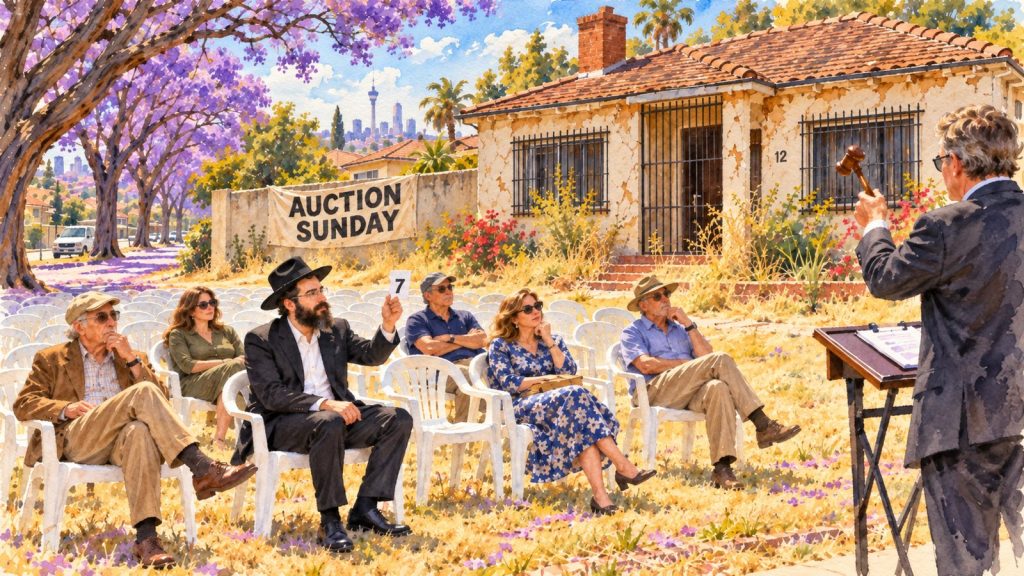
Along with the other shliach, they walked into the property auction. There was a Jewish neighbor who lived two doors down, the auctioneer, the estate agent, and three others looking for a good deal. That’s it. This was a very nice sized home and piece of land in a good, central location, yet there was almost nobody there.
At this auction, there was no lowest price set. That meant that if no one was willing to pay more than four bucks for the place, the auctioneer just had to submit their offer of four bucks. Rabbi Ari had no money to bid with, but, long story short, they still ended up with the highest bid.
The owner of the property didn’t arrive at the auction, like he was supposed to. This was a property with a house, and the offer was less than the cost of just the land itself.
The auctioneer and estate agent said, “Listen, if he accepts your offer, he’s crazy. But he’s not here, so we have to submit it. I don’t think you should get your hopes up. It’s not going to happen.”
They went home. Rabbi Shishler was really excited. His wife was really not excited. The last thing she wanted was to live in that place. It was, in her words, a dump.
Rabbi Ari wrote another letter, put it in Igros Kodesh, and got brachos.
He said, “Okay, that’s it. There’s nothing to worry about. It’s clearly ours.” Which was all the more reason for his wife to worry: this was actually where she’d be living!
Once again, as always, Mrs. Shishler was a brave pioneer, putting the needs of the community first, and agreed to make this her home if they won it.
By the end of the week, the guy came back and asked for an extra 20,000 rand, which was a joke, since it was so little money. Rabbi Ari got the house. Nobody believed it was possible.
The previous owners had done renovations, which included an extra-large garage. That gave them space for a shul and a kiddush.
For the next 12 years, the Chabad house was in that house. The monthly mortgage was so low, it was less than paying for a car.
They officially opened their Chabad House doors that year. Everybody around said, “You’re crazy. Everyone already has a shul. Nobody’s going to come.” Yet every Shabbos, people poured in to daven and strengthen their neshama for the week.
The neighbor who showed up at the auction joined immediately, bringing his wife. Rabbi Ari found out his next-door neighbor was Jewish. There was also the family who had been on his mivtzaim route. They lived in the area, literally on the same street.
They also had Steven, down the road. One of his sons was already Bar Mitzva. Rabbi Shishler used to wake him up every Shabbos morning to join the minyan. He never liked being woken up. He had two passions on Shabbos: one was to sleep, and the other, when he got up, was to play soccer. Rabbi Ari made his life a misery. Yes, going to shul on Friday night was South African custom. But on Shabbos day, it was extremely hard to make a minyan. Rabbi Ari woke him up every Shabbos morning for about two years straight.
The rabbi was convinced he would never forgive him – he thought the boy would never want to go to shul again. The opposite came true; he is now a Chassidishe father and husband, and has a beautiful family that’s active in his community.
So, what was the problem?
For twelve years, Rabbi Ari Shishler’s Chabad House was also the family’s home. The living room was the entrance. The dining room became the classroom. The kitchen was always busy. People came for davening, for farbrengens, for classes, for advice, for Shabbos meals, and sometimes just because they needed a warm Jewish place to walk into. At first, it worked. Then the community grew – forty people on Shabbos, then one hundred. Then, the family grew, one beautiful child, then another, and another. Both kept growing, until one day, Rabbi Shishler looked around the house and said, half smiling and half serious, “We have a problem.” He pointed around the crowded room. “The community is growing, and my family is growing. Somebody has to move out.” Everyone laughed, but it was the truth. Either the family needed a new home, or the Chabad House needed a new home. They couldn’t keep squeezing into the same space forever.
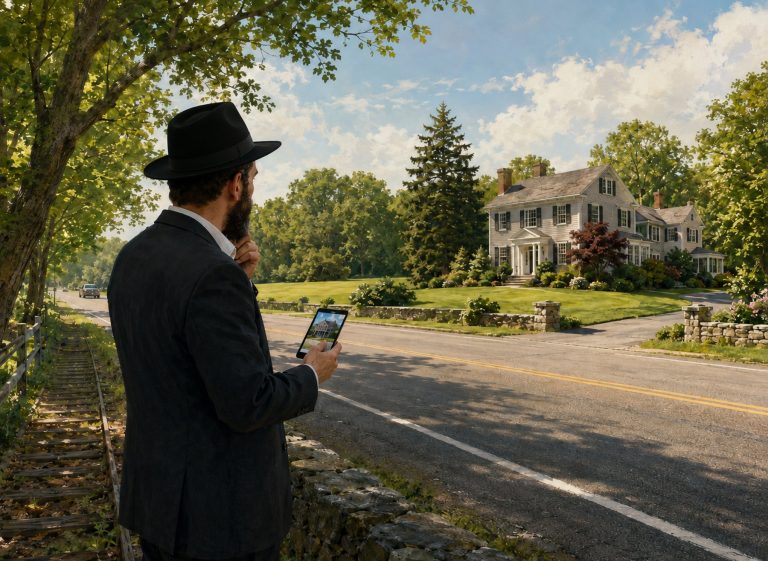
Then one day, a house went up for sale, right across the street. Not a few blocks away or in another neighborhood. Directly across the street, on the opposite corner. Rabbi Shishler went over and stood outside, looking at the property carefully. “This is interesting,” he said. The land was double the size of his own property. The location was excellent. It was easy to find, right where everyone already knew to go. Someone standing by said, “Rabbi, this could be it. This could be the new Chabad House.” Rabbi Shishler looked at the land, then at the house, then at the garden in front. “Maybe,” he said slowly. “Maybe.”
But the longer he looked, the more complicated it became. The first issue was obvious. “The price is too high,” someone said. Rabbi Shishler nodded. “Much too high.” But the second problem bothered him even more. The house was built all the way at the southern end of the property, and, in South Africa, where the sunlight comes from the north, homes are often built that way to get more light and warmth in the winter. The most serious issue, though, was that the rest of the land was full of fruit trees. Rabbi Shishler stood there quietly, staring at them. Someone said, “So? The trees can come down.” He turned around. “The Torah doesn’t allow cutting down fruit trees. I could never do it.”
The person with him looked across the land. “So we… walk away?” Rabbi Shishler took one last look at the property. It was close. It was perfect. Then he said, “We walk away.” And they did. The property that looked too perfect was left behind. It came with a halachic question Rabbi Shishler couldn’t answer. “If Hashem wants us to have a building,” he said, “He’ll send it in a way that is right.”
Soon after, another man bought the property. He wasn’t planning a Chabad House. He wanted to develop it. His idea was to tear down the old home and build a group of smaller townhouses, which would make him a nice profit. Machines came onto the property. The old house was knocked down. The garden was cleared, and the fruit trees came out. The lot that had once looked like a house and garden became open land.
But then, the developer’s plan hit a roadblock. The neighbors told the city they didn’t want more townhouses near them. The developer couldn’t get permission to build what he’d planned. It was strange, because further down the same street, on a quieter road, other properties had already been turned into exactly that – a lot of smaller homes, to sell to families. Yet here, on this road, the city turned the plan down. The developer waited, hoped, and pushed. Nothing happened. Finally, he moved on to another project nearby which kept him busy, and the empty lot sat there across from Rabbi Shishler’s house.
Day after day, Rabbi Shishler drove past it. Morning, afternoon, night. The land was just sitting there. Nothing was being built. No one was using it. Weeds sprouted, the place became overgrown. Month after month, he looked at it and thought, “That could have been the Chabad House.” Then he would remind himself, “No. We walked away for the right reason.” Almost two years passed. The empty land just sat there, across the street, almost waiting. Maybe it was their time…?
Finally, one day Rabbi Shishler decided he had to find the owner. He tracked down the developer and called him. “Is that still your property on the corner?” he asked.
“Yes,” the man said. “Why?”
Rabbi Shishler didn’t bother to explain the whole situation. He just said, “I want to buy it.”
The owner answered immediately, “Take it. You can have it, as long as you pay not one cent less than what I paid for it.” Rabbi Shishler said, “No problem.”
And then, by a miracle, Rabbi Ari gathered the money necessary in a matter of months. Not through a mortgage or even a loan. Rabbi Shishler, along with the support of some people in the community, were able to pay the whole amount. Rabbi and Mrs. Shishler stood on the land and saw all they could grow. The old house, which would have been difficult to remodel, was gone. The fruit trees, which they couldn’t cut down, were gone too – someone else had done the messy work for them.
“At first,” Rabbi Shishler said, “I thought Hashem had taken it away. But maybe Hashem was just preparing it.” Instead of renovating an old house this way and that way to become a Chabad House, they had a blank slate. Open land to design a center exactly the way they needed it. An architect even came forward and drew the plans for free. Rabbi Shishler smiled. For twelve years, the Chabad House had been squeezed into his home. Now, for the first time, there was space.This allowed them to dream bigger than ever.
Later, when community members heard the story, Rabbi Shishler told them, “Sometimes you think Hashem said no, but He really said not yet.” The empty lot across the street had looked like a dream that slipped away. First, it was too expensive. The house was unsuitable. The trees made it impossible. Then, someone else bought it, with grand plans of his own. Then the house was demolished, and the land cleared. Only a miracle kept him from getting zoning permits. The land sat empty for almost two years. But all that time, Hashem was moving the pieces around the board. And when the time was right, the dream finally crossed the street, and Chabad of Strathavon came home.
By Yosef Shidler, from the TzaddikStory.org collection
Beis Moshiach #1529 • כ״ו חשון תשפ״ז • pp. 55-59
© 2026 Beis Moshiach Magazine. All rights reserved.
This article originally appeared in Beis Moshiach #1529. You are welcome to share it with friends and family by email or in print, provided that you do not change, add to or omit any part of it, you credit the author and Beis Moshiach, and you include a link to archive.bmoshiach.org (written out in full in printed copies).
To republish this article in a newspaper, magazine, book or website, please request permission in advance at [email protected].