The Kennedy Curse: Truth or Hoax?
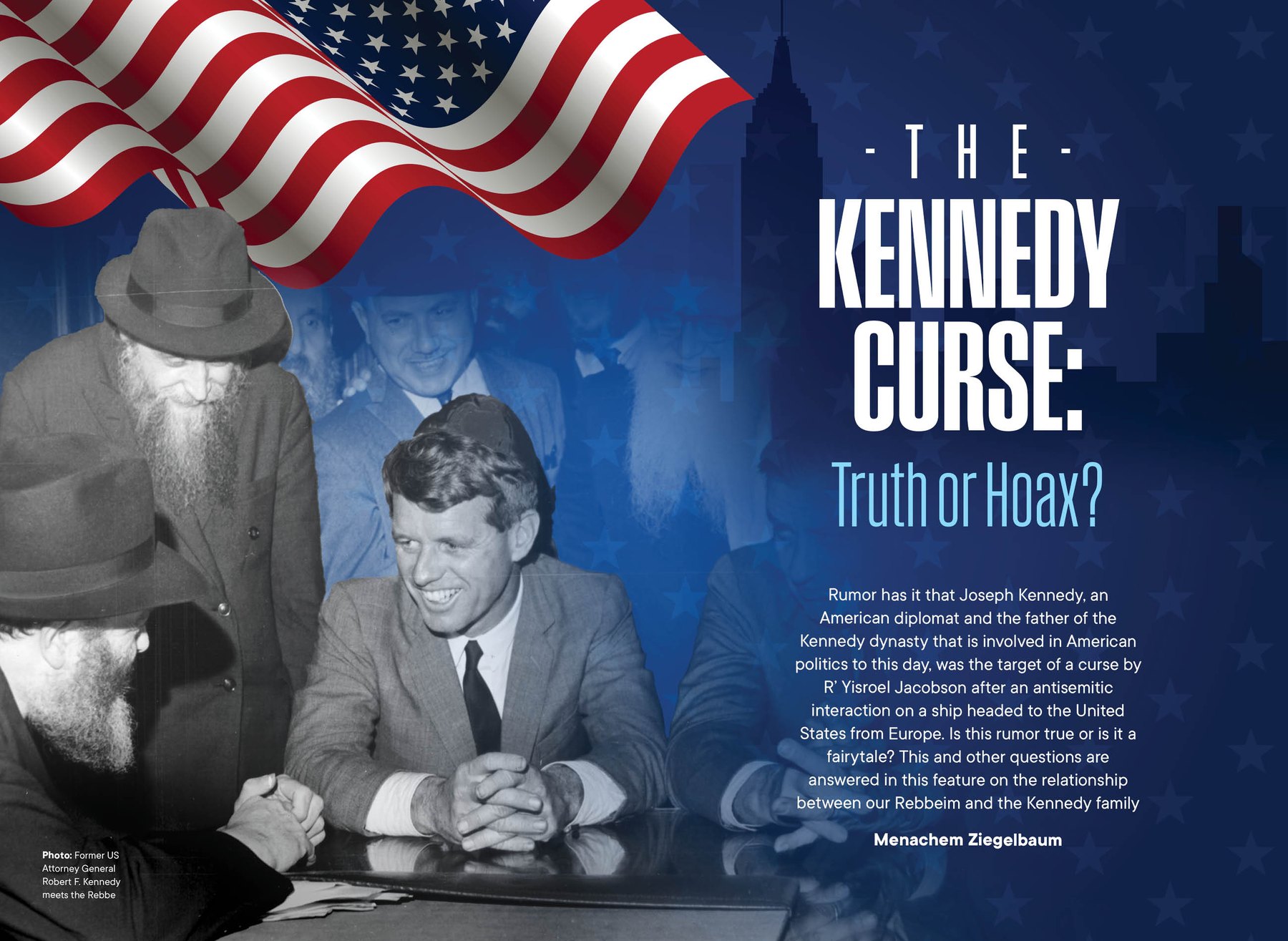
Rumor has it that Joseph Kennedy, an American diplomat and the father of the Kennedy dynasty that is involved in American politics to this day, was the target of a curse by R’ Yisroel Jacobson after an antisemitic interaction on a ship headed to the United States from Europe. Is this rumor true or is it a fairytale? This and other questions are answered in this feature on the relationship between our Rebbeim and the Kennedy family
It was a long winter night in 770. A small group of bachurim were sitting near the table in the small zal on the first floor, around the figure of the Chassid, Rabbi Yisroel Jacobson, of blessed memory, one of the most respected and esteemed mashpiim and Chassidishe askanim in the United States, listening to the stories flowing from his lips.
That night was an unusually long one, during which this prominent Chassidic figure retold in great detail about the process of bringing the Rebbe Rayatz and his son-in-law, the Ramash, to the United States during the frightful years of the Holocaust. He had personally been deeply involved in this episode, turning worlds upside down to secure them passage to the safe shores of America, thereby preserving the Chabad-Lubavitch dynasty of leadership for generations to come.
As he told his story, he also spoke about his journey from the United States to Europe on the eve of the Second World War with several young bachurim coming to learn with the Rebbe Rayatz, nishmaso eden in Otwock. However, a few days after their arrival, Nazi Germany invaded Poland, and the bachurim received instructions from the Rebbe to return to America immediately.
Quite miraculously, they managed to leave the bombarded country, somehow making their way to Riga, Latvia, where they remained for the Yamim Noraim, after which they safely boarded a ship for their return voyage to New York.
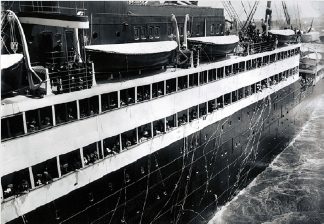
Rabbi Jacobson personally didn’t wait with the bachurim, and in accordance with the Rebbe’s direct instructions, he immediately made his way back to the United States. On the twenty-eighth of Elul, he managed to get aboard the S.S. George Washington at the French port of Le Havre, arriving in New York on the fifth of Tishrei 5700.
Together with them on the liner departing from France were other Jewish passengers who boarded at the eleventh hour despite the lack of available cabins. The ship’s captain agreed to empty the first-class swimming pool, and the crew arranged places there for Rabbi Jacobson and the other last-minute travelers.
As the story is told, another person also traveling on this voyage was Joseph Patrick Kennedy, Sr., the patriarch of “the Kennedy dynasty” – a family that produced a president, an attorney general, senators, congressmen, ambassadors, and presidential candidates. American nobility.
Joseph Kennedy was an American businessman, politician, and diplomat who supported the policies of isolationism. He was considered a strong believer in appeasement in the face of the growing power of the Third Reich, and he even sought to have a private meeting with the cursed Nazi dictator around the time of the Kristallnacht pogroms. In 5700 (1939), he resigned as U.S. ambassador to Great Britain due to his comments fiercely opposing war against Germany, which aroused considerable anger against him. Testimony given by many people who heard these statements directly gave credence to allegations that Kennedy himself was an antisemite.
While traveling on the ship bringing him to the United States, he came across the image of a proud Jew: Rabbi Yisroel Jacobson. Unable to restrain his feelings of repugnance, he unleashed a hate-filled diatribe against the rabbi over the mere fact that he was a Jew.
It has also been told that he even harassed the other Jewish passengers, and during the Rosh Hashana 5700 tefillos, disturbed their prayers. According to one account, Rabbi Jacobson himself – others say it was someone else – responded with a fervent curse.
What exactly happened there?
This story eventually ‘made the rounds’ in 770, albeit as a baseless rumor. Thus, for example, when the head Chabad librarian, Rabbi Sholom Dovber Levin, heard these stories during Rabbi Jacobson’s lifetime, he didn’t ask him about it. However, this story even appears in a bestselling book written by the well-known American author Edward Klein entitled “The Kennedy Curse: Why Tragedy Has Haunted America’s First Family for 150 Years”:
“According to a story that is told in mystical Jewish circles, shortly before the outbreak of World War II, Joseph Kennedy, who was then ambassador to the Court of S. James’s in London, returned to the United States aboard an ocean liner that was also carrying Israel Jacobson, a poor Lubavitcher rabbi, and six of his yeshiva students, who were fleeing the Nazis. A notorious antisemite, Kennedy complained to the captain that the bearded, black-clad Jews were upsetting the first-class passengers by praying on the Jewish high holy day of Rosh Hashana. Kennedy demanded that the captain stop the Jews from conducting their services in front of the other passengers.”
In retaliation, or so the story goes, the author claims that Rabbi Jacobson then cursed the senior Kennedy and all his family’s male offspring to tragic fates.
In fact, over the years, the Kennedy family has been labeled with the term “the Kennedy curse” (Wikipedia even has a special entry on this…), expressing the fact that for decades the Kennedy family has endured a series of incredible and strange tragedies – airplane crashes, devastating accidents, and most terribly of all – the assassination of the thirty-fifth president of the United States, John Fitzgerald Kennedy.
The Murder That Had America Reeling
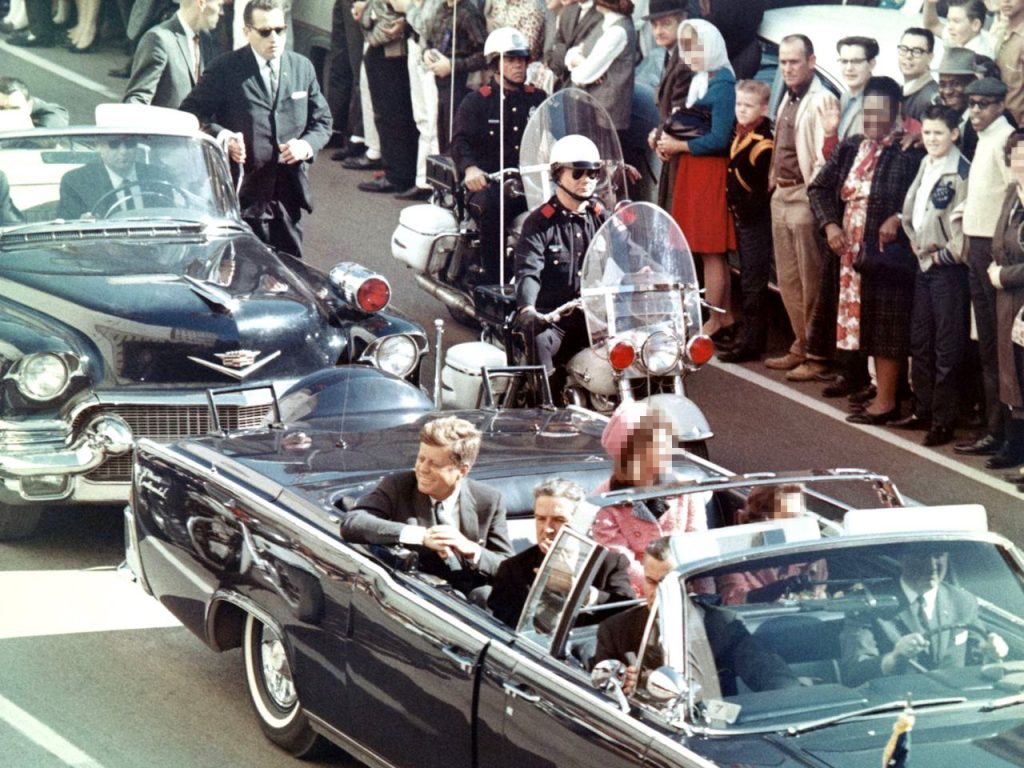
Friday, the sixth of Kislev 5724 (1963), is remembered as one of the most frightfully tragic in the annals of American history, when President John F. Kennedy was murdered in broad daylight on a bright autumn afternoon as he was riding in a motorcade as part of an official visit to Dallas, Texas.
The presidential cavalcade traveled through Dealey Plaza, a park located on the edge of the commercial district, as Mr. Kennedy and his wife sat together with the governor of Texas and his wife in the president’s convertible limousine, its transparent bubbletop roof removed due to the pleasant weather. The car made a sharp turn into the park, moving very slowly, less than fifteen miles an hour.
At exactly half past noon, three shots were fired at the presidential motorcade. The first bullet missed its target completely, the second struck the president in the back and exited his throat, and the third pierced his head.
At breakneck speed, Kennedy was transported to Parkland Memorial Hospital and brought by stretcher into Trauma Room One. The medical staff of doctors, nurses, and technicians worked feverishly to stabilize his moribund condition caused by the two gunshot wounds.
Despite the seriousness of his injuries, the hospital’s emergency team fought to save the president’s life.
While the staff at Parkland worked tirelessly, the American people followed with palpable tension as radio and television reports gave updates on Kennedy’s condition, each one taking away their collective breath or giving a flicker of hope.
Just thirty minutes after the shooting, at one o’clock, President Kennedy was officially pronounced dead. The American people found themselves in a state of shock and distrust. A beloved leader, a symbol of hope and change, had been struck down in the prime of his life. The tragedy that took place on that day left an indelible mark on the United States, a harsh reminder of how a person’s life can be cut short so suddenly.
The Rebbe’s Response to the Assassination
“The news of [the assassination] reached here [770] on Friday afternoon,” wrote one of the tmimim in Beis Chayeinu to his friend in the days following the event. “And when the Rebbe shlita heard about this – he was quite amazed how Kennedy traveled in an open car in such a manner that he could easily be harmed.”
As we have mentioned, the murder occurred on a Friday, and on Motzoei Shabbos, the Chassid Rabbi Yosef Wineberg was preparing for his weekly Tanya class to be given over the radio airwaves. “The Rebbe shlita often gives him instructions on what to say during the broadcast,” this bachur continued to describe in his letter. “On that Motzoei Shabbos Kodesh, Rabbi Wineberg asked the Rebbe shlita if he should refer to the Kennedy assassination, and the Rebbe shlita said that if the other programs (not necessarily of a Torah nature) are doing this – he should refer to it as well.”
A few days earlier, the kuntres ‘Bahd Kodesh’ was re-published, bearing the date ‘Chof Marcheshvan 5724’ on the flyleaf. It’s interesting to note that the Rebbe also told Rabbi Wineberg that he should speak during his radio program about the recently re-released kuntres ‘Bahd Kodesh’, emphasizing the note he added in his own handwriting on the new edition about ‘a minister and a ruler.’
At this stage, we entered a kind of spiritual uncertainty, clarified or alluded to in part by the Rebbe MH”M himself, and other details made clear by elder Chassidim.
The kuntres ‘Bahd Kodesh’ is a petition written by the Mitteler Rebbe to a regional government minister from the Belorussian city of Vitebsk in connection with his imprisonment. It explains certain key concepts in Chassidus in a style even a gentile mind can comprehend and clarifies the position of Judaism and Chassidus vis-a-vis the monarchy. The Rebbe first edited and published the kuntres in 5710, however, a few weeks before the Kennedy assassination, he instructed that they make a second printing, in which he added eight footnotes in his own handwriting.
In the final footnote, the Rebbe related to the statement at the end of the kuntres about the G-dly power given to kings and also to prominent government ministers. The Rebbe noted that halacha states how even the bracha on seeing a king is made for a local governor, and then explained why the Mitteler Rebbe didn’t mention this: a) since the bracha is made without uttering G-d’s Name; b) since the Alter Rebbe didn’t bring this halacha, it apparently meant that in his opinion, the bracha should not be said.
What connection does this have to the assassination of President Kennedy?
In fact, the anonymous bachur who wrote this letter at the time elaborated upon this point himself:
“Here in 770, the tmimim and Anash are saying that the whole publishing of the kuntres ‘Bahd Kodesh’ at this time was connected to the assassination of President Kennedy – in the manner of the special maamarim published in connection with the death of Stalin, etc., and as is known, the conduct of our Rebbeim regarding the change of leadership in powerful countries.
“Clearly, our assumption has grown stronger in light of the fact that the Rebbe told Rabbi Wineberg to speak about the kuntres ‘Bahd Kodesh’ in connection with the assassination!”…
Rabbi Wineberg later added that the Rebbe also told him to talk about how every country has its own ministering angel, and how a superpower such as the United States surely has one as well… (a concept often brought in Chassidic teachings).
If that wasn’t enough, the bachur added in his letter: “You surely have heard of the saying of our Rebbeim, who would say about the Tzemach Tzedek that he would customarily crown kings on Rosh Hashana and make sedarim (orders) in Petersburg. It is also known that every Rosh Hashana, the Rebbe alluded to the events that would occur during the year. Indeed, the elder Chassidim here are talking with excitement about how there were more allusions this year, when during the Shabbos Shuva farbrengen, held as a continuation to the Rosh Hashana farbrengen, the Rebbe shlita spoke explicitly about how on Rosh Hashana, there are hints of everything that will take place during the year…
“…The Rebbe then explained that this avoda of ‘ba’merchav’ belongs primarily to binyan ha’malchus, which is the main concept of Rosh Hashana, ‘make me King over you’, from which all matters are drawn in detail. He further brought what is explained in the Mitteler Rebbe’s kuntres ‘Bahd Kodesh’ on the matter of ‘May my judgment come forth from before You’, etc. – and it is but a word!
“After the fact, Ziknei HaChassidim spoke about this sicha as ‘Heavenly inspired…’”
“bob” Kennedy’s Yechidus with the Rebbe
Chol HaMoed Sukkos 5725.
On one of the days of Chol HaMoed, Joe Kennedy’s third son, Robert Francis Kennedy, former Attorney General of the United States, came to visit the Rebbe and to receive his support in the upcoming election for the U.S. Senate seat representing the State of New York, scheduled for the following month. Already in the early morning hours, security guards and police came to ensure protection for the Democratic senatorial candidate. Ordinary cars parked along the service lane were towed away from the area.
At ten o’clock in the evening, Robert Kennedy arrived with his entourage and entered the Rebbe’s holy room.
Kennedy, who thought that he was coming to another Jewish leader as many others he had visited previously, started reciting a whole list of campaign promises, e.g., if elected to the United States Senate, he would make certain to assist those Jews still living behind the Iron Curtain in the Soviet Union.
Diplomatically, the Rebbe replied that he thinks it would be far better that they do things in this matter without fanfare and without publicity, in such a way that they can help more effectively.
The Rebbe asked him that he should strive to help yeshiva programs and Jewish education in general. Kennedy replied that he is planning to give his support, and he has even begun making various financial accounts. Among them, he said that in another twenty years, he will have a million dollars, and he has started considering how many children he will have then (he had eight children at the time). The Rebbe smiled broadly and said that if they have to wait for their shares, the children themselves will by then already have grown old. Kennedy and his people laughed heartily.
The meeting between the Rebbe and the senatorial candidate lasted for about thirty minutes, as the photographer who was present for the event made certain to record it for posterity.
As it turned out, we know that on at least one occasion, Senator Robert Kennedy worked on behalf of the Chassidim still in the U.S.S.R.
This was after it became known that the brothers Yossel and Mulle Motchkin (sons of the well-known mashpia, Reb Peretz Motchkin) had been released from Soviet incarceration. Once people learned of their release, they began formulating plans to extricate them from the totalitarian valley of death. Ideas were raised and proposals were made, most of which were rejected due to the danger posed to their lives and the difficulty in carrying them out.
For example, Mrs. Rose Schrage, widow of the American entrepreneur and founder of the first Crown Heights shmira organization “the Maccabees”, Reb Shmuel Schrage, tells the following:
“Senator Robert (‘Bob’) Kennedy approached my husband during his campaign with a request for his political support. R’ Shmuel Schrage asked the Rebbe if there was something that Kennedy could do in exchange for his support. The Rebbe replied that he should work for the release of the Motchkin brothers from Russia.
“Reb Shmuel submitted the request, Kennedy looked into the matter, and then gave them an update. The good news was that Russia would release the brothers, however, the bad news was that they would be unable to enter the United States. The reason given was the stubbornness and intransigence of certain officials within the State Department.”
Anti-semitism in the Kennedy Family
Let’s get back to the story of the curse that did or didn’t take place on the ship traveling from Europe to America, and the bitter results that have accompanied the Kennedy family over a period of several decades.
As stated previously, the story made the rounds as a rumor in 770, and it even appeared in a biography examining the curse over the lives of the Kennedy family.
Rabbi Zalman Chanin, director of Vaad L’Hafotzas Sichos and a Chassidishe researcher, came out against the above story. He reasons that it is inconceivable that Rabbi Jacobson would ever utter a curse of any kind. “Much pain and anguish were caused to Rabbi Jacobson’s family when they heard the suggestion that their father and grandfather had cursed someone,” he wrote in an account previously published in Beis Moshiach. “Anyone familiar with Rabbi Yisroel Jacobson knows that with all his assertiveness – he was a gentle man who couldn’t harm a living soul. Rabbi Jacobson had nothing to do with curses and could never curse anyone.”
Rabbi Chanin adds that according to the assessments and calculations he made, Joseph P. Kennedy was never even on the same ship with Rabbi Jacobson. “While he sent his wife and family back to the United States immediately upon the outbreak of the Second World War, he personally remained in England until he resigned from his position as U.S. ambassador to Great Britain in October 1940. Rabbi Jacobson did travel on the same liner with Kennedy’s family, but not with the head of the family himself.”
“Joseph Kennedy was actually known as an antisemite who related to Jews with scorn,” Rabbi Chanin agreed. “More than once, he openly expressed himself that while there are some Jews who are fine people, regarding Jews in general he used insulting terms. He didn’t hide the contempt he felt towards Jews when he called them derogatory names such as ‘kikes’ and said that they spoil everything they touch. Joe Kennedy, Sr. even agreed with the unspeakable cruelty towards the Jews, perpetrated by Adolf Hitler and the Nazis, may their name be blotted out. He even expressed this publicly: ‘Well, they brought it upon themselves…’”
Another version states that during the period of the Second World War, the senior Kennedy did all that he could to prevent Jewish refugees from receiving entry visas to the United States, and it had been one of the prominent rabbanim in England who cursed him and his family.
“even…to the Great Ministering Angels”
No one knows the meaning and cause of all the many tragedies of the Kennedy family for certain.
As we mentioned earlier, in the days prior to the assassination of President Kennedy, the Rebbe submitted for printing a new edition of the kuntres “Bahd Kodesh”, adding a special footnote on the words “that even…to the great ministering angels.” He even instructed Rabbi Wineberg to mention this addition during his radio program, noting that every country has a ministering angel, and especially a superpower like the United States!
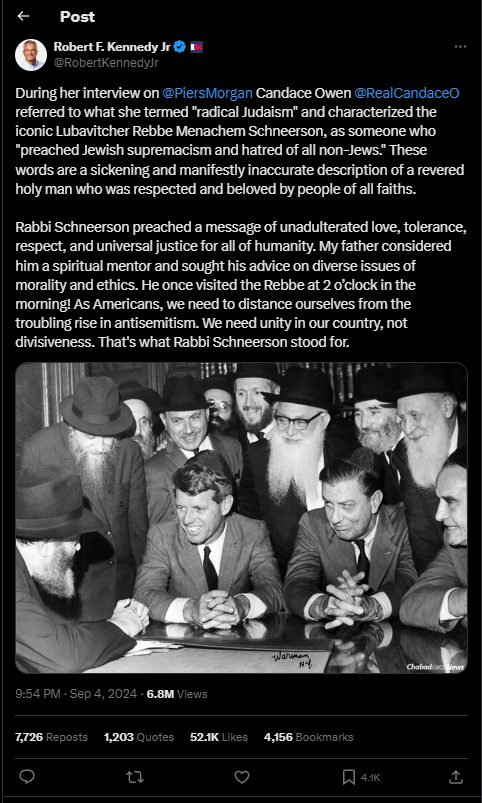
Just recently, Robert F. Kennedy Jr., a presidential candidate now slated to serve in the forthcoming administration responded on his social media account to antisemitic remarks made to the Rebbe’s Torah while sharing a photo of his late father’s Yechidus with the Rebbe:
During her interview… referred to what she termed “radical Judaism” and characterized the iconic Lubavitcher Rebbe Menachem Schneerson, as someone who “preached Jewish supremacism and hatred of all non-Jews.” These words are a sickening and manifestly inaccurate description of a revered holy man who was respected and beloved by people of all faiths.
Rabbi Schneerson preached a message of unadulterated love, tolerance, respect, and universal justice for all of humanity. My father considered him a spiritual mentor and sought his advice on diverse issues of morality and ethics. He once visited the Rebbe at 2 o’clock in the morning! As Americans, we need to distance ourselves from the troubling rise in antisemitism. We need unity in our country, not divisiveness. That’s what Rabbi Schneerson stood for.
* * *
Last week, as the stormy presidential campaign in the United States came to an end with the reelection of Donald Trump, we hope and pray that the ministering angel of the United States of America will influence its forty-fifth and forty-seventh chief executive to continue his support for the People of Israel and the Land of Israel.
Shazar At The Kennedy Funeral, And The Rebbe Sent Him The Kuntres “Bahd Kodesh”
The assassination of President Kennedy sent shockwaves throughout the world. Delegations of former diplomats came to Washington from the four corners of the earth to participate in the funeral. Among those who came to the nation’s capital was an Israeli delegation headed by Mr. Zalman Shazar.
As a result, the Rebbe sent his secretary, R’ Nissan Mindel, and ‘Beis Rivkah’ principal R’ Yitzchak Goldin to Washington as his emissaries to Mr. Shazar. Together with them, he also sent a copy of the kuntres “Bahd Kodesh”, published during this period, along with two bottles of mashke.
Shazar greeted the shluchim warmly. A minyan for Maariv took place at the embassy together with the members of the diplomatic mission, who placed kippot on their heads during the prayer service.
In the “Morgen Journal” daily on the following Thursday, it was reported that Shazar wanted very much to come to 770 for a ‘yechidus’ with the Rebbe. However, he chose not to leave Washington, because if he traveled to New York, it might appear as if he hadn’t come specifically for the president’s funeral, rather for other matters as well.
Nevertheless, being a Chassid with all his heart and soul, Shazar couldn’t restrain himself. According to his close advisors, he said the following: “To be in America and not to be in yechidus – is unthinkable.” Shazar eventually called the Rebbe shlita’s secretariat and asked if he could speak with the Rebbe. In fact, the Rebbe did get on the phone, and the conversation between them lasted more than half an hour…
Beis Moshiach #1435 • pp. 10-17, 18
© 2026 Beis Moshiach Magazine. All rights reserved.
This article originally appeared in Beis Moshiach #1435. You are welcome to share it with friends and family by email or in print, provided that you do not change, add to or omit any part of it, you credit the author and Beis Moshiach, and you include a link to archive.bmoshiach.org (written out in full in printed copies).
To republish this article in a newspaper, magazine, book or website, please request permission in advance at [email protected].