You’ve Got to Feel to Heal
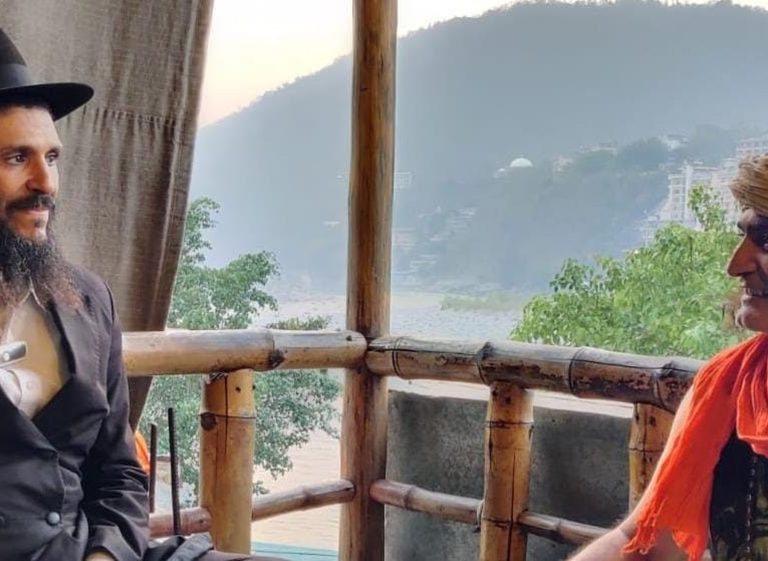
It’s not surprising that Miriam Racquel Feldman’s award-winning memoir, “God Said What? My Orthodox Life,” immediately became a bestseller. It is the story of her baalas teshuva journey, written with an authenticity that makes it truly unique. Her just-released second book, “Somatic Healing for the Modest Goddess,” very quickly also became a #1 bestseller in Women & Judaism.
In this book Miriam Racquel shares her “second” journey, from being drained to joyful, that led her to becoming a somatic healer, marriage coach, trauma and anxiety specialist, and a renowned speaker empowering women. She’s also well-known for the marriage programs that she does together with her husband Dovid Feldman, who is a marriage and family therapist. They live in Chicago, and are blessed with children and grandchildren.
Writing her memoir took about eight years, and immediately afterwards, for the last four years, Miriam Racquel has been working on her new book. Persistent and goal-driven, she finds the time to write before dawn, when it’s quiet and peaceful. She says, “I feel like I have a mission in my writing, and it’s important for me to take it to the finish line!”
Running on Empty
“Perhaps you’ve undergone an experience similar to mine, trying over many years to conform to certain expectations of yourself or of your community, but in the process have hurt yourself by trying,” Miriam Racquel opens our interview. “Or you may have prodded your husbands and children to also live up to expectations that are not suitable for them, or unwise to pursue. We all have our own path, purpose and destiny, designed specifically for us, and our unique way of serving Hashem. We’re not meant to be someone else, but to be the best version of ourselves, with all the wonder and all the imperfections.
“In my early forties, when my youngest child was two and my oldest was sixteen, I was burnt-out emotionally and suffering from aches and pains all over my body. I’d spent so many years pushing myself to complete my ‘very important’ to-do list, that I’d failed to notice that I was missing chayus and simcha in my avodas Hashem. I began running around to chiropractors, massage therapists, physical therapists and doctors, but they couldn’t find any reason for my body’s ‘rebellion.’ What was it?
“One day, in a session with my massage therapist, I asked her what she thought was causing my pain. Looking at me gently with her kind eyes, she said, ‘You are empty. There is nothing here.’ Her reply took my focus off of the pain in my body, and placed it in the direction of what was really asking for healing. It was my life.”
You’ve Got to Feel to Heal
“The awareness that my massage therapist shared with me led me on a path to the coaching and somatic work that I do today,” Miriam Racquel shares. “Even unconscious emotional distress takes its toll on the body, blocking blood and oxygen flow, which can lead to pain symptoms. Until underlying emotional issues are resolved, the pain will continue to ‘hop around’ to different parts of the body, which was exactly what was happening to me.
“The first wellness ‘key’ that I learned was: you’ve got to feel to heal. Healing comes from turning inward. Accepting and being honest about your emotions, especially the very human emotions of anger, fear, sadness and grief, is the first step to healing.
“Emotions are ‘energy in motion,’ showing up as physical sensations in the body. In the beginning they are quiet and subtle, but when ignored, repressed or suppressed, they get louder and louder, until they ‘scream’ in the form of a migraine, backache, or some other pain in the body. Each person’s body has their own way of expressing pent-up energy, in specific symptoms.
“As my training continued, I acquired different somatic/mindbody techniques for processing emotions, and began using them on myself and with my clients. Boruch Hashem, not only did my health improve and my vitality strengthen, but theirs did as well. Somatic processes pave the way for making changes in our thoughts, relationships and lifestyles.”
Holistic Healing
The opening quote of Miriam Racquel’s book is the message of the Rebbe Melech HaMoshiach that now is the time to put a much greater investment in making our bodies more refined: “For the later the generation, the closer the time to Moshiach’s imminent arrival; a time when the latent spirituality found within the body will come to the fore, nurturing and sustaining its soul. As such, special care must be given to the body and it should be accorded an additional measure of respect” (Likkutei Sichos, Vol. 2, pp. 530-532).
“My goal in writing this book is to empower women through somatic awareness, learning to process emotions, and connecting to feminine intuition,” Miriam Racquel says. “Physical, emotional and spiritual wholeness are all necessary to serve Hashem b’simcha. In the times of Moshiach the body will be refined to the extent that we will be able to hear its guidance and wisdom.”
Besides somatic wellness, Miriam Racquel also gives guidance in this book on other pertinent topics such as transitions for the baalas teshuva, friendship and community, parnassa, dating, marriage and parenting. She shares, “I’m so happy and grateful that my book is out in the world, enabling women to access tools to navigate life’s challenges in a healthier, more meaningful, and deeply spiritual way.
“Before I write, speak at an event, or start a healing and coaching session, I always give tzedaka. I make sure that there’s a pushka right near me. Afterwards I recite this prayer, ‘Hashem, may the light of wisdom and healing be available to me and to those that I am reaching. It’s not me doing the healing, Hashem is the healer.”
Joyful Partners with Hashem
Miriam Racquel concludes with advice on avoiding the tendency to “compare and despair.” “The yetzer hara dresses in all kinds of clothing – sometimes taking on the appearance of piety or self-pressure, lying to us so that we doubt our own self-worth. The yetzer hara’s ‘shoulds’ can also lead to tremendous tension in the body, causing aches and pains. It’s not a mitzva to listen to your inner slave-driver’s voice demanding that you overexert yourself!
“Hashem gives women gevura for a reason. It means setting limits for ourselves, for what we do with our precious time, and for who we surround ourselves with. It’s great to learn from others, as long as you don’t expect yourself to be others. Women who love who they are become joyful partners with Hashem in bringing light to their homes and to the world.”
Miriam Racquel can be contacted at MiriamRacquel.com
Beis Moshiach #1435 • pp. 38-39, 48
© 2026 Beis Moshiach Magazine. All rights reserved.
This article originally appeared in Beis Moshiach #1435. You are welcome to share it with friends and family by email or in print, provided that you do not change, add to or omit any part of it, you credit the author and Beis Moshiach, and you include a link to archive.bmoshiach.org (written out in full in printed copies).
To republish this article in a newspaper, magazine, book or website, please request permission in advance at [email protected].