Bringing Life to Beeswax
I interviewed Bassie Wolff in the cozy living room in her home on President Street in Crown Heights. What first struck me were the series of framed vintage illustrations of Yidden on the wall. One of them was from a newspaper clipping, dated May 14, 1870, of the consecration of the new Central Jewish synagogue in London. In this fast-paced, mass-produced, digital world, Bassie values authenticity, which defines the style of her artwork.
Looking for a Rabbi in a Phone Book
In her soft, gentle voice, Bassie begins her story, “I grew up in Queens, and my family was not at all religious. My friends went to Hebrew school and had Bar/Bas Mitzvahs, but I had no Jewish education whatsoever. The only thing I do remember is being at a Pesach seder by my grandparents, who kept kashrus and the Yomim Tovim.
“I went to the University of Michigan in Ann Arbor. At the time many of my classmates were getting swept up in missionary and ‘born again’ movements, as well as ashrams, yoga, and meditation. I tried to find spirituality in other ‘backyards,’ but there was none. It’s amazing that without any Jewish background, I easily refuted all the false teachings of the missionaries.
“I knew that there must be a reason that I was born Jewish, and was determined to find out what it was. In those days there were large paperback telephone books, and one day, while visiting a non-Jewish friend, I tried searching in these phone books to find a rabbi. Her father noticed what I was doing, and suggested that I get in touch with Rabbi Aharon Goldstein, the campus shliach at the University of Michigan. He knew Rabbi Goldstein from work he was doing monitoring all the electrical repairs at the local Chabad House. What hashgocha pratis!
“I called Rabbi Goldstein and met with him in his office. I came in wanting to discuss esoteric issues such as the meaning of life, but Rabbi Goldstein spoke to me practically about lighting Shabbos candles, which I started to do. I began coming to the Chabad House regularly and learning about Yiddishkeit. After a year of intellectual and emotional struggles regarding observance, I was convinced to keep Shabbos, kashrus, and tzniyus.
“It took a little longer for me to understand what it means to be a Lubavitcher, and to accept it as the truth. What opened my eyes was my experience at a summer retreat in Bais Chana in Minnesota. One of the counselors had just experienced a major trauma, but rather than being depressed, she was full of positivity and simcha. As I watched her dance and enjoy Shabbos, I felt that I’d come to the right place.
“As soon as I received my BFA, bachelor’s degree in Fine Arts, I went to Crown Heights and studied in Machon Chana for a year. Afterwards I married Daniel Wolff. Our shidduch was made by Michael Muchnik, who revolutionized Chassidic art. Throughout the years I was very busy raising my children, but as most of them were getting married, I felt an intense need to express myself in the fine arts.”
Finding My Own Niche
Our conversation turns to Bassie’s talents and artwork. She shares, “In elementary and high school, I took art classes. I loved to draw and paint, especially with watercolors, ink, and oils. In university I majored in illustration and graphic design, and had a part-time job in one of the departments of the university producing videos and designing promotional materials.
“Illustration and graphic design is art that is intended for a specific purpose, such as selling a product. True fine art, such as painting and sculpture, is a tool for self-expression and conveying ideas, and I wanted them to be Jewish.
“Later in my life I wasn’t sure what direction my drive for creativity should take. I always wished that I had a distinct, recognizable style. It pained me that I didn’t have my own niche.
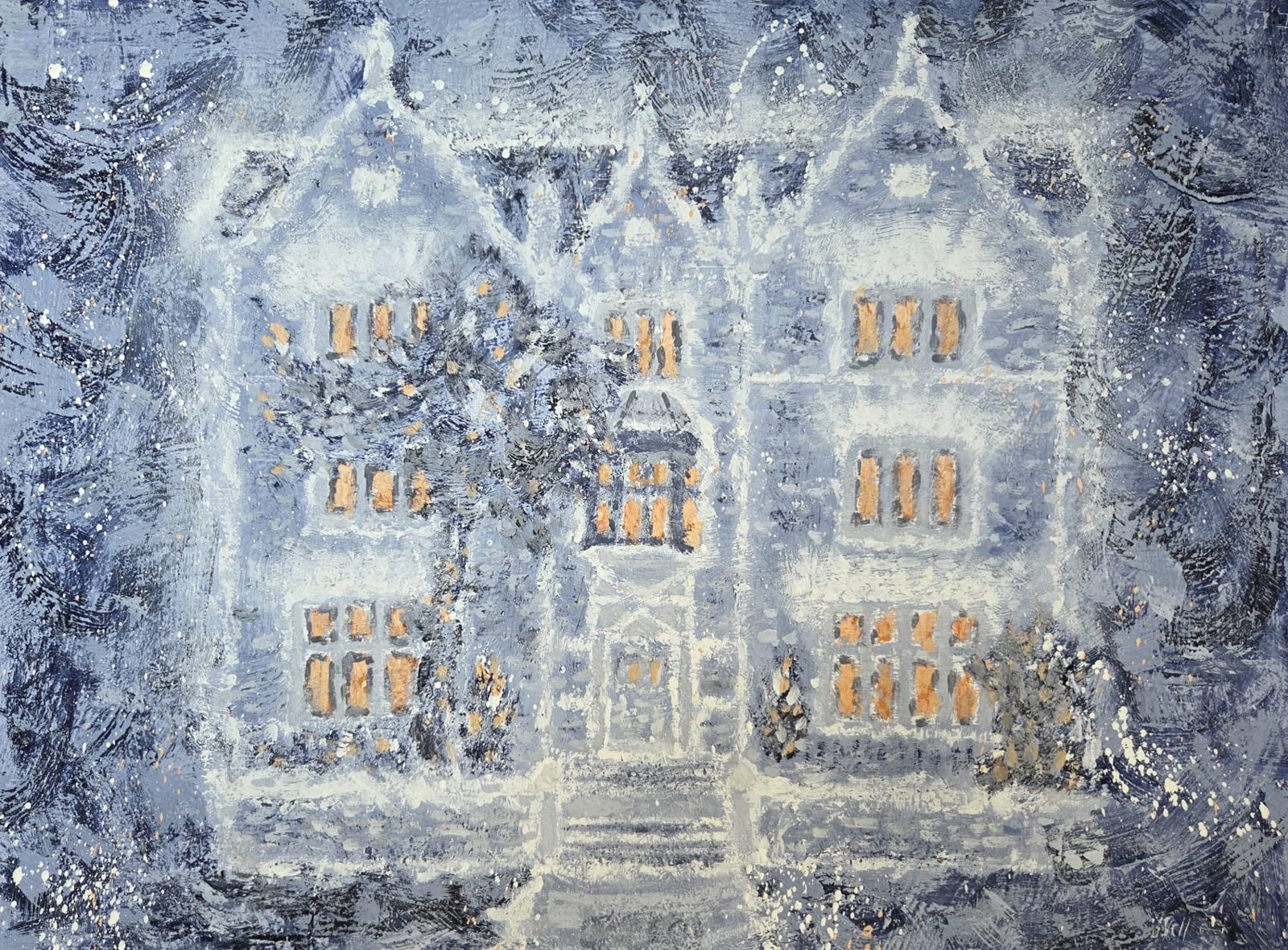
“Eight years ago I participated in a one-time workshop in encaustic painting. It’s an ancient art technique using heated, molten beeswax, to which resin from damar trees is added to harden it into a workable consistency. The instructor showed us how to use the material, and I was very eager, as the Rebbe says, to elevate the inanimate to the highest level.
“I carried over all my experience with oil painting to this new medium, and learned to make the the wax do what I wanted. Working with beeswax is an earthy feeling, similar to kneading, and it’s very satisfying. Beeswax is compatible with other oil materials, and I use oil pastels to give it color and definition. Encaustic paintings have a soft, radiant glow, and are unique in their texture, depth, and durability.”
Bassie has begun selling her paintings, which are unlike any other art that I’ve ever seen. They’re extremely fresh and ‘alive.’ I’m not surprised about what she says next.
“I always yearned to create something that would endure,” she shares. “Mediums such as watercolors, and even acrylic on canvas, fade over time, but encaustic painting is known for its longevity. There are encaustic mummy portraits in ancient Egypt that have lasted over 2000 years!”
Bassie concludes with the passion of an artist, “Hashem gave me the ability to create art, and I’d be very sorry if I got to 120 and didn’t use the gift that Hashem gave me! It’s there for a reason! Our purpose is to elevate the physical world and bring Moshiach!”
Bassie can be contacted at [email protected]
Beis Moshiach #1528 • י״ט חשון תשפ״ז • pp. 40-41, 54
© 2026 Beis Moshiach Magazine. All rights reserved.
This article originally appeared in Beis Moshiach #1528. You are welcome to share it with friends and family by email or in print, provided that you do not change, add to or omit any part of it, you credit the author and Beis Moshiach, and you include a link to archive.bmoshiach.org (written out in full in printed copies).
To republish this article in a newspaper, magazine, book or website, please request permission in advance at [email protected].