They Gave Their Most To Be A Host

Rafi and Shani Weisman had made Yom Tov plans. They’d be home for the Yamim Noraim, because they felt most comfortable davening in the shul near their home. The First Day and most of Chol HaMoed Sukkos, they would be with Shani’s parents, who lived nearby in Beer Sheva. Rafi’s parents – who lived all the way in Northern Eretz Yisrael, in Kiryat Shemone – were not so young anymore; so they would visit them only for two days – Hoshana Raba and Simchas Torah.
On Erev Sukkos, Rafi’s phone rang, and he heard the voice of his neighbor, Chaim Solomon.
“Hi Rafi, how are you? I hear you’re going away for the entire Sukkos…?”
“Yes, im yirtzeh Hashem, that is the plan – mostly to visit my in-laws. But I’m also excited to finally go up North and see my parents.”
“That’s wonderful! Enjoy the change of scenery!”
“Thank you, Chaim.”
“Um, Rafi, hope it’s okay to ask… can my brother and my sister-in-law stay in your apartment, just for Simchas Torah?”
Rafi remembered going to that wedding. It was pretty exciting. The kallah’s family was very well-off. He imagined his own apartment would be a hole-in-the-wall compared to the apartment he heard they’d been given by her parents.
“Oh, you mean letting them borrow our apartment while we’re away?” Rafi asked, thinking it over. “I’d love to help, but… we’ve never done this before. We’re still kind of newlyweds, so I’m not sure about letting others stay here…”
Rafi hung up the phone. He could picture exactly what his next conversation would look like. He would ask his wife, Shani, if she’d allow guests to stay in their home while they were away. Shani would think for a moment before saying she didn’t feel comfortable with it, especially not a couple who – at least in their minds – would likely look down on their more simple way of living.
Rafi thought about just sending Chaim a quick text, something like, “No, sorry, this won’t work,” and ending it there. But he paused. Maybe, he thought, doing a mitzva like this – something that felt difficult for both of them – would make Hashem happy. And who knows, maybe it would even bring them extra blessings for a good year! Once he made up his mind, he just had to talk to Shani. Hopefully, she’d be on board too!
“Shani, I got a call from Chaim…” Rafi began, explaining the situation and sharing his thoughts. He finished with, “This could be our chance to do the mitzva of hachnasas orchim – welcoming guests. I know it won’t be easy, but I just have this feeling we won’t regret doing it.”
This wasn’t the first time they’d been asked to let someone stay in their apartment while they were away. They both felt a little uncomfortable with the idea, especially Shani. She sometimes worried about their very simple life – a small apartment, not much extra money – and didn’t want others to judge them.
But to Rafi’s surprise, Shani took a deep breath and said, “Wow, this is going to be hard for me… but you know what, Rafi? Let’s do it. I don’t know why, but I feel good about this.”
Excited that Shani actually agreed to let guests stay in their home, Rafi wasted no time calling Chaim back with a big “yes.” Finally, the matter was settled—or so they thought.
* * *
It was early in the morning on Erev Simchas Torah. Rafi and Shani had already said goodbye to her parents and were busy loading the car for their long drive up north – they lived down south, so it would be quite the journey. Just as Rafi put the last bag in the car, he felt his pocket vibrate. He reached in to check his phone.
“Shalom, Ima. We’re heading out right now,” Rafi said cheerfully, then paused. “Ima, is everything okay? You sound really tired… not like yourself!”
“I am tired,” Ima began. “Abba wasn’t feeling well overnight, so we had to go to the hospital. But don’t worry – he’s feeling much better now, Baruch Hashem. I’m so sorry, Rafi, but having you all over for Yom Tov just isn’t going to work out. With Abba’s health, I just don’t think it’s a good idea. Maybe we can get together after the holidays. I feel terrible saying this at the last minute…”
“Of course, Ima. No worries. Another time,” Rafi said quickly, even though he was disappointed. After hanging up, Rafi and Shani knew what they had to do – cancel on their guests and head back home. They didn’t want to trouble any relatives with a last-minute change; it just wouldn’t feel right. But there was one problem: their guests were already on their way.
“Rafi, we’re going to have to find somewhere for the Solomons to stay. We can’t just cancel like that. Should we just invite them to stay with us anyway…?
“…No, never mind,” Shani thought to herself. The newlyweds could maybe stay with Chaim, but they probably wanted some peace and quiet. They wouldn’t be comfortable in her and Rafi’s tiny apartment, which was only big enough for one family! And with their baby crying so much, even louder than Chaim’s four kids put together, Shani knew it wouldn’t work.
“Wait! I know what we can do!” Rafi said, jumping up. “Yakov Pearson told me he was going to swap apartments with an American family, but they found something else last minute. Should I try calling him in the U.S. now…? Or is that crazy?”
“Rafi, that’s a great idea! Please call him. Like, right now.”
To Rafi’s delight, Yakov answered on the first try. And, by some miracle, his apartment was still available! Now, they just had to call Chaim and let him know about the new plan – a place for his family to stay nearby for Simchas Torah.
“Wait, Rafi, don’t call Chaim yet,” Shani suddenly said. “That apartment is in the Merkaz area. It’s a good half-hour walk from here.”
“True,” Rafi agreed. “But what choice do we have? We’re already being really nice, just by finding them another place. We could simply cancel. Plus, I’m sure Yakov’s place is a lot nicer than ours. We’re already doing them a favor.”
But Shani shook her head. “Rafi, we agreed to do this mitzva. Maybe this is just a test. Let’s let them stay in our apartment like we promised, and we’ll go to the Merkaz. We don’t even need to tell the Solomons that our plans changed. This way, they won’t feel uncomfortable.”
“You’re right…” Rafi said. “They’ll be eating meals and spending time with Chaim’s family anyway. The half-hour walk isn’t such a big deal for us.”
* * *
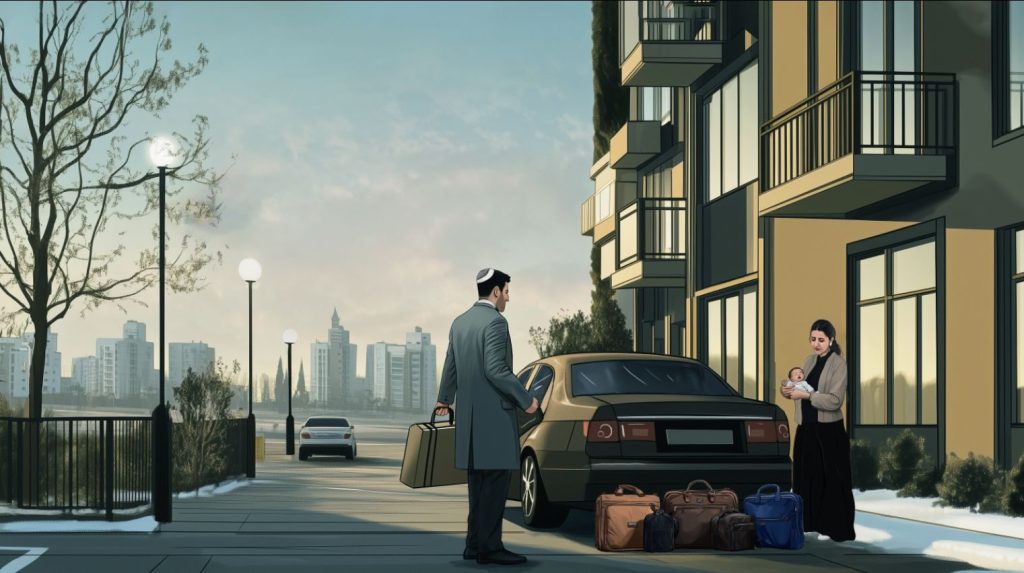
Less than two hours later, Rafi and Shani arrived at the apartment, carrying chickens, kugels, and a few store-bought dips. They rushed to warm up the food on the Shabbos warmer and make sure everything was set in time for Simchas Torah.
In Eretz Yisrael, Shmini Atzeres and Simchas Torah are on the same day – and that year, it was also on Shabbos. So warming up the food wasn’t as easy as a regular Yom Tov.
Rafi sighed as he looked around. This wasn’t the Yom Tov he had pictured. They were newly married, and he was excited for Shani and their new baby to spend time with his family. And if not with family, he’d hoped they could at least be home, surrounded by their friends at their own shul.
As they finished setting up, Rafi let out a tired sigh. “You know, davening and doing hakafos in the Merkaz shul just isn’t what I pictured for Yom Tov.”
Shani looked at him feeling bad. “I know. You were so excited.”
“Exactly,” Rafi said, shaking his head. “And honestly, I don’t have the energy to walk 30 extra minutes each way to our shul, let alone dance! Not after all that running around for food and climbing all those stairs today…”
“So… maybe just daven and do hakafos here in the Merkaz?” Shani suggested gently.
Rafi nodded slowly. “Yeah, I think that’s best. I’m just too wiped for anything else.”
“Rafi, we took on this mitzva willingly,” Shani said, smiling. “Let’s choose to do it happily, too.”
Rafi looked at her, amazed. “Wow, Shani, I didn’t expect you to say that. This has to be hard for you, too. I’m lucky to have a wife who values a mitzva this much, and even encourages me! I thought it would have to be the other way around. You’re a true aishes chayil.”
Shani blushed. Before they could say more, they noticed the clock – it was almost Yom Tov.
“Oh no,” Shani laughed, “we forgot matches!” She brightened up when she saw the gas stove. A minute later, she noticed Rafi tearing toilet paper. Oops – they’d forgotten that, too!
They exchanged a smile and laughed. They were in this for real, and ready to take on Yom Tov together, no matter what!
* * *
The next morning, October 7, Rafi was about to head to shul, when loud sirens blared outside.
Shani looked up, worried. “Rafi, what’s happening?”
Rafi glanced at his phone – it was plugged in but left on, like many people in Israel do in case of emergency alerts. His face grew serious as he read the warnings on the screen: “Terrorists are on the loose. DO NOT GO OUT.” He turned to Shani. “We need to stay inside, Shani.”
Shani hugged their baby tightly. “Do you think we’ll be okay?”
Rafi took a deep breath, trying to stay calm. “I don’t know how serious this is, but let’s lock the door and stay as quiet as possible.”
They spent the entire day in the small apartment together, listening for any sounds outside. Hours passed in silence until, finally, the “all clear” message arrived.
As they made their way home, Rafi and Shani were met with heartbreaking news. Many friends and neighbors had been hurt, and some of them hadn’t survived.
But there were also miracles.
On their way, they ran into Chaim, who looked shaken. “Rafi! Shani! Thank Hashem you’re safe,” he said, hugging them. “I have to tell you something incredible.”
“What happened?” Shani asked, holding her breath.
“When the terrorists broke into our neighborhood, they came to our door,” Chaim began. “We bolted it shut and stayed completely silent. The kids knew not to make a sound. The terrorists tried to break in, but they saw we had a strong lock, and because it was so quiet, they left.”
Rafi looked stunned. “But… What about our apartment…?”
Chaim nodded. “They moved on to your door next. Since your lock was easier to break, they got in and threw things around, looking for people… but they didn’t find anyone. My brother was with me, so they just left and continued on.”
Rafi’s face turned white. “So if we had been there…”
Shani’s eyes filled with tears. “We could have been in danger. But because we left, there was no one for them to find.”
Chaim shook his head in amazement. “And to think – it was all because you decided to give up your apartment for the mitzva of hachnasas orchim.”
Later that evening, Rafi turned to Shani, still in shock. “Shani, I can’t believe it. Because we went out of our way to do a mitzva, Hashem protected us. He saved our lives!”
Shani wiped her tears. “We went above and beyond what felt comfortable, and the zechus of that mitzva… it saved us.”
* * *
Rafi planned to spend Yom Tov with his parents, but when those plans changed, he and his wife had a choice. They could have canceled on their guests, but instead, they chose the harder thing – welcoming them in, even though it took a lot of extra effort. Hachnasas Orchim, or welcoming guests, isn’t just about letting people in; it’s about making them feel comfortable and cared for. Sometimes that means sharing our favorite things or giving up our own space. We might think, “Couldn’t they stay somewhere else?” But Rafi and his wife decided to go the extra mile.
Welcoming guests is a way we can “act like Hashem.” The Gemara says, “Just as Hashem is kind, you should be kind too.” Avrohom showed us this mitzva by running to greet strangers and offering them food and water, even though he didn’t know them at all. He treated them like royalty!
Avrohom was in the middle of talking to Hashem – why would he stop for strangers? Because Hashem wants us to be kind to others, just like He is. Hashem provided food for the Jewish people in the desert, and we can follow His example by going out of our way to help others. The Gemara tells us that Hachnasas Orchim brings blessings in this world and the next – and for this couple, it even saved their lives.
Adapted with permission from 102 Stories, Vol. 3 by Rabbi Tzvi Nakkar. Rabbi Nakkar informed us that his source was the Hebrew newsletter Metikut Ha’emunah (printed in Israel), but he had no further information regarding the individuals in the original story.
Beis Moshiach #1434 • pp. 58-62
© 2026 Beis Moshiach Magazine. All rights reserved.
This article originally appeared in Beis Moshiach #1434. You are welcome to share it with friends and family by email or in print, provided that you do not change, add to or omit any part of it, you credit the author and Beis Moshiach, and you include a link to archive.bmoshiach.org (written out in full in printed copies).
To republish this article in a newspaper, magazine, book or website, please request permission in advance at [email protected].