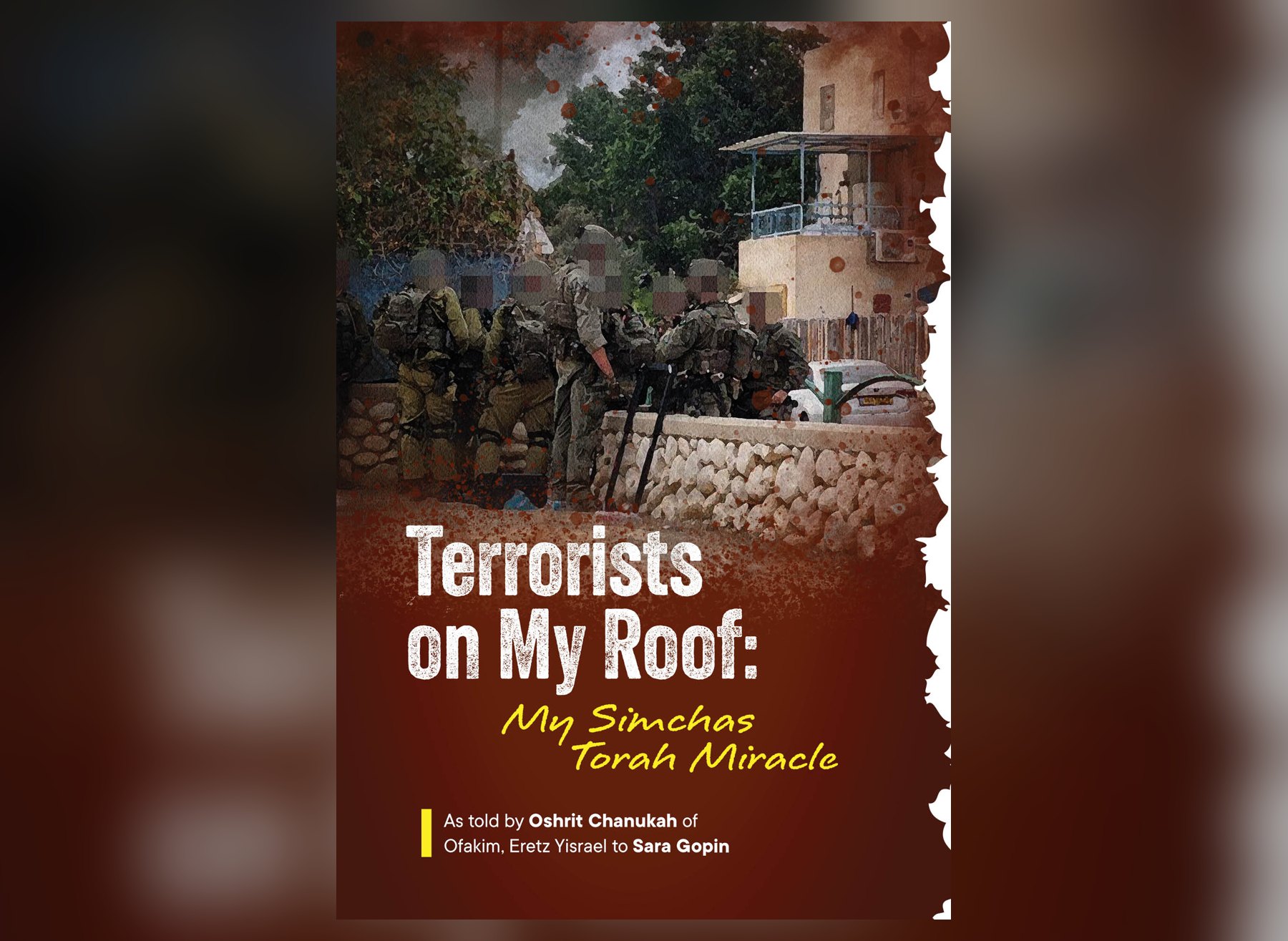
Terrorists on My Roof: My Simchas Torah Miracle
There are many deeper meanings to the mitzva to “choose life” in parshas Nitzavim (30:19). The simplest interpretation is to choose to live and not to die, ch”v. On October 7th many thousands of our brothers had to fight, with their own hands, to save their lives. Recently I was at an event in which Oshrit Chanukah told her miraculous story of how she and her husband Shai fought to survive as a terrorist was on their rooftop, ready to throw a hand grenade into their home.
“We live in the entrance to Ofakim, near the police station and Magen Dovid Adom, Israel’s national emergency service,” Oshrit opens our interview. “Since we are close to Gaza, we are familiar with the harsh reality of missile attacks. But immediately afterwards the IDF always took control and life returned to ‘normal.’ That’s what I was sure would happen this past Simchas Torah. But it didn’t…”
Hashem Made Me Invisible
“At six-thirty am there was a barrage of missiles. My husband and I, and three of our four children, ages eight, ten and fourteen, ran into our safe room. We remained inside for about three hours, as the alarming sounds of sirens and gunfire incessantly pierced the sky. Afterwards there was about half-an-hour of silence.
“I had to go outside to close the gate to our home, but first I wanted to ‘say goodbye’ to our sukka. Looking upwards to the beautiful blue sky, I thanked Hashem for saving us from all the missiles. Suddenly I heard the crashing sounds of a vehicle being driven madly back and forth on my street. I had an urge to leave the yard to see who the crazy driver was but, unexplainably, my legs were ‘glued’ to the ground. When the vehicle passed by once again I saw two figures inside, and one of them looked straight into my eyes. I have no logical explanation for how he didn’t see me, other than that it was a miracle.
“A shiver ran down my spine when later I realized that it was a van full of terrorists who were shooting people in the streets. Had I first closed the gate they would have spotted me too. Their plan was to take over the nearby police station, as was done in Sderot.
“Despite all of the turmoil, we tried to make an atmosphere of Simchas Torah. We davened and made hakafos around the dining room table, holding a miniature sefer Torah. Every time the sirens stopped, we got ready to go to shul, but the missiles continued, and we had to keep running back to the safe room. Yet I still had no idea that a war had broken out.
“At about five o’clock it was quiet again, and my husband and I thought that we could at least manage to get to shul for Tefilas Geshem. After all, the simcha of Tishrei reaches its peak on Simchas Torah!”
A Surrealistic Scene Of Chaos
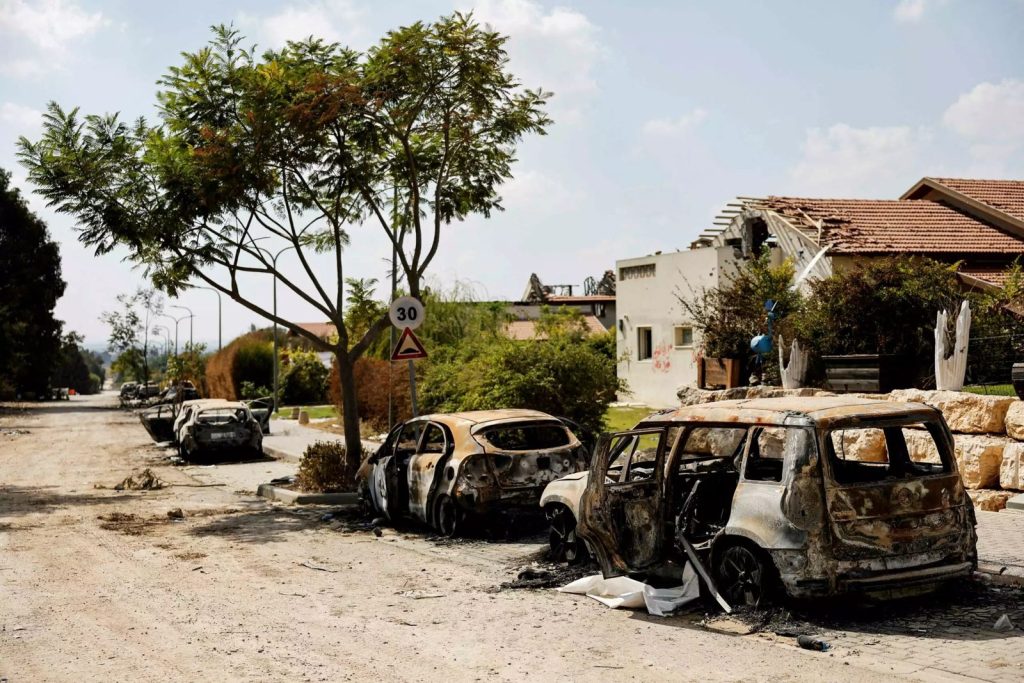
“When I opened the door I saw smoke in the air and there was a burnt smell. I could sense the presence of the Angel of Death,” Oshrit shares. “There were about forty ambulances outside of Magen Dovid Adom with their motors on. Tens of paramedics were running around frantically, as hysterical cries for help blared out from their beepers. It was total chaos. The paramedics seemed shocked to see us walking in the street, still alive.
“After a minute outside my husband and I looked at each other. We were both confused, but it was clear that something terrible was happening. One of the paramedics told us that we must return home immediately because terrorists had infiltrated Ofakim. But I never imagined that it was troops of terrorists!
“We ran home. Hashem protected our souls and spared us from seeing the bodies that were scattered in the streets nearby. An hour later soldiers knocked on our door to check if terrorists had broken into our home and captured us as hostages, which had happened elsewhere in Ofakim. I told them to make sure that there weren’t any terrorists hiding in our backyard. Who could possibly fathom this scenario? It was surrealistic, but it happened in real life.
“On motzoei Simchas Torah, as soon as I opened my cellphone, I saw frantic messages from my family, ‘Oshrit, are you alive?’ This was followed by a flood of phone calls, letting me know the horrific news that hundreds of people had been murdered or taken captive, and that almost all of the nearby yishuvim had been totally destroyed. My emotions froze, and I began functioning on autopilot. I knew that it wasn’t over yet. The worst was yet to come…”
Footsteps On Our Rooftop
“When night falls, fear intensifies, and it was indescribable,” Oshrit continues her story. “Our lives were still in immediate danger, and we had to be quick and quiet, calculating every move we make. We turned out the lights to prevent being seen from outside. My husband and I grabbed the knives and hid them in a towel, to prevent the terrorists from using them as weapons. We kept two knives, just in case we would need them to defend ourselves, and then entered the safe room. But my husband and I had to take turns being on patrol, moving quickly from window to window, carefully scrutinizing anything suspicious outside.
“At about 12:30 am I heard our gate being opened, and then footsteps on our rooftop. Shock waves went through my body as I realized that a terrorist was fiddling around with the lock on the door to our roof, attempting to barge in. It’s a miracle that he didn’t just throw a hand grenade at it to blow it up, which I was later told that he had, and capture us as hostages, or even worse…
“I immediately called the IDF operations unit, who that night had received over 2000 frantic calls for help from all over Ofakim. They promised to come as soon as possible. It took them four-and-a-half minutes, which to me felt longer than forty years in the desert.
“My children had to be prepared. I told them that no matter what noises they’d hear from outside the safe room, they must not open the door, unless it’s for someone they know. My daughter looked at me with tears in her eyes, and I said to her, ‘Now is not the time to cry. Be strong and follow my instructions.’ I kissed each of my children on their forehead, and closed the heavy door to the safe room. A thought went through my mind that I might never see them again…
“With a knife in our hands, my husband and I ran upstairs, prepared for battle. There was no way that we would let anyone harm our children! I kept davening mizmor 23 of Tehillim over and over again. ‘Even though I walk through the valley of the shadow of death, I will fear no evil, because you are with me!’
“Suddenly I heard the motor of a jeep outside and understood that the soldiers had arrived. There was about ten minutes of commotion as the terrorist kept jumping from roof to roof to avoid being captured, and then he managed to escape. It was finally quiet, but we were still terrified. We found out that he was caught three days later in someone else’s backyard.
“We remained in the safe room until Monday night, only going out to bring in some food and go to the bathroom, in fear of what could happen any minute. The next day we quickly packed the bare necessities, having no idea when we’d return home. We quietly dashed into our car, one by one, feeling grave danger every second that we were outside. But we kept saying Tehillim fervently, and the holy words protected us on our way.”
The Scars Of War
After a contemplative pause, Oshrit continues, “It felt like Hashem had lifted up our car up and placed it outside of my mother’s home in Rechovot. She ran to me, hugged me and cried, and I, shocked and terrified, was unable to cry with her… When I calmed down, I looked in the mirror, which I hadn’t done in three days, and was shocked to see the face of an old woman. War leaves scars not only on our souls, but on our bodies too.
“The first week I couldn’t sleep at all, and was still too ‘frozen’ to cry, as if a gigantic rock was stuck inside of me. Three weeks later, on yud-aleph Cheshvan, the yahrtzeit of Rochel Imeinu, my family was watching a livestream tefilla gathering at Kever Rochel. As we recited Tehillim together with the Chief Rabbis, I suddenly burst out crying, like I’ve never cried before, and didn’t stop for months…
“I’m part of a holy nation, that was wounded and is returning to Hashem, the source of life. The amount of tears shed in the past year has overflowed all the oceans. But Hashem ‘will wipe away the tears on all of the faces,’ and ‘fill our mouths with laughter and our tongues with songs of joy.’
“Boruch Hashem, we were able to return home right before Chanuka, which has always been my favorite holiday, perhaps because it’s my last name! Instead of dwelling on the trauma, we were all very busy with mivtzaim, distributing menorahs and jelly donuts, as uplifting music played in the background. Giving to others puts us in a position of strength, and is what heals us.”
When Choosing Life Was No Longer Just A Metaphor
“I’m not the same person after October 7th. I was so innocent, always seeing the good, as evil continued plummeting to unfathomable depths,” Oshrit’s emotions escalate as she concludes.
“Hashem decreed that our family would survive, but why did my husband and I have to be the ones actually fighting to save our lives? The nature of a woman is not to touch weapons, but there was no other choice. Nobody else was there to to protect us and our children. We had to do it all by ourselves!
“Yet, at that fateful moment, I felt a tremendous closeness with Hashem. As if Hashem was telling me, ‘I am giving you life, but I want you to take it. Your life is in your hands, literally. Now’s not the time for you to be passive! You are the soldier who must actively save yourself and your family! Know that you are higher than this life-threatening moment – and able to choose life!
“I’ve also learned an important lesson in Ahavas Yisrael. We should never be judgmental of our fellow Jew, even of those who are leftist, anti-religious, and fight to prevent Torah observance.
“No Jew can ever reach a higher level in shamayim than those who were murdered in the massacre on October 7th. But each of them was holy even beforehand, and should be valued in their life, not ch”v in their death.
“We are a nation that is כולו זכאי – fully worthy of the Geula Shleima and the immediate hisgalus of the Rebbe Melech HaMoshiach! May it be now!”
Beis Moshiach #1432 • pp. 12-15
© 2026 Beis Moshiach Magazine. All rights reserved.
This article originally appeared in Beis Moshiach #1432. You are welcome to share it with friends and family by email or in print, provided that you do not change, add to or omit any part of it, you credit the author and Beis Moshiach, and you include a link to archive.bmoshiach.org (written out in full in printed copies).
To republish this article in a newspaper, magazine, book or website, please request permission in advance at [email protected].