The Mysterious Disappearance of “Yehuda HaKattan”
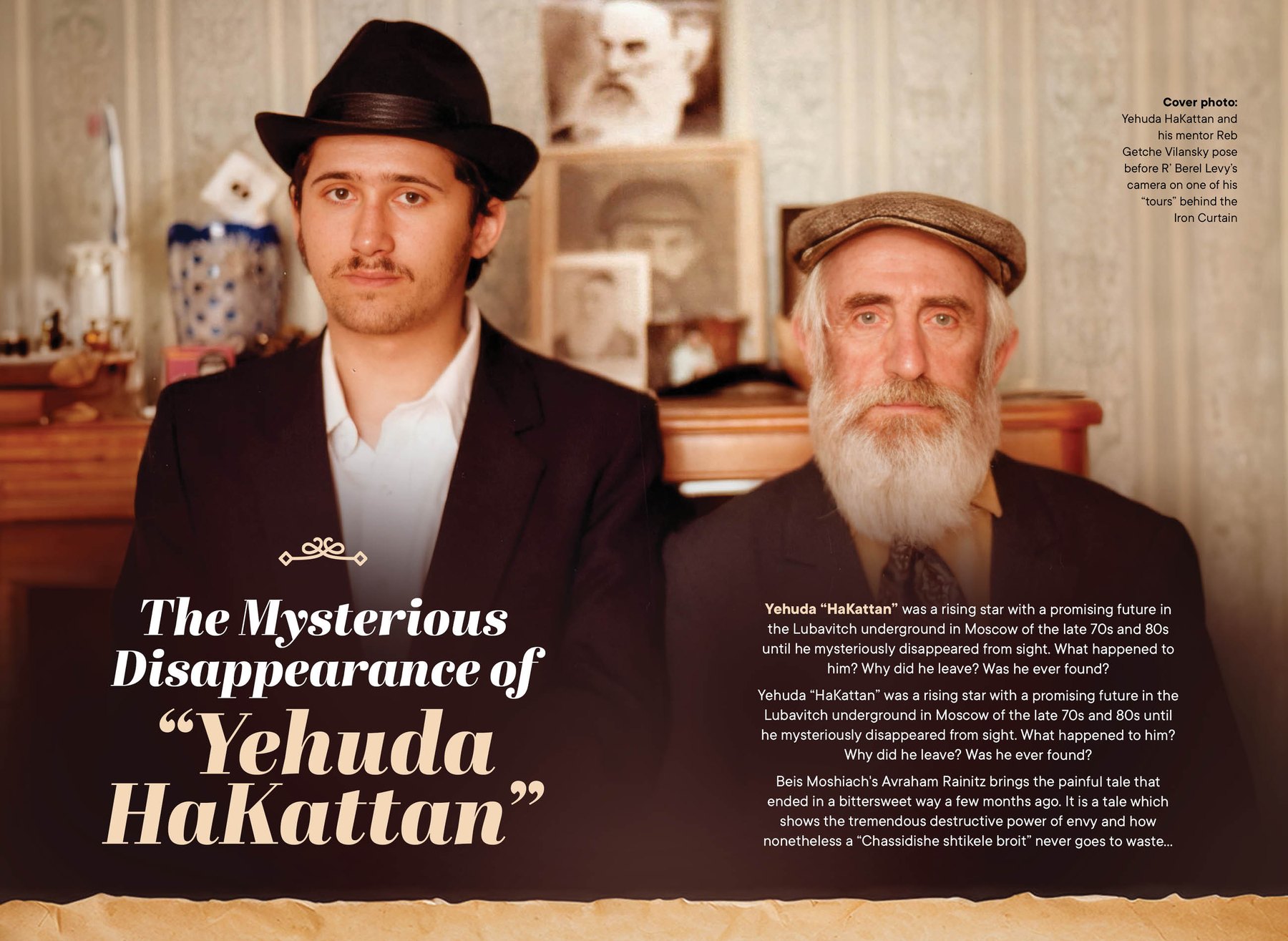
<strong>Yehuda “HaKattan”</strong> was a rising star with a promising future in the Lubavitch underground in Moscow of the late 70s and 80s until he mysteriously disappeared from sight. What happened to him? Why did he leave? Was he ever found? Beis Moshiach’s Avraham Rainitz brings the painful tale that ended in a bittersweet way a few months ago. It is a tale which shows the tremendous destructive power of envy and how nonetheless a “Chassidishe shtikele broit” never goes to waste…
A few years ago, I got a call from my friend, R’ Hillel Zaltzman, author of Samarkand, who wanted to tell me about a strange story that happened to him in the course of his work at Chamah, on behalf of Russian Jewry. This is his story:
One day, at the end of the nineties, an older man came to the offices of Chamah in New York who asked whether we had a job for him. He said he had come from Moscow to live in the United States and until he decided what he wanted to do with himself, he was asking for a job. He showed me letters of recommendation from Rabbi Berel Lazar and Rabbi Pinchas Goldschmidt about his talents and reliability.
Our discussion was in a rich Yiddish, like someone from Lubavitch stock, but he didn’t look religious. Although his story and he himself seemed mysterious to us, I took a liking to him and decided to hire him.
Over time, we became somewhat close and little by little he began telling me about himself. I understood from him that in his youth he had become a baal teshuva and became close with Chabad Chassidim who worked secretly in Soviet Russia. During that time, he learned to speak such a good Yiddish that if you closed your eyes and didn’t see what he looked like, you would be sure he was one of the elder Chabad Chassidim.
Once, my brother Berel came to Crown Heights and met him. After I said he is my brother, he opened up to him. Later on, my brother asked me suspiciously: Who is that man who looks like one of Anash but is unfamiliar to us? As Russians ourselves, we more or less knew Anash in Russia and this man was an enigma to us.
One thing was clear: He was a genius with unusual talents. In one of our conversations, when I mentioned one of Anash in Russia, he blurted out: Ah, the one who lived at such-and-such address, between these streets… When I asked him how he knew that, he smiled and did not answer. When this repeated itself, and it turned out he knew many of Anash in Russia, with their home address and an exact description of the street that they lived on, that was a red flag to us.
One of my friends in the office thought he was a KGB agent, if not currently, then previously. He said that he once read how they prepare spies in Russia; someone who has to go to a certain city is given a map of the streets of the city and he needs to study it until he doesn’t have to ask anyone where a certain address is.
One Big Question Mark
Over time, he provided us with additional details about his life and we learned that he was a member of the elite unit of the Chabad underground in Russia, one of those talented bachurim who was connected with the Chassid, R’ Getche of Moscow. He wasn’t an ordinary mekurav but was actually a ben bayis and dear to R’ Getche like a son.
He once showed me a kuntrus of the writings of R’ Getche where R’ Getche describes one of the members of the Chabad underground in Moscow who was gifted with special talents and extraordinary brilliance. It was a description of him.
We also learned that thanks to his talents he was the contact man between the Chabad underground and the Rebbe. The sichos and maamarim arrived through him and the Rebbe was interested in him and his welfare. He had a photographic memory and every time a maamar or sicha of the Rebbe would arrive, he went over it once in depth and already knew it by heart and could review it for other Chassidim.
I heard all this from him; obviously, not all at once, but in bits and pieces and I put together the pieces of the puzzle. The picture that was formed posed one big question mark. What happened to him? Why was he no longer religious?
A Deep Sigh And Another Deep Sigh
After he worked at Chamah for a while, we had a certain friendship. Sometimes, we went out walking and spent hours talking. I sensed that he was a deeply inward person and something bothered him tremendously. I felt that on the one hand he wanted to talk to me but on the other hand, he was afraid to confide in me. He loved walking with me because he needed to bare his soul to somebody and every so often he revealed a bit about his past but he always revealed just a bit, while concealing much more.
When during our conversations I would try to probe a bit and ask him about his spiritual state, he always responded with a deep sigh and after a few seconds, another deep sigh, and then a thunderous silence. Sometimes, when I insisted on speaking about spiritual matters, it seemed that I touched a very sore point. He would get upset and begin to curse himself in juicy Russian.
I told him: You’re still young and can marry and build a Jewish home. He sighed some deep, heartbreaking sighs and remained silent. At those times, he seemed broken to smithereens inwardly. I felt that he was in the throes of inner despair.
I always tried to help him and he was grateful to me. Several times he said to me: R’ Hillel, I’m someone who knows to be grateful and I will never forget the good you’ve done for me.
A Meeting With The Brother
He once told me about his brother, a very talented person who finished university by the age of sixteen. He climbed the political ladder and not only was he elected a member of the Russian parliament but he was the Speaker of the parliament (the Duma). It seems he thought I didn’t believe what he said about his brother and on one of my visits to Moscow he arranged a meeting for me with this brother.
I remember that when I entered his brother’s office in the parliament building, called the White House in Moscow, I was wary not only of speaking unnecessarily but I was even afraid to think overly much. We had been so frightened of these places where they see and hear everything.
After the official meeting, we had an open conversation outside his office and I was surprised by what he had to say. He spoke to me about strengthening Yiddishkeit in Russia and said that all the various movements wouldn’t strengthen Yiddishkeit; only Jewish education.
During our conversation, I was reminded of a sicha of the Rebbe in which the Rebbe said there were so many Jews in Russia, way more than people were used to thinking there were. Since this was someone who had access to a lot of information, I asked him how many Jews there were in Russia. He astonished me when he said that the government had recently checked and that in Moscow alone there were 1,200,000 people associated with the Jewish people, through one of their parents.
He said that the gap between this and the official numbers comes from the fact that in Russia, when a young man turns sixteen, he can decide his identity and there were Jews from two Jewish parents who wanted to hide their identities and registered as Russians.
The Picture Becomes More Clear
As time passed we learned more, and slowly, all the pieces of the puzzle came together to form a painful picture. The man who worked for us was R’ Yehuda Yuryev who was born in 5721 (the original family name was Greineman) and he became involved with the underground Chabad Chassidim. He later became one of the outstanding activists in spreading Yiddishkeit and Chassidus alongside the leading lights of the Chabad underground. Among the members of the underground he was known as “Yehuda HaKattan,” to differentiate between him and the old Chassid, R’ Yehuda Bartenovsky who was called, “Yehuda HaGadol.”
Although he did not have Jewish chinuch when he was a child, from the moment he began becoming close to Chabad he acquired vast knowledge in Lashon HaKodesh and Yiddish (and expertise in writing in coded language), in learning Gemara with Rashi, Tosafos and meforshim, and he had an enormous knowledge of Chassidus.
In the “mems” (80s), whoever was sent into Russia, whether by the various organizations or by the Rebbe, was welcomed by him and he arranged everything. He was known for his astonishing proficiency in everything going on in 770 and knew the smallest of details about farbrengens, sichos, and various events as though he had been present. This was because of the close and regular contact he had with the Rebbe’s secretaries, with most questions and answers going through him, from the Chassidim to the Rebbe and vice versa, through secret means, to all parts of the Soviet Union.
Additional Details About Yehuda Ha’kattan
We will pause with the recollections of R’ Hillel Zaltzman and tell additional details that came to light recently about the mysterious person called Yehuda HaKattan:
At a farbrengen on 13 Nissan 5742, the Rebbe told the following story:
“I just received happy news, that a few hours ago they spoke (by phone) with Anash in the Soviet Union and found them about to conclude a Chassidishe farbrengen. In response to the question – why a farbrengen now, the answer was that since the time is six to seven hours later than here, at the time they called from here it was already 13 Nissan and they held a farbrengen to mark the yahrtzeit of the Tzemach Tzedek. If this is so beyond the Iron Curtain, we understand how things ought to be here! Therefore, it would be proper to continue this farbrengen now and whoever adds is praiseworthy!”
Those in the know said that the farbrengen the Rebbe referred to was the farbrengen of R’ Yehuda HaKattan with his mentor, R’ Getcha.
Indeed, at the secret farbrengens in Russia, Yehuda HaKattan was one of the main speakers. He would review sichos of the Rebbe by heart and explain them well. He would regularly say, “The main thing is to do the will of the Rebbe shlita, without pshetlach.
Shluchim Report To The Rebbe About Yehuda Ha’kattan
In the archives of Ezras Achim, there are reports of shluchim to Russia in those days who reported to the Rebbe about their shlichus and highlight the activities of Yehuda HaKattan. For example, in a letter of Rabbi Asher Zeilingold (today a shliach and rav in S. Paul, Minnesota), from Tammuz 5743, it says that when he went to R’ Getche’s apartment, he met Yehuda HaKattan there. Zeilingold also described a special Shabbos that he spent in the company of Yehuda and some other Chassidim: “It was a fantastic Shabbos, definitely one of the nicest Shabbosos of my life.”
In a report written by Rabbi Tzvi Yechiel Greenblatt (today, shliach in Argentina) from Shevat 5744, he mentions that Yehuda HaKattan arranged technical things for them too. “In the meantime, Yehuda HaKattan called R’ Getche and told him about our arrival in peace and he immediately came and said l’chaim and I told them how the Rebbe gave us a bottle for our brethren in Russia, in gan eden ha’tachton, and he wanted to know exactly what was said at that time. We decided the immediate order of business, that is that on Friday night we would be with them and there we would daven and discuss sichos of the Rebbe etc. and that Yehuda would remain with R’ Getche (because I pushed strongly that I needed to teach him whatever is possible). Therefore, I asked that in the morning too, there be a shiur and we arranged to go to the house of Uri Kamishov to learn Chassidus and then to daven (as Yehuda HaKattan put it: to daven at length).”
His name is mentioned again and again in reports from those years. In the report of the shliach, Rabbi Yehuda Leib Schapiro (today, rosh yeshiva and mara d’asra in Miami) from Adar II 5744, he writes, “When we came to the hotel it was already late and it wasn’t possible to do anything then. We could see the microphones in every room and of course we didn’t talk about our shlichus. We also heard from Yehuda HaKattan that a woman, a baalas teshuva, who worked in this hotel said she could show the room where they sit and listen to what is said in the rooms.
“We took a taxi and went to R’ Getcha’s house and he was very happy. At first, we gave him regards from Beis Chayeinu and then we spoke about our family etc. Yehuda HaKattan came and after some time of talking to get to know each other we spoke about the situation there. He told us that he was afraid etc. especially after they arrested R’ Moshe Abramov. He told us what happened on Simchas Torah in the shul (I think he was referring to Simchas Torah 5743), how KGB agents came in the middle of hakafos and surrounded the shul and this greatly inspired the people gathered there and they began to loudly sing, “Nyet, Nyet Nikavo” and the police didn’t know what to do. On the one hand, they had nothing to pin their claims on because there were no drunks there and they sang in Russian. On the other hand, it was hakafos etc. and they were sent from their offices etc. and so they wrote down the names of all the participants and those who didn’t have their passports were taken to the police station.
“One of Anash was particularly inspired and he stood up tall and loudly said that until then he had worn his tzitzis inside and from now on, they were coming out. In any case, some of Anash had tzaros from this.”
R’ Schapiro went on to report to the Rebbe about Yehuda HaKattan’s involvement in all details of the shlichus and about his central position in the underground activities:
“We gave over a number of assignments to Yehuda, as well as a list of people who need matzos for Pesach, also those who need tallis and tefillin. We also gave him the medication to give etc. and he informed us of all the plans that he arranged for us. I asked Yehuda to arrange a meeting with us and Essas but at first he said he didn’t think it necessary because Anash had no connection with him, but I explained that we need to be mekarev all Jews and there was great significance in drawing close those called refuseniks and that this is what the Rebbe wants and he finally agreed and called Essas and they made up that on Purim evening we would call him. A few days later, Yehuda told us that he understands the matter and that from then on, when other shluchim would come, it would be part of his plans to arrange a meeting with Essas and his people.”
The Plan To Appoint Yehuda Ha’kattan As Rosh Yeshiva
In the Rebbe’s Igros Kodesh there is a letter to Anash in Russia which includes the following:
“Since they are pressuring and threatening Yuda HaKattan to accept and run their yeshiva in Moscow, 1) if he agrees that in everything pertaining to that, decisions will be made by a board of three (he and Rosenshein and Getche) and he will do nothing on his own; 2) the government will promise in writing not to get involved in matters of yiras shomayim, the curriculum etc.; 3) most importantly, that the talmidim and teachers be completely freed of the army – he should accept the offer. Obviously, it does not pay to publicize at all that this is my suggestion and it should not be revealed except to those who must know.”
We were unable to discover the details behind this offer but whatever it was, we see that this young man was a genius, talented and deserving to be rosh yeshiva, even in the eyes of the Rebbe!
When I recently discovered some letters of Yehuda HaKattan, I couldn’t help but be astounded by his tremendous proficiency in Shas and poskim as well as sichos and maamarim of our Rebbeim, including sichos and maamarim that were said just a few weeks earlier in New York and sent somehow to Moscow. He knew everything, and that which was etched in his memory was easily recalled and came to use even in his ordinary conversation.
In one letter he offhandedly quotes from Shas, Shulchan Aruch and its commentaries and from the teachings of our Rebbeim. It’s all fully integrated into one cohesive whole.
By the way, his letters display a neat, beautiful handwriting. Even the style of his writing is unique, like that of the early Chassidim.
The Destructive Power Of Jealousy
Getting back to R’ Hillel Zaltzman’s story:
After he found out who Yehuda HaKattan was, he was in utter shock. What could cause such a Chassidic young man who was blessed with every lofty quality to abandon it all and go off the derech?
The precise reasons for this aren’t fully clear but from what he researched and uncovered, the following painful picture emerged:
Life under communism created tremendous pressure on the Jewish community. Sometimes, people were unjustly suspected of collaborating with the government and others had to keep their distance in order to protect themselves and their families. The Chassid, R’ Chaim Zalman Kozliner, said about that era that we live in a time that it’s enough for someone to say about someone that it paid to be wary of him or, who knows, he might go “there,” and he would already be banned by everyone.
In this sensitive reality, there was someone who was jealous of Yehuda HaKattan’s abilities. Despite Yehuda’s young age, he was more talented than everyone in the underground. In order to undermine Yehuda HaKattan’s standing, he began spreading rumors that his parents were communists and one should be careful around him. Although at that time, meany people were registered as communists against their will, these rumors were enough for friends to start keeping their distance from him and to keep information from him.
Of course, he sensed a change in their attitude toward him and felt the noose of suspicions growing and tightening around him. Being very sensitive, he was deeply offended and he began staying away from the group, at first physically and then spiritually. Little by little, he cut off ties with the Chabad community and left the religious way of life. This was a huge loss to the community which lost one of its greatest talents.
He left Russia and moved to the United States where he tried to build a new life. However, as will soon see, the Jewish spark in his soul was never completely extinguished. Over these years, the name of Yehuda Yuryev was almost completely forgotten in Chabad circles. Only few remembered the brilliant bachur known as Yehuda HaKattan. But, as often happens in the Chassidic world, the story and memories continued to be recounted.
The Tmimim Discover Yehuda Ha’kattan
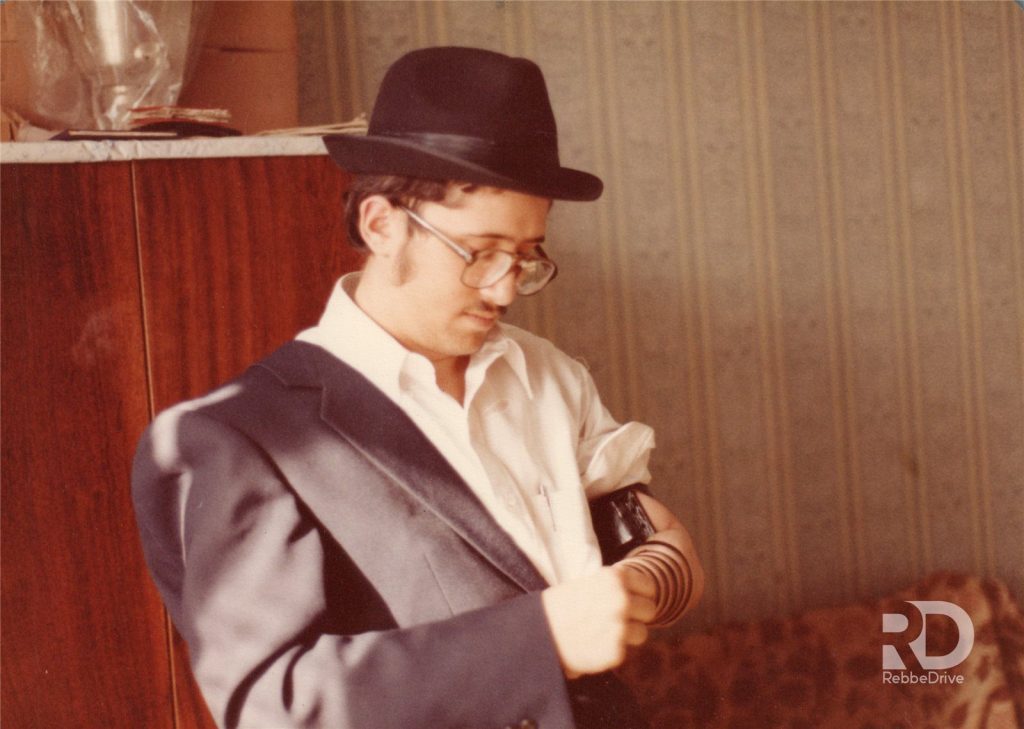
One of the tmimim who worked among Jews from Russia and Ukraine heard the story of Yehuda HaKattan and decided to try and locate him and bring him back to Yiddishkeit. The first obstacle was that everyone remembered him by the nickname “Yehuda HaKattan,” and nobody remembered his original name. He surely wasn’t going by that moniker any longer and had reverted to his Russian name.
One day, he happened to read a memoir account of the Jewish community in Moscow and the name of the gifted young man, Yuri Yuryev, was mentioned. For some reason, he thought this was the man and he asked one of the old-time shluchim who had been one of the group in the community in Moscow and when he said the name, the shliach’s eyes lit up and he affirmed that that was Yehuda HaKattan’s original name.
A brief search on Facebook showed six people by that name. After a process of elimination, one person was left with that name and it seemed to match the profile of Yehuda HaKattan. After comparing his picture from the period of the underground to the picture on Facebook, it was almost certain it was the same person.
They contacted Rabbi Chaim Tzvi Groner, one of the Rebbe’s shluchim to Australia who in his youth had been sent to Moscow and had a strong connection with Yehuda HaKattan – to make the first attempt to break through the wall. He sent a short message which the question: Are you Yehuda HaKattan?
Yuri Yuryev’s answer was sharp and painful: My time in Lubavitch is behind me. I don’t want to remember that time of my life. Please leave me alone, let go of me and that’s it!
‘My Dear Rebbe’
The tmimim were so sorry to see this answer but knew they had their man. They decided to enlist Moshe Kleinberg, one of the tmimim from the Chabad community in Moscow, whose father was a close friend of Yehuda HaKattan and who wasn’t involved in the accusations leveled against him at that time. It worked.
Kleinberg began corresponding electronically with him, asking him to share stories and memories from the period of the underground in Russia, seemingly out of Chassidic curiosity and with no connection to drawing him back to Yiddishkeit. Yehuda HaKattan went along with Kleinberg’s requests and began sending him stories and memories.
It seems that Chassidic memories have power of their own and slowly but surely they peeled away the walls of pain and rejection until Yehuda Yuryev, known as Yehuda HaKattan, decided to come back to Yiddishkeit albeit with small, slow steps.
It was a delicate, moving process. One could sense how the Jewish spark within him was reawakening. In the last two months of his life, Yehuda made a significant move back to Yiddishkeit and began putting on tefillin every day.
“That was a really moving moment,” said one of the tmimim. “Yehuda said that he still had his tefillin from the Soviet Union. He sent them to be checked and began putting them on, with great emotion.” Before that, he was inspired to put up kosher mezuzos in his home.
One of the most moving moments in his return was when he decided to write a pidyon nefesh to the Rebbe. The content of the p’n is private, of course, but he told one of the tmimim that at the beginning of the p’n he wrote this moving line: “My dear Rebbe, whom I left nearly forty years ago; I am moved when I say that I found you again.”
These words, simple but deep, express what Yehuda experienced in his final months. About two weeks before his passing, he met Moshe Kleinberg at the Chabad House where he lived. It was a very special occasion and a sense of closure.
Yehuda Yuryev (HaKattan) passed away on 28 Menachem Av 5784 at the age of 63. His life story is a testament to the power of the Jewish neshama and the complexities of Jewish life under communist rule. But more than anything else, it is the story of the destructive power of jealousy and the importance of genuine Ahavas Yisrael.
The story of Yehuda teaches us an important lesson. It reminds us that every Jew has a divine soul and that it is never too late to do teshuva. Even after decades of estrangement, the Jewish spark can be reignited.
Beis Moshiach #1432 • pp. 16-24
© 2026 Beis Moshiach Magazine. All rights reserved.
This article originally appeared in Beis Moshiach #1432. You are welcome to share it with friends and family by email or in print, provided that you do not change, add to or omit any part of it, you credit the author and Beis Moshiach, and you include a link to archive.bmoshiach.org (written out in full in printed copies).
To republish this article in a newspaper, magazine, book or website, please request permission in advance at [email protected].