The Divine Dreidel
A deep dive into the hidden spiritual significance of the Chanuka dreidel, exploring its profound meaning in p’nimiyus haTorah and its connection to the coming of Moshiach. This feature uncovers the secret meanings behind the letters etched on the dreidel, traces its sacred adoption by holy tzaddikim, and more. We’ll explore the Chabad perspective, including fascinating stories of the Rebbe’s personal interactions with dreidels, and unravel the hints to Moshiach’s name concealed within this seemingly simple Chanuka game. From a forthcoming book on Chabad minhagim by researcher and author Rabbi Zalman Hertzel
The dreidel game is one of the prominent symbols of Chanuka. After lighting the candles, family members sit and enjoy playing with the dreidel, eagerly watching each spin to see how it will fall and which letter will win.
The game, called dreidel in Yiddish, is an ancient and time-honored tradition. Its roots go back to the period of Bayis Sheini during the Chashmonaim era.
In those days, when the Greeks imposed harsh decrees, including the decree “to make them forget Your Torah” – outlawing the study of Torah, fathers and sons would gather to study Torah in hidden places. When the Greeks came to check if they were learning, they would play with the dreidel to cover the fact that they were learning Torah.
This tradition initially spread in Ashkenazi communities and not in Sephardic communities. However, today this custom has spread to all communities, especially in Eretz Yisrael.
Let us explore the dreidel’s path and try to understand its origins.
The Dreidel In Our Time
Why do we play with a dreidel today?
Many reasons have been offered up; here are three of them:
1 – To remember and publicize the miracle – especially during Chanuka, when the concept of “publicizing the miracle” is more emphasized – as through the dreidel game, they were able to study Torah.
2 – Since all the household members should participate in the candle lighting (due to publicizing the miracle), they instituted playing a game, so that children would not fall asleep before candle lighting (considering that sometimes the father returns home later, and additionally, there are countries where Chanuka falls during the long summer days).
3 – So that they would not be distracted from the miracle even while playing. In other words: remembering Hashem’s miracles and expressing gratitude not only during tefilla, when saying Hallel and “Al HaNissim,” not only during Chanuka meals when it is appropriate to say “songs and praises” (and Al HaNissim in Birkas HaMazon), not only during candle lighting, etc., but also during play – in the spirit of “Know Him in all your ways.”
Dreidel Variations
Dreidels are numerous and diverse, made in different shapes and of different materials – from wood, cast lead, to copper and silver.
Cheder children, primarily in European countries, were accustomed to making dreidels for themselves using wooden molds, into which they would create the desired shape and pour molten lead.
The “Bnei Yissachar” wrote: “The children play with a squared piece of wood.” And he explains that the reason is hinted at in the Haftora of parshas Vayigash (read in proximity to Chanuka) “And you, son of man, take one piece of wood.”
Some were accustomed to playing with a dreidel made of gold, and some with a dreidel made of silver. However, in practice, there is no difference in observing the minhag, and all types are suitable.
The Letters On The Dreidel
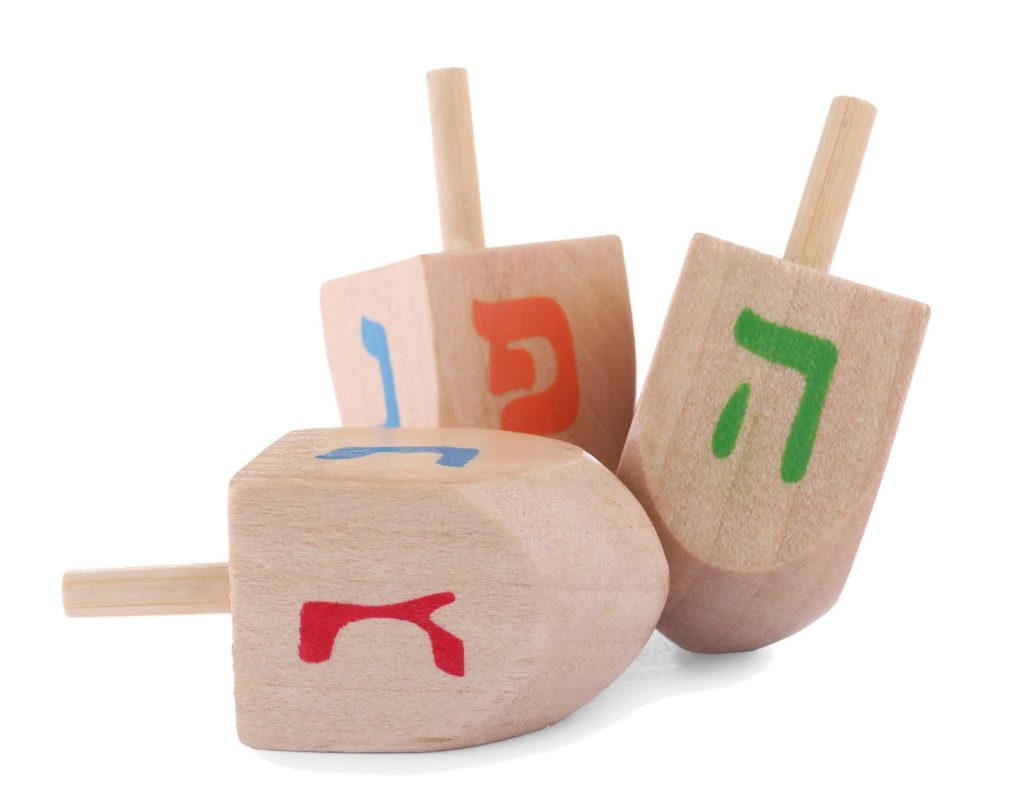
Outside of Eretz Yisrael, they engrave on the dreidel (by carving, etching, or writing) the letters: ג. ש. נ. ה. – which are the initials of the words: “Nes Gadol Haya Sham” (A Great Miracle Happened There).
In another source, it is brought that these letters are also the initials of: “Nasi Gadol Haya Shimon” (A Great Leader Was Shimon), referring to Shimon the Chashmonai.
In the name of Rabbi Pinchas of Koretz, it is brought that נגה”ש in gematria equals Moshiach [= 358]. As he writes in Imrei Pinchas: “All miracles come from the chamber of Moshiach, and also on Chanuka, the light of Moshiach descends, and this is the hint that the four letters in gematria equal Moshiach.”
To further clarify: Chanuka is a holiday that symbolizes redemption – something expressed in the number eight (eight days of Chanuka when lighting an eight-branched menorah). While the number seven symbolizes nature and the ordinary cycle of life (seven days of the week, seven years of the shemitta cycle, holidays that are seven days long like Pesach and Sukkos), the number eight symbolizes what is beyond nature, like the eight days of a bris (a bris is performed on the eighth day because it “draws down” a level that is above nature). Likewise, Chazal say the harp of Moshiach will have eight strings.
The Chanuka miracle that lasted eight days also expresses something beyond nature and alludes to Yemos HaMoshiach.
Interestingly, the dreidel contains inner meaning connected to Moshiach, both in the aforementioned gematriya נגה”ש and in the reason and purpose of the dreidel game in which the “secret of Geula” is hidden:
In many communities, they recite the piyut “Maoz Tzur” during Chanuka candle lighting, which includes the request “Reveal the arm of Your holiness and bring near the endpoint of salvation.”
And the question is asked: Isn’t the time of Geula predetermined, so what does it mean to bring near the end? Rather, since Hashem is all-powerful, He can turn the wheels more quickly. This is what is said “I am the L-rd, in its time, I will hasten it,” as the Gemara explains that there are two times of Geula (the final time “in its time,” and the closer time “I will hasten it”), and Hashem can accelerate the time of “in its time.”
Therefore, on Chanuka, which is the holiday of chinuch as well as a holiday whose essence is preparation for Yemos HaMoshiach, we take a dreidel that has two “points” (two pointed ends on top and bottom), which hints at two types of ends – the end of “in its time” and the end of “I will hasten it” (and on which are engraved the letters נגה”ש which is the gematriya of Moshiach as mentioned), and spin it quickly, to hint and request from Hashem, “and bring near the endpoint of salvation” – accelerate the Geula and bring it immediately.
It is further mentioned that when playing with a dreidel shaped like a “tower,” it is an auspicious time to request the fulfillment of the promise “magdil yeshuos malko” (“He magnifies [from the same root meaning tower] the salvations of His king”), the coming of Moshiach!
As such, we have an additional and more substantive reason for playing dreidel during the days of Chanuka.
In Eretz Yisrael, they engrave the letters: ג. פ. נ. ה. (Hagafen) – which are the initials of the words Nes Gadol Haya Po, (“A Great Miracle Happened Here”), in gematriya: Menachem – which is one of the names of Moshiach.
(Although some claim there is no authoritative source for these initials (with the letter פ), on the other hand, replacing the letter ש with the letter פ is mentioned in several booklets printed by the Kehot Publication Society that the Rebbe saw. In any case, these four letters are the gematriya of Moshiach’s name!)
And here a question arises: What letters were engraved on the dreidel during the time of the Chashmonaim?
After all, during the Greek decrees, before the miracle occurred, they couldn’t publicize that “a great miracle happened there”?
Indeed, it is interesting to note that books mention that even on the dreidels of their time, the letters גשנ”ה were engraved – referring to the land of Goshen where the Jewish people resided during the Egyptian exile. This was to remind and instill in children the recognition that “it already happened in the past” – that there was a situation where the Jewish people were surrounded by forces of impurity, in Egypt, which was the worst of nations, and despite this, Bnei Yisrael dwelt in the land of Goshen and engaged in divine service without being impressed by all the constraints (as it says “and Yehuda he sent before him to Yosef, to prepare before him in Goshen,” and as Rashi explains there “to establish a house of study, etc.”), so too one should not be impressed by the powers of evil and impurity of the Greeks and continue to engage in avodas Hashem.
Therefore, they also engraved on their dreidels at the time (even before the miracle occurred) the letters גשנ”ה!
The Customs Of Tzaddikim
There were gedolei Yisrael who played with the dreidel, at least on one of the nights of Chanuka:
In the book Elef Kosav it is brought: “The holy Rabbi, the Chasam Sofer, observed the minhag Yisrael and played on one of the nights of Chanuka with a silver dreidel that he had.”
In the book Ben Beisi it is written: “I heard from a ‘kosher’ man that the righteous Rabbi Meir of Premishlan would also play with his sons and students during the days of Chanuka with a dreidel.”
In the work Rimzei Elul in the introduction, he writes: “With my own eyes, I saw… the righteous Rabbi Yechezkel Shraga, Av Beis Din of Shinova, who would spin a dreidel during Chanuka in the company of youths, in commemoration of the ancient practice.”
They tell about the holy Rabbi Meir Horowitz of Dzikov, author of the Imrei Noam, who once played dreidel during one of the Chanuka days with his son Rabbi Yehoshua (author of Ateres Yeshua). Each time, the Imrei Noam would say with holy awe: “Now I will win.” And so it was, that every time he said this – he would win the game. During the continuation of the game, his son said, “Look, now I am about to win,” and his father turned pale as chalk. The son understood that there was some loftier matter at play and remarked: “Well, let father win this time as well.” But the Imrei Noam said in pain: “It’s already lost,” and that same year the Imrei Noam ascended to the heavenly academy…
It is further told about the holy Rabbi Yisroel of Ruzhyn that once on the eighth night of Chanuka he saw his Chassidim playing dreidel and said to them: “Play dreidel today, for what is gained on Zos Chanuka is difficult to lose, and the winnings will remain with the victor.”
The Bnei Yissachar said: “When spinning below, it spins above.”
The Rebbe’s References To The Dreidel
In the sicha of Shabbos parshas Vayeishev 5737, the Rebbe said: “Playing with a dreidel and eating latkes, etc. – these are Chanuka customs… in many holy communities in Israel, and minhag Yisrael is Torah” (whatever the explanation of these customs may be).
In the sicha of Yud-Tes Kislev 5742, the Rebbe said: “As is the minhag Yisrael to do special actions (in matters of Yiddishkeit) during Chanuka that are connected with Jewish children… playing with a dreidel, etc.”
In the sicha of the eve of 8 Teves 5747, the Rebbe said: “It is known that ‘[and Yehuda he sent to teach before him] to Goshen [Goshnah]’ are the four letters on the dreidel (roshei teivos of ‘A great miracle happened there’), as is the minhag Yisrael (which is Torah), as was seen in the house of our Rebbeim, and as is known that there are many hints regarding the dreidel and all its details, explained in sefarim about reasons for minhagim.”
In the sicha on Shabbos HaGadol of parshas Tzav 5748, the Rebbe said: “Also on Chanuka, the matter of ‘A great miracle (happened there)’ is emphasized – as is known in the minhag Yisrael to write on the dreidel the letters נ’ ג’ ה’ ש’ (roshei teivos of ‘A great miracle happened there’) – because also on Chanuka, the matter of refining the darkness is especially emphasized.”
In Likutei Sichos volume 12, the Rebbe writes: “Regarding Chanuka, people say about the reason for the custom that on the dreidel are engraved the letters נ’ ג’ ה’ ש’ – because they are the roshei teivos: A great miracle happened there.” Similarly in Likutei Sichos volume 27.
The Rebbe’s aide, R’ Chesed Halberstam, related that during one of the Chanuka meals, the Rebbe turned to his son Aharon Yosef Hy’d and asked: “Do you have a dreidel to play with?” When he answered that he had one at home, the Rebbe took a nickel from his pocket and with a quick motion spun it on the table like a dreidel…
Afterwards, the Rebbe gave the coin to the child and asked him to try doing the same. It is also told that on another occasion, when he had a dreidel, the Rebbe took it and spun it upside-down (with the handle pointing towards the floor).
Around 1956, several children were playing with a dreidel near the Rebbe’s room, including Sholom Yisroel Chodakov and Abba Piekarski. Suddenly the Rebbe arrived from his home, and when he saw the children playing, he took a dime from his pocket, threw it on the floor, and instructed one of the children to spin the dreidel. The dreidel fell on the letter ה (Hei), and the Rebbe asked the children what to do in this case. The children answered that they needed to split the pot in half. Meanwhile, the Rebbe entered his room, the children conducted a lottery among themselves, and Abba Piekarski won the coin.
It is told that once the Rebbe’s brother’s grandson, the son of Rabbi Yisroel Aryeh Leib’s daughter, visited during Chanuka, and the Rebbe played dreidel with him.
During the Rebbe’s visit to France in 5707, he gave a large dreidel to the young daughter of the Butman family.
In 5744, when the editorial staff of The Moshiach Times (published by Tzivos Hashem in the USA) brought the Rebbe the cover of the Kislev issue (which had a drawing of Tzivos Hashem children lighting Chanuka candles), the Rebbe instructed the newspaper’s editorial staff: “It would be worthwhile to add a dreidel shape in the bottom right corner.”
RULES OF THE GAME
When the dreidel falls on the letter נ (Nun), which in Yiddish is the beginning of the word “Nisht” (nothing) – the spinner receives nothing.
When the dreidel falls on the letter ג (Gimmel), which in Yiddish is the beginning of the word “Gantz” (whole, i.e. all) – the spinner receives the entire pot.
When the dreidel falls on the letter ה (Hei), which in Yiddish is the beginning of the word “Halb” (half) – the spinner receives half the pot.
And when the dreidel falls on the letter ש (Shin), which in Yiddish is the beginning of the word “Shtel” (put in) – the spinner must give something to the pot.
What Can We Learn From The Rules Of The Game?
Letter נ – Nes. When the dreidel falls on this letter – one wins nothing, teaching us that “one may not rely on miracles.”
Letter ג – Gadol. One wins the entire pot. Teaching us that only by connecting with a great person in Israel, with the Rebbe, Rosh Bnei Yisrael, and following his instructions, can one truly succeed and gain everything. This is in line with the saying of Chazal: “Anyone who takes counsel from the elders will not fail.”
Letter ה – Haya. When the dreidel falls on this letter, one wins half the pot, because ‘was’ refers to the past. This represents a person who only connects to the past and not to the future. Such a person does not worry about educating and passing the message forward. Essentially, they only care about themselves and do not seek to illuminate the world around them. We must know and instill in our hearts that it is not enough to only remember the past, for the past, despite its great importance, is merely ‘half the work,’ and the work is only completed by passing it on to the next generation.
Letter ש – Sham. ‘There’ indicates Eretz Yisrael. We must always strive to help mosdos of Torah and chessed in our holy land, for this is the true building of Eretz Yisrael, as the Alter Rebbe explains at length in Igeres HaKodesh in Tanya about the great quality of tzedaka in the Land of Israel.
Beis Moshiach #1440 • pp. 18-22
© 2026 Beis Moshiach Magazine. All rights reserved.
This article originally appeared in Beis Moshiach #1440. You are welcome to share it with friends and family by email or in print, provided that you do not change, add to or omit any part of it, you credit the author and Beis Moshiach, and you include a link to archive.bmoshiach.org (written out in full in printed copies).
To republish this article in a newspaper, magazine, book or website, please request permission in advance at [email protected].