Tanya in Court
From the TzaddikStory.org collection
My name is Rabbi Daniel Shahino!
Some time ago, I was the Rabbi for a Sephardi community in Sunrise, Florida, called “The Rashbi Shul”. My journey there began when I was just a bachur. It was the early 2000s, around the year 5762 (2002). I was only supposed to be in Florida for one year, working with a devoted Shliach of the Lubavitcher Rebbe, Rabbi Motty Anati, A”H.
Every Shabbos, I’d walk five miles to help complete the minyan at an interesting little place called The Rashbi Shul. It was just getting started, and often needed an extra person or two for the minyan. When the year ended, I thought my time in Florida was over, too.
But then, something unexpected happened. The people at the Rashbi Shul heard I was leaving, but they didn’t want me to go! They loved that I knew Sephardi chazanus, and asked me to stay and become their rabbi. They even rented a house for me! I wasn’t married yet, and they appreciated me there, so I decided to stay.
I gladly accepted the position. Imagine this: a young rabbi, barely starting out, entrusted with an entire community to lead. Exciting, right?
Three years later… the real story begins.
* * *
When I arrived at The Rashbi Shul, I was shown all the small changes they’d made over the years.
“See this corner?” someone said, pointing to the wall. “We added electricity here, for a menorah.”
“And look over here,” another person added. “We finally put a sink in the kitchen!”
It was clear they’d worked little by little to fix up the shul.
But after three years, I had an idea. “You know what?” I said. “It’s time to fix up the whole shul—all at once. No more small changes. Let’s make it beautiful!”
Everyone got excited. “Really? Do you think we can do it?” someone asked.
“I know it’ll take work,” I said, “and time and money—but if we all help, we can make it happen.”
We didn’t do it the usual way—normally, you need permits, official papers that give people permission to build things, for a big project like this. But we didn’t realize how important it was, and being so eager to go ahead with the project, we didn’t bother getting the permits. Instead, I focused on raising money. Soon, everyone was on board, and the excitement kept growing.
“We’ll have air conditioning on the roof, new tiles, fresh paint…” I told them. “This’ll be a shul we can all be proud of!”
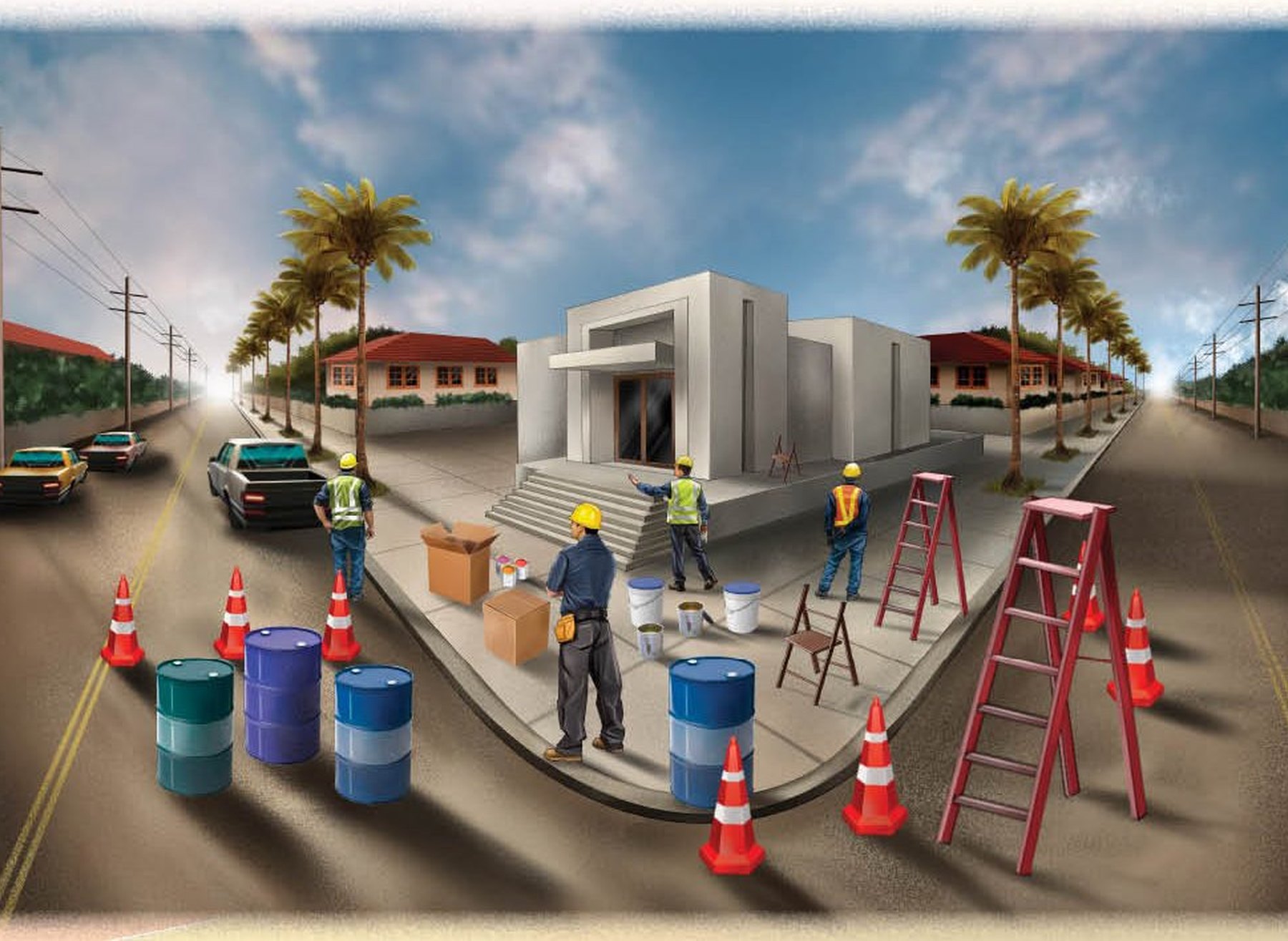
Construction had begun, and the shul quickly became a mess. The sound of hammers and drills filled the air, as workers rolled up old carpets and set up ladders to reach high places. On the roof, they carefully installed a new air conditioner, while on the ground, liquid cement spun in a big machine. Dust floated on the wind, along with the smell of paint and wood.
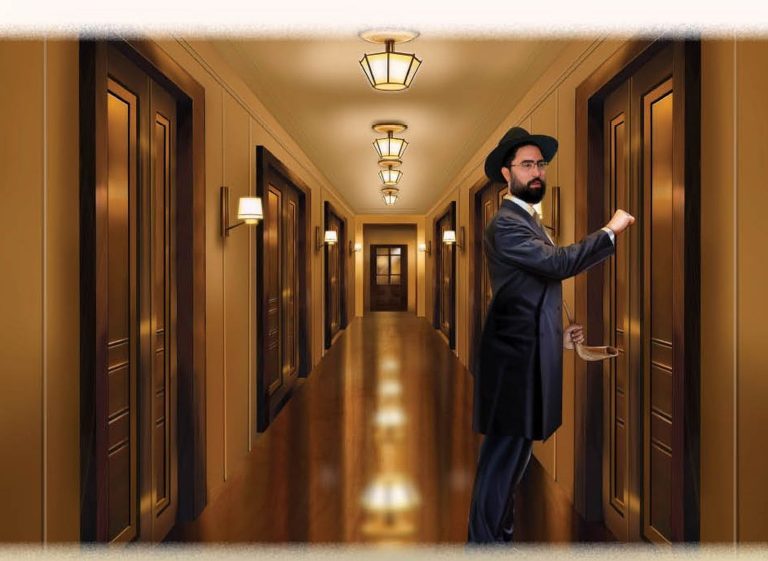
Everything was going according to plan! Until one day, there was a knock at the door.
“Hello,” he said. “I’m an inspector from the State of Florida. I heard there’s construction here, but I don’t see any permits. Move aside, so I can take a look.”
Now, I wasn’t in shul at the time. It was the gabbai who opened the door.
“Can I ask what’s going on over here?” the inspector asked, becoming less and less friendly by the second.
“Eh, umm, eh… ken. I mean, yes,” the gabbai stammered in his broken Hebrew, giving a nervous chuckle. “You see, we’re, uh, painting. And, um, we took down this wall… oh, and maybe the ceiling, too?”
The inspector looked around and spotted a man working on an air conditioner, wires hanging everywhere. His eyes went wide, and he stormed outside, only to see someone on the roof.
“YOU’RE TELLING ME YOU’RE JUST PAINTING, WHEN THERE’S A GUY ON THE ROOF AND WIRES ALL OVER?!” he shouted.
The gabbai tried to explain, his voice shaking. “Well, um, you see… it’s part of the, uh, painting process?”
“PAINTING PROCESS?!” the inspector roared. “WHAT KIND OF PAINTING PUTS PEOPLE ON THE ROOF?! EVERYONE, OUT OF HERE. RIGHT NOW!”
Determined to see what was happening, the inspector climbed the ladder to the roof. But before anyone could say a word, there was a loud zap! He’d touched a live wire. Sparks flew, and he fell to the ground with a heavy thud.
“WHAT IN THE WORLD?!” the inspector shouted, lying on the ground, looking ready to explode with anger.
The gabbai froze, his face pale as a sheet. I ran over as fast as I could. Things were getting worse by the second!
I arrived shortly after, and couldn’t believe my eyes. Around 15 inspectors were in the shul, walking around, pointing at things, and scribbling furiously on their clipboards.
One inspector turned to me and said, “Do you know how many violations I’ve already found? This is unacceptable!”
Another chimed in, “And look at this wiring! It’s a miracle nothing worse happened!”
I tried to explain. “We were just trying to fix up the shul. It’s a place where the whole community comes together—”
The first inspector cut me off. “Exactly! That’s why these fines are so high. This is a public space. Safety rules exist for a reason!”
By the end of it, I was holding a stack of 70 fines, and a bright red sticker was slapped on the door, warning everyone that the building was closed and couldn’t be used.
“This is serious,” another inspector said. “You’ll need to fix everything before this place can reopen.”
I stood there in shock. The fines were huge—more than I ever imagined. I had no idea how we were going to handle this.
I begged in my broken English, “Please, we have nowhere else to go!”
After some back and forth and negotiating, the inspectors allowed us to stay open for another three months while I figured everything out, which was certainly Chasdei Hashem, but I had a big problem on my hands, and I wasn’t sure how to fix it.
“Hashlech al Hashem yehavecha”—a line from the niggun Pada B’Shalom, came to my mind.
“Give your worries to Hashem, and He will take care of you,” I thought. I took a deep breath and decided, Hashem will handle this. I’ll do my best, and He’ll do the rest.
* * *
A short while later, we began getting letters from the inspectors. I don’t recommend this, but I never opened any of them. I was too scared to see what they said, so I decided to trust Hashem and hoped everything would be fine.
But a few months later, someone showed up at the Rashbi Shul.
“Sir,” he said seriously, “you haven’t responded to any of our letters. You’re wanted in court. I’m here to let you know.”
He handed me the court date. I stared at it, my heart racing.
“I don’t understand,” I said. “I can’t read all of this… and my English, it’s not so good.”
He looked at me, a little confused. “You don’t speak English well?”
I nodded, feeling more and more nervous. “And… my Hebrew accent… will make it hard for anyone to understand me.”
He sighed and shook his head. “You’ll need to find someone who can speak for you. You can’t go alone.”
I felt a knot in my stomach. I didn’t know who could help me, but I knew I needed to find someone—quickly.
* * *
I reached out to three ladies in our community who I thought could help. I knew what needed to be said, but I wasn’t sure how to say it the right way.
All the judge needed to hear was that I didn’t know I needed permits. I’m from Israel, and didn’t understand the process. I just needed to explain that we wouldn’t make this mistake again. It seemed simple enough, right?
I also wanted to explain that the shul had been expanded long before I became the Rabbi, so I figured these changes wouldn’t be a big deal, and I was very sorry for this mistake. I hoped if the judge knew this, he wouldn’t be too hard on me.
“Don’t worry, Rabbi,” one of the ladies said on the phone. “We’ll make sure you explain everything clearly. You’ve got this!”
Baruch Hashem, the women all agreed to help us in court, and I felt so much better.
* * *
The night before the court case came much faster than I expected. Knowing I needed to be there at 9:00 am the next morning, I wanted to get a good night’s rest, but on my way to bed, I got a text.
Hi Rabbi, this is Sharona, I’m so sorry, but something came up and I need to fly to Israel. I wish you hatzlacha. Shehakol yihyeh tov — everything should work out fine!
Okay. I thought to myself. No problem. B”H, there are still two others coming with me to court tomorrow. Bez”H, everything will be fine.
But in the morning, I got a call.
“AAAACHEW!” Maya sneezed into the phone. “I’m so sorry, kvod haRav. I can’t come. I’m very sick. Slicha! Please forgive me!”
Okay, fine, I figured. At least one person is still coming to help me out.
But then came another call. It was Maayan.
“Rabbi… I’m really sorry, but I completely forgot about the court case today! I won’t be able to make it.”
“Then I won’t go,” was my first reaction. “I won’t be able to explain myself. There’s no point in going!”
“No, no, no Rabbi,” Ma’ayan said, “You should still go. If you don’t, the shul will be in even more trouble. B’ezrat Hashem, everything will be alright.”
I knew that Maayan was right, but I still felt so hopeless, so lost. I had only five minutes until I knew I had to leave, so in those precious minutes, I decided to write a letter to the Lubavitcher Rebbe.
* * *
Until Moshiach comes and we’ll be able to see the Rebbe physically, many Chabad Chassidim write letters to him, and put them into the Igros Kodesh, the holy books filled with letters the Rebbe once wrote to people. When we open the sefer to the place where our letter lands, we read the Rebbe’s words to someone else, hoping to receive some advice or guidance for ourselves.
So that’s exactly what I did—quickly, in under five minutes. And the letter, of all things, said that my blessing would come from learning Tanya, with deep understanding, true focus, and really grasping the ideas.
I wasn’t sure how this would help with the court situation, but I had no other ideas. I grabbed a Chitas— a book with Chumash, Tehillim, and Tanya all together—and left for court, hoping the Rebbe’s blessing would guide me.
The courthouse was nothing like I expected. There were about 70 people in the waiting area. All of them were in trouble for some reason and were waiting for their turn to see the judge.
One by one, people were called into the judge’s area. They’d spend about 5-10 minutes there, then leave with the judge’s decision, and the next person would be called in.
I sat down, waiting my turn, and immediately pulled out my Chitas, opening to Sefer HaTanya. I focused as hard as I could, translating every word and thinking deeply about its meaning. I was swaying back and forth, studying out loud, completely lost in the book of Tanya. Nothing else mattered—not the court case, not anything—just me and the Alter Rebbe, learning together.
That was, until someone tried to grab my attention. I looked up, surprised to see a lady standing there.
“Excuse me, sir,” she said, “but what are you reading?”
I didn’t have time for small talk. I had a court case to deal with, and I had to learn Tanya! So I answered as quickly as I could, in the best English I could.
“This…. Um… It’s a book about… ghosts.”
I know, I know! As I’m telling you this story, I’m laughing too! I meant to say “souls” (neshamos), but I couldn’t think of the right word in English. So I ended up saying “ghosts!” It was a funny mix-up, but I had no time to explain!
To be continued
Beis Moshiach #1438 • pp. 59-62
© 2026 Beis Moshiach Magazine. All rights reserved.
This article originally appeared in Beis Moshiach #1438. You are welcome to share it with friends and family by email or in print, provided that you do not change, add to or omit any part of it, you credit the author and Beis Moshiach, and you include a link to archive.bmoshiach.org (written out in full in printed copies).
To republish this article in a newspaper, magazine, book or website, please request permission in advance at [email protected].