How the Maggid of Mezeritch Became a Chassid
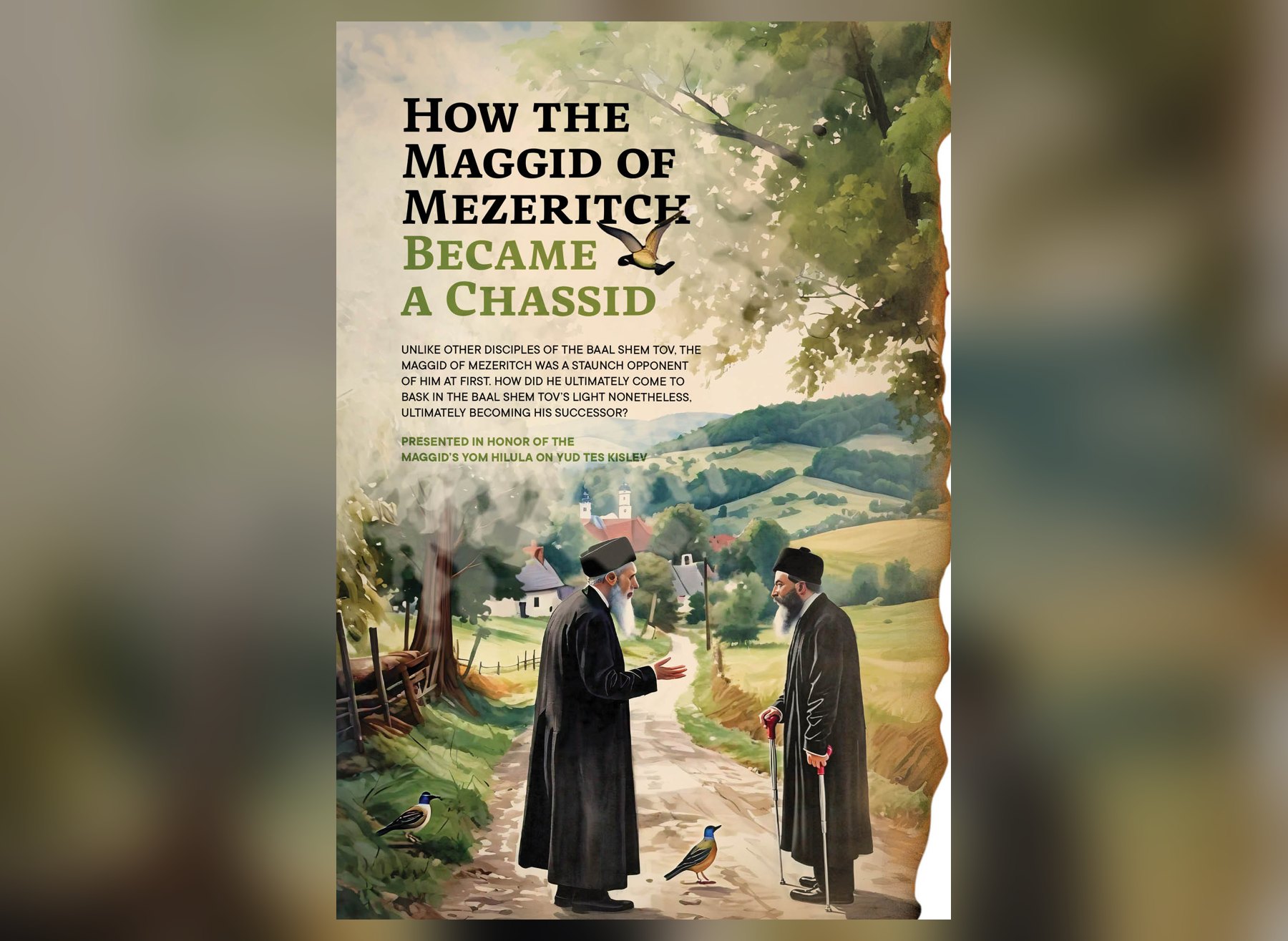
Unlike other disciples of the Baal Shem Tov, the Maggid of Mezeritch was a staunch opponent of him at first. How did he ultimately come to bask in the Baal Shem Tov’s light nonetheless, ultimately becoming his successor? Presented in honor of the Maggid’s yom hilula on Yud Tes Kislev
I
For many years, the Baal Shem Tov longed to take Rabbi Dov Ber, later known as the “Maggid of Mezeritch,” under his wings. The Baal Shem Tov perceived with his holy eyes the great and lofty soul of Rabbi Dov Ber, and he greatly desired to draw to him this student to be the first and foremost of his holy fellowship.
At that time, Rabbi Dov Ber resided in the city of Turczyn.
One day, a distinguished guest arrived in the city – Rabbi Menachem Mendel of Bar, one of the Baal Shem Tov’s prominent disciples. Due to his stature, he was invited to stay at the home of the parnes ha’chodesh [monthly communal leader]. Only a narrow room separated the parnes’ house from the poor and dilapidated home of the Maggid, Rabbi Dov Ber, who sat and taught students with great patience.
In those years, Rabbi Dov Ber would fast from Shabbos to Shabbos, to the point that severe weakness would overcome him. When Rabbi Menachem Mendel met him, he saw before him a weak man, oppressed by suffering.
Rabbi Menachem Mendel was surprised and said with great astonishment: “Rabbi Dov Ber, haven’t you heard that there is a Baal Shem Tov in the world? Your honor should travel to Mezhibuzh, and he will heal you.”
The Maggid smiled a faint smile and responded: “It is better to take refuge in G-d than to trust in man.”
Rabbi Menachem Mendel was not satisfied, and when he arrived in Mezhibuzh to bask in his Rebbe’s presence, he spoke of the Maggid’s praises. “I was in the holy community of Turczyn and saw there a ‘beautiful vessel.’”
The Baal Shem Tov’s face radiated with longing and he said: “Indeed, I saw him already several years ago, and I have a yearning for him to come to me…”
* * *
There are various versions about how the Maggid eventually drew close to the Baal Shem Tov; this is one of them.
II
Somewhere in the town of Lukatch near the city of Rivne in Ukraine, a young child was born to his parents Rabbi Avrohom and Chava, and he was given the name ‘Dov Ber.’
His father, who was descended from the Tanna, Rabbi Yochanan HaSandlar, barely made a living as a melamed of young children.
Already at a young age, brilliant talents were evident in his son, and on the advice of the rav of the town, the boy Dov Ber was sent to study in the great city of Lemberg (Lvov), where he joined the yeshiva of the gaon, Rabbi Yaakov Yehoshua Falk, the author of the “Pnei Yehoshua.”
After marrying his wife Kaila, he began to teach in the city of Mezeritch, and simultaneously began to study Kabbalah, delving into it deeply.
Despite the years that passed, the Maggid and his wife were not blessed with children. More than ten years went by, and his wife urged him to divorce her so that he could have offspring, but the Maggid refused her request.
During those years, the name of the Baal Shem Tov began to spread among Jewish communities in Poland, Belarus, and many other countries. The name of the righteous miracle worker spread from one person to the next, and people would speak of him with great reverence.
However, there were also those who feared this new “miracle worker” who might sweep the people after him. The memory of “Shabsai Zvi” was still fresh in the minds of the generation’s great leaders. Some suspected him, and some belittled this holy man.
The Pnei Yehoshua, was one of the generation’s leaders who decided not to take a stance. He never spoke either for or against the Baal Shem Tov.
However, every time his talmid Rabbi Dov Ber would discuss this new wondrous figure with him, he would speak disparagingly, and the Pnei Yehoshua would listen and remain silent.
III
It was a wintry day when the Pnei Yehoshua was in his yeshiva, engaged in Torah study with his students. His high forehead was furrowed with wrinkles, and his face was flushed with the passion of toiling in Torah. Around him stood promising young scholars, drinking in his words.
In the midst of this, a wagon approached the yeshiva, containing a distinguished-looking man. The wagon stopped near the entrance of the yeshiva, and the anonymous traveler asked the guard standing at the entrance of the study hall to approach the Rosh Yeshiva and tell him to come out for a moment, as he had a secret matter to discuss.
The guard shrugged his shoulders. He knew well that one should not interrupt the Rosh Yeshiva during his studies, but something in the man’s demeanor convinced him. He disappeared into the building and entered the large study hall which was buzzing and roaring with Torah discussions.
The Rosh Yeshiva was impatient. “Tell the man sitting in the wagon,” he whispered back to the yeshiva guard, “that if he wants to tell me something, he should enter the Beis Medrash and wait until the end of the learning session.”
The guard returned to the waiting traveler and relayed the message exactly as it was given.
The anonymous traveler’s face darkened for a moment. He did not give up.
“Again, please tell the Rosh Yeshiva that the matter I have come to discuss is very serious, and that he is causing bittul Torah of the many…”
When the Pnei Yehoshua heard this, he understood that there was something significant at hand, and this was not just idle chatter. He lovingly wrapped the large sefer in his white handkerchief and went out to the waiting wagon.
Without preliminary words or formalities, the traveler began speaking: “Know that the shochet of the town has been feeding non-kosher meat to the townspeople for ten years. After your shiur, send someone after him, and you will immediately see that he will confess.” The anonymous traveler finished his words, and immediately the wagon disappeared down the street, leaving the gaon no opportunity to ask about his identity or actions.
The gaon did not wait for the end of the shiur. The matter was too serious to delay.
Quickly, he summoned the shochet. Not minutes passed before he began interrogating him, and the shochet caved and fully admitted to his disgraceful actions. It turned out that for a long time, he had been feeding the townspeople forbidden meat. The Pnei Yehoshua was shocked to no end. He himself had been witness to open ruach ha’kodesh, like the prophets of Israel in their time…
He contemplated at length, until with his keen insight he felt that this anonymous figure was none other than the Baal Shem Tov himself, who had gone to such lengths to come to his city to inform him to correct the wrong.
IV
Months passed, and again a wagon appeared at the entrance of the great yeshiva of the city rabbi, the Pnei Yehoshua. Again, the anonymous traveler sent the guard to the gaon with a message: someone is waiting in the wagon outside and wishes to speak with you.
This time, the Pnei Yehoshua did not hesitate for a moment and hurried quickly to the wagon. As soon as he got a look, he saw before him the same mysterious person who had revealed the secret actions of the shochet to him months earlier.
As the gaon approached, the traveler did not delay and said: “When the gaon Rabbi Dov Ber comes to you again, tell him that he will not be able to heal his leg without coming to me…” [It was known that the Maggid had a limp in one leg].
The anonymous traveler finished his words, and again the wagon left and soon disappeared down the street, without the traveler adding another word.
The serious face of the Pnei Yehoshua brightened at once. This time he was certain that the anonymous traveler was none other than the holy Baal Shem Tov himself, whose very name caused the earth to tremble.
Weeks or perhaps months passed, and one day Rabbi Dov Ber’s figure appeared at the gaon’s yeshiva in the city of Lemberg.
That very evening, the gaon called Rabbi Dov Ber to his room and, with a serious expression, told him the events exactly as they happened. He added, “Although I know your opinion about the Baal Shem Tov, which you did not hesitate to express repeatedly, my faithful advice is that you should go to him, for this is not an empty matter.”
Rabbi Dov Ber accepted the advice, got up, and traveled to Mezhibuzh, where he met the Baal Shem Tov, and acquired profound secrets from him, and acquired Torah wisdom and secrets that no ear had ever heard before, until he became his most distinguished disciple.
When a year passed, the Maggid returned as was his custom to Lemberg, to the home of his Rebbi the Pnei Yehoshua.
“Nu?” the Pnei Yehoshua asked briefly.
The Maggid opened his mouth with words of praise and glorification of the Baal Shem Tov.
The Pnei Yehoshua’s face broke into a smile.
“And what about all the words you spoke in his disparagement?” he challenged in a scholarly tone.
“As long as I considered him just a man among men – I had arguments and counter-arguments,” the Maggid of Mezeritch responded. “But when I came to him, I realized that he is an angel of G-d, to the point that it is unbelievable that he is born of a human mother, and I am unable to open my mouth against him…”
The Baal Shem Tov knew well that this new student had not been blessed with children, and at that opportunity promised the Maggid that he would still have a great and renowned son.
And indeed, in the year 1741, a son was born to him and his wife, Rabbi Avrohom, known among Chassidim as “Rabbi Avrohom the Malach,” due to his holiness that was like that of an angel.
When the Maggid prepared to return to his city and place, he approached to receive a farewell blessing from the Baal Shem Tov. Afterward, the Baal Shem Tov bowed his head and asked the Maggid to bless him, but he refrained from doing so due to his immense bittul towards the Baal Shem Tov. The Baal Shem Tov therefore took the Maggid’s hands and placed them on his own head. Only then did he consent to bless him.
Beis Moshiach #1439 • pp. 26-29
© 2026 Beis Moshiach Magazine. All rights reserved.
This article originally appeared in Beis Moshiach #1439. You are welcome to share it with friends and family by email or in print, provided that you do not change, add to or omit any part of it, you credit the author and Beis Moshiach, and you include a link to archive.bmoshiach.org (written out in full in printed copies).
To republish this article in a newspaper, magazine, book or website, please request permission in advance at [email protected].