Better Than The Original
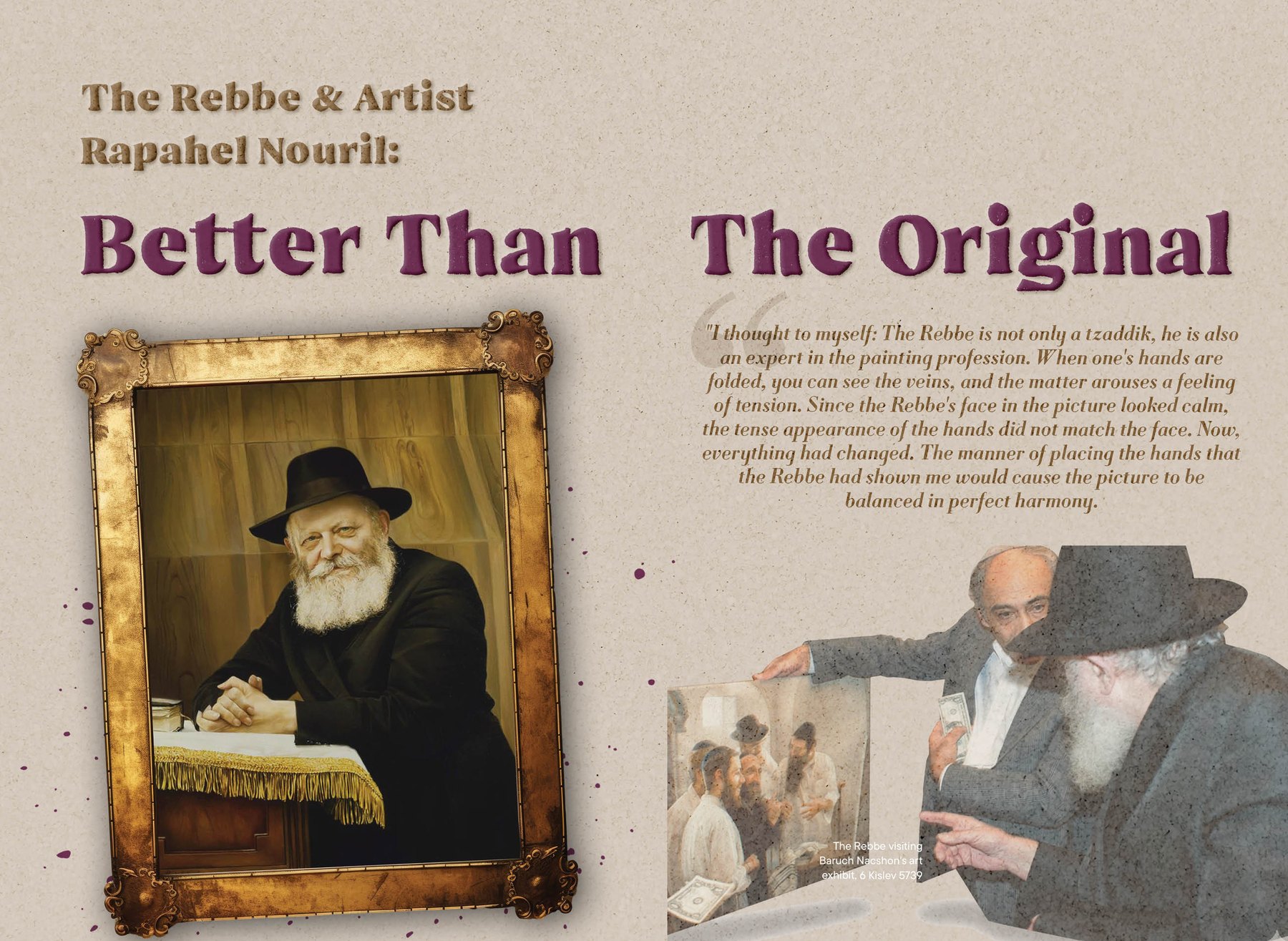
“I thought to myself: The Rebbe is not only a tzaddik, he is also an expert in the painting profession. When one’s hands are folded, you can see the veins, and the matter arouses a feeling of tension. Since the Rebbe’s face in the picture looked calm, the tense appearance of the hands did not match the face. Now, everything had changed. The manner of placing the hands that the Rebbe had shown me would cause the picture to be balanced in perfect harmony.”
The artist Raphael Nouril was a world-renowned painter of Persian descent, who was privileged to paint the Rebbe MH”M’s picture and receive expressions of the Rebbe’s appreciation of the former’s meticulously precise artwork. Raphael was profoundly influenced by the Rebbe’s persona, and he used his talents in spreading Yiddishkeit at the art exhibits he held.
Raphael was born in 5700 in the city of Tabriz, the capital of Iran’s Azerbaijan region, to a family with a warm regard for Jewish tradition, although his family did not conduct a Torah observant lifestyle. His father was a well-known goldsmith who maintained trade and industry connections with the royal family, and he even prepared a crown for the Shah and jewelry for the Empress.
It was there, in the city of Tabriz, that he was trained to be a classic style artist by Reza Samimi, who painted portraits of members of the royal Persian household. During the period when modern art took hold throughout the European continent and the United States, it was still possible to find artists in Iran from the old school who taught the more classic method.
At a certain stage, he traveled to France for a period of time and visited an art school in Paris in order to present his artwork to the people there. While their reactions were extremely positive, their level of expertise was not in the area of artwork he dealt with. Although they were unable to assist him, they suggested that he visit the classic art museums as a means of broadening his professional knowledge and becoming more familiar with the work of the “Old Masters.”
During his visit to Eretz Yisrael in his youth, Raphael met his future wife Esther, and the two married and established their home together. In 5730, after living for some time in Iran, where he opened an art studio, the Nourils emigrated from Iran to the United Kingdom, and from there they relocated to live in France.
Already at the age of eight, he began painting, and over the years, he became an expert in the art of painting and received considerable expressions of appreciation. He made portraits of the family of the Shah of Iran, U.S. Secretary of State Dr. Henry Kissinger, and other prominent personalities.
The Neighbors Showed Concern, And The Bracha Came
“Throughout those years, I did not maintain any connection with traditional Judaism,” Raphael later recalled. “Only when my children had begun growing up a little did I feel the need for some Yiddishkeit, and I started going with them to synagogue on Shabbos. I wanted at least that my eldest son Ronen should know about Judaism. I personally didn’t even know how to read out of a siddur. I would look over my neighbor’s shoulder to know where they were holding in the prayer service.”
Among their new neighbors was the Rutman family, Chabad chassidim who offered much assistance. However, the contrast between the families’ lifestyles left the Nourils a bit impassive.
In the summer of 5739, they were blessed with the birth of a daughter, and they gave her the name Ruth-Laura. The little girl’s development seemed normal and natural. However, after about a year, the parents realized there was something wrong with their daughter: she still hadn’t uttered a word. Sometimes, she merely let loose with a kind of single-syllable yell, but no more than that.
While other girls her age already had a huge treasure trove of first words, Laura seemed to be taking her time. The doctor who thoroughly examined her reassured the parents that there was no medical evidence of any problem. The child’s delay in speaking was still deemed as normal and no cause for concern. Raphael and Esther listened, however, a sense of worry continued to nestle in their hearts.
When Laura reached age two, their concerns grew stronger. She still didn’t speak. The only sounds she made were screams of fears and anxiety when something startled her. The parents kept convincing themselves that this mysterious problem would eventually work itself out. However, Raphael often found his wife alongside their daughter’s bed, tears welling in her eyes.
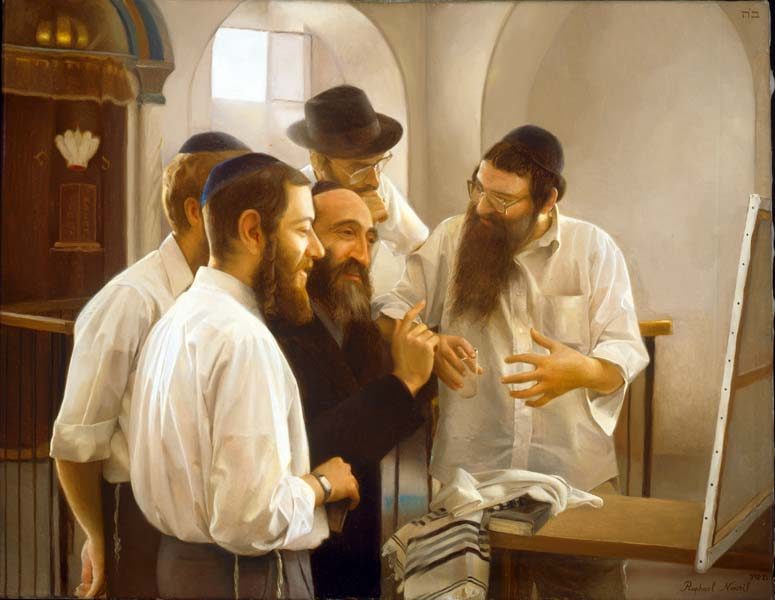
At a certain stage, Laura developed some difficult fears. Strange voices and unfamiliar people caused her to cling to her parents in terror. At night, she was consumed by bad dreams. She would cry hysterically, and no one was able to calm her down.
By the time Laura turned four years old, the situation only worsened. Her nightmares even deprived Esther of sleep. Laura continued with a variety of frightful screams, and as a result of the tremendous physical exertion, it caused some internal damage. The family doctor determined that an operation should be arranged as soon as possible before the child’s condition grew more complicated.
Their neighbor, Mrs. Rutman, who was aware of the family’s distress, hesitated whether to approach them with an offer of help, in light of their reservations about becoming Torah observant. At this point, she did decide to approach them. The parents, as if they were just waiting for an attentive ear, spoke with her about their tremendous fears leading up to the operation due to occur in another couple of days.
Mrs. Rutman proceeded to give them a practical suggestion: ask for a bracha from the Lubavitcher Rebbe. “I believe with the utmost certainty that the Rebbe’s blessing will help you,” she said as she told Raphael and Esther about the greatness of the Rebbe and his love for every Jew. The frustrated parents agreed that Mrs. Rutman should place a telephone call to the Rebbe’s office and ask for his blessing in their name, and with that the conversation ended.
On the morning of the operation, an answer was received from the Rebbe’s secretaries as follows: “Blessing and success, and a complete recovery in other matters as well.” Mrs. Rutman transmitted the text of the answer to the parents, who thanked her profusely as they quickly made their way to the hospital.
As expected, Laura was quite hysterical by the sight of an unfamiliar environment, and she only calmed down once they gave her a strong sedative. To the joy and relief of the parents, the operation was brief, quick, and successful, and they even had a surprise waiting for them that changed everything: the recovering Laura was in a state of deep and peaceful slumber, as if she hadn’t slept for a very long time.
When she opened her eyes, they could see a smile in the corner of her mouth. However, the biggest wonder took place when she woke up a second time: she began to sing the melody of “Adon Olam” with the words!… The parents stood dumbstruck. These were the first significant syllables that Laura had ever uttered.
In the days that followed, Laura exhibited no signs of pain. Her fears had completely vanished, and she even began talking and quickly closed the educational gap between herself and other girls her age. It was impossible not to attribute this to the Rebbe’s bracha. The matter caused Raphael and Esther to strengthen their connection with the Rutman family and inquire more into traditional religious Jewish subjects.
“I Never Drew A Picture Of A Holy Man Before”
As was previously stated, Raphael was an expert artist. At a certain stage, he came to the decision to draw the Rebbe’s likeness as a means of expressing thanks. “When a person loves someone, he wants to express this in a manner unique to him, and accordingly, when an artist loves something, he draws its picture. Thus, I wanted to draw a picture of the Rebbe,” he stated quite simply.
Painting portraits was his specialty, and therefore, he was surprised by the fact that for some inexplicable reason, he felt a great difficulty in expressing the Rebbe through a portrait. “It was a difficult decision, because I needed to relate to him. When I paint someone, I don’t just portray their resemblance; I need to convey their character and feelings.
“Although I had previously painted many well-known personalities, including the Shah of Iran and even Dr. Kissinger, the portrait that required the greatest effort on my part was – l’havdil – specifically the Rebbe. I had never painted a holy man before. I always approached my subjects by trying to get to know them, but how could I connect to a holy man and get to know him up close?
“It’s not too difficult to paint a non-Jewish king. While he can be a good man or a bad man, he’s not connected to a level of spirituality. You can speak with him and understand him like any other person. However, a true portrait must express not only a person’s external facial features, but also – and perhaps most importantly – the inner essence of his soul. If you don’t feel an understanding and connection to the person’s essence, you can’t draw his portrait. When I wanted to draw the Rebbe, I discovered that he was too spiritual for me.
“I felt distant on a number of levels. Besides being thousands of miles away from the Rebbe physically, as a secular person, I didn’t feel like I could relate to him on a personal level either. I had to remedy this by becoming closer, both physically as well as spiritually. I realized that if I want to succeed in painting the Rebbe’s portrait, I had no alternative other than to try and start walking a little in his path and getting a little closer to his mode of conduct.
“To begin with, because the Rebbe was in New York and I was in London, I started watching videos of him, and borrowed some photographs from Mr. Gedalya Rutman, my neighbor. But that was not enough. In my quest to get closer to him, I turned to a Chabad yeshiva bachur from Paris who studied in London, one of those who came to my house on a number of occasions, and he suggested that I put on tefillin. Until then, I hadn’t agreed, but now I wanted him to teach me how, and I davened as much as I could from Krias Shema, and I even began keeping Shabbos and the holidays.
“After two months of living a stringent observant life, I felt I was ready to begin painting the Rebbe. I affixed a huge empty canvas and then sat in front of it, breaking my head on how to draw the Rebbe’s image. Since at the time, I had yet to see the Rebbe face-to-face, I had to use photographs from a variety of angles in order to find his proper likeness. Eventually, I felt that I was ready for this task and I began sketching the Rebbe’s portrait.
“When painting in the past, I would often sketch and erase the outline many times before being satisfied; I’d rub out what I had done and start all over – sometimes two or three times. But in this case, I never rubbed out anything – not even once! I felt as if a force was conducting my hand to the destination of every single line. I began with the Rebbe’s eyes, painting them on blank canvas and then, with his eyes looking at me, I moved forward to paint the face and the rest.”
With The Rebbe’s Portrait Facing The ‘Original’
“When I nearly finished the painting, I traveled with Gedalya Rutman and my family to see and speak to the Rebbe and complete the final touches of the painting.
“I wanted very much to meet the Rebbe and speak with him in order to show him the picture before carrying out its final stages. However, in 1984 [5744], the Rebbe was no longer granting private audiences and, when I arrived at Chabad Headquarters, I was told to leave the painting with his secretary and that it would be shown to the Rebbe later.
“This I could not do because I had come all the way to meet the Rebbe in person. So, instead, I waited outside, the portrait covered with a cloth, hoping to unveil it when the Rebbe arrived there.”
It was the morning of Yud-Gimmel Tammuz 5744, and Raphael waited for the Rebbe and the moment when he would come to 770, as he personally recalled some time later:
“As the Rebbe exited his car, my wife took the cloth off the portrait, and the Rebbe was immediately drawn to it. The Rebbe glanced at the picture, and even before I had managed to introduce myself and explain that I had come to ask his opinion, he had already noticed all the fine nuances in the picture,” he recalled with much excitement.
“Without any prompting, the Rebbe first spoke about the hands. I had drawn them as they had appeared in the picture I had used as my basis. In that picture, the fingers of the two hands looked intertwined. However, the Rebbe noted to me about this: ‘The hands like this are prohibited … they should be like this.’ And the Rebbe put his right hand over his left to demonstrate.
“My error stemmed from the fact that the picture had been photographed in the middle of a hand motion by the Rebbe, and therefore, I had painted the Rebbe’s hands with his fingers intertwined with one another, something that I later found out is problematic. I then asked the Rebbe: ‘Should I change the hands in the portrait?’ The Rebbe replied in the affirmative.
“I thought to myself: The Rebbe is not only a tzaddik, he is also an expert in the painting profession. When one’s hands are folded, you can see the veins, and the matter arouses a feeling of tension. Since the Rebbe’s face in the picture looked calm, the tense appearance of the hands did not match the face. Now, everything had changed. The manner of placing the hands that the Rebbe had shown me would cause the picture to be balanced in perfect harmony.
“When the Rebbe finished speaking, I told him that I would do as he advised. I then asked the Rebbe to comment on the face and then he looked at the face and replied, ‘Very good’ – he said three times. And then he added, with a smile on his face, ‘Better than the original, better than the original.’ I was greatly moved. I said with much enthusiasm, ‘Thank you, Rabbi.’ My excitement grew, and I kissed his hand and again said, ‘Thank you very much…” The Rebbe shook my hand and said in parting: ‘Besuros tovos’ [Good news].
“When I returned home, I erased the portion of the hands using a special acid, and started to paint the hands all over again. When I was done, I sent a photo to the Rebbe’s office and then printed 358 limited edition lithographs of the original. The reason I printed 358 is because that is the numerical value of the word Moshiach, a topic the Rebbe was so passionate about. I numbered and signed each of them and gave the final one to the Rebbe.”
A Painting With A Unique Sense Of Personal Fulfillment
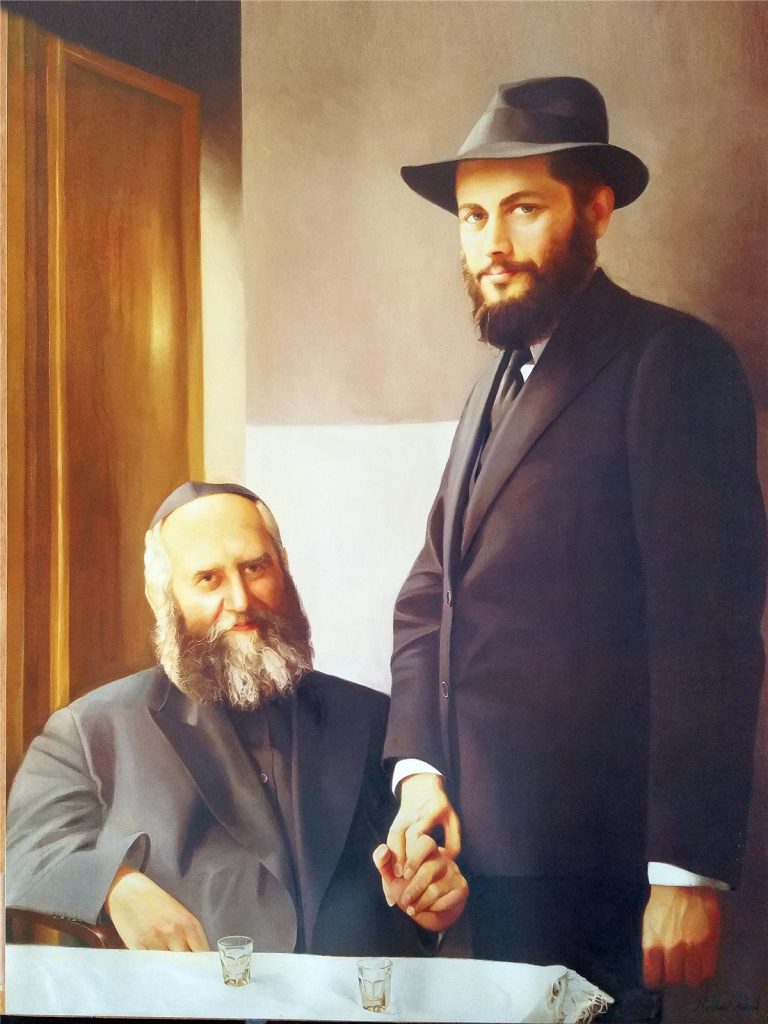
“This whole experience brought me closer to the Lubavitch community in London. In the process, I learned more about the Rebbe, especially that he was very tightly connected to his father-in-law, the Previous Rebbe. So, I decided to paint them together.
“After a long search, I found a very small, very faded photograph – which you had to view with a magnifying glass – of the two of them together. This photograph was taken shortly after the Rebbe’s marriage to the Previous Rebbe’s daughter. He was very young in that photo and the Previous Rebbe was holding his hand in a touching way. I decided to reproduce this photo as a life-size painting.
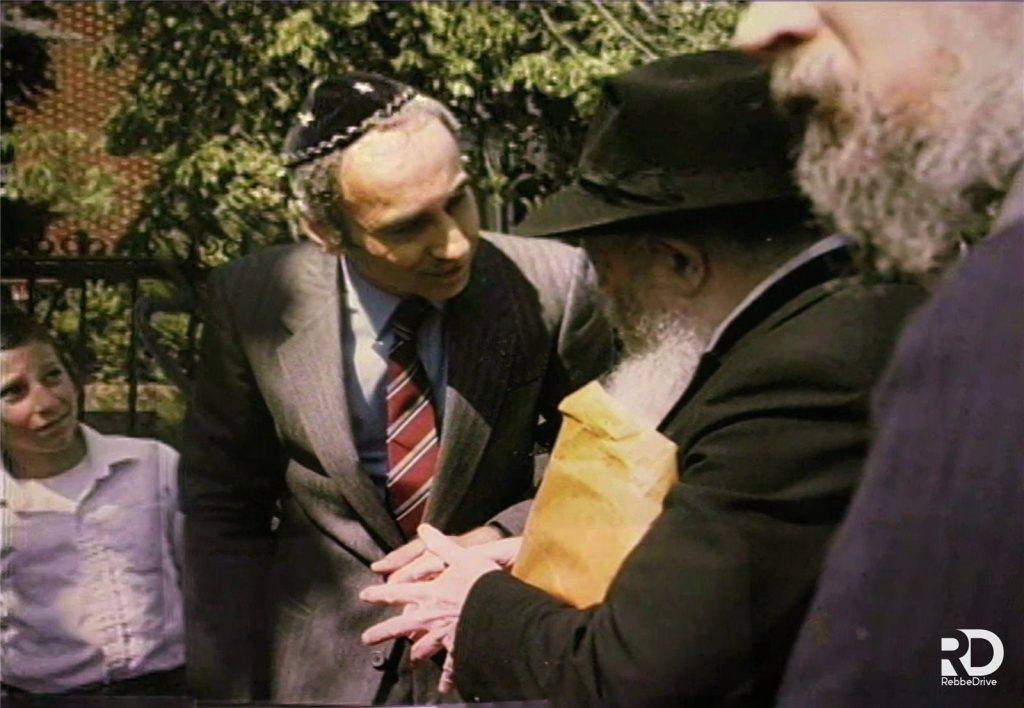
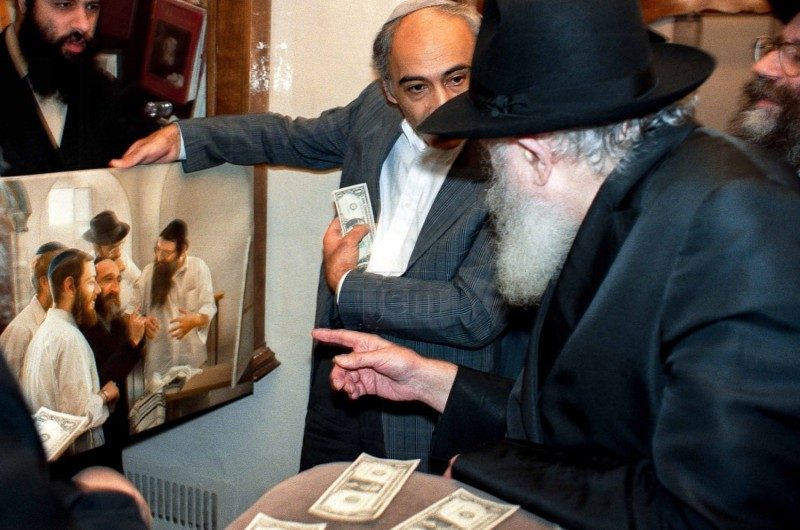
“It took me a year to finish it, and I brought it to New York to show to the Rebbe in 1988, the year his wife passed away. When I unveiled it for him, he was clearly very thrilled with it. ‘Spasiba,’ he said, which is Russian for ‘Thank you,’ and then he switched to English, saying, ‘Thank you very much for showing it to me. This painting should be a good start for you to double your efforts and spread Judaism through your works of art, together with your wife.’
“Then he gave me and my family many blessings for success and several dollars to pass on to charity. As I was walking away, he called me back and raised his hands upwards, saying, ‘Don’t forget about growing … up, up, up!’
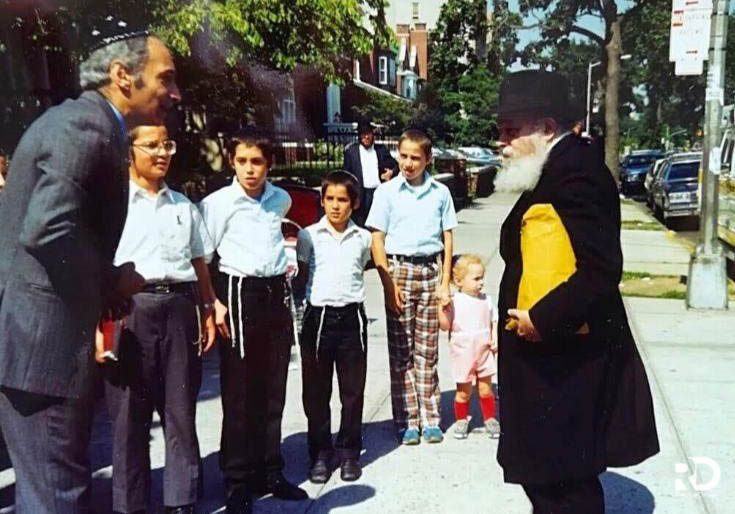
“From that moment, unusual things started happening with my paintings. They became vehicles for many people returning to Judaism, which just goes to show how a blessing of a holy man can influence the world.
“From among many examples, this is just one story I would like to relate:
“One day I happened to be in Florida, and I stopped at a gallery in Bal Harbour. I began talking with the owner, an old man. He was Jewish but refused to have anything to do with Judaism since suffering terrible tragedies in his family. Then I pulled out my portfolio, and he was immediately taken by my portrait of the Rebbe. So much so, that he bought a lithograph from me and put it in the window of his gallery.
“I had occasion to check up on him some time after and learned that he had spent $500 framing the portrait and that he refused to sell it. Because he had it in his gallery window, Chabad boys started coming around and helping him put on tefillin. He had become religious at seventy-five!
“When I heard that, I remembered what the Rebbe said to me, ‘Spread Judaism with your works of art,’ and, because of his blessing, it happened – it automatically happened!
“From my standpoint, the greatest directive that I received from the Rebbe was not to stop for a moment and keep moving forward,” Raphael said.
As the years passed, he eventually moved to live in London near the local Chabad yeshiva, and he began to harness his talents for spreading Yiddishkeit through his artistic drawings, which he displayed at his various art exhibits.
Raphael Nouril then concluded his description of his life-story: “When the Rebbe blessed us with a ‘complete recovery’ on all matters as well, the Rebbe not only meant my daughter’s physical recovery, but also the spiritual welfare of all of us…”
* * *
Raphael Nouril passed away of the nineteenth of Sivan 5780 at the age of eighty, and he was interred in the Mt. of Olives cemetery in Yerushalayim.
Beis Moshiach #1495B • pp. 18-26
© 2026 Beis Moshiach Magazine. All rights reserved.
This article originally appeared in Beis Moshiach #1495B. You are welcome to share it with friends and family by email or in print, provided that you do not change, add to or omit any part of it, you credit the author and Beis Moshiach, and you include a link to archive.bmoshiach.org (written out in full in printed copies).
To republish this article in a newspaper, magazine, book or website, please request permission in advance at [email protected].