Excavators of Light
From the TzaddikStory.org collection
My name is Rabbi Shalom Bakshi, but I’m happy just to be known as the Lubavitcher Rebbe’s shliach in Woodbridge, Ontario, a town near Toronto, Canada. Besides my regular shlichus, I also like to visit the new hospital nearby in Vaughan. I’m here to tell you a special Chanuka story!
The hospital opened a few years ago during COVID, when many people were sick, but back then, it wasn’t fully open to the public. Recently, they’ve opened it up for everyone who needs it, and they let me visit Yidden there all the time.
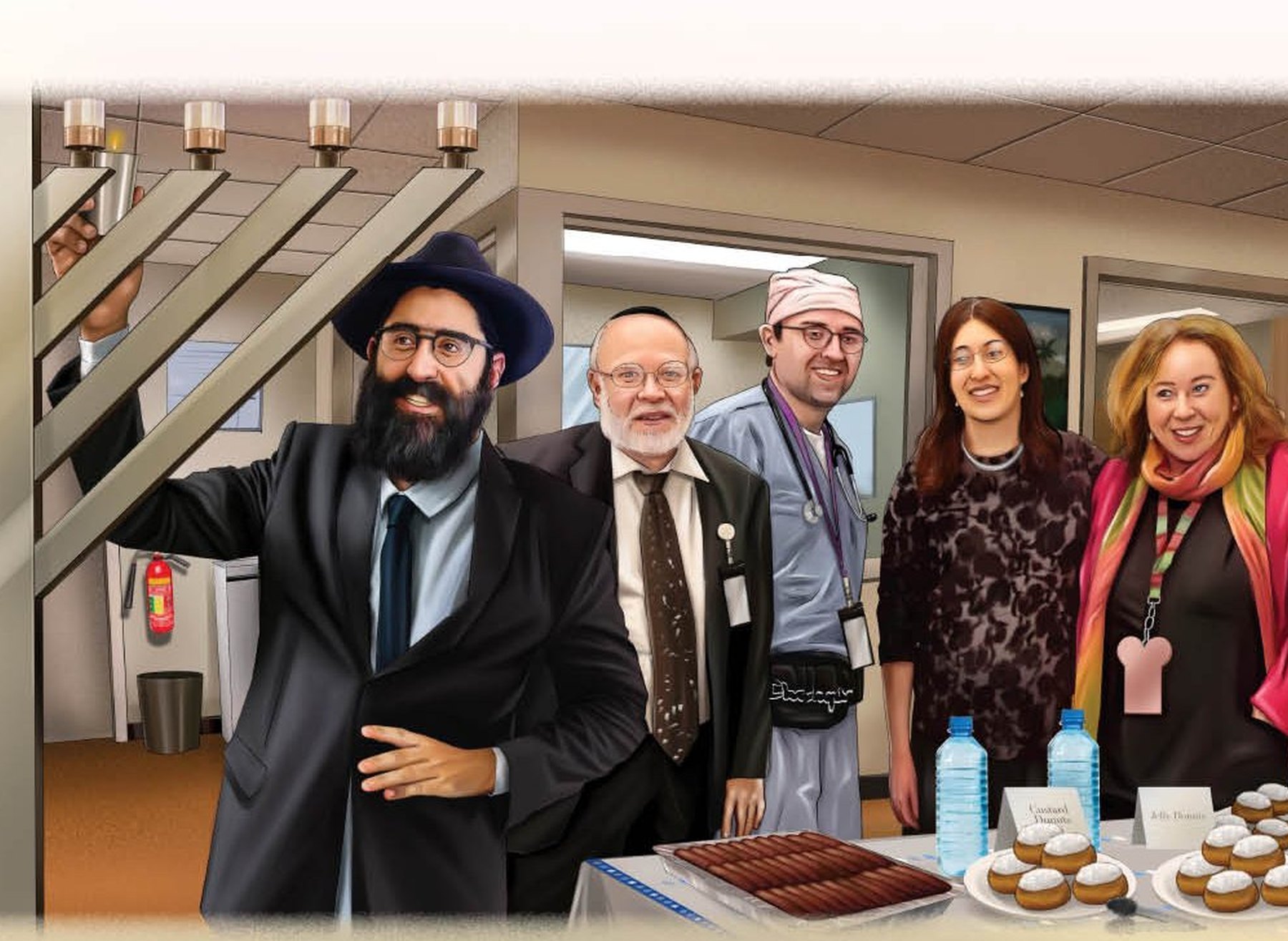
Even though I’m not the hospital’s official rabbi, I visit the patients and staff every week. This past Chanuka, I had what I thought was a great idea—I wanted to organize the hospital’s first-ever grand Menorah lighting!
Why, you ask? Well, I’d read a letter from the Rebbe where he mentioned how much joy lighting a Menorah in a hospital can bring. That gave me the push I needed to make it happen.
But here’s the funny part—I only knew one Jewish doctor and one Jewish patient in the entire hospital. So I wasn’t sure who else would come. But hey, between the two of them, I figured we already had a decent group! Even if it ended up just being me, that doctor, and that patient standing around the Menorah, I knew it could still brighten someone’s day.
Who knows? Maybe something big would come from something small! That’s the story of Chanuka, right?
I knew a few of the non-Jewish staff members at the hospital, including the director. He was a Christian. He’d helped me set up my visits. When I told him about my idea, he said he wouldn’t be in Vaughan then, but he could tell how much it meant to me.
“You should definitely do it!” he said. Then, to my surprise, he handed me a small electric Menorah. “Here, you can use this one!” I couldn’t help but laugh—imagine that! A non-Jewish hospital director not only supported the idea, but he actually had a Menorah in his office! Who knew my first helper would be someone who wasn’t even Jewish? Chanuka brings people together!
* * *
Now, it was the night of the big Menorah lighting!
“Everybody, into the car!” I called to my family, who were busy frying latkes and packing up doughnuts for the event. “We need to get to the hospital! It starts at 4:30!”
Pretty soon, we were all squeezed into the van—driving to Vaughan. Latkes, doughnuts, and, of course, my wife and kids—all packed into a car that smelled like a Chanuka party on wheels.
As we pulled out of the driveway, I told my family, “This is going to be so special! I’m not expecting a big crowd, but every Yid counts!” They all nodded, excited to make this night a memorable one, even if it ended up just being us, some doughnuts, and the Menorah.
When we got to the hospital, they told me the Jewish doctor I thought would come had already left for the day. For a moment, I felt worried. What if no one shows up? But then I saw the Jewish patient I knew sitting downstairs, waiting for us. I felt so much better—I already knew it was worth it!
You see, we light the Menorah even if only one person is there. Every Yid is important, and bringing the light of Chanuka to even one person can make a big difference. That’s what the Rebbe taught us our job is.
While we were setting up the candles, I noticed a woman nearby who looked like a nurse.
She seemed familiar, but I couldn’t figure out from where. Then it hit me—I knew her from an old doctor’s office I used to visit with my kids.
“Chani, look who it is!” I said, pointing her out to my wife. “It’s Mandaline, a nurse from our old doctor’s office! Maybe she can help us find more Yidden!”
My wife and I got excited, and she ran over to greet Mandaline. “Hey, Mandaline! Do you remember us?”
“Of course I do! How nice to see you again,” Mandaline said with a big smile. “I hope you’re here for good reasons?”
“Yes, yes, we are,” my wife explained. “We’re here to light the Chanuka Menorah. Maybe you can help us?”
“A Menorah lighting? Here? Why didn’t anyone tell me?” Mandaline looked surprised. “As a Jew, I’d love to join! And I’d be happy to help you find more… let me think,” she said. Suddenly her face lit up. “Oh! Dr. Mozar is Jewish! Let me go find him!” And before we could say another word, she ran off to get him.
* * *
Soon, we had our group: a doctor, a patient, and a nurse. Three people, plus doughnuts, latkes, and the Menorah. It might not have been a big crowd, but it was exactly what we needed. Was it worth all the effort? The Rebbe would tell us it absolutely was.
So, at 4:30, we lit the Menorah. The room felt so alive, and it was very emotional for everyone there. The patient, Ben, had tears in his eyes as he shared his story.
“Before my accident,” Ben began, his voice trembling, “I was a professor at a college. I didn’t believe in Hashem, and I didn’t really believe in religion. But then, something happened.”
Ben wiped a tear from his face and continued. “A few months ago, I had a terrible stroke. It was really scary. The doctors told me it was very serious, and they didn’t think I would get better. I couldn’t move or talk the way I used to, and everyone thought it would stay that way.”
“But somehow, I started to get better. Every day, I could do a little more. I could move, I could talk, and I could think clearly again. The doctors were so surprised—they didn’t understand how it happened. But I do,” he said, his eyes shining with emotion. “It’s because of Hashem.”
Ben’s hands covered his face as he quietly cried. “Since you started visiting me, I’ve been thinking more and more about Hashem. And now, standing here, lighting this Menorah, I feel closer than I ever have before.”
* * *
“Rabbi, I see your sign says you live in Woodridge?!”
Mandaline, the nurse, asked in surprise. “My brother lives there too. He got divorced two years ago, and he’s been in bad shape ever since.”
“I’m so sorry to hear that, what’s his name?”
“Sam,” she said softly. “If I give you his address, would you go visit him? He’s been so lonely these past two years. With COVID-19 and everyone staying home, it’s been very hard for him.”
“Of course I’ll visit him!” I told her with a smile. She gave me his address, and I promised to visit during Chanuka. I hoped lighting the Menorah and bringing him some Chanuka cheer might lift his spirits.
* * *
As we were driving home, I couldn’t hide my excitement.
“We need to visit Mandaline’s brother!” I told my wife. “Look at what we accomplished tonight! Not only did we light the Menorah for three Yidden, but we also learned about a fourth!”
My family all agreed. Finding new Yidden to connect with is the best part of what we do.
We talked about when we could visit Sam. The next day, Wednesday, we had another Chanuka party planned, so that wouldn’t work. But Thursday was perfect! Thursdays were our usual Bikur Bayis day—the day we went to visit people’s houses to meet new Yidden.
When Thursday night came, a big snowstorm hit. The roads were covered in snow and ice, and the wind was freezing, but that didn’t stop us. We bundled up in scarves, hats, and gloves and headed out to find Sam. We didn’t have his phone number, just his address, and as we pulled into a driveway, we hoped we had the right place.
We rang the doorbell and waited. A man answered the door, but it wasn’t Sam. “Hey, does someone named Sam live here?” we asked.
“Oh, Sam, huh?” the man, who seemed to be the owner of the home, said, looking surprised. “You came to visit him?” His eyebrows shot up, as if he couldn’t believe it. “I’ll knock on his door and let him know you’re here,” he said, disappearing down the stairs.
After a moment, a man came out and stepped onto the snowy porch. He looked older, and he was wearing pajamas and slippers, with a robe wrapped around him to stay warm. Even though it was freezing outside, he didn’t seem to care.
He looked surprised. We could see little puffs of his breath in the cold air, and when he spoke, his voice had the same South African accent as his sister Mandaline’s.
“Rabbi, how did you find me?” Sam asked, his face lighting up with surprise. Before I could answer, he gave me a big hug and kissed me on the cheek, smiling from ear to ear. “I didn’t even know there were other Jews here!” he said, looking excited.
Then he told me about his life. He shared that he’d left South Africa a few years ago, after his family situation became very bad. He told me how lonely it had been since then, and how much he missed having people to talk to.
After chatting for a little while, I smiled and said, “Sam, I brought some latkes for you! But first, let’s light the Menorah and sing Haneiros Halalu together.”
The apartment was so small, there wasn’t a good spot to properly light the Menorah, but we made it work. As we enjoyed the treats, we talked some more. Then Sam’s smile started to fade, and tears began to fill his eyes.
“Rabbi, I remember when my father used to light the Menorah,” he said, his voice a little shaky. “It was such a special moment for our family. After my father passed away on Chanuka, people would bring Menorahs to our home, but it just didn’t feel the same. He was the one who made Chanuka so special for us.”
It was clear that this moment made him feel connected again to his family, to Chanuka, and to the joy of being Jewish.
“Your father passed away on Chanuka?” I asked Sam, surprised.
Sam nodded slowly. “Yes,” he said, his voice quiet. “I’ll never forget it. It was on Chanuka, but I didn’t know which night it would be this year.”
Hearing that, I quickly started making a mental calculation, based on the English date and year Sam had shared. My heart started pounding as I worked it out. Could it really be?
When I finished, I looked up at Sam, barely able to contain my excitement.
“Sam, do you know what tonight is?” I asked, leaning closer. “It’s your father’s yahrtzeit—the anniversary of his passing!”
Sam’s eyes widened, and he stared at me in shock.
“Tonight?” he said, surprised. “My father’s yahrtzeit is tonight?”
“I need to be absolutely sure,” I said, grabbing my phone to call his sister. When I explained what I had calculated, she gasped. “Rabbi, you’re right!” she said. “Tonight really is my father’s yahrtzeit! I can’t believe this!”
It sent shivers down my spine. Of all nights, this was the night I met Sam—the exact night his father passed away. The Hashgacha Pratis, the divine plan, was so clear. His father was sending a sign.
I immediately called a friend and arranged for Kaddish to be said that night in honor of his father. I turned to Sam and explained how lighting the Menorah and saying Kaddish on a yahrtzeit was a special way to bring honor to his father’s memory.
Then, Mandaline spoke up, her voice full of emotion. “Rabbi, this must have been planned by G-d,” she said.
“You didn’t even know it, but my father must have sent you! I didn’t tell you this before, but when you came to the hospital, I was there when I’m usually not. I was supposed to leave much earlier that day, but I stayed very late. Now I see why! It wasn’t just so you could meet my brother—it was so we could remember my father’s yahrtzeit, the Jewish way!”
Sam nodded, his voice filled with emotion. “It’s amazing how everything worked out,” he said. “It’s like my father wanted to remind us, even now, how much he loves us.”
The timing, the connections, and how everything came together so perfectly—it was no accident.
Both Sam and Mandaline cried together on the phone —it was their father’s yahrtzeit.
After that, Sam went for a walk, his first time leaving the house in a long, long while. It lifted his spirits and brought a big smile to his face. He seemed like a different person, happier and more at peace.
Here’s another amazing twist: I found out Sam’s landlord, who opened the door for us, was also Jewish! That snowy Chanuka night, we didn’t just find Sam—we discovered another Yid who needed help connecting with Yiddishkeit.
They call Shluchim “excavators” because our job is to dig and uncover every precious Yid waiting to discover what it means to be a Jew. With Hashem’s help and incredible Hashgacha Pratis, we find them, one by one.
Sometimes, Hashem’s plan is easy, and sometimes it takes a little longer. But nothing happens by accident—every moment is part of His plan. Even a Menorah lighting for just three can bring light to many more lives. Every Yid counts, and Hashem is guiding us every step of the way.
Beis Moshiach #1440 • pp. 58-62
© 2026 Beis Moshiach Magazine. All rights reserved.
This article originally appeared in Beis Moshiach #1440. You are welcome to share it with friends and family by email or in print, provided that you do not change, add to or omit any part of it, you credit the author and Beis Moshiach, and you include a link to archive.bmoshiach.org (written out in full in printed copies).
To republish this article in a newspaper, magazine, book or website, please request permission in advance at [email protected].