The Man Who Brightened London’s Fog
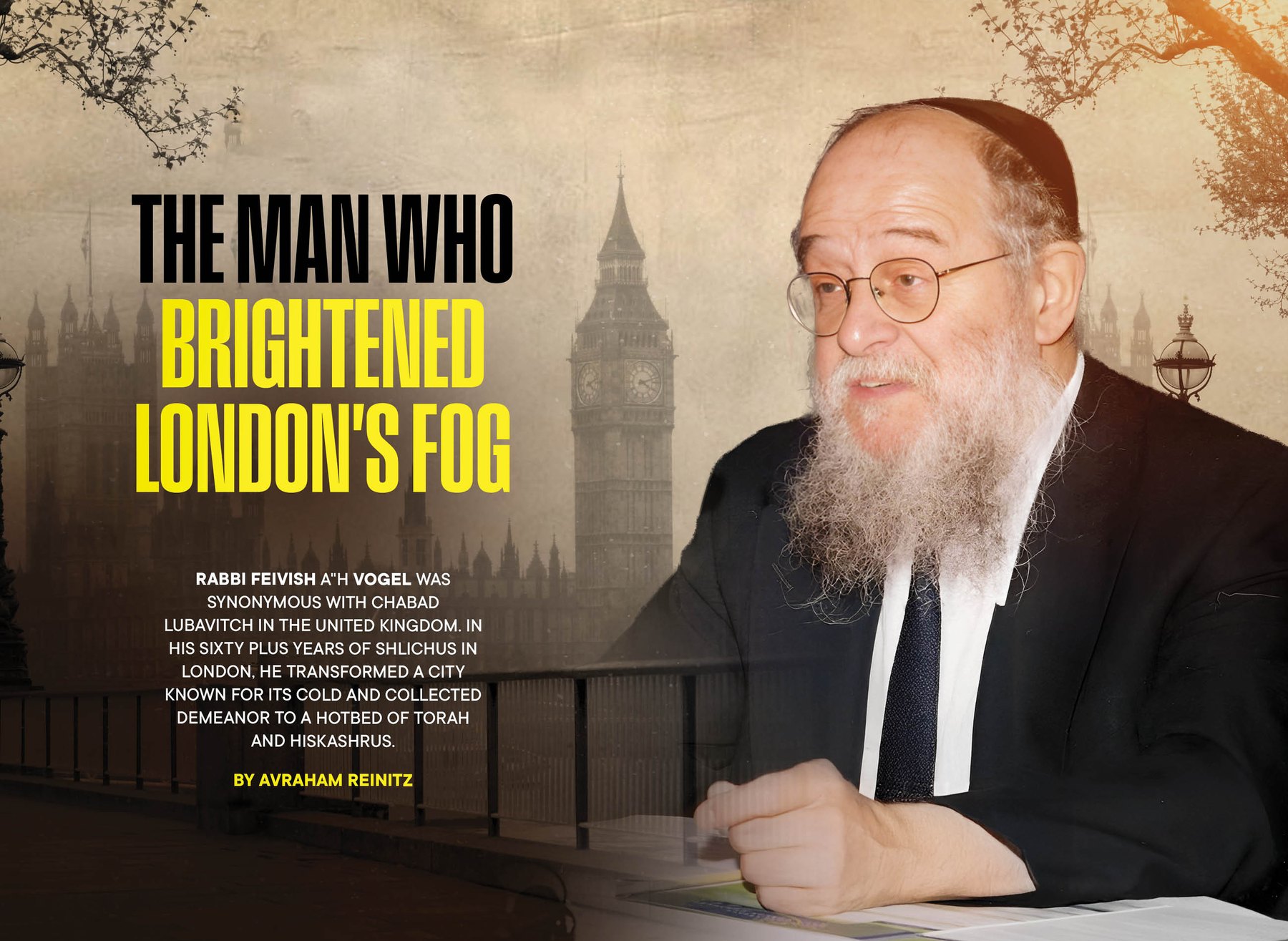
Rabbi Feivish a”h Vogel was synonymous with Chabad Lubavitch in the United Kingdom. In his sixty plus years of shlichus in London, he transformed a city known for its cold and collected demeanor to a hotbed of Torah and hiskashrus.
Rabbi Vogel was born in England in 1936 to parents who were yerei shomayim who, although not counted among the Chassidic community, maintained certain Chassidic customs. Rabbi Vogel’s father always davened Nusach Ari as did his grandfather. Years later, when Rabbi Vogel inquired about this practice, he discovered that his father was born in Vaslui, Romania, where a Chassid named Reb Koppel, a student of the Tzemach Tzedek, had influenced many Jews. “There was a strong Chassidic influence there,” Rabbi Vogel explained, “but it was never really expressed in an open way.”
The Early Days In Gateshead
At age fifteen, in 1951, he began studying at Manchester Yeshiva, where he first encountered the world of Chabad through the personality of the Chassid Rabbi Yitzchak Dubov a’h, rav of the “Adas Yisrael” community.
In those days, his knowledge of Lubavitch was limited. He knew about the existence of a “Lubavitcher Rebbe” in America and had heard about the activities of the Rebbe Rayatz in Soviet Russia, but not much beyond that. His first meaningful encounter with Chassidic teachings occurred at the famous Gateshead Yeshiva when he stumbled upon a Chabad pamphlet containing collected talks of the Rebbe Rayatz. That first reading created an internal upheaval inside him, as he discovered for the first time the depth of pnimiyus ha’Torah.
A turning point in his life occurred when the Chassid Rabbi Benzion Shemtov arrived in Gateshead. One evening, a friend told him about a Tanya class that was to take place in one of the private homes. Together with a small group of students, Rabbi Vogel slipped away from the evening seder at the yeshiva. They walked in England’s freezing cold with their Tanyas hidden under their coats to the Rothenberg family’s home.
That evening, Rabbi Shemtov taught “Shaar HaYichud V’haEmunah,” explaining the revolutionary innovation of the Baal Shem Tov regarding the constant renewal of the world through divine speech. The young bachurim were captivated, and Rabbi Vogel felt that a completely new world had opened before him. He understood the concepts with a depth he hadn’t known before and felt that the profound Chassidic explanations penetrated his heart.
Anonymous Classes
Following that pivotal class, Rabbi Vogel decided to begin studying Chassidus regularly. In a brave step, he wrote to the Rebbe requesting advice on how to advance in his Chassidic studies. The Rebbe responded by letter and directed him to Rabbi Berel Levin, a local shochet who came to Gateshead weekly.
“Every Friday I traveled to study Chassidus with him,” Rabbi Vogel recalled. “For ten shiurim, he didn’t even know my name. I didn’t want to expose myself too much. When he asked my name, I told him it didn’t matter, let’s just continue learning.
“He taught me ‘Likkutei Torah,’ starting with the maamar ‘Adam Ki Yakriv,’ and for two hours every Friday we were immersed in study. Only after some time did I reveal my name to him,” Rabbi Vogel related. “Of course, it meant nothing to him…”
The special relationship that developed between young Rabbi Vogel and Rabbi Levin was a significant turning point in his life. His faith and understanding of Chassidic teachings deepened to such an extent that on Shavuos, when asked to speak before all the yeshiva bachurim – a privilege reserved for outstanding students – he chose to repeat a maamar Chassidus. In a bold move that surprised the roshei yeshiva, he began by saying that in honor of the Baal Shem Tov’s yahrtzeit, he would share a teaching from his talmid’s talmid. The atmosphere was tense, but he continued and delivered the maamar with clarity and depth.
This step changed his relationship with the yeshiva administration. The menahel, seeing him studying Tanya in the Beis Medrash, told him he could continue his studies but should do so in another room, away from other students’ view.
The Journey To 770
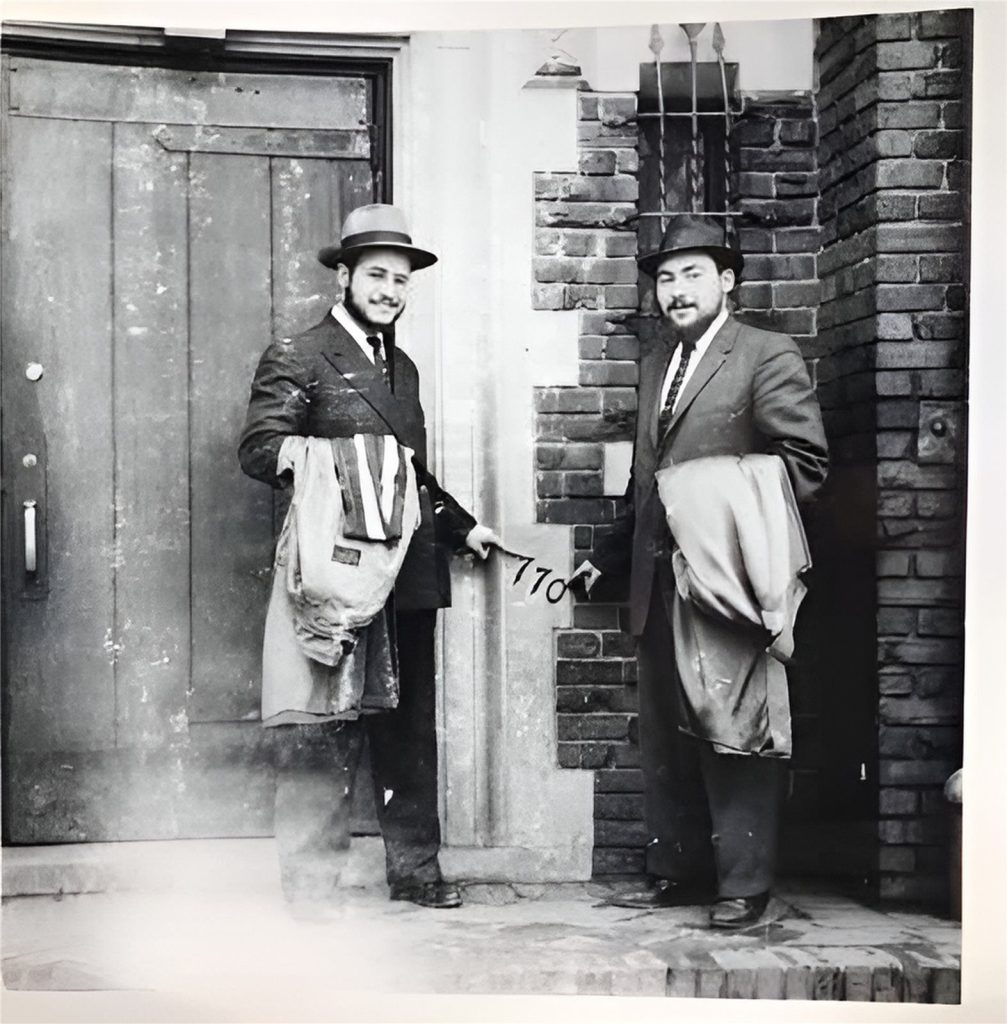
In 1958, after extensive correspondence with the Rebbe and receiving his blessing, Rabbi Vogel decided to take the significant step of traveling to study at 770. The decision was particularly difficult for him and his family. His parents struggled to accept the idea of traveling overseas, which in those days was perceived almost as being cut off. In the emotional moment of parting, when his father said goodbye and added pleadingly, “Please, come back here,” he understood how difficult the separation was for them.
The journey itself was challenging. The boat ticket to America cost an enormous sum, and to finance the trip, he traveled twice a week to teach at a cheder in Sunderland, earning four pounds per week. With the help of a generous loan from a local Jew named Kaufman, which he managed to repay only after five or six years, he completed the required amount.
First Tefilla With The Rebbe
His first day at 770 was deeply etched in his memory. It was a clear but particularly cold winter day, and the snow reached levels he had never seen before. After his first warm meal in days, instead of resting as suggested by the Rosh Yeshiva, Rabbi Mentlick, he chose to wait in the shul for Mincha with the Rebbe. At exactly 3:15, as he was told, the Rebbe entered for davening. The Rebbe looked at him for several seconds, a moment that was forever seared in his memory.
“The first time I saw the Rebbe,” saidd Rabbi Vogel, “was at Mincha in 770. I saw the Rebbe standing motionless, completely immersed in prayer. His entire being radiated holiness and inner quiet. I understood that here was a personality far beyond anything I had ever seen. It wasn’t just a first impression, but an understanding that the Rebbe was a figure who would influence me and my life in the most profound way.”
The first farbrengen he attended was the historic Purim farbrengen of 1958. In his youthful enthusiasm, he arrived early and waited two full hours to secure a good position. For ten consecutive hours, from 5 PM until 5 AM, he stood in one place, drinking in every word of the Rebbe’s teachings.
The Chassidic maamar delivered at that farbrengen, “Chayav Inish,” lasted one hour and five minutes. Although he struggled to follow the rapid speech and deep concepts, he was captivated by the sight of the Rebbe’s holy countenance and his eyes closed in supreme devotion during the maamar. “In my naivety, I thought such revelations occurred every Shabbos,” he recalled, “until my friends explained that I had been privileged to witness an especially rare event.”
The stay at 770 completely transformed him, and he held a special place in his heart for farbrengens with elder Chassidim. “In those long farbrengens I attended, there was something that completely changed me. I learned that Chassidus speaks not only about Torah scholarship but also about genuine inner work. In conversations and meetings with great Chassidim, I learned that every person must completely dedicate themselves to serving Hashem, even if it involves difficulties and inner struggles.”
Shortly after his arrival, the yeshiva’s menahel, Rabbi Dovid Raskin, approached him and announced that he had arranged a chavrusa for “Seder Chassidus” – a bachur, Yisroel Friedman, who later became famous as the Rosh Yeshiva of Oholei Torah. The special relationship that developed between them profoundly influenced Rabbi Vogel’s spiritual development.
For over a year they studied together, sitting on the bench where the Rebbe used to sit during Mincha and Maariv. They began by studying “Shoresh Mitzvas HaTefillah” in “Derech Mitzvosecha.” R’ Yisroel’s remarkable talent for explanation and his genius in Chassidic teachings helped really ground Rabbi Vogel’s understanding of Chassidus, guiding him to the point where he became well-versed in the conceptual world of Chassidic works.
First Activities In Spreading The Wellsprings
Alongside his studies, Rabbi Vogel began participating in activities to spread Yiddishkeit and Chassidic teachings. Every Wednesday, he participated in the “Released Time” program, through which English-speaking yeshiva students would go to public schools throughout New York to teach Torah and Yiddishkeit. In the school where he taught, there were 1,200 students, of whom 800 were Jewish – a fact that testified to the magnitude of the shlichus.
For him, the weekly transition from the protected, spiritual world of the yeshiva to the American street was a significant exercise in hanochas atzmuso (putting one’s own self aside). The tension between complete immersion in Torah study and going out to teach children who had no concept of Judaism was a practical lesson in Chassidic ways. He learned to internalize that the purpose of everything is “to serve my Creator,” and that a Jew must be ready to move between different and opposing situations to fulfill the divine intent.
Tanya Classes At Yeshiva University
Another significant activity in his development as a mashpia was delivering Chassidus classes at various yeshivas in New York every Thursday night. Rabbi Vogel was assigned to give a Tanya class at Yeshiva University. Although the class started with a small number of participants, he persisted devotedly, and every week he would report to the Rebbe about the class’s development.
From these reports, a special system of guidance from the Rebbe emerged. When he once reported about a heated debate that developed with the students, the Rebbe responded: “Generally, there is no benefit in arguments,” adding a significant qualification – unless it could lead to a regular class. When he reported about a class that extended until 1:30 AM due to a discussion that developed, the Rebbe briefly remarked: “Much too late.”
A special relationship developed between Rabbi Vogel and one of the rabbis at Yeshiva University. Rabbi Vogel would share the Rebbe’s recent talks with him and study Tanya together. Once, they had a deep discussion about Chapter 1 of Tanya, which deals with the four elements. The profound questions that arose in the discussion reached the Rebbe’s desk, and he responded extensively in a special letter, part of which was later published in Igros Kodesh.
The Shidduch And The Surprising Condition
In 1960, when the time came to establish a Jewish home, Rabbi Vogel was suggested a match with his wife, a daughter of the Charitonov family. Her family was deeply connected to Chabad – her father, R’ Mordechai Tzvi, who had lived in Yekaterinoslav, was very close to the city’s rav, Rabbi Levi Yitzchok Schneerson, the Rebbe’s father.
When he entered for a yechidus to ask about the shidduch, the Rebbe said something that surprised him: “Ich ken noch di mishpacha fun Nikolayev” (I know the family from back in Nikolayev). This was a clear positive confirmation for the match. However, behind the scenes, a dramatic development was unfolding. It turned out that the Rebbe had told his secretary, Rabbi Chodakov, that the family should know that the prospective chassan was being sent on shlichus to London. If they agreed to this – very good, and if not – the shidduch was not suitable. All this before Rabbi Vogel himself knew about the plans for his shlichus.
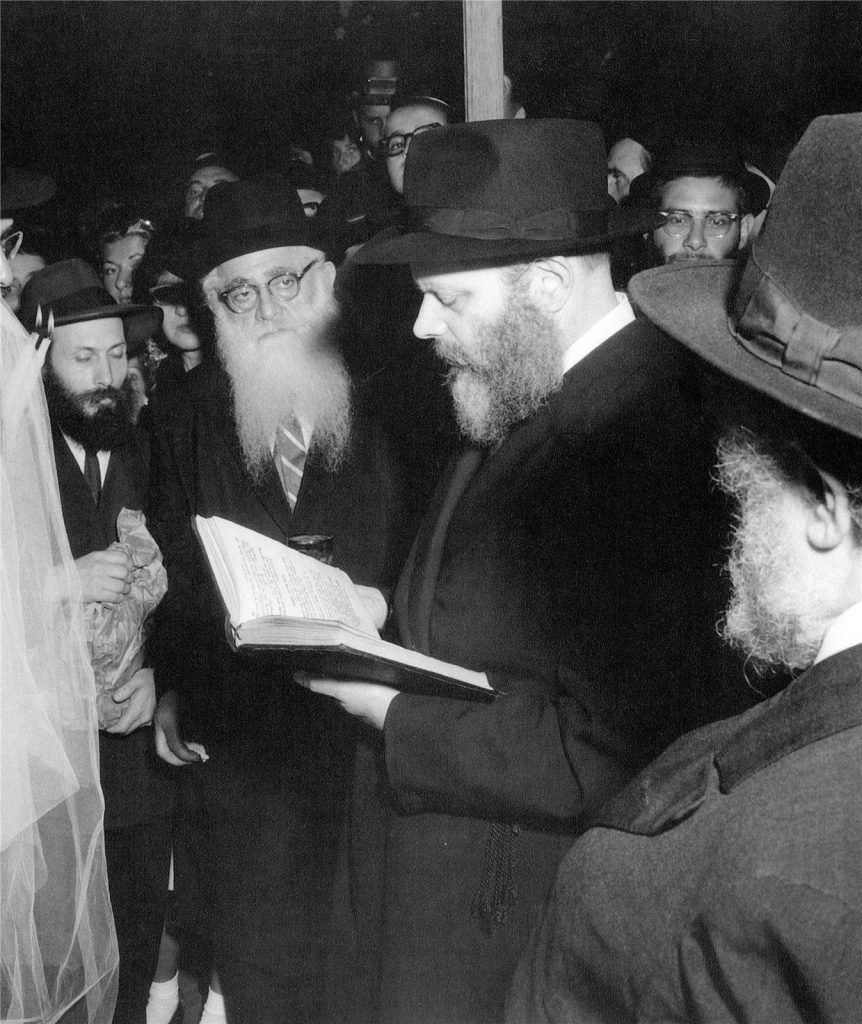
The wedding date was set for the 16th of Elul. Like every bachur in those years, Rabbi Vogel also yearned for the Rebbe to officiate at his wedding, a custom that had already become rare at that time. He wrote a request to the Rebbe but received no response. When he approached the secretary Rabbi Chodakov to inquire about the matter, he received a surprising answer in the Rebbe’s name: “Uber ven fort er oif in London?” (But when is he going to London?).
The message was clear – the Rebbe’s agreement to officiate at the wedding was contingent upon accepting the shlichus to London. The Vogel family was among the last to merit having the Rebbe officiate at their chuppah, a rare privilege that testified to the special connection and trust the Rebbe had in the young shliach.
Begininning Of Shlichus In London
The Rebbe’s Shlichus revolution was in its initial stages at that time. Rabbi Vogel was among the pioneering shluchim.
Rabbi Vogel clearly remembered the special farbrengen that the Rebbe held to honor Rabbi Zusha Posner’s departure on Shlichus to Eretz Yisrael. The Rebbe unexpectedly entered that gathering which was attended by only about twenty students. Rabbi Vogel, who stood in a position that allowed him to see the Rebbe’s face up close, was so excited that he could barely listen to the words. The entire farbrengen was dedicated to the topic of ‘Ufaratzta.’
This atmosphere of constant pushing to expand the boundaries of holiness deeply influenced Rabbi Vogel. Even before his marriage, he wrote to the Rebbe that he was ready to go on shlichus, but the Rebbe responded that at this stage, his shlichus was to study diligently in Tomchei Tmimim. This was another example of how the Rebbe systematically prepared him for his future role.
Chabad Revolution In Britain
Upon arriving in London, Rabbi Vogel began working intensively. He was appointed director of the Lubavitch Foundation, a role that included fundraising, organizing annual dinners, managing relationships with banks and various organizations, and simultaneously delivering shiurim in shuls throughout London.
After two months of his shlichus, the Rebbe wrote to him: “It is most surprising the complete lack of information and letters from him and his wife, despite receiving initial information about their activities.” This response caused him to write to the Rebbe much more frequently.
One of the first challenges was fundraising. The Rebbe gave him interesting guidance in this matter – not to schedule meetings in advance with wealthy donors. Although this seemed strange at first, it turned out that spontaneous meetings, when they could be held, yielded significant success and created long-term relationships.
The Rebbe also guided him regarding activities. After the first dinner, the Rebbe instructed that participants who donated should themselves host meetings in their living rooms and invite their circle of friends, naturally expanding the circle of supporters. This was an important principle in the Rebbe’s method – that every mekurav who is a ‘receiver’ become a ‘giver’ themselves.
The Rebbe personally nurtured connections with supporters, writing personal thank-you letters and sending copies to Rabbi Vogel. In these letters, the Rebbe would refer to Rabbi Vogel with special respect, writing “You will have heard from my colleague.” These letters were extremely precious to the recipients, and many framed and proudly hung them on their walls.
Once, when he wrote to the Rebbe about numerous difficulties, he received a special response: “Du darfst geyn mit a breitkeit” (you need to act with expansiveness). The Rebbe further guided him: “You must be confident and remember what the Rebbe (my father-in-law) said in the name of the Mitteler Rebbe, who said in the name of the Alter Rebbe – that in every matter of Torah, fear of Heaven, and good character traits, the hand of his followers and those who walk in his footsteps will be uppermost.”
The Rebbe’s special relationship with Rabbi Vogel was also evident in the many yechiduyos he was privileged to have. Some of these audiences were particularly long, and the Rebbe provided detailed guidance on shlichus work.
An unprecedented development in Chabad activity in London occurred with the establishment of the Chabad school. This was an innovation in London and unprecedented in the Jewish world of those days. Local Jews sent their children en masse to the growing school, and it was a significant breakthrough in spreading Judaism.
When once asked to describe the Rebbe’s guidance, he said: “I remember how every time I would send a report about our activities, the Rebbe would send back precise notes and sometimes, they were harsh. The Rebbe demanded perfection, but simultaneously radiated complete love for every shliach. The Rebbe’s guidance gave us the strength to continue, even in difficult moments.”
Behind The Scenes Of The Sefarim Trial
A fascinating chapter in Rabbi Vogel’s activities was during the Sefarim Trial. It all began at a farbrengen, where the Rebbe cried out painfully about the severity of holding these sefarim [referring to the sefarim that were taken and sold to collectors – Ed]. “I had never seen the Rebbe in such a state,” Rabbi Vogel recalled. “The Rebbe spoke to an audience that mostly didn’t understand what was being discussed, and suddenly his thundering voice was heard. He warned that anyone holding these sefarim must know they are holding ‘bombs,’ and immediately added that to transform these ‘bombs’ ‘into ‘sweet apples,’ the sefarim must be immediately returned.”
Immediately after the farbrengen, Rabbi Vogel approached the famous book collector, Jack Lunzer. “I brought a large recording device to his home and played the Rebbe’s words. He understood Yiddish and smiled: ‘Bombs? Sweet apples? Okay, I agree.’ He owned a Zohar from Krakow 300-400 years old, and the Chevra Kadisha regulations of Amsterdam written on parchment – a rare historical document.”
For the Zohar alone, $6,000 was paid. “On Friday noon, I arrived at his office in Hatton Garden, and he agreed to hand over the books after receiving payment from Rabbi Chaim Chodakov or Rabbi Groner. I placed the books in a small cabinet on the upper floor of my home, and from two or three books, thirty books were redeemed in various ways.”
A special story involved a rare Haggadah in the possession of collector Michael Ploschey in Switzerland. “I called him and said we wanted to redeem the Haggadah. He demanded $140,000. When I reported this to Rabbi Groner, Rabbi Chodakov called me and said: ‘I am sitting now with a checkbook on the table and my pen in my right hand. If you tell me to write a check for $140,000 – I will write it. I am your shliach now.’”
“I was stunned,” Rabbi Vogel recalled. “I requested a few minutes to think, and after five minutes, I called back and confirmed. The Haggadah was redeemed and transferred by Rabbi Mendy Rosenfeld from Zurich.”
Later it became known that when Rabbi Chodakov asked the Rebbe about the high price, the Rebbe instructed: “Ask Feivish.”
When about ten to twelve books had accumulated, Rabbi Vogel asked Rabbi Groner what to do with them. Rabbi Groner asked the Rebbe, who responded: “We must wait, because he will get more.” Ultimately, when the number of books reached around 30, they were sent by bachurim traveling to New York.
Rabbi Vogel revealed that he received from Rabbi Leibel Groner a list of 104 books, which included the book’s name, year of printing, author’s name, and the amount paid for it.
Another key figure in the matter was Rabbi Hershel Gorman from London, who was knowledgeable about ancient books. He directed Rabbi Vogel to an important book collector, a Gerrer Chassid named Yitzchok Heidler, who held books from the Chabad library sold in the open market.
“Heidler didn’t want to talk to me directly,” Rabbi Vogel recounts, “but agreed to act through the dayan, Rabbi Yosef Padwa, son of the head of the London Hisachdus Kehillos HaChareidim Beis Din. The Rebbe stipulated that anyone wanting to return books must present a purchase receipt, or alternatively – a certification from a rabbi who would testify that the returner is a trustworthy person and the amount he is requesting is reasonable.
“I received from Dayan Padwa lists of books with the amounts paid for them, with him signing ‘verified’ at the end of each list. These were not large amounts – 400 pounds, 600 pounds. We collected the total sum and transferred the money.
“When I suggested payment to Dayan Padwa for his services, he refused but requested a bracha from the Rebbe for his unmarried daughter. I wrote to the Rebbe, provided his name and mother’s name. Two weeks later, Dayan Padwa called me and said: ‘The blessing has been fulfilled!’”
During the trial, when there was a need for Elie Wiesel to testify that the Rebbe’s library cannot be inherited or divided among family, Rabbi Shemtov approached Rabbi Vogel, who had a close relationship with Wiesel, and requested his help. When Rabbi Vogel called Wiesel and began explaining the importance of the matter, Wiesel stopped him mid-sentence and said: “Feivish, it’s simply theft.” He immediately agreed to come and testify, a testimony that proved crucial to the trial’s success.
The Rebbe Said: ‘Do Not Be Hidden’
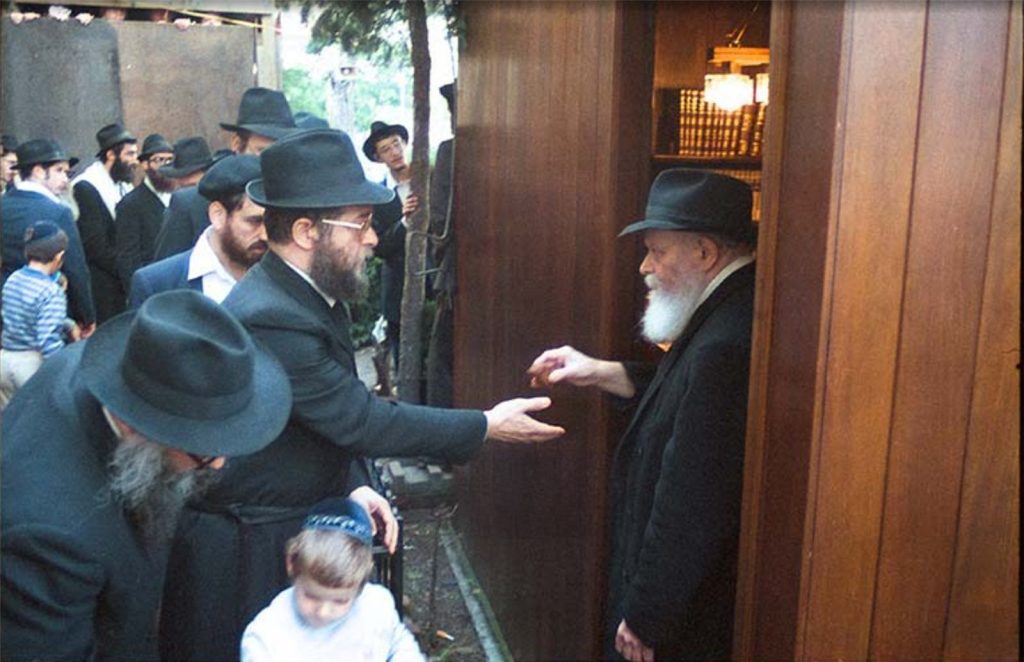
One of the defining moments in his shlichus occurred on Simchas Torah 5746, when he came to the Rebbe with his son Yaakov Koppel. Due to his distant position, he couldn’t hear the Rebbe during the farbrengen. When he later passed to receive kos shel bracha, the Rebbe asked loudly: “Where were you? I was looking for you!” and added: “Enough of being ‘hidden among the vessels’” (i.e. being too modest or staying in the background).
The next day, during dollar distribution, the Rebbe repeated the message: “The main success is not to be ‘hidden among the vessels.’” The following Shabbos, with friends’ help, Rabbi Vogel managed to position himself directly in front of the Rebbe. When he passed during dollar distribution again, the Rebbe looked at him softly and said: “Thank you for not being hidden.”
“Sometimes, when a Chassid goes on Shlichus, a ‘foolish’ idea of acting modestly enters his mind,” Rabbi Vogel explained. “But the truth is that a shliach must be extroverted, he must force himself to be extroverted. The tendency not to put yourself at the forefront, which stems from anxiety, causes shluchim to miss so many opportunities to do what they need to do.
“The Rebbe tells me – and all shluchim – ‘The main success is not to be hidden among the vessels.’ Indeed, my greatest moments of success throughout my years of shlichus were only when I was especially bold. Sometimes I would throw caution to the wind and act with audacity in the spirit of ‘l’chatchila ariber’ (proactively overcoming obstacles), and that is when I experienced the greatest successes.”
‘A Great Wonder Is The Doubt’
Throughout his sixty years of shlichus, Rabbi Vogel worked tirelessly to spread Judaism and Chassidus in England. He saw his role as a shliach in the deepest sense – a means for introducing G-dliness into the world. He understood that when the Hashem “uses” a person for His purposes, this is the highest possible elevation.
Once, when offered a board member position in a successful business – a role that wouldn’t require daily involvement – he asked the Rebbe whether to accept. The Rebbe’s response shocked him: “No, and the doubt is a great wonder. His essence and shlichus in England is in the tent of Torah and public work related to Torah, and not at all in commercial matters in any form.”
With his recent passing, the Jewish world lost someone who dedicated his life to spreading the wellsprings of Judaism. His rich legacy – thousands of students and those brought closer to Yiddishkeit, the flourishing institutions he established, and the well-paved path he left behind in spreading Yiddishkeit and Chassidus, will continue to illuminate Great Britain with the light of Torah and Chassidus.
Based on a video interview Rabbi Vogel gave to Rabbi Eli Friedman of Kfar Chabad weekly, and recordings from speeches and gatherings.
When We Spread The Message To The ‘Outside,’ Our Internal ‘Outside’ Will Also Change
Speech by Rabbi Shraga Feivish Vogel at the founding gathering of the ‘Matteh HaOlami L’Kabbolas Pnei Moshiach’
When will Moshiach come? When the wellsprings will be spread outward. This is the message we heard from the Rebbe in recent decades, and he repeated it consistently. This is the only solution – there is no other solution, no other plan, and no other ideas that we, simple mortals, can imagine as a solution to the problem of galus.
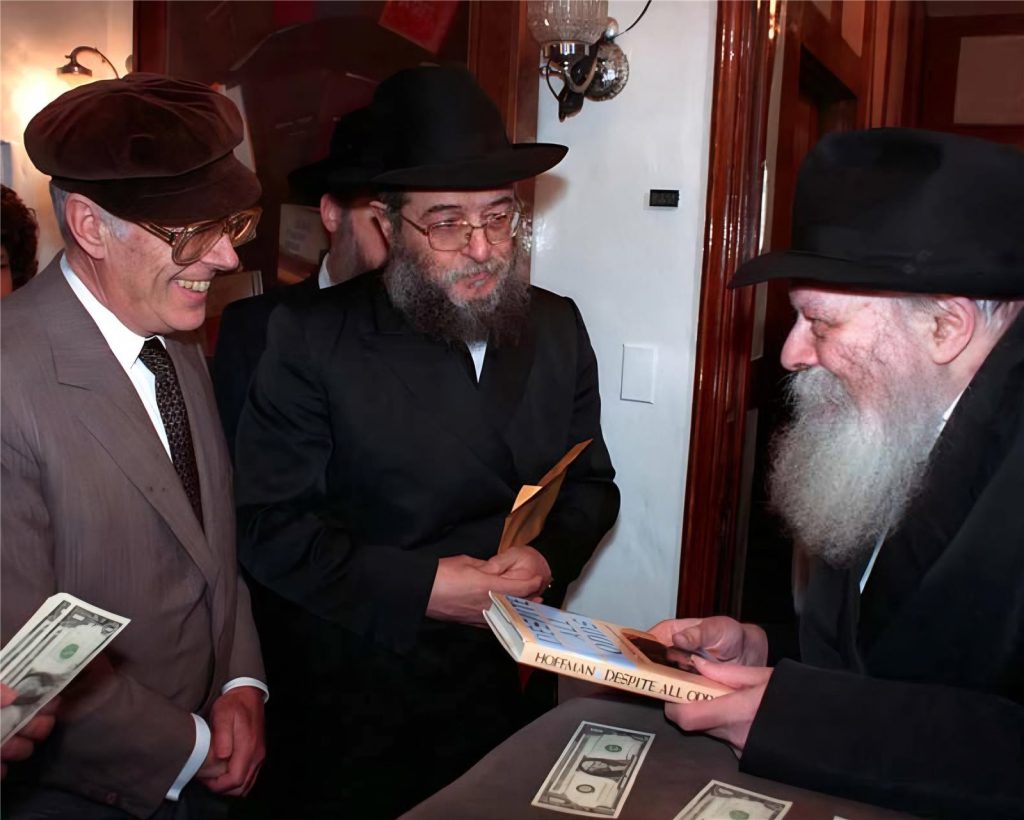
Many of us are frustrated, and there is enormous confusion throughout the world. Each of us imagines that we can come up with a new idea, something fresh, something never revealed before. But this is not true. The Rebbe has already established the way and spoke about it many times. The Rebbe said that we cannot manage without Chassidus. Anyone who believes for a moment that it is possible to bring Moshiach, to arrive at the revelation of Moshiach without spreading the wellsprings – lives in the realm of imagination.
Everyone looks inward to their own ‘chutza’ and everyone is depressed. I think this is true, and I suppose it is the same for everyone. We look at our personal ‘outside’ and understand that we need to make a change, an essential change, a change in which we transform from one state to another. The problem is, I do not know how to do this, and perhaps many others in this room also do not know how.
But one thing we know, and this is what the Rebbe taught us over the years: through his talks, through his personal audiences, through the yechidus’n that continue to this day. He raised a generation of thousands and tens of thousands of yungeleit and bachurim, shaping their understanding, their thoughts, and their desire to carry his message outward.
We all, each and every one of us without exception, are capable and therefore obligated to go outside. When we transmit the Rebbe’s message, even just as simple messengers, we are spreading the wellsprings outward. In this way, G-d helps that the message will return and influence the internal ‘outside’ that exists within each of us, something that cannot be addressed personally without transmitting the message outward.
I have the great pleasure to announce to this gathering tonight that Hashem has granted us to be shluchim, to spread wellsprings outward in a way that has not been done until today. I am pleased to report that a book titled Against All Odds – The Story of Lubavitch, has been published by the respected and large publishing house in this country, Simon & Schuster.
This is the first time this publishing house has agreed and published a book that gives us the opportunity to reach places that were previously impossible to reach. All we need to do is transmit the message outward. All we need to do is take a word, take a sicha, take a message, like the Sichos in English that were recently published – outlining the Rebbe’s perspective on the sequence of events in the past year.
I remember when the sixtieth year arrived, and the Rebbe spoke then about gratitude. He said that the first thing the Holy One, Blessed be He, wanted, demanded, and expected from the first man was gratitude. Unfortunately, at that event, as we all know, and as Rashi says, he was ‘kafah b’tova’ (was ungrateful).
And the Rebbe, just last week, just before the events we are talking about now, spoke again about gratitude and thanks for the miracles.
The Rebbe calls to us: Look how miracles are occurring. Look how miracles are happening before your eyes. Why are you blind? Why do you close your eyes? Why do you block your ears? Why do you close your heart? Why is your mind blocked? Why can you not see these miracles?
Each and every one of us in this room has a duty, a holy obligation, to spread the wellsprings outward. This, the Rebbe said, is the only way. This is the hisgalus of Moshiach. Each of us must make the decision, and then the Rebbe tells us that when we spread the wellsprings outward, it will return to the personal ‘outside’ of each one. This is what is needed, this is all that is required, this is what the Rebbe expects and hopes we will succeed in finding within ourselves.
The Rebbe gave us these mivtzaim. The Rebbe gave us Chassidus. The Rebbe gave us the language. The Rebbe gave us every bit of intellect and understanding that we have. The Rebbe gave us everything. Perhaps this is also included in what the Rebbe said that he did everything in his power. Now it is our turn to act, and our action must be in the traditional Chassidic way of spreading the wellsprings outward, going to shuls and spreading Chassidus. Give someone the sichos and tell him that here is the truth that can illuminate the false, blind, and dark world in which we live today.
Sometimes, and I say this personally, people feel desperate, people feel troubled by the double and multiplied darkness. But it has always been this way – the entire idea and basic understanding that darkness precedes light has always been part of the existence in which we live. We should not be fazed.
We must strengthen ourselves and spread the wellsprings outward, and this is what will bring light to our internal ‘outside’!
Beis Moshiach #1442 • pp. 10-21
© 2026 Beis Moshiach Magazine. All rights reserved.
This article originally appeared in Beis Moshiach #1442. You are welcome to share it with friends and family by email or in print, provided that you do not change, add to or omit any part of it, you credit the author and Beis Moshiach, and you include a link to archive.bmoshiach.org (written out in full in printed copies).
To republish this article in a newspaper, magazine, book or website, please request permission in advance at [email protected].