Building Networks of Love Among Siblings
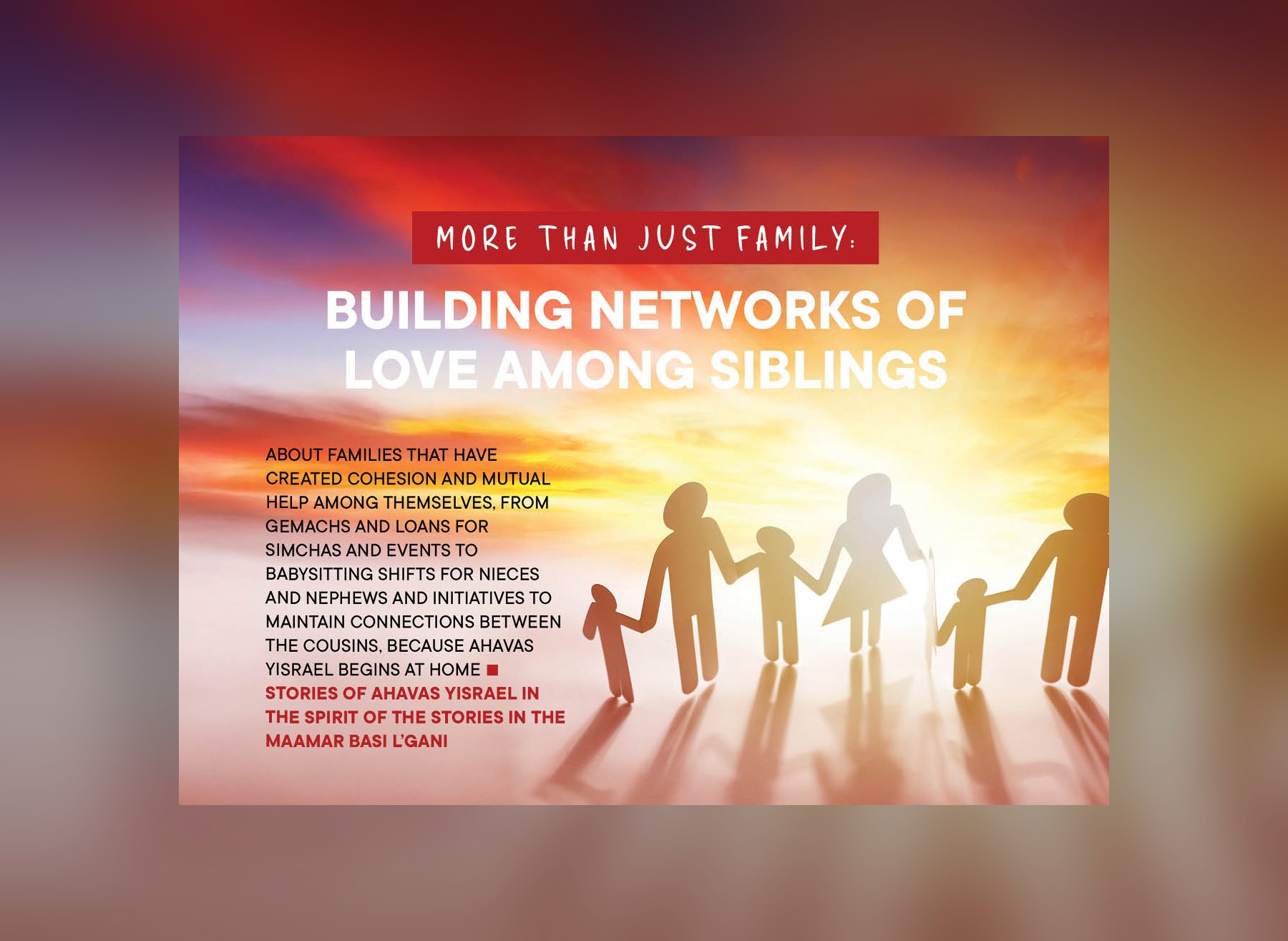
About families that have created cohesion and mutual help among themselves, from gemachs and loans for simchas and events to babysitting shifts for nieces and nephews and initiatives to maintain connections between the cousins. Because Ahavas Yisrael begins at home. Stories of Ahavas Yisrael in the spirit of the stories in the maamar Basi L’Gani
A busy evening hour. Showers, dinner, putting kids to bed, with healthy sibling arguments in between. Bedtime Shema, a Chassidishe story. And… finally silence descends upon the house. The exhausted mother tries to restore the house to its former state while recalling the day’s events. Snippets of the children’s behavior toward each other throughout the day pass through her mind, moments of sensitivity, consideration, compromise and displays of Ahavas Yisrael, versus moments of fights and arguments.
“Which will prevail over which?” she wonders with a tired yawn. “When they grow up, will the magical moments of compromise and mutual sharing grow strong, or ch’v, the opposite? How do you increase the feeling of love and unity between the children? How do you preserve it and establish it for life?!”
With us are several families who have already passed the first stage and share with us about the love between grown siblings. Because Ahavas Yisrael, as we all clearly understand, begins at home.
“We’re Just Paying You Back”
Mushka, an oldest sister, says: “As a married oldest sister and mother of little ones, I greatly enjoy the help of my younger sisters, who aren’t so little anymore. Despite all their activities as busy high school and seminary students, they find time to come almost every time I need them, whether it’s to watch the children when we’re not around, or to take them out a bit so I can attend to regular household needs.
“Their help in my case is more crucial, since my oldest son has special needs, which requires more intensive care and supervision, as well as more frequent visits to clinics and various treatments. It’s reassuring to know that most times, one of my younger sisters will be able to respond to my request and come to watch the other children at home, or come to keep him occupied when I need to go out with the others.
“Once at the clinic, I met a mother who came with all her children because she couldn’t find suitable arrangements for them. Her parents and in-laws live far away, and she doesn’t always manage to find a babysitter to watch the children. ‘How lucky you are to have sisters who are willing to come help you,’ she said to me enviously.
“Suddenly I was struck with the realization of how this isn’t a given. I had always appreciated my sisters, but this time my appreciation increased sevenfold. I started looking for opportunities to repay them even a little for what they do for me. For the upcoming Yom Tov, I bought all three of them a special gift and wrote a note to express my appreciation. I was moved to discover they didn’t understand at all why it was so special. And the oldest of them even said to me: ‘I remember when we were children, you always watched us, played with us and helped us with homework. We’re just paying you back for what you did for us as an oldest sister.’”
Friends Change; Family Doesn’t
Orit relates: Boruch Hashem, the brotherhood and unity in our family are very strong. We were blessed that out of ten children who are all married now, eight of us live close to our parents. This proximity allows us to help and help each other with everything. Whether it’s inviting a sister for Shabbos when you know she had a difficult week because her three little ones were sick, or sending your older daughters to play with the third sister’s children… Each of the sisters, and sisters-in-law by the way, knows that if she prepared some new salad that turned out well, she’ll share it with everyone and even send samples.
We meet a lot with the children in the park, or at our parents’ home, or even drop by for visits and Shabbos meals without any special reason, and it’s special to see how our children are connected to each other and play together as one big family.
Of course, we “shop” for clothes from each other. And obviously, if something is too small for one child and the next child hasn’t reached the appropriate age yet, if there’s a nephew in between who it might fit, it gets passed on to him happily. Sometimes the clothes come back in good condition, but even if they don’t, none of us is bothered. Someone else will make up for what’s missing…
This proximity also creates challenges sometimes. Not all of us share exactly the same opinions and thoughts about everything, of course. And each family is special in its own way with subtle nuances of how they conduct their lives. But from experience, when there’s love, it conquers everything. We respect each other, learn to sometimes gloss over things, bite our lips, and also know how to speak openly if something bothers us.
As children, I remember we fought much more, as children do… But our parents really instilled in us the importance of love and respect for each other. Even during heated arguments between teenagers, they would stop us and ask us to treat each other with respect, not to drag things to personal places, always emphasizing to us that in the end, we are one family. Friends change, family doesn’t. And there are places where only family will truly be there for you.
It turns out these words eventually had their effect, and today we are connected to each other in a way that amazes many people. In the end, we know that we are the main beneficiaries of this. The ones who lose out a bit are the two siblings living far away… but we don’t forget them either and try to invite, pamper, and make them happy as much as possible. After all, they’re also part of the family.
The Family Gemach
“In our family, we have many internal family gemachs,” Rachel says, “There’s a costume gemach, for example. Preparations for Purim begin with checking with each other to find out what costumes we have in the right sizes, and whether any of them can be used by the other’s children. If yes, we’ll find a way to send them, even though each of us lives in a different city. There’s also a clothing gemach, of course, which also moves from city to city. Each one donates good clothes to another when they’re too small for her children, or there’s no demand for them right now, because the next daughter is three sons away and it’s not worth keeping clothes in the closet for so many years. Here too, the distance doesn’t bother us. The packages find their way even from north to south, because when there’s goodwill, there’s a way.
It’s not uncommon for one of my sisters to call me in the middle of a regular day: “I’m at store x and there’s a sale on shoes/clothes/any other item. Do you need anything for any of your children?”
Even when I go shopping, besides my own children, my nephews and nieces are also in my thoughts, that’s how it is with family.
There’s also an information gemach, each of the brothers and sisters knows they can consult with the other about matters the other understands, has experience with, or works in the field. And of course, everyone is happy to help the other with whatever possible.
And of course, there’s a gemach of ideas for everything, from lunch recipes to ideas for a social studies lesson I gave that might suit my sister’s class who lives at the other end of the country…
Despite the physical distance between us, the internal family connection is very strong, we help each other a lot, share a lot. Everyone is happy to help with whatever they can. After all, we’re all siblings!
What makes it difficult for us is the physical distance that doesn’t allow our children to meet each other often. Most of us have small children who aren’t easy to travel with, and our get-togethers are quite rare. Because of this, it’s clear to all of us that we make an effort to show up for every simcha and we try to spend Shabbos at our parents’ at least with one other family. And occasionally we also host each other. The older girls in the family can already maintain contact more independently, and also travel alone occasionally to stay for Shabbos. Because as my oldest sister says, “It’s not right that we sisters are so connected, and our children barely know each other.”
Looking back, I think this family cohesion was built during our childhood years. And maybe the fact that we hardly had any relatives helped unite us. So true, as children there were arguments like in any healthy family, but at the core, it was clear to all of us that we are one, and there’s no substitute for family. We went out into life with this knowledge, and it’s so much a part of us that despite the great physical distance, our souls are very close to each other.
Beis Moshiach #1445 • pp. 42-43, 52
© 2026 Beis Moshiach Magazine. All rights reserved.
This article originally appeared in Beis Moshiach #1445. You are welcome to share it with friends and family by email or in print, provided that you do not change, add to or omit any part of it, you credit the author and Beis Moshiach, and you include a link to archive.bmoshiach.org (written out in full in printed copies).
To republish this article in a newspaper, magazine, book or website, please request permission in advance at [email protected].