The Tooth and Nothing But the Truth
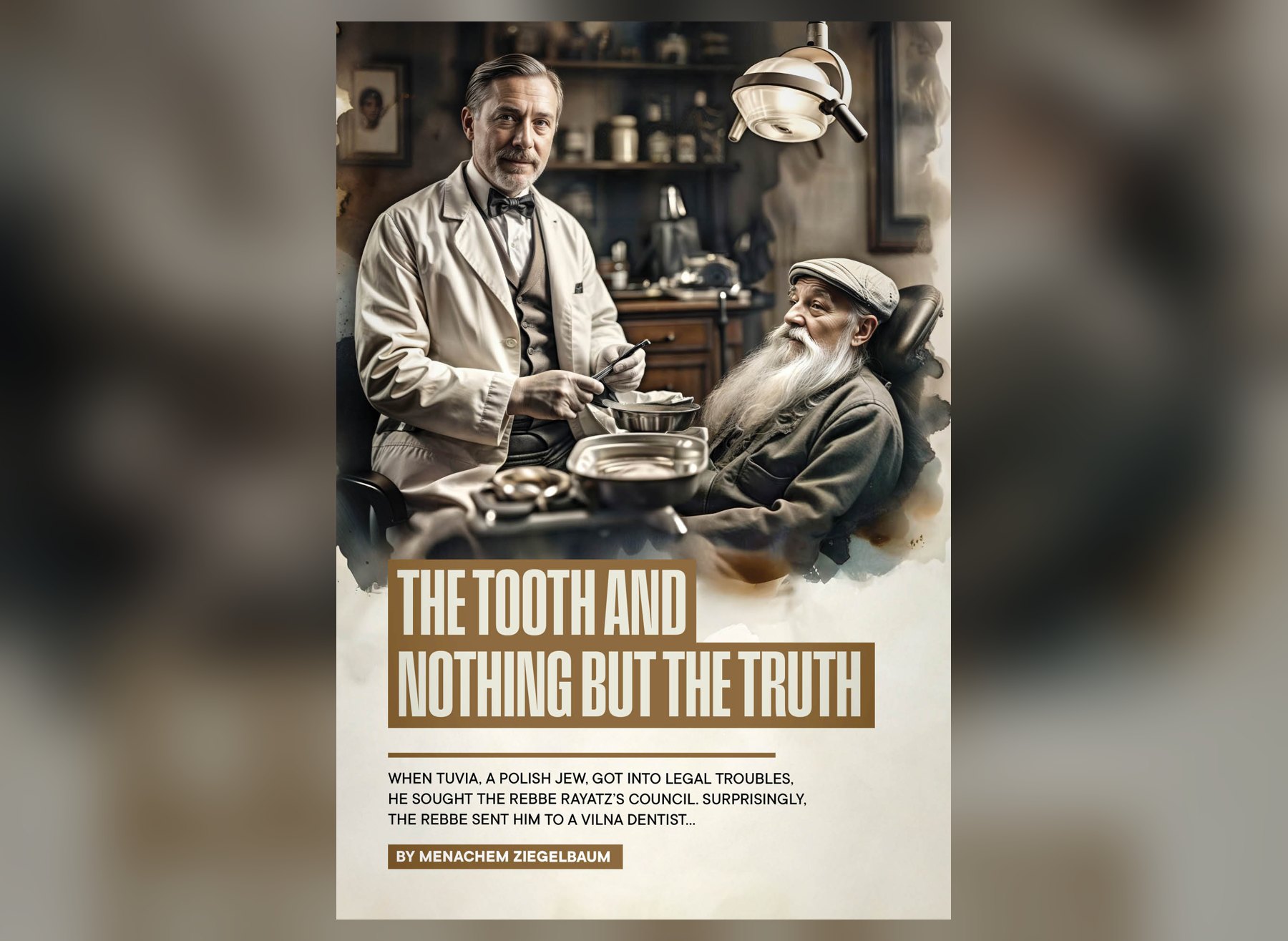
When Tuvia, a Polish Jew, got into legal troubles, he sought the Rebbe Rayatz’s council. Surprisingly, the Rebbe sent him to a Vilna dentist…
I
They, Tuvia and his wife Rosa, were a Jewish couple in their fifties living in the town of Pszanów in Poland. Their lives were quite peaceful. Rosa was a simple woman with a warm heart, a housewife who performed all household tasks with alacrity and joy, while in between, she recited Tehillim and read from Tzena U’rena.
Her husband Tuvia was an experienced businessman. His watch shop, located at 18 Marształ Street near the city center, not only sold retail but also wholesale to traders who traveled and wandered between the various towns of Poland.
The tranquility in the family’s home was perfect, despite the differences between Tuvia and his wife. For example, while she was a fervent believer in tzaddikim (and there was no shortage of them in Poland at that time), Tuvia was colder, more moderate, and more rational. While Rosa’s eyes sparkled at every miracle story of the great Rebbes of her time, Tuvia’s eyes would narrow in concentration, and then he would mumble something and return to his affairs. All of Rosa’s attempts to excite her husband with the faith in tzadikkim were in vain.
II
One day, Tuvia returned from work early. Rosa’s eyes widened. Her inner sense had already predicted trouble. She looked at her husband questioningly. He poured himself a glass of water, sat down across from her, and sighed. “We have a serious problem,” he began, and her heart skipped a beat. “A very serious problem. I received a court summons.”
“What happened?” A choked scream escaped her lips.
Tuvia recounted to his wife the story of the slander that was reported to the authorities, probably by rival traders, claiming he was evading taxes within his extensive business dealings. He told her as many details as she could handle. “I have already been to our friend, the lawyer Mr. Pashter,” he offered cautiously, “and he said the situation looks very serious, and we need to think about what to do to win the trial.”
It took Rosa a long time to recover, but once she did, she was as vigorous and decisive as ever. While wiping her hands with determined movements, she announced to her husband that “you are going to the Lubavitcher Rebbe, and you will ask him what to do and request his blessing.” When she said “the Rebbe of Lubavitch,” she meant the Rebbe Rayatz, who at that time resided in Warsaw. It was during the nesius of the Rabbi Rayatz, between the period in Russia and the period in America – when his net was spread across all of Poland and even beyond.
“Travel to the Rebbe? Why on earth would we travel to the Rebbe?” Tuvia fumed. “What does he have to do with taxes and law?” His eyes narrowed again, and his wife could clearly see that he was angry. She was not fazed. “You will go to the Rebbe now and consult with him about what to do,” she said decisively. Tuvia shrugged his shoulders: “I understand that the rabbi knows how to study Gemara, knows Kabbalah, says Chassidus in front of Chassidim, but what does he understand about legal matters?” He repeated his claim with disbelief and reluctance.
It was impossible to move Rosa from her position. “If he is a Rebbe, then he knows everything, there is nothing the Rebbe doesn’t know!”
While speaking, she poured red lentil soup into the bowl in front of him, its aroma wafting far and wide. The danger to his freedom, and perhaps the determination of his wife along with the comforting soup, left Tuvia no choice but to leave for Warsaw the very next day and meet the Lubavitcher Rebbe.
III
About two hundred and twenty kilometers separate Pszanów from the capital, Warsaw. After several hours of traveling by train, he arrived at the bustling Warsaw station. He quickly located the Rebbe’s address and was received for a private audience. He detailed the matter extensively to the Rebbe and spoke about the ongoing legal case against him.
“It is impossible to know how this will end,” he said.
The Rebbe’s glowing face instilled hope in him. The holy eyes, like two shining diamonds, looked at him for a long moment. The Rebbe raised his hand and said, “You must travel to Vilna, where there is a dentist named Dr. Mark Lazovsky. Visit him, and Hashem will grant you success.”
Tuvia understood that the yechidus had ended, and he stepped outside, silent and very surprised. The Rebbe’s words seemed strange and unrelated to his situation. The one who bore his bitterness was Rosa, when he returned home.
“I told you!” he spat bitterly at her. “Why are you making a fool of me? He sent me to Vilna, what do I have there? Do I really have toothaches?! As soon as I enter the dentist’s office, he’ll ask me which tooth hurts, and what will I tell him?” Tuvia scoffed in anger.
Roza, like an iron wall, was not moved by her husband’s words.
“If the Rebbe said ‘Vilna’ – then it’s off to ‘Vilna.’ There is no other option. Go in peace.”
It took a little more time, but finally, Tuvia was convinced, perhaps willingly and perhaps due to having no other choice, and he left for Vilna. After a long search, he found the address of the dental clinic of Dr. Mark Lazovsky. When his turn came, he sat down in the patient’s chair and sighed. The doctor looked at him, and he looked at the doctor. He knew that this was the moment he would have to come out of the conversation looking foolish.
“Well, open your mouth. Which tooth is hurting you?”
“Listen, Doctor, I don’t have a toothache…”
The doctor stared.
“So why did you come here?”
“My teeth are all fine, thank G-d. I came here because I have a problem with false accusations that I am being charged with, and soon I have to stand trial. I was with the holy Rabbi Yosef Yitzchok Schneersohn, and he is the one who referred me to you.”
“Rabbi Schneerson sent you here?” Lazovsky said, half mumbling to himself, half expressing understanding. “Well, come back to my clinic tomorrow at four in the afternoon.”
Tuvia left the dentist’s office confused and embarrassed. He saw the doctor’s understanding reaction and realized that there was something to it. ‘Surely there is some connection between the Rebbe and the doctor,’ he thought to himself, but he still didn’t know what or how. In fact, he was confused.
The next day, at the appointed hour, Tuvia returned to the clinic. This time, his heart was quieter than the day before. Upon his entrance, the dentist hurried out to him from the treatment room and instructed him to take his place in the waiting room until he was called inside. Tuvia then sat down and sighed lightly.
As he sat and waited, he heard from the inner room the dentist telling the patient lying in the chair about the lawsuit directed against another patient of his, against him, Tuvia. Despite the torturous noise of the drill, he managed to hear most of the story sliding smoothly from the doctor’s mouth. Tuvia was angry. “What is he doing?” astonished. “I told him things in confidence. These things must not be made public as it might doom me. Why is he telling others about it without my permission?!”
Despite his anger, Tuvia had no choice but to hold back. He continued to sit on the chair as if on smoldering coals. The patient’s mumblings during the treatment sounded like a response to the dentist’s words, but Tuvia couldn’t grasp the content of what was being said. After a few minutes, the dentist came out of the room.
“The person who is being treated by me now is a judge. I told him about your problem, and he wants to hear all the details of the story from you; perhaps he can help you. Come in and tell him the whole story.” The two entered the treatment room. Tuvia recounted, the dentist drilled, and the judge listened attentively. When he finished, the judge signaled the doctor to stop for a moment.
“And what do you have to say in your defense? The facts are not that simple.”
Tuvia immediately laid out the facts as they were, adding that he had evidence for all his claims.
“These are nothing but baseless and unfounded false accusations,” Tuvia argued passionately. “My competitors seek to slander me – nothing more.”
“On what day do you have to appear in court?” the judge asked, and Tuvia stated the date. When the judge-patient got up from his chair, he pulled out his diary from his bag, glanced at it for a moment, and smiled broadly: “You know what? That’s the day I am scheduled to hold court… Well, listen carefully to what I propose: From here on in, you neither know me nor I you. You will appear on the appointed day in court, and when I turn to you to present your arguments and defend yourself, you will say exactly what you told me here without any sign or hint that we met each other beforehand.”
IV
Tuvia returned to his home in the city of Pszanów where his wife Rosa was waiting for him impatiently. “So, what happened at the dentist?!”
Tuvia began to recount to her all the details of the story, about his meeting with the judge and the presentation of the case.
Her eyes lit up. “Now you believe that the Rebbe knows what he’s doing?!”
While Rosa didn’t need any convincing at all; from her perspective, the Rebbe’s advice had already been beneficial the moment it was given, Tuvia still needed some persuasion. He didn’t give up.
“Let’s see how it turns out first,” he said.
This time, he was less forceful, but Rosa didn’t hold back.
“Well, the matter is already settled as far as I’m concerned,” she replied. “You’ll win the trial, go back home, and everything will be fine. I’m sure of it.”
It goes without saying that the trial proceeded as planned. The judge called Tuvia and asked him to present his case. Tuvia did so with the same fervor as when he stood in the dental clinic before the judge in the treatment chair.
The judge furrowed his brows as if pondering the words, flipping through the documents before him with excessive seriousness. Finally, he banged his gavel and declared that all the claims and accusations against Tuvia were unfounded, and that he was acquitted.
“You are free to go,” he addressed him.
Adapted from a story told by the Rebbe’s secretary, Rabbi Yehuda Leib Groner, at a Chassidishe farbrengen. .
Beis Moshiach #1447 • pp. 34-37
© 2026 Beis Moshiach Magazine. All rights reserved.
This article originally appeared in Beis Moshiach #1447. You are welcome to share it with friends and family by email or in print, provided that you do not change, add to or omit any part of it, you credit the author and Beis Moshiach, and you include a link to archive.bmoshiach.org (written out in full in printed copies).
To republish this article in a newspaper, magazine, book or website, please request permission in advance at [email protected].