An Orthodox Rabbi in a Communist Parliament
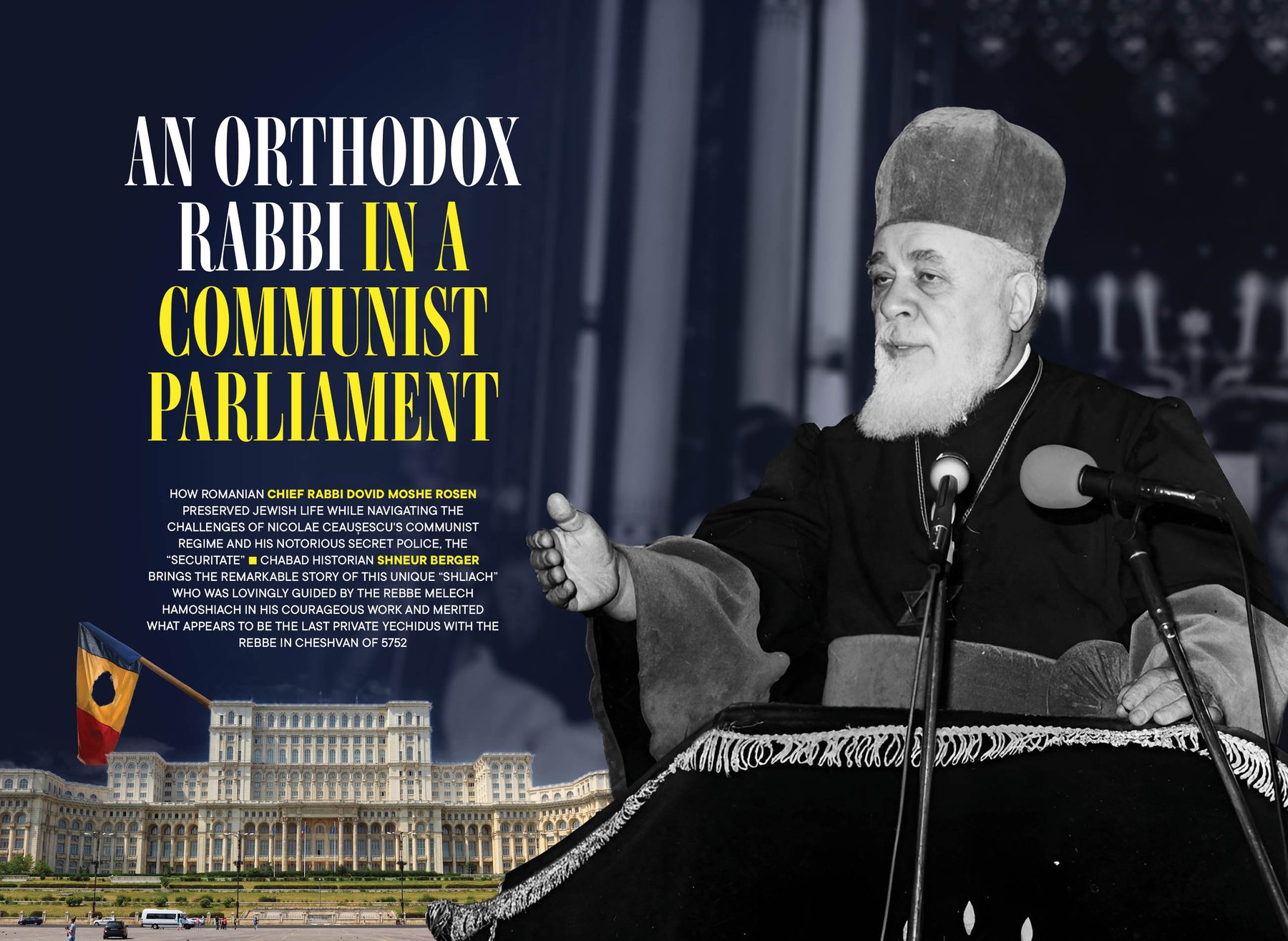
How Romanian Chief Rabbi Dovid Moshe Rosen preserved Jewish life while navigating the challenges of Nicolae Ceaușescu’s communist regime and his notorious secret police, the “Securitate” * Chabad historian Shneur Berger brings the remarkable story of this unique “shliach” who was lovingly guided by the Rebbe Melech HaMoshiach in his courageous work and merited what appears to be the last private yechidus with the Rebbe in Cheshvan of 5752
Communist Romania was one of the countries that became a major challenge as far as the Jewish community was concerned. Unlike other Communist states in the Soviet Union, Romania was the only one that maintained ties with Israel throughout the years. The attitude toward Jews and Judaism was different than other Communist countries, although in Romania too, the approach was far from liberal.
Although outwardly residents could freely practice their religion, at the same time Romania was ruled by the Communist dictator Nicolae Ceaușescu. He instituted a murderous totalitarian regime in his country.
The government did everything to enforce strict laws in every domain through the secret police. The surveillance by the secret police, the “Securitate,” was extremely rigorous. Citizens themselves were under severe restrictions. A citizen who was targeted by the authorities would be placed under close surveillance with listening devices. If caught in an act or saying something inappropriate in their view, they would be sent to prison or even prolonged exile.
Even at Jewish tefillos and events held in shuls, plainclothes officers would arrive to “maintain public order.” They would come with recording devices under their clothes to ensure no one dared speak against the authorities or organize activities that went against the Communist regime.
On the other hand, the Romanian government kept shuls open, as well as other religious institutions, but activities were conducted under their watchful eye.
Jewish officials, rabbis, and community leaders were also expected to operate strictly within the framework established by the state. Anyone who deviated was arrested and exiled. For instance, Rabbi Eliezer Zusia Portugal, the Skulener Rebbe zt’l, was exiled. At one point, the authorities began to restrict his movements and would arrest him from time to time. In 1959, he was imprisoned for an extended period. Only through lobbying efforts by Jewish organizations and leaders, including the Rebbe, was he released from prison and expelled from the country.
Rabbi and Leader
Against this challenging background, Rabbi Dovid Moshe Rosen a’h worked as Romania’s chief rabbi while shepherding his community. Rabbi Rosen served as Romania’s chief rabbi for 46 years, from 1948 until his passing in 1994. He also served as chairman of the Federation of Jewish Communities in Romania, and for some years, he held the distinguished position of member of the Romanian Parliament. In this role, he would appear in his rabbinical attire and was treated with respect and open appreciation by government officials.
Over the years, he received encouragement and support from the Rebbe, and from 5721-5752 he was granted private audiences with the Rebbe almost every year. R’ Rosen also received many letters and messages from the Rebbe over the years regarding matters connected to Romanian Jews, with much more concealed than revealed.
R’ Rosen was born in 1912 in the town of Moinești, in the Bacău district of Romania, to his father Rabbi Avrohom Aryeh Leib Rosen, a descendant of the Ruzhiner dynasty and a prominent Chassid of Chortkov. He named his son after his teacher, the holy Rabbi Dovid Moshe of blessed memory.
When Dovid Moshe was only 4 years old, the family moved to Fălticeni in the Suceava district of Moldavia, Romania, where his father was appointed as the city’s rabbi and darshan in the Chabad shul. It was there that young Dovid Moshe first encountered Chabad.
In his childhood, he studied Torah from his father. At age 14, after publicly expressing a position against the acquittal of Nicolae Totu, the murderer of Jewish student David Falik, he was arrested and tried on charges of desecrating the names of the king and queen. He was convicted but received a pardon after a month. From then on, he was viewed by the authorities as a “Bolshevik.”
In his youth, he enrolled as a student in the law school track in Bucharest, but due to the violent antisemitic atmosphere there, he discontinued his studies and went to Vienna to study at an institute for rabbinical studies.
Upon his return to Romania, he was ordained as a rabbi by members of the rabbinical council in Bucharest.
His first rabbinical position was in a shul in his hometown. In the summer of 1940, he was appointed as the rabbi of Suceava, and in the following years, he served in various rabbinical positions.
After World War II, Romania was liberated by the Red Army and formed an alliance with Communist Russia. The authorities established the “Jewish Democratic Committee” at that time to manage Jewish community life according to the government’s wishes.
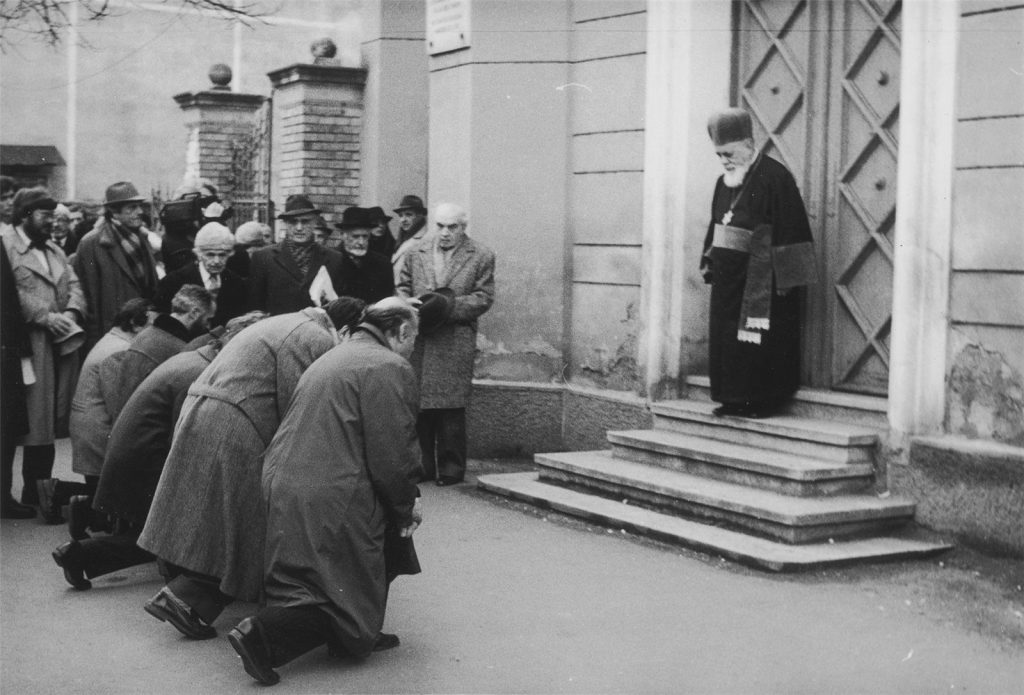
In the summer of 5708, elections were held for the Chief Rabbi of the country, with the participation of rabbis and community representatives from all over Romania. R’ Moshe Rosen was elected by a majority vote as the Chief Rabbi of Romania, a position he held, as mentioned, until his passing in 5754. Needless to say, despite the independence he had, he was always subject to the Communist regime.
Despite this fact, he worked and did much to strengthen Jews and Judaism in Romania. Even when the authorities eased conditions for the country’s Jews, and even established many Jewish institutions, R’ Rosen was still under close surveillance by Securitate agents.
R’ Rosen, with his wisdom and astuteness, knew how to navigate carefully all those years, helping Judaism flourish among Romanian Jews while not antagonizing the authorities. Because of this, he received quite a few sharp criticisms, alongside compliments and much appreciation.
“I Have Time for Sixty Thousand Jews”
Over the years, R’ Rosen maintained a close connection with the Rebbe, who was mekarev him greatly, received him for lengthy yechiduyos over decades, heard detailed updates from him about the situation in Romania, and even transmitted various messages and instructions through him.
The first time R’ Rosen merited a private audience was in 1961. This yechidus lasted a long time. After that, throughout the years, he was granted many lengthy private audiences, even after private yechidus was discontinued.
“I am an enthusiastic admirer and appreciator of the Rebbe,” R’ Rosen said about his impression of the Rebbe. “Every time I have the privilege to be with him, I observe that he is thoroughly familiar with the state of Judaism in Romania. It is unbelievable how all the instructions and advice he gave me over the years hit the mark in an amazing way.”
The special relationship the Rebbe accorded him can be learned from the following incident he related:
“During one of my visits, I saw in the waiting room many rabbanim and gedolei Torah waiting to enter the Rebbe’s room. When I entered, the Rebbe’s first question was: ‘How many Jews are there in Romania?’ I answered: ‘Sixty thousand.’ Then when he asked me to sit down, knowing that many were waiting and his time was limited, and so that I would know which main points to focus on, I asked the Rebbe how much time was allocated to me. The Rebbe said: ‘I’ve already answered you!’ I was surprised and said: ‘But I didn’t ask before?’ And the Rebbe insisted: ‘I’ve already answered you!’ I was puzzled and said again: ‘But I didn’t ask before?’ And the Rebbe repeated: ‘I’ve already answered you.’ Finally, seeing that I didn’t understand, the Rebbe said to me: ‘However much time sixty thousand Jews need, I have for you…’”
About the deep spiritual connection between the Rebbe and R’ Rosen, the latter himself recounted with great amazement:
“One day, on the day after Simchas Torah in the morning, my phone rang, and on the line was, to my great surprise, Rabbi Chodakov, the Rebbe’s secretary. Rabbi Chodakov told me that the Rebbe was interested in knowing how I was feeling, and then my surprise turned to astonishment.
“The previous night, when I returned home after the hakafos, we sat down for the Yom Tov meal, I went to sleep, and at about four in the morning I suddenly felt unwell. When I tried to get up, I lost consciousness and collapsed. They thought about rushing me to the hospital, but after a few moments I surprisingly recovered and got up on my feet as if nothing had happened.
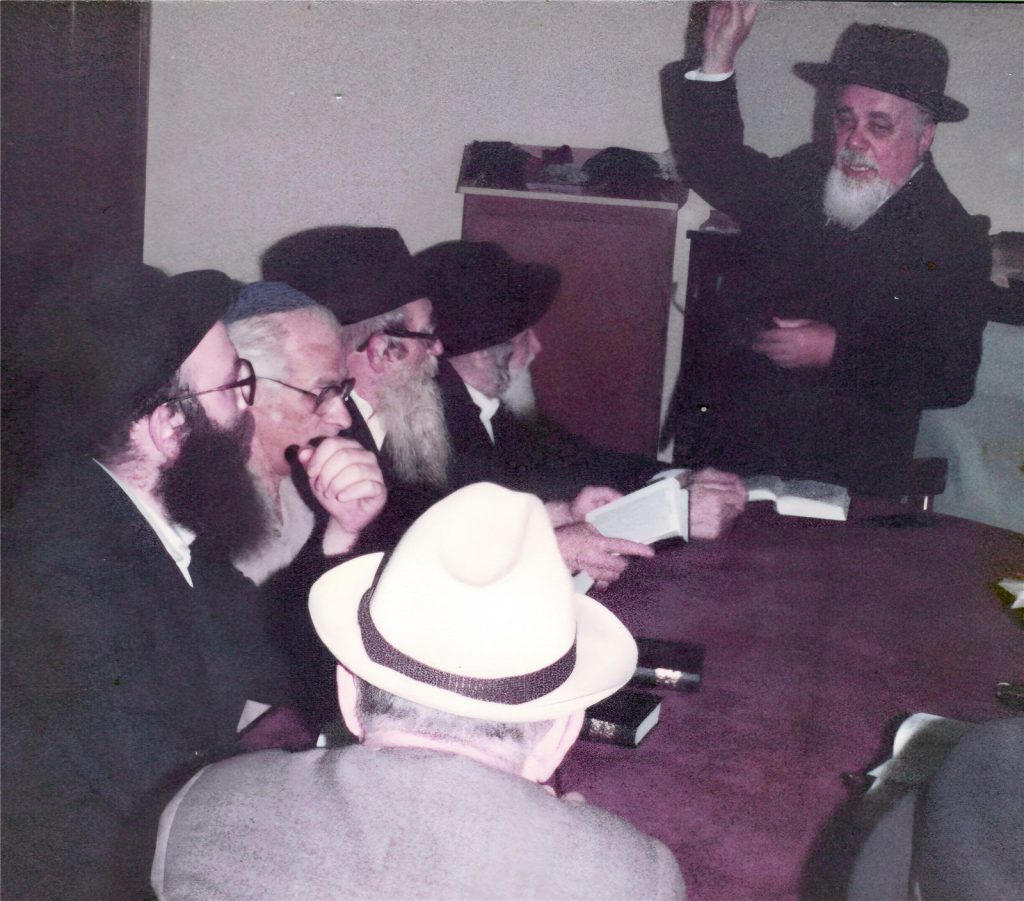
“Still surprised, I asked Rabbi Chodakov: ‘How did the Rebbe know I wasn’t feeling well?’ Rabbi Chodakov answered me: ‘I don’t know. Last night, in the middle of the Simchas Torah farbrengen, the Rebbe called me over and asked me how Rabbi Rosen was doing. And he even told me to say ‘l’chaim’ on your behalf. Now, about ten minutes ago, when the distribution of kos shel bracha ended, the Rebbe called me to his room and asked me to call and inquire about your well-being. I asked Rabbi Chodakov: ‘At what time yesterday did the Rebbe mention me during the farbrengen?’ When Rabbi Chodakov told me the time – I saw that it was exactly at the moment when I collapsed at home…”
Never Retreating From the Battlefield
R’ Rosen’s challenges in his high position were not simple. The conflicts he faced between the community’s welfare and pleasing the authorities often led him to want to leave his position and emigrate from Romania. During one yechidus, the Rebbe told him (the content of the words): The father-in-law [the Rebbe Rayatz] had great sorrow from leaving Russia. You should know that you are doing much more than many rabbanim and Admorim when you are in Romania.
In 1984, R’ Rosen purchased an apartment in Eretz Yisrael. When he entered for a yechidus, the Rebbe brought up this topic on his own initiative, saying he had heard about the apartment purchase. He urged R’ Rosen to remain in Romania.
“When will I also provide for my own household?” asked R’ Rosen, citing the verse uttered by Yaakov Avinu to Lavan, and the Rebbe replied: “When you reach my age, we will reconsider…”
Eight years passed. The Communist regime had already fallen, and R’ Rosen reached the age of eighty. On the 10th of Kislev 5752, he again entered for yechidus and asked to leave Romania: “The Rebbe not only demanded that I stay in Romania but gave me to understand as always that I am on a shlichus, and I must draw strength from the shlichus… In every yechidus, I understand anew from where the Rebbe’s shluchim draw their strength…”
Indeed, R’ Rosen did not retreat from the battlefield, and for 46 years he served as the country’s Chief Rabbi until his last day in 1994, standing guard over all that is holy to the Jewish people much as he could.
“The Rebbe has a decisive part in the fact that I am still in Romania,” he later recounted in an interview he gave to Kfar Chabad. “I have had an agreement with the Romanian government since 1961 that I can leave whenever I want. Indeed, Moshe Sharett, Golda Meir, Zalman Shazar, Menachem Begin, and others, always urged me to stay and not leave, but that’s not what influenced me. What was decisive for me was only the Rebbe’s opinion that I should stay there. So much so that about two months ago when I was in a private audience, the Rebbe told me that he heard I bought an apartment in Eretz Yisrael – ‘I was really shocked by that’ – he said what he said, and urged me to stay.
“It is indeed very difficult for a person my age to be wandering. I have to travel a lot from here to there and to other countries, etc., but, as mentioned, the Rebbe’s commandment is strong upon me, and he is also the one with the correct perspective on all matters related to the Jewish people, and I see as an exceptional honor and privilege the Rebbe’s special concern for the problems of Romanian Jews and the guidance and advice that I merit to receive from him.
“Even now when I had the privilege to sit with him for about two hours, I also want to note my amazement at the fact that, despite his age, he is as fresh as a very young man and is completely alert to every detail of our affairs, and showers us with an abundance of wisdom and understanding in his advice and guidance.”
The last yechidus he was granted took place on Yud Kislev 5752 and it lasted about an hour and a half in “Gan Eden HaTachton.” At the end of the yechidus, the Rebbe accompanied R’ Rosen through the side entrance until his exit from 770. He was the last person, for now, whom the Rebbe received for a private audience…
About this yechidus, one of the tmimim wrote in his journal: “Tonight R’ Moshe Rosen visited for a yechidus for about an hour and a half!… The event might not have been known at all, if not for a bachur who recognized him and gave him ‘Shalom Aleichem.’ R’ Rosen answered him hastily that he was in a hurry, and when the young man asked where to, the Rav answered: ‘To the Rebbe…’
“The yechidus began at 8:15 PM and lasted until 9:45. When he came out, he was surrounded by some of the tmimim who had learned about it, and they asked him about the content of the yechidus. R’ Rosen didn’t want to tell and sufficed with a brief answer: ‘Jewish matters on the agenda were discussed, and the Rebbe appeared pleased…’”
The Rebbe’s Shliach to Romania
One who assisted R’ Rosen in his activities was Rabbi Yisroel Tzvi Heber, who arrived as the Rebbe’s shliach to Romania. R’ Heber worked extensively within the local community, in complete coordination with R’ Rosen.
In 1973, R’ Heber first arrived in Romania to serve as a shochet, but on the Rebbe’s instructions, he combined his work with extensive activities to spread Yiddishkeit, albeit with the necessary caution.
After a period of activity, he returned to Eretz Yisrael, but later returned to Romania per the Rebbe’s instructions for another period of several years.
The Chief Rabbi quickly recognized the quality of R’ Heber the Lubavitcher and enlisted him for various matters.
“I wouldn’t be exaggerating if I said that R’ Rosen was a Chassid in the fullest sense of the word, connected with all his soul to the Rebbe and obeying his instructions,” R’ Heber later recounted. “The very fact of his remaining in the Romanian vale of tears was only because of his complete obedience to the Rebbe’s instruction.”
R’ Heber added: “But how did I know that R’ Rosen was indeed ‘one of us’ and could be trusted without concern?
“Well, it was the first time I traveled to Romania, and R’ Rosen told me that ten years earlier he had been in a yechidus with the Rebbe, and the Rebbe told him that he had received a Jew who had left Russia after ‘earning’ an arrest there for spreading Judaism. This person told the Rebbe that one of the questions in his interrogation was: ‘Do you have connections with the Lubavitcher Rebbe, who is the greatest Rebbe in the world and the greatest enemy of communism?’
“The Rebbe continued and told me: ‘The first detail they asked him is not correct, but the second detail is correct…’
“From this I understood,” R’ Heber concluded, “that Rabbi Rosen was not a communist or a ‘state-appointed rabbi’ and I had full confidence in him throughout my stay in Romania…”
R’ Heber, for his part, worked quietly and discreetly, without fanfare, to strengthen Judaism. He did this in various creative ways.
Once he recounted how he managed to cancel instrumental music playing on Shabbos in a shul:
“Once in Bucharest, Tzvi Altdorf, the only community member who was shomer Shabbos, came to me and told me that in the ‘Sinagoga Mare’ shul they play the organ on Rosh Hashana and Yom Kippur! I was shocked and wrote a strongly worded letter to R’ Rosen, who was on vacation outside the city at that time.
“When he returned to Bucharest, I went to his office. I arrived just as a meeting with all the shul gabbaim in Bucharest was ending. When they saw me, they pointed at me and said to each other: ‘He is responsible for this whole matter…’ When I entered R’ Rosen’s office, I saw my letter open on his desk, and I already understood what I was ‘guilty’ of…
“The Rav told me that following my appeal, it was easier for him to convince the gabbaim to stop using musical instruments. He even agreed with them that a sum of money would be given to the chazan to organize a choir to help him instead of musical instruments.
“In general, it is worth noting R’ Rosen’s praiseworthy stance in the breach on all matters of Judaism, as well as his responsiveness to the Rebbe’s inyanim. R’ Rosen had power due to his high position and special skills.”
A Jewish Newspaper Versus Censorship
Of the prohibitions and restrictions in Romania, the most severe prohibition was on freedom of speech and expression, freedom of writing, publishing, and creative expression. All these were reasons to make R’ Rosen’s activities difficult. However, despite all the limitations, R’ Rosen managed to produce a Jewish newspaper, a bi-weekly in four languages, called Journal, and in Yiddish Tzayt Shrift.
The journal was distributed among institutions and individuals in Romania, to Jewish communities throughout the country, and was even sent to communities in the Moldavian Republic and Northern Bukovina. This newspaper was an educational and informational tool par excellence. It excelled in imparting Jewish values and rich Jewish-historical knowledge. It also published R’ Rosen’s articles on the weekly parsha, as well as brief news items from the Jewish world and Israel.
Each issue, before publication, had to receive approval from the Commissioner of Religions. Often there were fierce disagreements about whether the material published in it was too nationalistic. Often the Commissioner prohibited the publication of certain material – especially R’ Rosen’s articles addressing antisemitism in Romania.
Over the years, ideas from the Rebbe’s sichos were also published in the newspaper, as well as special Chabad events, or reports on activities of a Chabad bent.
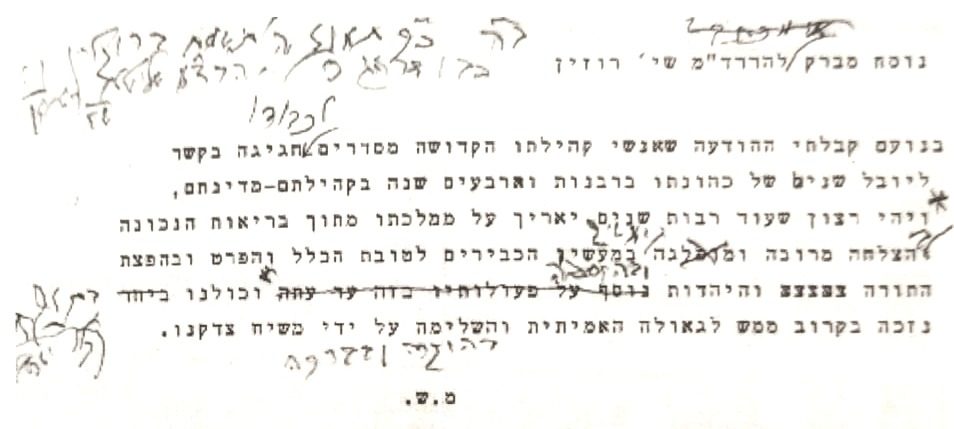
When the journal completed 30 years of publication, the Rebbe sent a special congratulatory letter, in which he noted the merit of the newspaper:
“…And if the dissemination of Judaism and Torah values was always a vital matter for our Jewish brethren and the necessity to do this in a way that reaches the widest circles of readers, then in our era, and especially as this is the only journal in several countries in Eastern and Western Europe appearing in the language of our Holy Torah and together with this also in the language of the country, etc., so that those who still do not understand Lashon HaKodesh and Yiddish, the word of G-d and His Torah and mitzvos will reach them too, the necessity for this is many times greater” (Igros Kodesh volume 38).
In 5742, when the Rebbe initiated the project of writing a general Sefer Torah for the Jewish people, R’ Rosen purchased thirty-three thousand letters on behalf of all Romanian Jews… The siyum ceremony took place on the 17th of Sivan 5742, and R’ Rosen came especially to take part in the great celebration, in which tens of thousands of Jews from his country participated.
After the hakafos, R’ Rosen spoke with evident emotion in his voice due to the event, “something that with us in Romania is impossible to arrange.”
Printing the Tanya in the Romanian Capital
Over the years, two editions of the Tanya were printed in Romania. The first time was in 5603/1843 in the city of Iași, and the second time – in Bucharest in 5744. Printing the Tanya under Communist rule was a dream that was hard to believe could come true, but with the Rebbe’s encouragement, the task was accomplished.
It turns out that the initiative for this came as an “arousal from above” from the Rebbe. In a letter the Rebbe sent to R’ Rosen (18 Elul 1978 – Igros Kodesh volume 30) he writes:
In connection with the auspicious day of 18 Elul, the birthday of the Alter Rebbe, author of the Tanya and the Shulchan Aruch, and the Baal Shem Tov, may their merit protect us, the holy book of Tanya by the Alter Rebbe has been printed in several countries in offset printing. And I come with a suggestion that if his honor finds it appropriate, they should do so also in the capital city of his country, where there are surely several offset printing houses, through which the expenses are relatively not great, and the main thing is that there is no need for proofreading, but only to change on the title page, the place of printing, and the year of printing.
The printing somehow did not materialize that year. Only several years later, the shochet Rabbi Shmuel Gloiberman asked R’ Rosen for permission to print the Tanya. R’ Rosen responded with an absolute negative. R’ Gloiberman, who wrote about this to the Rebbe, received a response that it was not worthwhile to spoil relations with R’ Rosen.
Throughout 5744, the Rebbe encouraged printing the Tanya in many places around the world. That year, R’ Heber received instructions to print the Tanya with permission from and in cooperation with R’ Rosen.
Indeed, after overcoming many challenges, the Tanya was printed even in the communist country.
* * *
Rabbi Rosen passed away while at his post, as per the Rebbe’s request. He was brought to Eretz Yisrael and buried there. He and his wife were childless.
In 5759, Rabbi Naftali Deutsch, shliach of the Rebbe, arrived in Romania. Since then, he has been working among the Jews of Romania to spread Yiddishkeit and Chassidus, alongside other shluchim, and they see success in their work.
Sources: Igros Kodesh, Shlichus in Communist Romania, Admorei Chabad and Romanian Jewry, Shemen Sasson Mechaverecha, Beis Moshiach, Kfar Chabad, Interviews, and more.
Beis Moshiach #1452 • pp. 20-27, 28
© 2026 Beis Moshiach Magazine. All rights reserved.
This article originally appeared in Beis Moshiach #1452. You are welcome to share it with friends and family by email or in print, provided that you do not change, add to or omit any part of it, you credit the author and Beis Moshiach, and you include a link to archive.bmoshiach.org (written out in full in printed copies).
To republish this article in a newspaper, magazine, book or website, please request permission in advance at [email protected].