A Scroll Touched by Heaven

The story of the Maharam of Rothenburg Sefer Torah
I
For many long years, Rabbi Meir of Rothenburg (1215-1293), the Maharam, one of the great Baalei Tosafos and the prominent teacher of the Rosh, was imprisoned in King Rudolph’s fortress, “because the king falsely accused him of a certain matter.” The king, who was clever, understood that the Jews of Rothenburg, and not only they, would give any amount of wealth to release their great Rabbi. The king coveted this wealth.
When Rabbi Meir heard of this, he issued a decree, unofficially, that no one should give the king more money than the value of his release – his reasoning being that the money would only cause the king to continue with his wicked actions and imprison more rabbis and righteous people to demand a great ransom for their release.
The people of Rothenburg could not remain indifferent when they knew their great Rabbi was imprisoned under harsh and disgraceful conditions. They tried to persuade him to allow for his ransom, and among them was his distinguished student, the Rosh, who even offered to sit in place of his master. But this tzaddik did not agree to their requests and prepared himself to remain in prison until the end of his life.
The sorrow of Rabbi Meir was immense, not because of his imprisonment, but because he had nothing with him except his tallis and tefillin, which he was allowed to bring inside. By special permission, a quill, ink, and parchment were also brought to him so he could write down the Torah insights that came to him during those dark days. In time, his student, Rabbi Shimshon ben Tzaddok (author of Sefer HaTashbetz) was also allowed to visit and study with him.
In prison, Rabbi Meir immersed himself deeply in Torah study, diving deeper and deeper, extracting pearls and jewels from the sea of Torah. The Talmud, both Bavli and Yerushalmi, the Sifra, Sifri, Tosefta, and the teachings of the great Rishonim were all familiar to him.
While in prison, he wrote a commentary on the Mishna, Seder Taharos, where he wrote among other things: “I have worked on and added to the chapter ‘Migdal HaPoreach B’avir’ in the Migdal of Ensisheim while I was imprisoned there, apart from what I had already written on it when I was at home. Praise and glory to G-d, my extolment, who did not remove His prayer and kindness from me, and in the darkness, His word was a lamp to my feet and a light to my path, and He did not abandon me and will not forsake me all my days, and even after my death.”
Despite this, his sorrow was great that he had no kosher Sefer Torah with which to read the weekly parsha on Shabbos. The tzaddik’s sorrow was unbearable, and he found no rest for his soul. He understood that, in the natural way of things, he would not hear a proper Torah reading from a kosher Sefer Torah until he was released, if at all…
II
It was a Friday night. Rabbi Meir sat in his prison cell, reviewing his studies by heart as was his habit. Despite his exhaustion, he continued to study Torah fervently, knowing that “they are our life and the length of our days.” The small candle that flickered in his cell barely illuminated the heavy darkness.
Suddenly, he heard a strange sound. When he lifted his eyes, he saw a great light before him, and in the light stood a Malach Elokim (angel of G-d,) holding a Sefer Torah. Rabbi Meir recognized the angel as Gavriel. He did not know how he knew this, but he did. The tzaddik looked at the angel in awe and trembling, not daring to speak.
“Meir ben Baruch, blessed of G-d and beloved of mankind!” the angel began. “In the heavenly court, they saw your sorrow over bittul Torah and had compassion on you. Therefore, they commanded me to bring you this Sefer Torah. Know that this Sefer Torah is one of the thirteen Torah scrolls that Moshe Rabbeinu, the master of prophets, wrote before his death. Twelve of them were distributed to the shevatim, one scroll for each tribe, and the thirteenth was brought to the great heavenly court, where the tzaddikim in the heavens read from it on Mondays, Thursdays, and Shabbos, on Rosh Chodesh, and on Yomim Tovim. Since they had mercy on you in the heavens, I have brought you this holy scroll so that you may read from it aloud during the times of Torah reading, so that the tzaddikim in Gan Eden may hear from your mouth the divrei Elokim chaim.”
The angel finished speaking, and before Rabbi Meir could respond, he placed the scroll by his head. In a flash, the angel vanished, and the darkness returned to envelop the prison cell.
The Maharam did not know what to think. A great joy and astonishment filled his heart, and from this indescribable feeling, he woke from his sleep. It seemed that while he had been studying Torah, a deep slumber had overcome him…
He raised his head, looked around, and to his amazement, saw a Torah scroll lying by his pillow.
Quickly, the tzaddik washed his hands and approached the scroll with great reverence – the Sefer Torah written by Moshe himself, the Sefer Torah that the tzaddikim of all generations read in Gan Eden…
Throughout that entire Friday night, Rabbi Meir did not close his eyes. He immersed himself in the Torah in preparation for the Torah reading. For him, it was like a miniature “Mattan Torah,” and therefore, one must prepare with awe and trembling.
After Shacharis which he davened from the depths of his pure heart, he dared to approach the Sefer Torah that had been placed in the corner, exactly where the angel had left it. When he opened it, he was moved to see that it was precisely at the parsha of that week.
With immense emotion, he began reading from the Sefer Torah, and in that instant, the small prison cell was filled with a great light. The tzaddik knew that all the tzaddikim in Gan Eden had gathered to hear his reading, and their holy radiance filled the place.
When he finished reading, he rolled up the sefer, and in that instant, the great light disappeared, and everything returned to how it was before. Then he knew that the tzaddikim had returned to their dwellings in the high places.
From that Shabbos onward, he would read from the Torah during all the reading times—on Mondays and Thursdays, on Shabbos, Rosh Chodesh, and Yomim Tovim. Each time, the tzaddikim from the heavens would gather to hear his reading.
Meanwhile, his imprisonment continued. Seeing this, the tzaddik dared to use the Sefer Torah as a source for oral Torah as well. He would read a pasuk from the precious Sefer Torah and immediately incorporate all the teachings of the sages from the Talmud, Medrashim, and chiddushim from his revered teachers. In this way, he would link together all the teachings and weave together new insights for his pleasure and for the pleasure of the Holy One, blessed be He.
III
One day, Rabbi Meir had the idea to copy the Sefer Torah written by Moshe himself, and to leave an additional scroll, an exact copy, as an eternal memorial for the Jewish people. Rabbi Meir knew that every letter and crown was precise according to what Moshe received from Hashem at Har Sinai.
For many months, Rabbi Meir sat and worked on the copying. With evident affection, he counted the letters like a diamond counter and inscribed them on parchment exactly as written and formed, in holiness and purity. Thus, he prepared a faithful copy of the exalted Sefer Torah.
When he finally completed it after many months, he sat and proofread the new scroll, comparing the two scrolls side by side, and rejoiced in his heart seeing that Heaven had helped him perform this sacred work faithfully. Everything was according to law—the missing letters and added letters, the large and small letters.
Rabbi Meir rejoiced greatly upon realizing that everything was written faithfully and he considered it like the Sefer Torah written by Moshe, directly from the mouth of Hashem.
One night after completing his writing, the tzaddik fell asleep and sank into a deep slumber. Again he dreamed, and in his dream he saw the angel Gavriel descending from heaven for a second time, approaching the corner of his cell and taking the Sefer Torah he had received. He took it and disappeared as he had come…
In fear and trembling, Rabbi Meir awoke from his sleep, went to the place where the sefer had been placed – and it was gone!
The tzaddik burst into bitter weeping. It seemed to him that his entire world had collapsed. Maharam examined his deeds and thought that this punishment came to him because he had copied the holy sefer without permission. If so – he did not know if he was allowed to use the Sefer Torah that remained in his possession, for it was made through a “sin.”
He therefore decided to ask a ‘dream question.’ He fasted and in purity asked his question. Then he was informed from Heaven that he was permitted to use the new Sefer Torah he had written. Moreover, it was made accurately and based on it, sofrim would write other Sifrei Torah for all of Am Yisrael.
When he received this answer, his mind was at ease.
IV
Rabbi Meir of Rothenburg sat in prison for seven years. During all that time, he firmly refused to be redeemed for large sums of money. The king himself would not agree to reduce the ransom by even a whit.
When Rabbi Meir understood that his days were numbered, he realized it was time to send the Sefer Torah to the Jewish communities so they would have a source for copying. However, the tzaddik knew that the king would not agree to remove the Sefer Torah from his cell to the nearby Jewish community, and who knows, perhaps for this too he would demand an enormous ransom.
What did he do? He prepared for himself a wooden box the size of the sefer. Afterward, he coated the box inside and out so that water would not enter. When he finished his work, he placed the Sefer Torah in the box, kissed it one last time, and sealed the box with trembling hands.
From the window of his prison cell, he looked down to the distant base of the fortress, where the waters of the Rhine River flowed. Rabbi Meir closed his eyes in dveikus, partially parting from the precious treasure and partially praying that it would reach its destination safely, and carefully lowered the box into the water… After a split second, the box began to be carried away with the current downstream. Rabbi Meir gazed at it with longing and yearning until it disappeared from his sight…
A few days later, on 19 Iyar 5053 his soul departed in holiness and purity while his pure body remained in prison. No one stood by him at the time his neshama left him.
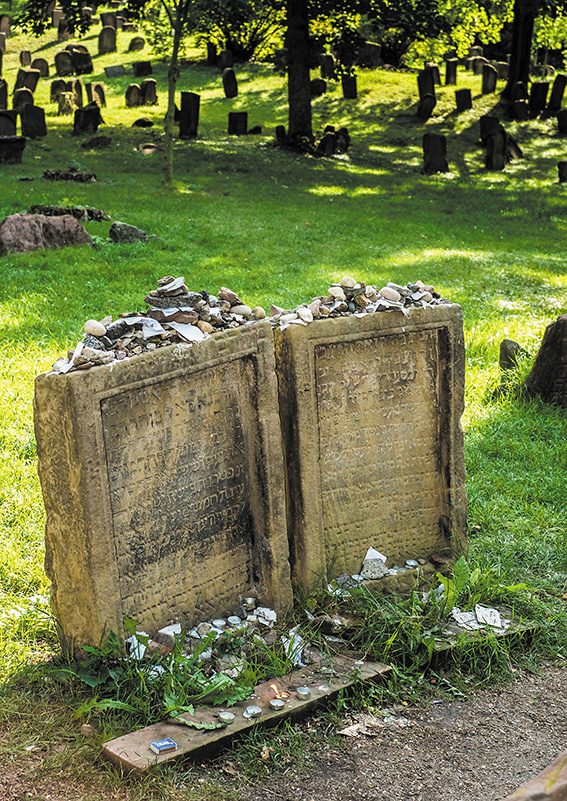
Even now the king persisted in his stubbornness and would not agree to release the body of the tzaddik except for a fortune. For fourteen years the body of the tzaddik lay in the prison cell, until Rabbi Alexander son of Solomon, one of the wealthy men of Rothenburg, risked his life and interceded with the king to bring Rabbi Meir to burial for a large sum. In the month of Adar 5067 (1307), Maharam was brought to proper burial.
It is told that on the night after the burial, Rabbi Meir came to Rabbi Alexander in a dream, his face shining like sapphires. “Choose one of two,” said the tzaddik to the wealthy man in his dream, “either you and your descendants will merit wealth and honor, or you will die immediately and merit to be with me in my proximity.”
The wealthy man responded without hesitation: “To be with you.”
A few months later, on Yom Kippur 5068 (1307), he died, and the next day was buried next to Maharam’s kever. Later, he appeared to the city’s rabbi in a dream and told him that he merited to sit in Rabbi Meir’s heavenly chamber.
V
Days and weeks the box was carried on the waves, passing by cities and countries, moving with the flow of water until it reached the famous city of Worms.
When the fishermen of Worms noticed the wooden box floating on the water, they hurried to try to retrieve it from the water. A hidden find had suddenly come to them in the early morning of a gray day… But the wooden box continued to sail on the waves, moving away and disappearing. All the fishermen’s efforts were in vain. The closer they got to it, the farther it moved away from them, as if it were laughing and mocking them; quickly it escaped and slipped away from them.
By midday, the news about the wonderful box had spread throughout Worms. Many of the city’s residents gathered at the river to see the wonderful box that refused to be caught by its pursuers.
News of the wondrous box also reached the Jews of Worms, and some of them came to the shore to see the wonderful sight with their own eyes. One of them suggested, “Perhaps there is something holy in the box, and that is why it flees from the unclean gentiles?!”
When all attempts failed, a few Jewish fishermen decided to present their proposal to their friends. The gentiles laughed, but they had nothing to lose. “On the contrary,” they said with a dismissive smile, “you try and prove your ability.”
The Jewish fishermen boarded a small fishing boat and began to sail it toward the box. As if by miracle – slowly the boat approached the box. Now everyone was sure that the box would move away, but it stood in place as if waiting and expecting them to take it. After two minutes, the box was held in the hands of one of the Jewish fishermen.
The Jewish fishermen understood that something significant was happening, and with trembling hands they brought it ashore.
The moment their feet stepped on dry land, the Christian fishermen rushed to them and demanded to receive the box and all that was in it. “This find is ours, since we saw it first.” This was not an argument, but an insolent demand to get the box. The Jews understood that their power was weak compared to the brutality of these gentiles, and without saying a word, they gave up the box.
But in vain did the impure ones labor to open the box and move it from its place; but it, like a huge rock, refused to move from the place…
Now it was clear to everyone to whom the box belonged…
The hearts of the Jewish fishermen feared and trembled. With shaking hands, they handled it and rocked it from side to side. They immediately understood that something sublime and holy beyond their understanding was in their hands, and that they should not open it except with the permission of the Rabbi of the city.
With excitement, they brought it to the great shul of Worms, and with the permission of the community’s Rav, they placed it on the reading table. They opened it with fear and trembling and found in it a new and beautiful Sefer Torah, written on deer parchment with shining black letters. The Rav understood that it was not for nothing that this Sefer Torah had arrived in Worms in such a miraculous way; he searched for the solution to the mystery behind the Sefer Torah.
After a thorough examination, his eyes lit up. On the inside edges of the box was inscribed in bright letters: “This sefer is the Torah commanded to us by Moshe, written in the handwriting of Meir. A gift sent to the holy community of Worms. And the scroll is holy and pure, and whoever approaches it shall be made holy. And they shall read from it only twice a year, on Shavuos, the time of Mattan Torah, and on Simchas Torah, the time of the completion of the Torah.”
The Rav’s eyes moistened. He quickly understood that this Meir was none other than the great Rabbi Meir of Rothenburg who had died in prison with great sorrow and pain. The congregation looked at him in expectant silence. “This Sefer Torah was written by our great and holy Rabbi, Rabbi Meir of Rothenburg, may Hashem avenge his blood,” said the rabbi with emotion, “in a way I do not know, this tzaddik has sent us this holy Sefer Torah, and he has earnestly requested that we treat it with extra holiness beyond other Sifrei Torah…”
They immediately crowned the scroll with a gold crown, adorned it with pomegranates and a silver yad, and brought it into the Aron Kodesh with much song.
From then on, this exalted Sefer Torah lay in the Aron Kodesh all year round, and no human hand touched it. Only on the holidays of Shavuos and Simchas Torah, did the gabbaim bring it out with great excitement and read from it, year after year.
* * *
Regarding this Sefer Torah, the Rebbe Rayatz related: “When I was in Worms, I saw a Sefer Torah which they had a tradition was written by Maharam of Rothenburg.” The Rebbe even searched for the word “דכא” to decide on the great question about which scholars disputed how to spell this word, with a hei or with an alef, and saw that it was written with an alef, as Moshe wrote it from Hashem…
This is also mentioned by the Rebbe in one of his letters: “I heard from my father-in-law, the Rebbe, of blessed memory, that when he was in the city of Worms before the First World War, he saw there a Sefer Torah which they had a tradition was written by Maharam of Rothenburg.” (See also in Hayom Yom, 7th of Elul).
(Sources: Sefer HaSichos 5691, end of page 227, briefly there. Igros Kodesh of the Rebbe, volume 14, page 168; and in Sefer HaDoros (5046) additional versions are brought; R. Yechezkel ben Yaakov in “Sefer HaMaasiyos” part 2 page 314. See his sources there page 360. And I was greatly assisted by ‘Chikrei Minhagim’ by Rabbi Y. Gurary.)
Beis Moshiach #1453 • pp. 20-25
© 2026 Beis Moshiach Magazine. All rights reserved.
This article originally appeared in Beis Moshiach #1453. You are welcome to share it with friends and family by email or in print, provided that you do not change, add to or omit any part of it, you credit the author and Beis Moshiach, and you include a link to archive.bmoshiach.org (written out in full in printed copies).
To republish this article in a newspaper, magazine, book or website, please request permission in advance at [email protected].