Philippine Paradise With Purpose

On the pristine shores of Siargao, where crystalline waters meet powder-white beaches and perfect waves attract surfers from across the globe, an unexpected spiritual sanctuary has taken root. This remote Philippine island – long celebrated as a tropical paradise and crowned “Best Island in Asia” by travel magazines – has become more than just a destination for thrill-seekers and beach enthusiasts. Rabbi Mendel and Rivka Shindler’s welcoming outpost offers something the island’s legendary surf spots and lagoons cannot – a place where wandering souls can find not just respite, but genuine connection and purpose beneath the endless Pacific sky.
Make Yourself at Home
Chabad House, Siargao, Philippines. 7:00 PM.
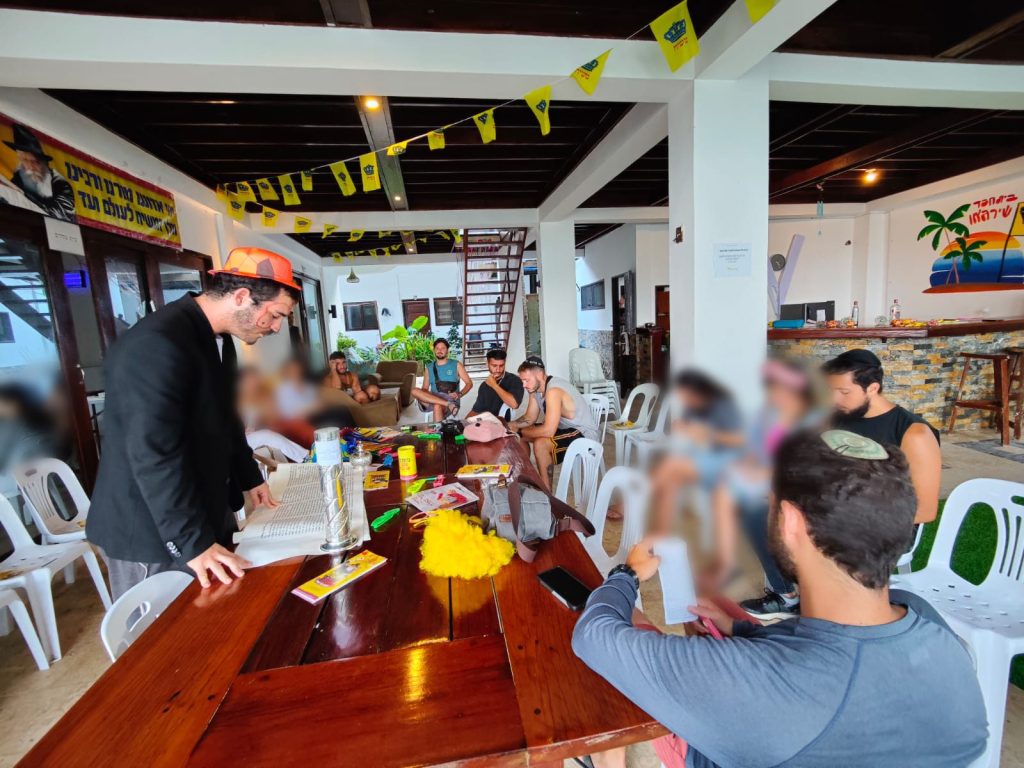
Ruphila, a Chabad House staff member, places the final tray of pastries on the table. The shiur is about to begin. “Just like in Yemos HaMoshiach, we have a Torah class which pampers both physically and spiritually—meant for every Jew, wherever they are at, who, by divine providence, finds themselves at our Chabad House,” says Rivka Shpindler, shlucha of the Rebbe, in Siargao, as she warmly welcomes us into the embracing, heartfelt atmosphere that permeates this home.
The class ends, and the group heads out into the pastoral yard with guitars—to play, sing together, ignite the spark of the Moshiach within the heart, and walk deeply into the Jewish soul.
In the adjacent restaurant, people come to nourish their bodies with delicious kosher food. A traveler arrives needing to change a bandage after an accident, and at a side table, two friends have been playing a board game for hours.
To an outsider, this scene might seem odd—a modest-sized house where so many people feel at home. Whose house is this? Of course—it belongs to the Rebbe, Melech HaMoshiach.
There is a homey feeling here. Every Jew has a place. Every Jew is a friend, beloved. When sitting together, you can talk about anything in the world and express your true self—free of the walls and layers you’ve carried since childhood. Something pure connects everyone. A unique unity.
Jumping Right In
“During our dating period, we talked about going on shlichus; it was in our blood. We didn’t know where or what, but we knew we’d do it,” Rivkah recounts:
At the Kinus Ha’Shluchim two years ago, when we were engaged, Rabbi Yossi Levy, the shliach in Manila, the capital of the Philippines, approached my husband and suggested we go on shlichus to the island of Siargao. He explained that many Jewish travelers go there and need a warm, connecting Chabad House. My husband replied that he’d consider it after the wedding and kept the idea in mind.
Before the wedding, we didn’t buy furniture and we rented our apartment only for a short period. A few months after our wedding, the Rebbe sent us to get some experience. We replaced a couple for six weeks in Africa. The experience was powerful, but demanding.
Simultaneously, we looked into how to advance the offer we had received earlier and open a Chabad House in Siargao. We felt this was our shlichus. We chose to go there, with the hand of the Rebbe guiding and supporting us. After just a few months, we were already in the Philippines and opened a Chabad House.
The Rebbe Runs the Show
I’d always heard about miracles happening to shluchim, but I didn’t know how close it would hit home. I used to wonder when we would be in the main role—and it came from an unexpected direction.
We believed the building where we first opened our Chabad House would be our permanent home, and we even started planning how to turn it from a rental into our own property. But suddenly, while calculating the costs, we found out that the landlord had sold the property without informing us. In just about three weeks, we’d have to vacate it for the new owners.
We were completely helpless. The place had already become a known location, full of visitors. And now we had to pack everything and leave—to where?…
We began searching for a new place that would meet all our needs, but in Siargao, suitable buildings are scarce. And when a Jew in the seventh generation faces hardship—especially a shliach of the Nasi HaDor—he turns to the Rebbe through the Igros Kodesh.
The Rebbe responds with glowing words that illuminate the path and dissolve the fog of confusion and worry: “Change of place brings a change of mazel—for the good and blessing.”
The anxiety eases, the heart calms. In his letter, the Rebbe also wrote about building a mikva.
We set out again, confident in victory. In the meantime, we found a beautiful building, but it belonged to wealthy people. They were in no rush to sign a lease, and we didn’t have time to waste.
At that moment, I had the opportunity to fly to the International Kinus HaShluchos. I planned that during my time at the Rebbe’s court, I would ask him to make everything go smoothly and quickly—after all, it’s his!
I entered 770, and before I even opened a siddur or sefer, the exciting, Geuladik news arrived from our Chabad House: The building’s owners were ready to discuss a contract!
To our delight, the building includes space for a mikva (a major advantage not found in the previous building), and although friends tried to dissuade us, saying that building a mikva is too complex, the Rebbe’s words and requests were fulfilled to the letter.
The new building is larger, more suitable, in a better location—and most importantly, the Rebbe personally gave it to us, with his precise blessings.
Thank you, Rebbe.
I’m Not Lonely
At first, my outlook on shlichus was different. I saw everything through the lens of a challenge, a hardship. I felt I was sacrificing myself for a noble cause, but I didn’t see myself in the story.
The biggest struggle was the distance from my community. I felt like I was flying to a desert island—with no family and no friends who had been a key part of my life. Experiences, deep connections, and meaningful relationships were gone. I felt neither here nor there. Satellite communication wasn’t really a solution, due to the time zones and the simple fact that distance disconnects.
I assumed the women coming to the Chabad House couldn’t fill the void—they weren’t like me. I wasn’t in my natural place. I wasn’t “at home.”
But after a few months, something shifted in me. I began to see things differently. I internalized that the shlichus is my home, and so the travelers who come can absolutely be my friends.
True, it’s a different kind of experience. Finding shared interests takes more effort, relationships take work… But even a friendship for a week or a month is a friendship worth having.
Despite the workload, and even if at first glance the differences seem vast, I enjoy sitting with visitors at the Chabad House. I’ve learned how to find common ground, topics we can talk about (and by the way, it turns out there are many), to take an interest in each traveler, to hear her story, to create my own experiences.
Sometimes we even go shopping or cook something together. We all benefit from it.
It takes time and energy. Friendships formed here are not like those in Eretz Yisrael—but meaningful friendships are created, ones that give me strength.
This is my place. This is my shlichus. I am not unfortunate or lonely. A shliach is not a victim!
And this positive, real, transformative outlook can apply to every part of our lives and our work.
As the Rebbe says: Act with joy and a good heart.
Permeated By the Only Shlichus
When two Israeli travelers were looking for the Chabad House, they told the driver to find the big Moshiach flag…
From the outside of the building, to the signs proclaiming Moshiach lives here—everything is infused with the light of emuna. There’s no need to be embarrassed, because the Rebbe says the world is ready. And that’s exactly what we see.
The divrei Torah at Shabbos meals and classes on Chassidus are always saturated with the main theme—inyanei Moshiach and Geula.
When someone consults about a troubling issue—or even a small problem—we guide them to write to the Nasi HaDor. Overall, we try to bring together the physical and the spiritual, just as the Rebbe describes in his Dvar Malchus talks—just like in the Yemos HaMoshiach.
Yechi Adoneinu Moreinu v’Rabbeinu Melech HaMoshiach l’Olam Va’ed!
Beis Moshiach #1460 • pp. 48-49, 54
© 2026 Beis Moshiach Magazine. All rights reserved.
This article originally appeared in Beis Moshiach #1460. You are welcome to share it with friends and family by email or in print, provided that you do not change, add to or omit any part of it, you credit the author and Beis Moshiach, and you include a link to archive.bmoshiach.org (written out in full in printed copies).
To republish this article in a newspaper, magazine, book or website, please request permission in advance at [email protected].