Rescuing 3 Sifrei Torah From a Remote Siberian Village
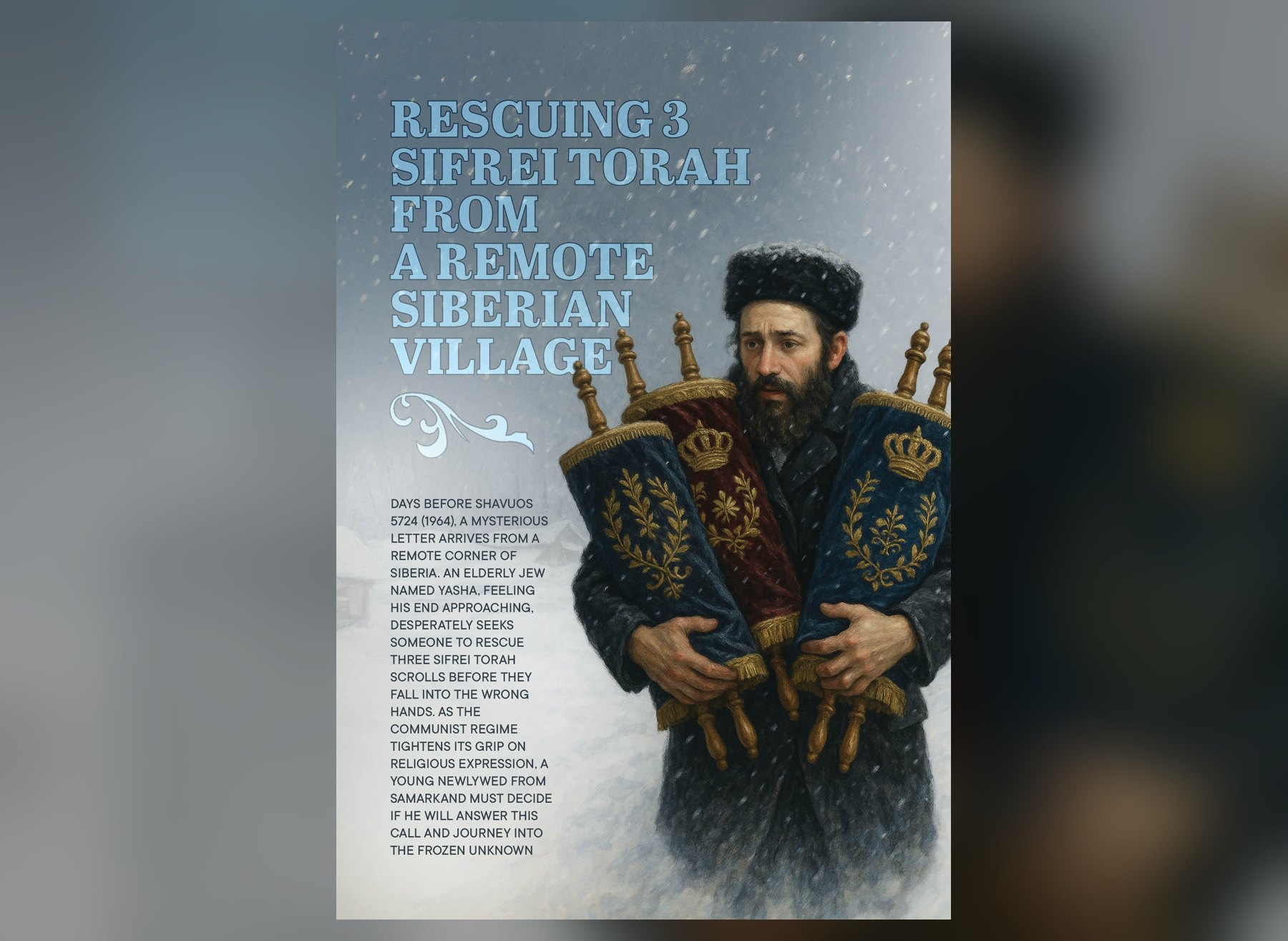
Days before Shavuos 5724 (1964), a mysterious letter arrives from a remote corner of Siberia. An elderly Jew named Yasha, feeling his end approaching, desperately seeks someone to rescue three Sifrei Torah scrolls before they fall into the wrong hands. As the Communist regime tightens its grip on religious expression, a young newlywed from Samarkand must decide if he will answer this call and journey into the frozen unknown
I
The ‘days of preparation’ (yemei hachana) for the Yom Tov of Shavuos, 1964.
In those dark days, the Communist regime was at the peak of its power, ruling tyrannically under the leadership of the Communist Party Secretary, Nikita Khrushchev. The Communists did everything in their power to suppress the Jewish spirit throughout the Soviet Union – and to a large extent, they sadly succeeded in their despicable mission.
At that time, Berke Schiff was a young married man living in Samarkand. One day, he received a visit from Rabbi Moshe Nisselevitch, a revered Chassidic figure in the Chabad community of Samarkand. In a hushed voice, the rabbi told the young scholar that he had recently received a message from the Chief Rabbi of Moscow, Rabbi Yehuda Leib Levin. The rabbi relayed news of an unusual letter he had just received from Yasha – a solitary Jew living in a remote Siberian village. In the letter, Yasha wrote that he was in possession of three Sifrei Torah. Feeling that his strength was waning and his days were numbered, he begged that someone come take them before they might be desecrated after his death. How and by what means – he left to the wisdom of the rabbi.
Although Rabbi Levin was not himself a follower of Chabad, he knew well that if anyone could handle such a task, it would be the Chabad Chassidim.
As he spoke, R’ Nisselevitch pulled Yasha’s letter from his coat’s inner pocket and handed it to Berke. The letter included Yasha’s full address in a remote Siberian village called Yasin. “Go there and bring back the Sifrei Torah. May Hashem be with you,” R’ Nisselevitch blessed him warmly.
Even though Siberia was very far from Moscow, Berke accepted the difficult mission.
II
Although he had agreed to take on the task, many doubts filled Berke’s heart. He knew the journey to Yasin would be long and grueling. Deep down, he feared that the elderly man who wrote the letter might not even know what Sifrei Torah really were. How could three Sifrei Torah have ended up in such a remote village? Perhaps Yasha only had printed books – Chumashim – that he mistakenly called “Sifrei Torah”? Was he perhaps just hoping for some company in his final hours?
Berke’s family, with whom he consulted, raised their eyebrows in disbelief. They thought he had lost his mind – to travel so far through the cold and snow because of a letter from someone whose identity and background were completely unknown?! Some family members even doubted whether Yasha was really Jewish.
After much hesitation, Berke set a sign for himself: “If I find a flight today to that area and manage to get a ticket, it will be a sign from Heaven that I must go. If not – I’ll return home.”
He went to a Moscow hotel that also sold flight tickets. The clerk told him flatly that yes – in six hours, a flight was leaving for the area.
The decision was made.
III
The first leg of the journey was on a large airplane that landed several hours later at a regional airport, where he boarded a small ten-seat aircraft that flew into the heart of Siberia, now covered in white snow.
After landing, there was still an 11-hour bus ride ahead – a bus that stopped at every village in the area. Yasha had written in his letter that after several hours, Berke should start asking locals where he lived. Since he was well-known among the villagers, someone would surely point the way.
Seven long, exhausting hours passed. The region was blanketed in heavy snow, and the only visible path was the bus’s route. From time to time, Berke asked fellow passengers if they knew the man from the letter – but no one did. His initial fears that Yasha might be delusional grew stronger. Still, it was too late to turn back.
Near the end of the bus ride, an elderly man boarded.
“Do you know this man?” Berke asked with some hope.
The man looked at the letter and nodded.
“I know him well,” he said. “Since I’m getting off after you, I’ll tell you when to get off.” A heavy weight lifted from Berke’s heart.
After eleven hours, the man told Berke it was time to get off. From the bus window, he pointed toward one of the streets. “From here, you can get to his house,” he said, and Berke stepped directly into high piles of snow.
He was dressed like a city-dweller, his shoes not suited for trudging through deep snow. He hadn’t imagined just how cold it would be this time of year and had not dressed accordingly.
After a long while struggling through the snow, he spotted a local woman wearing a warm fur hat, walking slowly.
“Do you know where Yasha lives?” he asked.
The woman did not hesitate and pointed directly to his house, but added a few chilling words: “He died this morning.”
A shiver ran down his spine.
He had finally reached the man’s home – only to learn he had missed him by mere hours.
IV
As he approached, he was greeted by fierce barking from a large guard dog – common in the area to ward off wolves and other predators. Berke didn’t dare enter the yard, so he began shouting, hoping someone would hear.
After a long minute of calling out, a tall, middle-aged peasant appeared. When he heard what Berke wanted, he nodded: “Yes, old Yasha lived here until four months ago. But he moved to another house in the center of the village,” and directed Berke accordingly.
The man noticed Berke’s clothing and took pity on him. He quickly brought the dog inside, fetched high boots and a warm coat, and offered to accompany him to Yasha’s home. Along the way, the two struck up a lively conversation.
“Do you know of any Jews living in the area?” Berke asked.
The man looked surprised by the unexpected question and shook his head firmly. “I’ve heard of Jews, but I’ve never seen one. I don’t even know what a Jew is supposed to look like.”
Berke’s original doubts came rushing back. Was Yasha even Jewish?
He asked the man directly.
The man shrugged and replied with a definitive no. “He was a peasant like us. I never heard of him having any connection to Jews.”
When they arrived, Berke saw several women dressed in black, weeping and mourning. He hesitated, but when they saw him, they cried out, “He’s here! He has arrived!”
Berke was bewildered – he hadn’t told anyone he was coming…
Later, R’ Nisselevitch explained that after entrusting the mission to Berke, he had sent Yasha a telegram saying someone was on the way to retrieve the Sifrei Torah. Shortly before his death, Yasha had told his wife and daughters that someone would come to take the scrolls, and they should hand them over if he was no longer alive.
The only question that now preoccupied Berke was: Was he really Jewish?
He politely asked the women for permission to enter. Inside the living room, he saw Yasha’s body covered in a worn tallis (prayer shawl). In the eastern corner stood a simple Aron Kodesh with a curtain displaying a magen Dovid.
A long sigh of relief escaped his lips. Indeed, the man was a Jew in every sense.
Berke finally let the emotion flood his heart. He felt that it was no coincidence he had arrived on the day of the man’s death. Though he was exhausted, he sat beside the body, pulled a Tehillim from his pocket, and began reading for the elevation of Yasha’s neshama.
“Why haven’t you buried him yet?” he asked at dawn.
“We are waiting for his son from Alma Ata in Kazakhstan,” one daughter replied. “Our father instructed him what to do after his death.”
Berke recited Tehillim until midnight. Then he checked his pocket calendar – only two days remained until Shavuos. If he wanted to get home in time for Yom Tov, he had to leave the next morning.
Almost no time remained to rest. He asked the women about Yasha and why he had lived in that village. They shared a remarkable story:
V
In earlier times, before the Communists seized power, the village had been home to a group of non-Jews who had converted to Judaism. Yasha had served as their spiritual leader, teaching them Jewish law and tradition. After the Communist rise, persecution began, and many left the village or abandoned Judaism. Goyim replaced them. Yasha alone held fast to his faith and remained – guarding the three Sifrei Torah with all his might.
“Our father asked that you take not only the Sifrei Torah,” the women said, “but all the Jewish items here.” Berke took everything – a Machzor, a Siddur, and a shofar.
When he opened the Aron and saw the three scrolls standing upright, seemingly waiting for a loving Jewish hand to redeem them, he was overcome with emotion. With reverence, he kissed them and placed them in his bags.
The widow and daughters arranged for a special sleigh to carry him and his bags to the bus stop.
VI
On his way back, Berke felt an unmistakable sense of heavenly blessing accompanying his steps. The moment he reached the station, a bus arrived. The planes from Alma Ata and then to Samarkand came with minimal delay. Looking out the window, he saw the southern villages buried buried in snow and reflected on the unique mission he had just fulfilled.
Yasha had clung to his Jewish spark and protected the Sifrei Torah – and in the end, hashgacha pratis had brought Berke to him on the day of his death to recite Tehillim for his soul.
Berke did not make it home to celebrate Shavuos with his young wife in Samarkand, but he did reach Tashkent, where his mother lived, and spent Yom Tov with her.
“That Shavuos was special to me,” Berke Schiff would later say with undisguised emotion. “I felt tremendous fulfillment having completed such a sacred mission.”
When he returned home to Samarkand after Yom Tov, he went to Reb Moshe Nisselevitch’s home and reported that the mission had been carried out in the best possible way. He handed over the Sifrei Torah.
“I kept the Machzor as a memento,” Berke concluded, “and it still sits in my home to this day.”
Beis Moshiach #1461 • pp. 32-35
© 2026 Beis Moshiach Magazine. All rights reserved.
This article originally appeared in Beis Moshiach #1461. You are welcome to share it with friends and family by email or in print, provided that you do not change, add to or omit any part of it, you credit the author and Beis Moshiach, and you include a link to archive.bmoshiach.org (written out in full in printed copies).
To republish this article in a newspaper, magazine, book or website, please request permission in advance at [email protected].