Meeting the Moshiach of the Generation
Previously: The Arizal’s students come to Lublin, the Maharshal’s city, and work out the machlokes between the city’s esteemed Rav and their master. Then they start on the next leg of their journey – the town of Tisovich, where they are meant to meet a very special person:
From the TzaddikStory.org collection
“The way to Tisovitch is left at the bridge,” the Maharshal replied. “And if you return by Shabbos – please, you must be my guests.”
“We’d be honored,” they said.
Wrapped in borrowed coats, because they came from Eretz Yisrael they stepped into the cold evening air.
As they reached the bridge, Rabbi Chaim whispered, “Perhaps this is the time we meet Moshiach ben Dovid.”
Rabbi Yisroel smiled. “I wonder what he looks like.”
And with that, they continued on their way.
* * *
Early the next morning, the two talmidim made their way to the home of the Rav of Tisovich.
Surely, Elyakim bar Shmuel must be known here – maybe he was even the Rav of the shul himself!
They knocked just as the sun peeked over the trees.
“Elyakim bar Shmuel?” the Rav repeated. “I’ve never heard of anyone by that name. Certainly not in this town.”
From the back of the house, the Rebbetzin chimed in, “I know all the names people say for Tehillim… that name doesn’t sound familiar at all.”
The Rav stroked his beard. “Let me call the head of the kehilla. If anyone knows, he will for sure.”
Soon, the leader of the community arrived. “Elyakim bar Shmuel?” he said, shaking his head. “There’s no one in Tisovich by that name. You must be mistaken.”
The two talmidim looked at each other uncomfortably.
“But our Rebbe – the Ari HaKadosh – he said he was here,” said Rabbi Yisrael quietly. He can’t be wrong.
The Rav noticed the look in their eyes. “You know what? Come to the earliest Shacharis. After davening, I’ll bang on the bimah and ask if anyone has heard of him.”
At Shacharis, the Rav kept his promise.
“Does anyone know a man named Elyakim bar Shmuel?” he called out. “Anyone? Even a similar name?”
Silence.
Then, from the back of the shul, one man slowly raised his hand. “Um… maybe?”
“Speak up,” said the Rav.
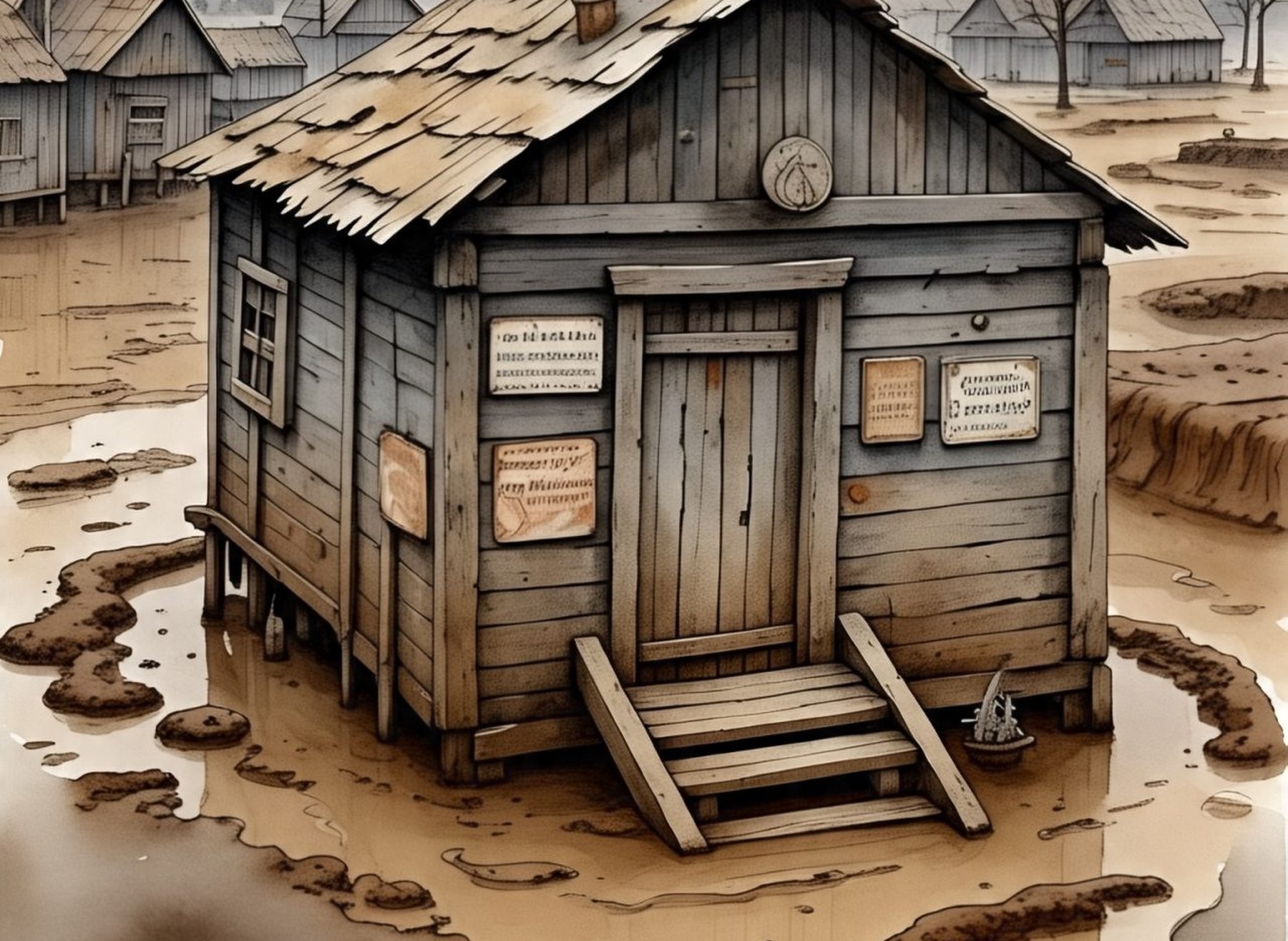
“There is someone named Elyakim… but I doubt he’s the one you’re looking for. He lives in a broken-down shack on the edge of town. Covered in mud. He barely leaves his house. No one ever visits him. That’s why no one really knows him.”
The Rav turned to the students of the Ari. “What do you say?”
Rabbi Chaim looked at Rabbi Yisrael. “Let’s go.”
The man in shul shrugged. “I really don’t think he’s who you’re looking for. He’s… just not the type of holy man your Rebbe would send you to.”
“Our Rebbe said it’s him,” Rabbi Yisrael answered. “So it’s him.”
The man sighed. “Alright. It’s about a half-hour walk. But… they’re strange people.”
As they walked, he filled them in. “Elyakim is sick, very weak. He doesn’t have children. Spends all day lying in bed. His wife… she digs clay from the ground and sells it to builders so they can eat. She’s always covered in mud.”
“Does Elyakim work?” asked Rabbi Chaim.
“No. He just stays in bed. He can’t do much.”
When they finally reached the house, it was exactly as described.
The ground around it was so soggy and sunken, the whole home tilted slightly into the earth. The wooden steps creaked as they climbed up to the door.
Knock knock.
No answer.
“I hope he’s home,” whispered Rabbi Yisrael.
They knocked again. After a moment, the door opened a crack. A tired-looking woman stood inside. It was too dark to see clearly, but the smell of dust and onions drifted out.
The room behind her was empty – just an old wooden table and two very broken chairs.
“Yes,” she said. “My husband… that’s his name. Elyakim bar Shmuel. He’s not here right now. He’s at the mikva – getting ready for Shabbos.”
* * *
“Oh…”
Rabbi Yisroel and Rabbi Chaim looked at each other.
What did that mean…? The Ari HaKadosh had said that if Elyakim wasn’t home when they arrived… it was a bad sign. A sign that he was not going to be the Moshiach of this generation.
Oy. That was not a good sign at all.
“You can wait,” said the wife, not knowing what was going through their minds. She pointed to an old tree stump by the door.
Instead, the talmidim decided to walk to a nearby field to say Tehillim.
When they returned, they stepped into the small house. It was dark and still. In the corner were two mattresses. On one of them lay a pale, thin man with closed eyes. His face was weak.
“Who are you…?” he asked, his voice heavy and slurred. “Why… why have you come?”
“We are students of the holy Rabbi Yitzchok Luria, from Eretz Yisroel,” said Rabbi Yisrael softly. “He sent us to find you. He revealed that… you are the Moshiach ben Dovid of this generation.”
“Me…?” Elyakim whispered.
He closed his eyes.
“Your Rebbe…” he sighed deeply, “he’s made a mistake sending you here – for him and for me.”
There was a long pause.
“I must leave this world now.”
The room fell silent.
The two talmidim stood still, unsure of what to say. After a moment, Elyakim opened his mouth again.
“Come closer. I have a request.”
They stepped forward.
“Please… don’t let the Chevra Kadisha, the people in town who take care of burials, don’t let them handle me. They don’t know who I am. I ask only you two should prepare my body after I pass.”
Rabbi Yisroel nodded slowly. “We understand.”
The two students stepped outside, sat on the stumps, and began saying Tehillim with all their hearts. They davened for clarity, for strength, and for the soul of the man their Rebbe had called Moshiach.
A few hours passed.
The door creaked open. Elyakim’s wife stepped outside.
“My husband has passed,” she said softly, then sank to the floor, weeping.
A neighbor ran to call the Chevra Kadisha. Soon they arrived – men in dark hats and black coats, prepared to carry out their task.
But the talmidim rushed to them.
“Please,” they said, “he asked us to care for his body. It was his final request.”
One of the Chevra Kadisha members, a tall, serious looking man, looked them over.
“Excuse me – who are you people? You just arrived in town this morning. This is our holy responsibility.”
“We came from Eretz HaKodesh,” said Rabbi Chaim Vital.
“Our Rebbe – the Ari HaKadosh – sent us.”
“We’ve never heard of him,” the man rejected. “This is our town. We follow our Rav.”
“We mean no disrespect,” said Rabbi Yisroel, holding back his words. “But the niftar – Elyakim – asked us personally. This was his final request.”
The man folded his arms. “Why would he ask you? Have you even done this before? We’re trained.”
Rav Chaim lowered his head in sadness. Rabbi Yisroel was ready to reply – but before he could, Elyakim’s wife stepped forward.
“Please, stop arguing,” she begged. “Let the Rav decide.”
The local Rav arrived shortly after and heard both sides. Time was running short – it was nearly Shabbos.
Finally, he ruled. “The Chevra Kadisha will carry the body and bury him. But the taharah – the washing and preparing of the body – will be done by these two talmidim, as the niftar had requested.”
The students nodded and quietly did the holy work, washing, drying, and dressing Elyakim’s body with great care for burial. As they worked, they whispered the holy kavanos of their Rebbe, honoring the soul they now knew was far greater than anyone else around them realized.
When the body was ready, the Chevra Kadisha returned to carry the simple wooden box. A few townspeople came along, curious. A few children followed, and even a stray chicken.
It was the levaya of the Moshiach of that generation… and almost no one knew.
Ten men stood and said a simple Kaddish. Then they left quickly to prepare for Shabbos.
The talmidim washed their hands and sat beneath a tree, singing a soft niggun.
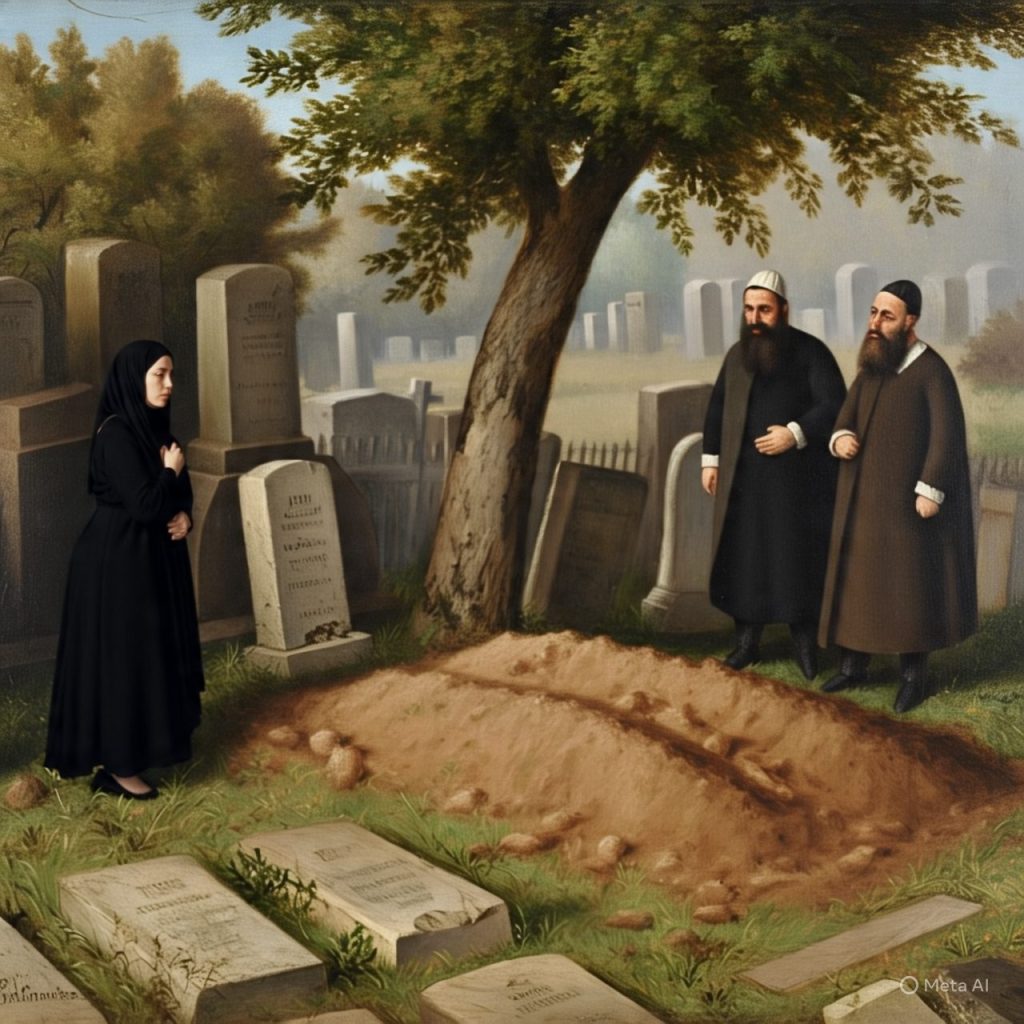
Only one person remained by the grave – Elyakim’s wife, bent over and crying softly.
“Excuse us, Rebbetzin,” Rabbi Yisrael called gently.
She looked up, her eyes red. “Yes?”
“Did you know your husband was so special?” he asked.
“What do you mean?” she said.
“He… he was Moshiach,” Rabbi Yisrael said quietly.
“Moshiach? What do you mean?!”
“Well, we’re not sure – did you ever see him do anything… surprising?” asked Rav Chaim Vital.
* * *
The woman paused, her eyes looking far away.
“Well… when we got married, my husband looked young and strong – like any chosson. Not at all like how you saw him. But after a little while, he got very sick. He could barely get out of bed. He refused to go to the doctors… I never understood why, so I had to work instead of him.
“What was interesting,” she continued, “was that every Shabbos, the moment I lit the candles, everything changed. My husband would suddenly look young again, strong, standing tall like the day we got married.”
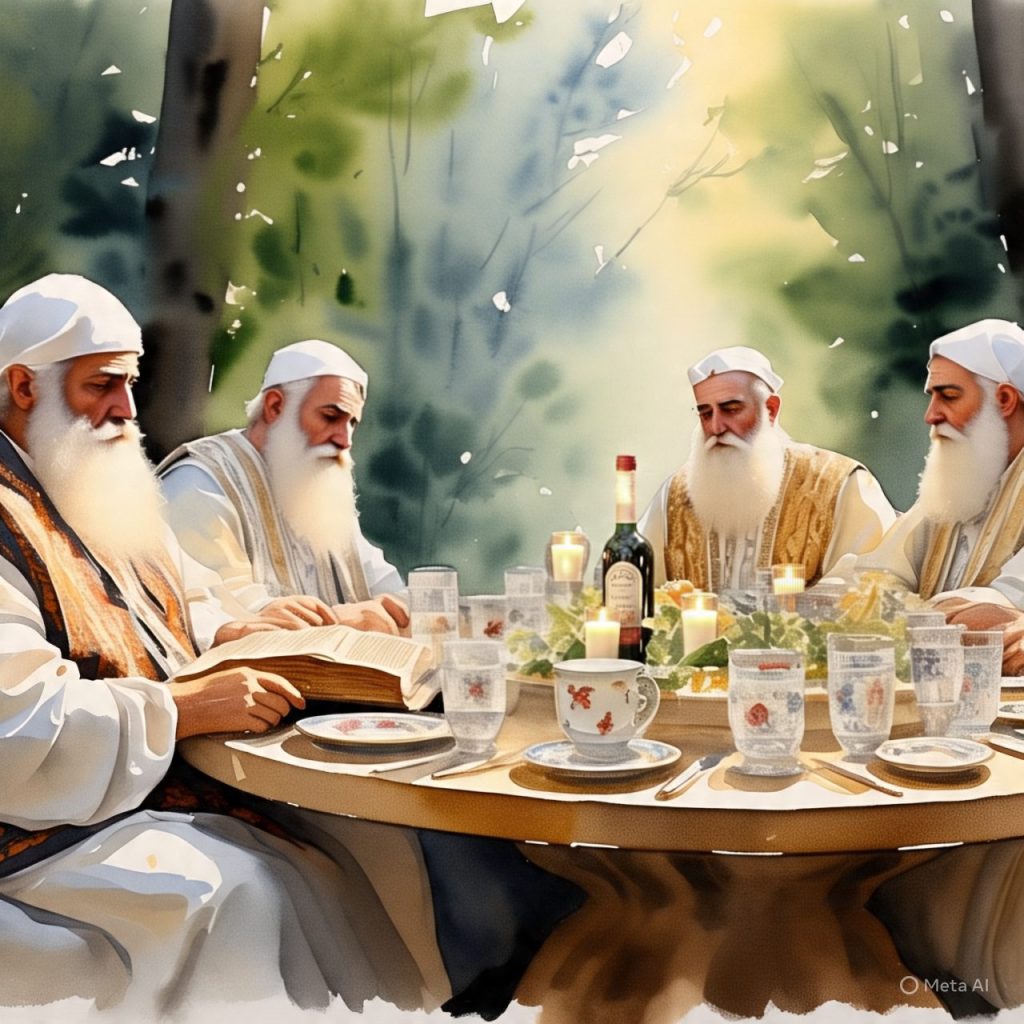
“And when I looked around, I would see a beautiful table – shiny wood, a gold and white tablecloth… and food. So much food. I could smell chicken, soup, salad, kugel, fish, cake… Everything. The table was full of Shabbos food – but I never made any of it. It just arrived on its own.”
The two talmidim were speechless.
“I’d put on my Shabbos clothes,” she continued, “and holy-looking men with white beards would come into the house. I thought maybe they were from the town, but I never saw them during the week. My husband would sit at the head like a king and share Divrei Torah. And they would all listen and smile.”
“Wow,” whispered Rabbi Chaim.
“Did you ever tell anyone?” he asked.
“Tell them what?” she said, a bit confused. “It always happened that way. I guess I just thought it was… normal.”
“Normal?” said Rabbi Yisrael. “Guests appearing out of nowhere? A royal table?! You thought that was regular?”
“Yes,” she said softly. “At our wedding, they told me the chosson is like a king and the kallah is like a queen. I got married very young… I guess I just believed it.”
Rabbi Chaim raised an eyebrow. “So you thought you just turned into royalty every Shabbos?”
“Yes. Isn’t that how it works?” she asked, still a little unsure.
The two talmidim smiled. They were convinced now. They truly had seen Elyakim bar Shmuel, the hidden Moshiach of their generation – even if only for a short time.
They stood and handed the woman some of their fresh challah. “Thank you,” they said, kindly.
She bent down to wipe away her tears as they turned to leave.
They made their way back to the Rav’s house to say goodbye.
“We must go,” said Rabbi Yisrael.
“Please, stay for Shabbos,” the Rav urged. “There’s no time for you to travel.”
“No, we must travel to the Maharshal in Lublin,” said Rabbi Chaim. “It’s part of our mission.”
“But how? That journey takes days!” The Rav’s eyes widened.
“Yes,” explained Rabbi Chaim, “the Ari will send us through Kefitzas Haderech.”
Before the Rav could respond, they were gone.
****
At the Maharshal’s home, the house was busy with Shabbos preparations.
“You’ve returned!” The Maharshal smiled. “Please, be our guests.”
That Friday night, the Maharshal, his family, the two talmidim, and a few local yidden gathered around a long table set for Shabbos. They heard Kiddush, washed, and sat down to eat.
Just before Hamotzi, Rabbi Chaim Vital took out a sack. One by one, he pulled out twelve fresh loaves of challah.
The smell filled the room.
“Were these just baked?” someone whispered.
“Yes,” said Rabbi Chaim with a smile. “This is bread from the Ari. Like the Lechem Hapanim in the Beis HaMikdash – it stays warm and fresh, just like the holy showbread.”
They ate fish, soup, chicken – a full royal feast.
“Please,” said the Maharshal, “teach us some more Torah from your Rebbe.”
The two talmidim looked at one another and began to speak, taking turns. As they shared the teachings of the Ari, a soft, warm light began to spread from them, filling the room, a glow that reached every corner of the house.
In that moment, the Maharshal sat silently and thought:
“Ah… the Ari truly is a servant of Hashem. A holy man, a master of the secrets of Torah. There is no way I could ever put a cherem on him. Chas v’shalom.”
* * *
Rabbi Shlomo Chaim, the Rebbe of Koidanov, finished his story. “I heard this tale from my father, who heard it from his father, who heard it from his father…”
And so, Reb Noach stood tall, ready to walk down to the chuppah, the story fresh in his heart.
He knew that one day, he would visit the Jewish cemetery in Tisovich.
And when he did, he would know exactly whose grave he was standing before.
Beis Moshiach #1462 • pp. 54-59
© 2026 Beis Moshiach Magazine. All rights reserved.
This article originally appeared in Beis Moshiach #1462. You are welcome to share it with friends and family by email or in print, provided that you do not change, add to or omit any part of it, you credit the author and Beis Moshiach, and you include a link to archive.bmoshiach.org (written out in full in printed copies).
To republish this article in a newspaper, magazine, book or website, please request permission in advance at [email protected].