From Controversy to Vindication
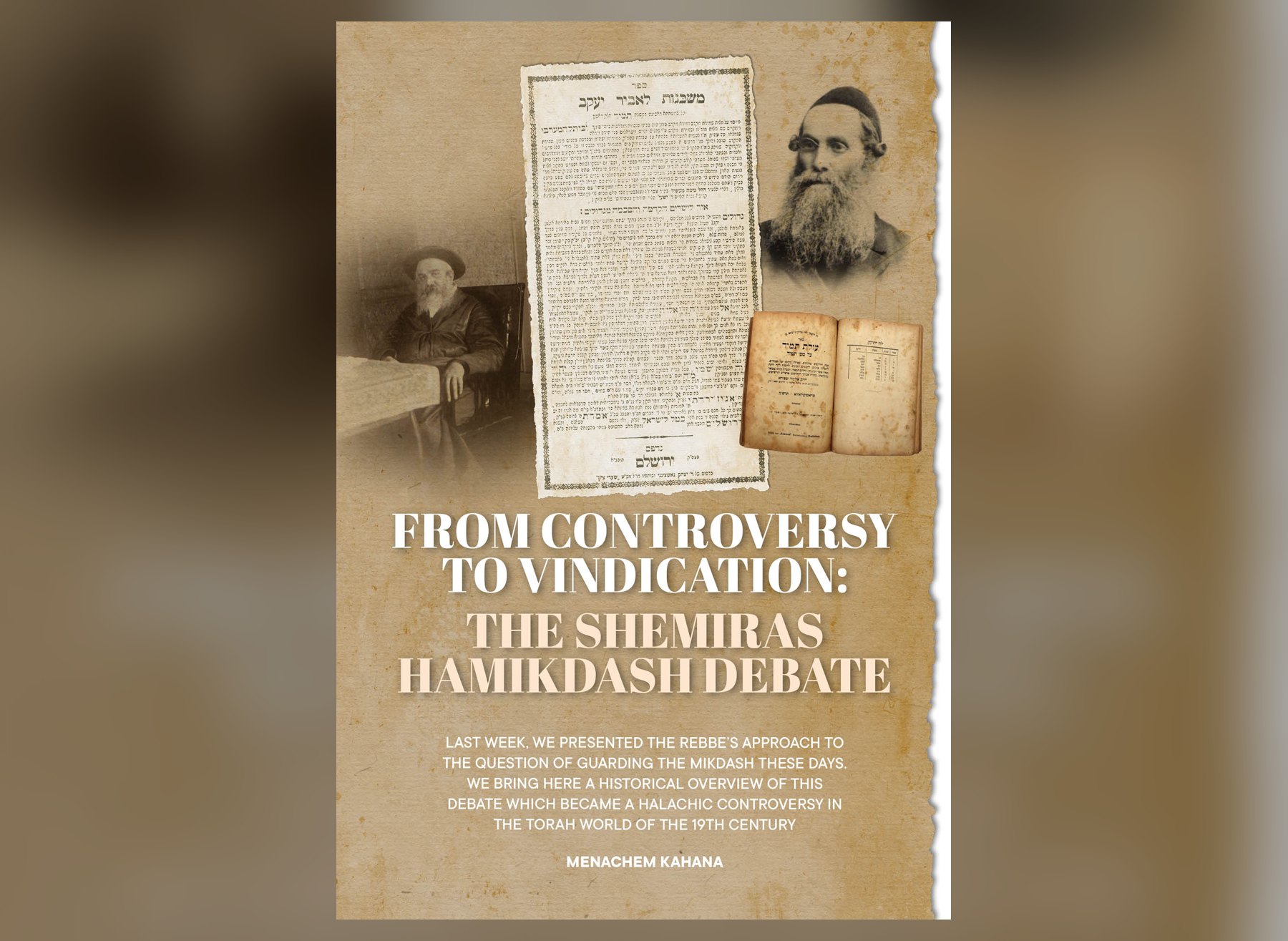
Last week, we presented the Rebbe’s approach to the question of guarding the Mikdash these days. We bring here a historical overview of this debate which became a halachic controversy in the Torah world of the 19th century
The Source of the Mitzvah
The mitzvah of guarding the Mikdash is one of the 613 mitzvos that require Leviim and Kohanim to guard the Beis Hamikdash. The guarding was done by Kohanim and Leviim at 24 locations throughout the night, and some say during the day as well.
The mitzvah comes from two pesukim in Sefer Bamidbar: “V’shamru es mishemeres Ohel Moed” (They shall guard the watches of the Tent of Meeting), and the pasuk about Moshe, Aharon and his sons “guarding the charge of the Mikdash for the charge of Bnei Yisrael.” Interestingly, some Rishonim don’t count it as one of the 613 mitzvos.
The Rishonim gave several reasons for this mitzvah:
(1) To honor the Beis Hamikdash, making sure that attention wouldn’t be diverted from it day or night. Some commentators explain that this guarding wasn’t due to concern about theft, since “ein aniyus baMikdash” (there’s no poverty in the Mikdash).
(2) Another reason is to guard the Mikdash from people who are forbidden to enter (zarim), such as non-Jews or those who are tamei.
The Rambam wrote that the purpose of the guarding is for honor, even when there’s no cause for concern: “A palace with guards isn’t comparable to a palace without guards.”
From the Rambam’s words, it seems that when the Beis Hamikdash was destroyed, there’s no mitzvah to guard it. The Chinuch also ruled this way.
A Revolutionary Idea: Guarding Even in Galus
The gaon Harav Hillel Moshe Meshil Gelbshtein zt”l was among the distinguished Chassidim of the Tzemach Tzedek and was considered a revolutionary in his generation when he came up with a chiddush in his sefer “Mishkenos L’Avir Yaakov” that even in our time there’s an obligation to guard the Mikdash.
He was only 35 years old when he arrived in Yerushalayim and surprised the city with his plan to set up watches of Kohanim, Leviim, and Yisroelim who would study hilchos kodashim as close as possible to the Kosel HaMaaravi and the site of the Mikdash. This was a bold plan, and R’ Meshil revealed all his genius in Torah to prove that the mitzvah of guarding the Mikdash applies even in our time.
In 5641 (1881), Harav Gelbshtein published his sefer “Mishkenos L’Avir Yaakov,” where he argued that the mitzvah can be fulfilled even by guarding from outside Har Habayis.
His Main Arguments:
Rav Gelbshtein wrote that according to the opinions that say the guarding is to prevent tamei people and zarim from entering the Mikdash, even in our time it’s a mitzvah to guard, since the kedushah of the site of the Mikdash hasn’t been nullified, and it’s forbidden for a tamei person to enter there even today.
But even according to the Rambam’s reason that the guarding is for honor, there’s still an obligation today. He proved this from the Rambam’s commentary on the Mishnayos, where the Rambam wrote that they guarded “in the days of Shlomo until the end of generations.”
The Rambam holds that the kedushah of Yerushalayim and Har Habayis hasn’t been removed by the churban, and therefore out of honor for the place, guards should be stationed around it: “Even now it’s the palace of the King of kings, Hakadosh Baruch Hu, and it needs to be honored.”
Rav Gelbshtein even argued that the mitzvah is more severe now than when the Beis Hamikdash stood, since we need to guard both day and night. During the day when the Beis Hamikdash stood, there was no need for guarding because the avodah itself gave honor to the Mikdash. But in our time when there are no Kohanim doing avodah and Leviim on their duchan, guarding is needed even during the day.
In line with his approach, Rav Gelbshtein began recruiting people and funds for guarding the Mikdash. This stirred up extensive controversy in Yerushalayim and beyond.
The Aderes’s Response
Before publishing his work, Rav Gelbshtein approached the “Aderes”—Hagaon R’ Eliyahu Dovid Rabinowitz Teomim, the av beis din of Yerushalayim at the time—with this proposition. The Aderes was impressed with his scholarship but ultimately disagreed.
The Aderes wrote that since today Har Habayis isn’t in our possession and we can’t station guards there to prevent entry, it’s not relevant to fulfill this mitzvah today.
Rav Gelbshtein responded strongly: Would the mitzvah of the Torah change because of this? Besides, we have pikuach nefesh here—people could accidentally enter Har Habayis and transgress kares! He shared a personal story of almost accidentally entering Har Habayis one night when walking home when he was new to Yerushalayim, only turning back when he realized where he was.
“Since now it’s easy to rent a place in the courtyard surrounding Har Habayis, since you merited that Heaven crowned you with the crown of rabbanus in the holy city Yerushalayim, please strive with the generous donors of Am Yisroel to rent the courtyard to build there a holy house for Leviim and Kohanim, to fulfill there the mitzvah of guarding the Mikdash.” But we don’t know what the Aderes’s response to him was regarding this.
The Avnei Nezer’s Objections
The “Avnei Nezer,” the Rebbe of Sochatchov, also disagreed with HaRav Gelbshtein in a correspondence they shared:
He wrote that there’s no mitzvah to guard since there’s nothing to guard: “In simple terms, you could say that even though the guarding isn’t because of thieves since there are no thieves there … or that there’s no poverty etc., meaning that the intended purpose of the guarding isn’t for this. But nevertheless, there needs to be something there to guard, and the guards certainly guarded the vessels. Even though in any case there would be no thieves, nevertheless, it isn’t the honor of the Mikdash that it should be hefker, and if they wanted, they could steal. Therefore, guarding is needed. But in our time, what will the guards guard?” That is, even though the guarding isn’t due to fear of thieves and the like, but in a situation where even without the guarding there’s no possibility at all to steal, the entire concept of ‘guarding’ isn’t relevant.
The Avnei Nezer nonetheless acknowledged that there may be merit to Harav Gelbshtein’s position that guarding is in place also to prevent tamei people from entering, but this, he argued, can’t be done anyway because of two main strong objections:
Firstly, guarding the Mikdash by the Kohanim has the status of ‘avodah’ and must be done wearing Bigdei Kehuna. This can only be done by those who are tahor. Since we’re all tamei meis today, it can’t be fulfilled.
Secondly – as for the Leviim, Dovid and Shlomo divided the Leviim into specific watches—singers and gatekeepers. Since today the Leviim don’t know their specific roles, if they guard they might be transgressing the prohibition of “a singer who acted as gatekeeper,” which carries a death penalty.
Rav Gelbshtein responded in his book to both points. Regarding the first, he proved from the Rambam that guarding isn’t considered avodah, since even Leviim over fifty (who can’t do regular Temple service) can still guard. Regarding the second, he suggested using elderly Leviim whose voices are already disqualified from singing, so there’s no concern of mixing roles.
The Holy Rebbe of Koidanov Weighs in on This Matter
The holy Rebbe Shalom of Koidanov, author of “Mishemeres Shalom,” also sent HaRav Gelbshtein a letter to disagree with him: “This rule is given to us: wherever halachah is weak [i.e., not established clearly] in our hands, follow the custom, and we haven’t seen the early sages for hundreds and thousands of Torah scholars and holy people who were concerned with this custom, headed by the Ramban and the Arizal, masters of ruach hakodesh and revelation of Eliyahu who were in Eretz Yisroel and weren’t concerned with this at all.”
To this, HaRav Gelbshtein replied that “you can’t bring proof from our holy fathers and rabbis, for perhaps then this matter wasn’t relevant because they weren’t given permission by the ruler to make guards, but in our days when it’s possible to arrange that we be given permission to do so, why should we be lenient in such a serious matter.”
Baron Rothchild Gets Involved
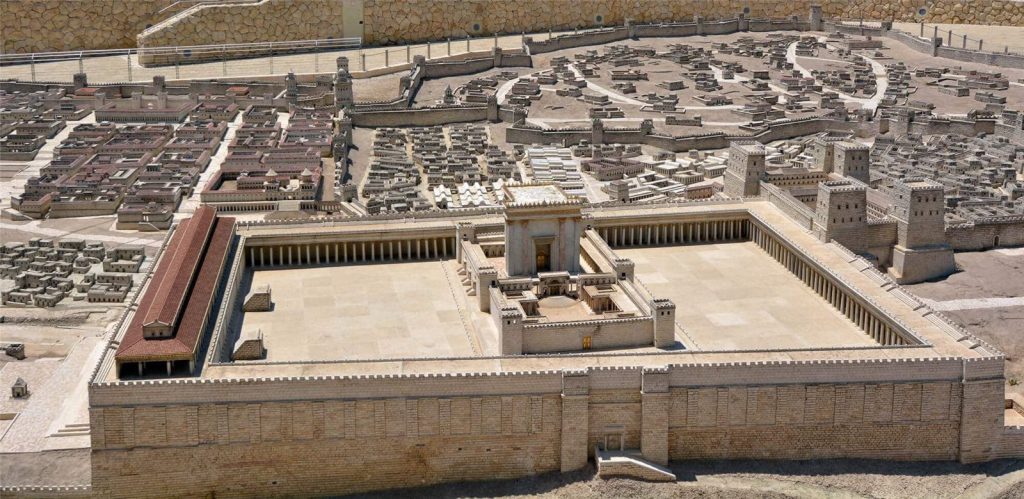
During the forty years of his life that he lived in Yerushalayim Ir Hakodesh, HaRav Gelbshtein didn’t rest, as his main goal was to bring to fruition the fulfillment of the mitzvah of guarding the Mikdash. He worked to procure funds from generous donors so that he could purchase from the Arabs three courtyards near Har Habayis where there would be a place for the Kohanim and Leviim guards of the Mikdash to sit. He managed to raise the large sum of 270 gold Napoleons, which was an enormous sum in those days. He also involved Baron Rothschild in this, who worked hard to obtain permits from the Turkish government for establishing guard posts, but due to great fear that arose among several community leaders lest this cause provocation with the Arabs, great opposition arose to this, and the matter didn’t come to fruition.
The Munkatcher’s F ierce Opposition
The Minchas Elazar of Munkatch published an entire pamphlet called “Olas Tamid” sharply attacking HaRav Gelbshtein’s position. He wrote – several years after HaRav Gelbshtein passed way — with characteristic fire: “A man brought us to put salt on our wounds… and stirred the world [claiming] that guards are needed around the place of the Mikdash even in our time.”
The Munkatcher argued that not only is there no mitzvah to guard today, but there’s actually a prohibition, since it would appear that we’re giving honor to the Muslim house of prayer that now stands on Har Habayis.
He concluded that “in our days, the main avodah of guarding Beis Hamikdash that’s incumbent upon us is to “guard” as in “V’aviv shamar es hadavar – and his father kept the matter,’ meaning to wait, hope and yearn for the building of the third Beis Hamikdash.”
The Minchas Elazar didn’t question HaRav Gelbshtein’s greatness in Torah and Yiras Shamayim: “We know and have heard that the rabbi zt”l was great in Torah and a great chassid, but with all due respect to his Torah honor, he’s going to extremes. Let him have what is his, may his soul be in Gan Eden and his memory be blessed, and we’ll walk in the ways of our fathers and not in ways that our fathers and rabbis throughout all generations, all the holy ones who are in the land of the living, never envisioned—to station guards there…”
The Rebbe’s Support
While the Rebbe Melech HaMoshiach was very fond of the Minchas Elazar, in this question the Rebbe sided with HaRav Gelbshtein’s position. In a farbrengen in 5732 (1972), the Rebbe said: “I recently had occasion to look into the sefer Mishkenos L’Avir Yaakov… If the guarding is for honor, that ‘a palace with guards isn’t comparable etc.,’ then since the kedushah of the Beis Hamikdash exists even in our time… there’s room to say that even in our time there’s an obligation of guarding.”
The Rebbe noted that the author “was a great Chassid—first he was with the Tzemach Tzedek, then with the Rebbe of Ger, then he went up to Eretz Yisroel.” Regarding the Munkatcher’s opposition, the Rebbe said: “Not all his refutations are necessary, and on the contrary, in several details—it’s reasonable that the author of ‘Mishkenos L’Avir Yaakov’ is correct!”
Why Wasn’t This Mitzvah Fulfilled?
The Rebbe addressed an obvious question: If this mitzvah applies today, why didn’t gedolei Yisroel throughout history fulfill it?
The Rebbe explained that “after the destruction of Beis Hamikdash, when Bnei Yisroel were exiled to galus under the subjugation of the kingdoms of the nations—the mitzvah of guarding the Mikdash is connected with danger to life, and pikuach nefesh overrides the entire Torah.”
The danger from the nations isn’t just during times of open persecution, but throughout galus. “Even when the hand of Yisroel is strong and they make a peace agreement with the governments of the nations, as long as they’re in galus, they’re under the subjugation of the kingdoms of the nations.” The rule is that “Eisav hates Yaakov,” and “it’s impossible to know what individuals will do [despite their own government’s position].”
Therefore, for reasons of pikuach nefesh, “they didn’t fulfill throughout the generations in galus the mitzvah of guarding the Mikdash by stationing guards for the honor of the Mikdash.”
The Spiritual Dimension: Guard Every Moment
The Rebbe concluded that while we can’t fulfill this mitzvah physically today, we can fulfill it spiritually: “The spiritual avodah of guarding the Mikdash for the honor of the Mikdash, honor of the Shechinah—his holy books and all matters of kedushah (the spiritual Mishkan and Mikdash in his private life) he needs to ‘guard’—he should cherish them especially.”
The Rebbe noted that we need to guard every moment because “every second there’s a possible reality that Beis Hamikdash will be built, and therefore one must guard every moment already from the first moment that Beis Hamikdash descends from Heaven.”
Conclusion
This fascinating debate reveals the tension between halachic obligation and practical reality. Rav Gelbshtein’s revolutionary position—that we’re obligated to guard the Mikdash site even today—challenged the Torah world of his time. While his practical efforts didn’t succeed, his scholarship impressed even his opponents.
The Rebbe’s endorsement of his position, combined with the explanation of why it wasn’t historically fulfilled due to pikuach nefesh, provides a nuanced understanding. Though we can’t physically guard the Mikdash today, we can prepare spiritually for the time when we’ll once again merit to fulfill this mitzvah in its complete form with the coming of Moshiach and the rebuilding of the Beis Hamikdash teikef uniyad mamash!
Beis Moshiach #1469 • pp. 32-35, 36
© 2026 Beis Moshiach Magazine. All rights reserved.
This article originally appeared in Beis Moshiach #1469. You are welcome to share it with friends and family by email or in print, provided that you do not change, add to or omit any part of it, you credit the author and Beis Moshiach, and you include a link to archive.bmoshiach.org (written out in full in printed copies).
To republish this article in a newspaper, magazine, book or website, please request permission in advance at [email protected].