Ctrl + Z
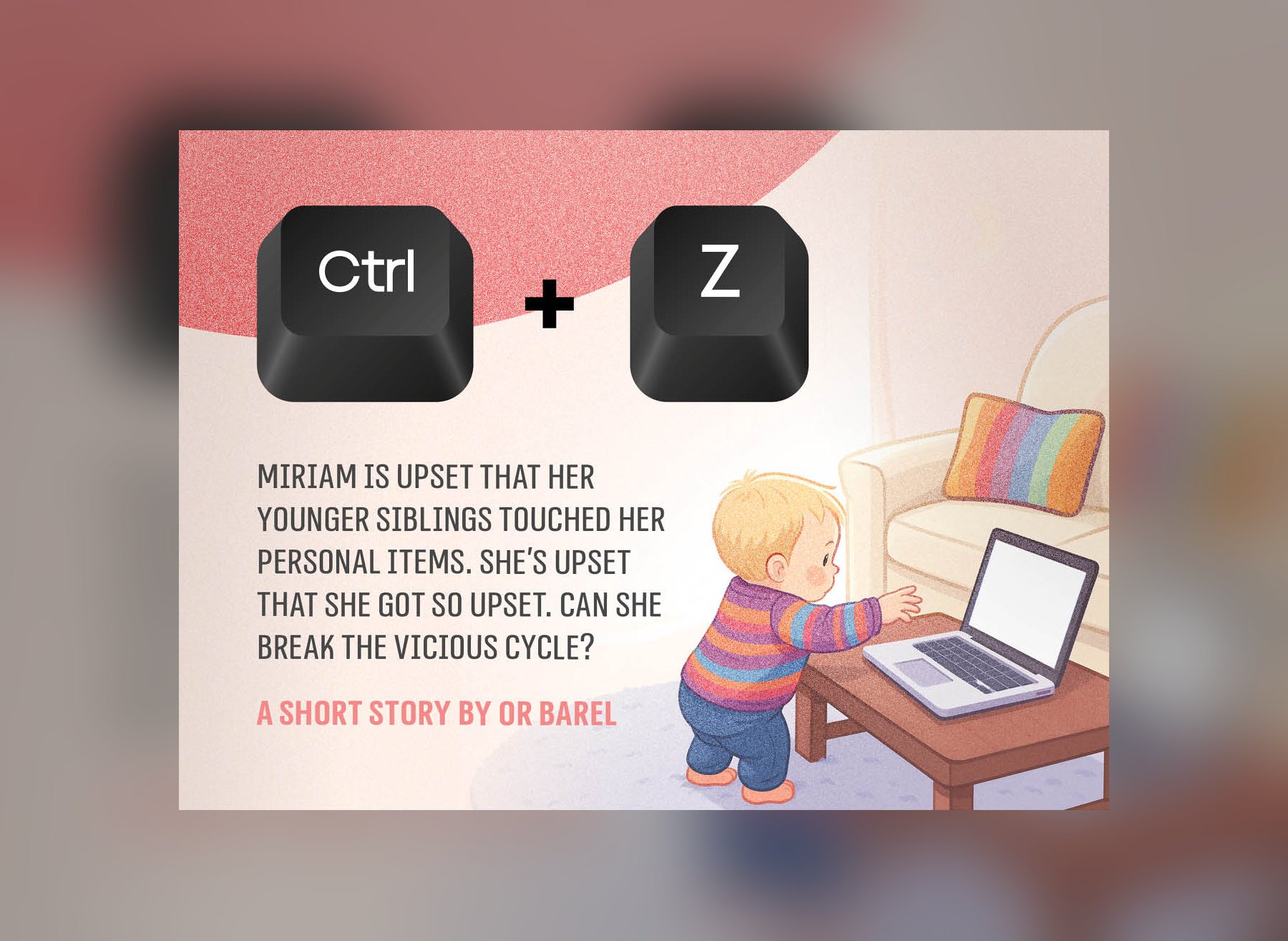
Miriam is upset that her younger siblings touched her personal items. She’s upset that she got so upset. Can she break the vicious cycle? A short story by Or Barel.
After she sets her bag on the bed, slips off her shoes, and fixes her ponytail neatly, she notices the three missed calls and the message waiting for her on her phone.
“We went shopping with the little ones, and Abba still hasn’t come home from work. Hope you have a key. I’ll bring the kids home at 8:30 and then I’m heading out to a farbrengen. Can you watch them?” – Ima, 5:39.
Miriam exhales slowly. Watching Shneur, Dovi, and Dini isn’t that hard. Depends what kind of mood they’re in.
But since the exhaustion that usually comes over them after shopping somehow tends to make them more hyperactive, she decides to open her homework now.
Twenty minutes later, she blinks in confusion as a trail of three children and countless supermarket bags joyfully spills into the house.
It’s hard to focus when the noise around you is caused by two mischievous boys and a seven-year-old girl who is, surprisingly, even more mischievous than they are. Miriam writes a sentence and a half for the last paragraph of the introduction. Deletes it. Rewrites. Checks it. Swaps two words. Deletes everything in frustration. Realizes she deleted the last word of the previous paragraph too.
Ugh.
“If you keep the Shabbos, keep the Shabbos, keeep the Shabbos!” Shneur is a master at inventing new vocal riffs, and the sounds he’s making are jarring to Miriam’s musical ears. Dovi is jumping on the couch, wrapping himself in a blue blanket like a tallis, while Dini is cheering him on, competing with Shneur’s volume.
“Shneur! Shneur! Shneur and Dini!”
They turn innocent faces toward her.
“Can you stop, please? It’s distracting me. I’m trying to focus and I just can’t.”
“Go to our room,” Dini shrugs.
“But I need to charge my computer, it only has seven percent left!” Miriam explains. There are three sockets in the room she shares with Dini, and all are blocked behind the large wardrobe. “And I need to watch you too.”
“Fine, we’ll be quiet,” says Shneur in a tone that says, Just leave us alone.
Oy. That’s not going to help.
“Can you please be quiet?” she asks again after ten minutes, with the last remnants of her patience. “You should be getting ready for bed now anyway, you know? You can’t make noise like it’s a zoo here.”
And Dovi, who had been the quietest of the three so far, slides down from the couch excitedly.
“A zoo! Let’s build a zoo!”
Oish.
Well, peace and quiet are clearly off the table for today. She closes her laptop and leaves it to charge.
“Dovi, no zoo right now. You’re coming with me to get into pajamas. Dini, Shneur – go get ready for bed.”
It takes a ton of patience to get Dovi into bed. Only after she recruits the help of the elephant from his imaginary zoo does he slowly begin to cooperate. She announces that “the elephant is going to brush his teeth” and “the elephant is going to say the bedtime Shema,” and after a half hour – far too long – he finally gets into bed, satisfied, while she is completely drained of the last drop of energy.
Only then does she notice the suspicious silence from the living room.
* * *
The pillow receives her with a soft, sinking embrace, and her left arm shields her face. Her breathing is rapid, and her cheeks are red.
“Idiot,” she whispers so quietly that even the walls can’t hear. “Idiot, seriously, you couldn’t hold it in a little longer? All you know how to do is mess things up.”
Her mind replays the words that flew around the living room minutes ago, and she buries her face deeper into the pillow with every sentence, just looking for a way to shut it off.
She can’t.
Enough!
She shoves her face deeper into the pillow. She’s sick of herself. Sick of making mistakes and not learning from them. Sick of being someone who loses control.
True, they touched her laptop. And yes, she hates when people mess with her expensive things, but she was really the one at fault. She left the laptop somewhere way too accessible, without a second thought – and this is the result. And besides – she had no right to lash out like that. They didn’t even turn it on, just lifted the screen. Why did they deserve to be yelled at like that? She is the grown-up, not them!
And why, anyway, did she leave her mother to deal with the chaos the moment the edge of her sheitel entered the house, and flee to her room without even explaining what had happened?
The wave of self-blame makes her curl up tighter.
She always behaves like this, with the bare minimum of responsibility. And she has plenty of examples just from the past six months, not to mention how today she missed the bus just because she stopped to talk with Racheli, without sparing a moment’s thought for the bus – until it was too late! She missed Mincha. Got home after sunset. And it’s definitely not the first time.
She just wanted to run. Run from herself.
Why was she cursed to be someone who only makes mistakes – and never learns from them?
How many times can she repeat the same ones again and again?
At least she criticizes herself, she tells herself. That’s how she knows how much she needs to work on.
The sun had long since set. She hadn’t turned on the light when she entered.
She couldn’t lie there for too long. She needed to get up. Do something. But what?
She hadn’t said Chitas today! She suddenly remembers. It’s already after sunset. Ugh. She forgot again.
Automatically, she reaches for the shelf, opens the sefer with the help of the bookmark.
After she closes it, she thinks about how this is the first time in the past month that she missed Chitas before sunset. And really, in the last three months, she could count on one hand the times she’d had to make up the shiurim, from the day before.
Once, back in high school, Chitas was a serious struggle.
She used to forget about it sometimes. Other times, she preferred to forget. Most times, she simply pushed it off until she remembered too late. Her guilt back then rivaled the height of Everest – and the weight of it only grew heavier.
What changed?
She tries to recall.
An old, forgotten memory suddenly surfaces in her mind, throwing her back five years – to the first time she met Chani.
She doesn’t remember what topic they were talking about or where they met. Just that it was a Tuesday in mid-winter, and her sock was a bit wet.
“Look, everyone has struggles,” Chani had said to her in the middle of their conversation. “And it’s okay, even if they’re really hard, and you can’t overcome them. For example, I really struggle with Chitas. I barely remember to say it, and it’s honestly really hard for me. Everyone has challenges.”
Chani’s confession confused her a bit. Something about it bothered her, though she couldn’t pinpoint why.
“I also struggle with Chitas,” she told her. “But like really struggle. It’s seriously hard for me. I don’t know what to do about it. I can go days, even weeks without saying it. It’s too much. It’s not normal.”
Chani laughed.
“It’s very normal. I’m exactly like that – what did you think?”
Miriam blushed like she’d just revealed a shameful secret.
“It’s not ideal,” Chani added, “but it’s normal. It’s okay. Saying Chitas is something that takes effort, and it makes sense that we’d find it hard. It’s a basic obligation – but not a given.”
“But you’re a Chassidishe girl, you’re supposed to…”
Chani didn’t interrupt her. Miriam simply didn’t know how to finish the sentence.
“You feel guilty,” Chani said simply.
The accuracy of it startled Miriam.
“Yes,” she replied.
Chani had beautiful eyes. Green. Always laughing. But now they were serious.
“Why? Are you doing something wrong on purpose? Are you skipping Chitas because you enjoy doing that? Why should you feel guilty?”
“But it’s not supposed to be this way.”
The laughter returned to Chani’s eyes.
“It’s supposed to be exactly this way, my dear. Because everything is determined from Above, and our job is to accept it with love.”
“Uh…”
“Understand, a test is a test. But once it’s over and you didn’t pass – it’s part of your personal history. And everything in that history is there by hashgacha pratis. Yes, it was decided from above that I wouldn’t say Chitas for three days, even though I tried. Now – I can either believe it’s a personal failure I’ll never overcome, or I can accept that this is how Hashem wanted it, and I’m not at fault. I did try, I really did. It hurts me. But I’m not guilty.”
“You’re not taking responsibility for your actions?”
“Of course I am. But the only actions I can be responsible for are the ones happening right now. And I try to be as responsible for them as I can – without letting the mistakes I made once, or yesterday, affect them.” She paused for a moment, “Miriam, forgive yourself. It’s okay and allowed and worthwhile. In every moment a new page opens, it’s not worth staining it just because the previous one is dirty.”
It didn’t happen in one day, and not in two days either, but between tenth grade and first year sem, Chani’s words brought about in her, not necessarily consciously, an enormous change.
Today, Chitas is almost part of her.
Guilt, and this she knows to say this only now, as she looks back, creates distance between us and the desire to improve. A distance built from failures. From disappointments. From regrets.
So maybe… it’s possible, and necessary, to simply free oneself from it?
The idea was foreign to her. She had never liked psychological tricks.
But Chani’s smile urged her to try.
Simply to forgive herself? Even for shouting at her brothers?
Miriam,
Know and remember,
there is good in you that is just waiting to be revealed. You have strength, you have power.
No matter what you did,
you have a G-dly soul.
Remember only that, study it,
remind it why and where it came from,
remind it that there is purpose and meaning,
so onward,
give it forgiveness from me,
for all the times I didn’t listen,
and ignored,
and silenced.
From me,
Miriam.
She put down the pen, got up, with a smile that urged her to try and live her best life in this moment.
Beis Moshiach #1475 • pp. 42-45
© 2026 Beis Moshiach Magazine. All rights reserved.
This article originally appeared in Beis Moshiach #1475. You are welcome to share it with friends and family by email or in print, provided that you do not change, add to or omit any part of it, you credit the author and Beis Moshiach, and you include a link to archive.bmoshiach.org (written out in full in printed copies).
To republish this article in a newspaper, magazine, book or website, please request permission in advance at [email protected].