A Dream, An Underwater Vision, A Sled & A Cave

The mysterious revelation of the Baal Shem Tov on 18 Elul based on the account he wrote to his brother-in-law and disciple Reb Gershon of Kitov, as it appeared in the pages of the pre-war HaTomim journal.
I
Yisrolik was five years old when he was orphaned from his father and mother. He was thus freed from the constraints of a normal home life, and the entire horizon opened before him. Wherever the child went, he remembered his father’s testament: “Yisrolik, fear no man, only the Blessed Holy One alone.”
These few words were spoken just moments before his father’s passing, almost in a whisper. The intense pallor of his father’s face only deepened the gaze that focused from within a pair of black eyes.
The words “not to fear any man” calmed the child’s heart like magic, and from then on he feared no one. On the contrary, his heart and soul drew him to the fields, or to the great forest that wrapped his childhood village in endless green. While his melamed was teaching the little ones the alef-beis, young Yisroel would quietly slip away from the cheder and go out to G-d’s world, where he would recite by heart what he had learned in the classroom. When he finished reciting, he would continue to gaze at the deep blue of the sky that sometimes turned bright red, and later also black. Even then, he was not frightened by the darkness, and often would stay to sleep in the field or forest. For what should he fear?!
The guardians appointed to watch over the five-year-old orphan, along with other orphans, did not like the strange child’s conduct, and would harass him for it.
Two years passed this way, when seven-year-old Yisrolik, growing ever taller, again and again slipped away from his class to the forest, but one day a surprise awaited him.
As he approached the sturdy forest trees, moist with night dew, he heard a voice emerging from among the trees. Yisrolik stopped for a moment, wondering at the meaning of the voice. He was accustomed to the perpetual silence that reigned in the place. ‘Who is it that disturbs the pleasant melody of the birds’ morning chirping,’ he wondered to himself.
Since he had no fear, after all, father had said… he continued walking toward the voice until, to his surprise, he encountered a man adorned with tallis and tefillin, davening with great enthusiasm. The man’s sweet voice rose and emerged from among the trees. Yisrolik, who easily hid behind the trunk of a sturdy tree, listened with great pleasure to the tefilla. He closed his eyes and his heart melted. ‘Surely he is one of the thirty-six hidden tzaddikim who exist in the world,’ he thought.
When the man finished davening, he opened and recited Tehillim with a sweet melody. Even then, he did not remove his tefillin and tallis, but sat on an improvised grass carpet, learning sweetly from a sefer he held in his hand. Only when he put the tallis and tefillin in his bag, took his staff and began to walk, did Yisrolik hurry to emerge from among the trees, and walked toward him with small steps.
The man’s eyes widened. “What is a small boy doing alone in the forest?” He did not hide his amazement. “Are you not afraid to be alone here in the forest?”
“I love the field and the forest,” the child replied in a sweet voice.
“Why?” the man wondered.
“Because here there are no people, most of whom are arrogant and liars. I fear no man. I am orphaned from father and mother, and my father, alav ha’shalom, commanded me before his death: ‘Yisrolik, fear no one, only Hashem.’ And indeed, I fear no one, except Hashem.”
A spark of understanding lit up in the man’s eyes. “Aha, you are the son of Rabbi Eliezer?!” he asked, half question, half statement. The child nodded affirmatively.
From then on, the child stayed with the man, and the two walked together for days, weeks, and months. Yisrolik did not know where they were going or for what purpose, but the man’s holiness captivated the child’s heart, and he walked after him, enchanted.
II
Three years of shared wanderings passed, until one day, when they arrived at a small settlement with a few huts, the man said to ten-year-old Yisrolik: “Not far from here, in the forest, lives a G-d-fearing and learned Jew. I will leave you with him for a while.”
Only later did it become clear to him that Meir, the host, was also one of the hidden tzaddikim. He stayed with him for four years. Despite the age gap between them, the two sat and learned together with endless diligence. Only before tefillos would Meir go out to the shul, and immediately after davening he would return home. This is why none of the village Jews knew that simple Meir the shoemaker was a genius in Torah and a hidden tzaddik.
In Rabbi Meir’s house, Yisrolik became acquainted with the group of hidden tzaddikim who wandered from city to city, from settlement to settlement, to fulfill mysterious heavenly missions. Yisrolik, who had already become a young man, joined them, and he too began to wander and fulfill various missions they assigned to him. He was the youngest in the group.
No one could guess that the young man who was not yet sixteen, was already possessed of an extensive knowledge in Torah and Kabbalah, occasionally davening according to the Ari’s mystical intentions, with unification of names and holy combinations.
III
18 Elul 5474 (1714)
Yisrolik was staying at the house of Aharon-Shlomo the innkeeper, a simple Jew among the simple, who could barely daven. The man did not know or understand even the meaning of the tefillos. Nevertheless, he was a big yerei shomayim with the Hashem’s name always on his lips. “Boruch Hu u’mevorach l’olam va’ed,” he would say with sparkling eyes at all times and on every occasion, while his wife would respond and reinforce after him “Yehei mehulal shemo shel HaKadosh Baruch Hu.”
That day, his sixteenth birthday, the young man went out to seclude himself in the field, as he had learned from the tzaddikim who received from earlier mystical tradition to set aside time for seclusion on one’s birthday.
The young man wandered among the treasures of G-d’s nature, absorbed in his thoughts, reading Tehillim melodiously. intermittently engaging in unifications of the holy names and their combinations. He was so absorbed in his thoughts that he did not sense anything happening around him. When he suddenly looked up, he noticed the radiant figure of Eliyahu HaNavi, standing before him and smiling.
Yisrolik, despite his young age, had already seen Eliyahu HaNavi more than once during his time with Rabbi Meir and with his companions, the hidden tzaddikim, and therefore recognized him—but this was the first time he merited Eliyahu’s revelation when he was alone. He gazed at the navi, trying to understand the meaning of the smile spread across his glowing face.
The radiant figure did not wait: “You toil with great effort to direct the unifications of the holy names that emerge from the pesukim of Tehillim that Dovid Melech Yisrael arranged, but know that when Aharon-Shlomo the innkeeper says ‘Boruch Hu u’mevorach l’olam va’ed ‘ and his wife when she says ‘Yehei mehulal shemo shel HaKadosh Baruch Hu,’ they themselves do not know the sublime unifications that emerge from these words of theirs that cause a stir in the high heavens far more than the unification of names that the great tzaddikim intend.”
Eliyahu HaNavi was silent for a moment, and continued to tell about the great divine satisfaction in heaven from words of praise and glory that men, women and children praise and glorify the Creator of the world, especially when the praise comes from simple people who have trained themselves to say words of praise regularly. “Thus, they are always cleaving to the Alm-ghty with pure faith and simplicity of heart,” said the navi.
The words of Eliyahu HaNavi penetrated the soul of the young man who had climbed his way in a storm to the high heavens through holiness and purity. From then on, he began to convince Jews – men, women and children – to say words of praise to the Creator. He would approach them and inquire about their health, the health of their children, and about their livelihood. These simple Jews would respond with words of praise to the Blessed Creator.
Initially, the Baal Shem Tov paved this path alone, but over time he included the hidden tzaddikim in this, until this way of serving G-d was accepted by all of them.
“And I did not know then that I have, by merit of my holy ancestors, a lofty soul,” the Baal Shem Tov later wrote about that hidden period.
IV
Reb Yisroel went through two more years of wandering until he arrived in the small community of the city of Brody.
He was an eighteen-year-old young man when he was appointed as a teacher of young children in the city. Each day he would welcome the little ones and teach them Torah and tefilla with love. Among the talmidim was also an orphan who grew up in the house of Rabbi Gershon, later known as Rabbi Gershon of Kitov. This acquaintance is what led to the shidduch between Yisrolik the hidden tzaddik and Rabbi Gershon’s sister, Chana daughter of Rabbi Efraim. The two established their home, a modest and quiet house, in a suburb of the city of Brody, while the young scholar continued his avodas Hashem far from seeing eyes.
One Friday, about an hour after midday, a deep slumber suddenly fell upon the young scholar. While he was sleeping, an old man with a noble face appeared in his dream.
“Do you know who I am?” asked the man.
“No!” replied the Baal Shem Tov as he slept. “Know that I was sent to you from heaven to teach you Torah. But I warn you that no mortal man may know of this, not even your wife.”
The man went on to say, “Every day I will come to you among the nearby mountains and I will study with you and teach you how to conduct yourself.”
“And what is your honor’s name?” asked the Baal Shem Tov.
“I am not permitted to reveal it to you now, but in time you will know,” replied the figure, and added a warning: “Do not even reveal this dream to anyone,” he said and disappeared as he had come.
When the Baal Shem Tov awoke, he thought that it was only a dream and nothing more. He hurried, put on his coat and went out to immerse in honor of the approaching Shabbos Queen.
As soon as he put his head to immerse in the water, he saw the man standing before his eyes in the water – ”for such was my way to open my eyes in the water.”
Great fear fell upon Reb Yisroel. At that moment he felt he had become a different man, and a spirit of holiness was hovering over him. From then on – strange things began to happen around him, whose meaning he did not know. During the Kabbolas Shabbos prayer he saw people looking at him with a certain look, but he did not know why or about what.
Later that holy Shabbos night, the same old man appeared again in the dream of the scholar-melamed: “My son Yisrolik, do not think this was just an ordinary dream; know that everything is true, and here is the sign – G-d willing, on Sunday you will go outside the city, and you will find me in such and such a place. But before you come, you must immerse four times in the mikva before you leave.”
Again the old man finished his words and disappeared.
“And when I awoke from my sleep, I understood that this was not just a dream, but something from heaven, and this is by merit of my holy ancestors of blessed memory, who endeavored and made much supplication and request before the throne of glory that they should have mercy on me from heaven so that I would merit to reach a high level.”
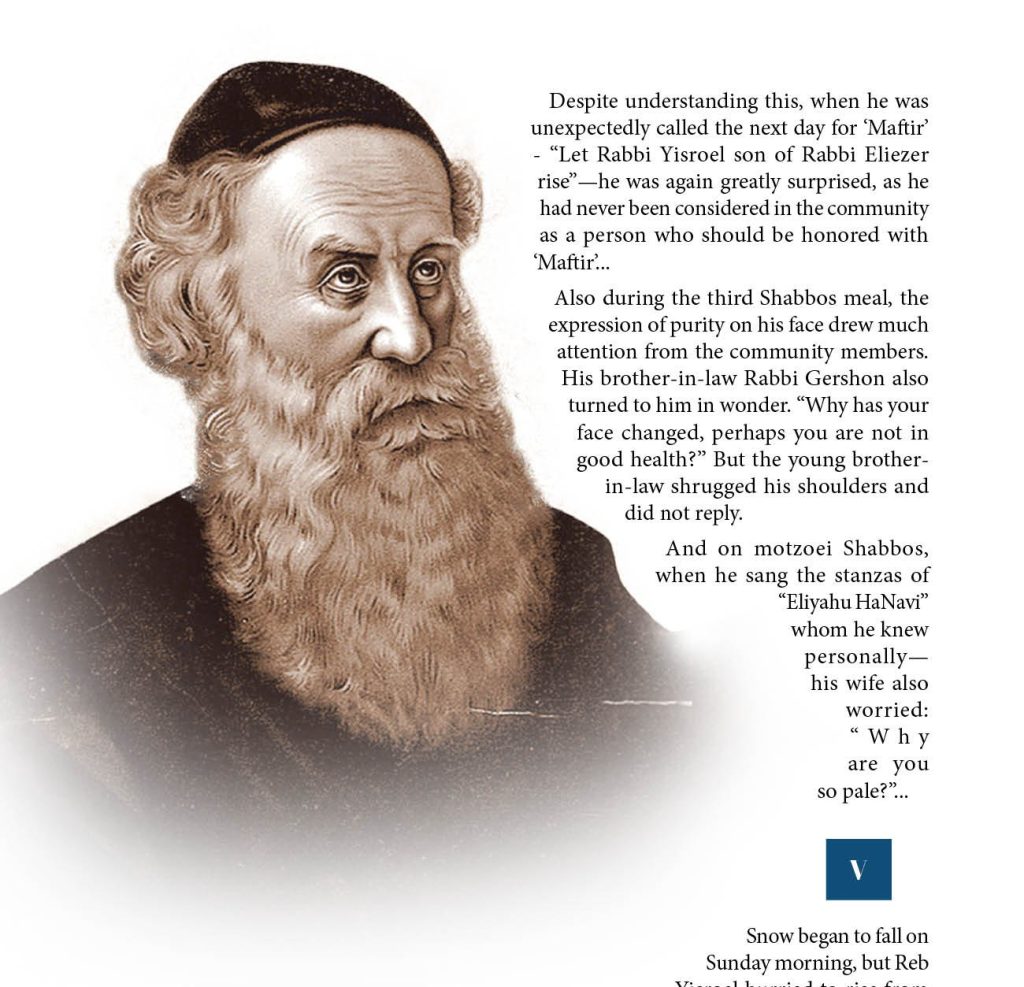
Despite understanding this, when he was unexpectedly called the next day for ‘Maftir’ – “Let Rabbi Yisroel son of Rabbi Eliezer rise”—he was again greatly surprised, as he had never been considered in the community as a person who should be honored with ‘Maftir’…
Also during the third Shabbos meal, the expression of purity on his face drew much attention from the community members. His brother-in-law Rabbi Gershon also turned to him in wonder. “Why has your face changed, perhaps you are not in good health?” But the young brother-in-law shrugged his shoulders and did not reply.
And on motzoei Shabbos, when he sang the stanzas of “Eliyahu HaNavi” whom he knew personally—his wife also worried: “Why are you so pale?”…
V
Snow began to fall on Sunday morning, but Reb Yisroel hurried to rise from bed before midnight arrived, and hurried to immerse in the mikva. From there he continued outside the city. He knew that the wondrous old man was waiting expectantly for him…
A long road lay before him, and from heaven they sent him a goy who was traveling on a snow sled.
“Would you like to get on?” asked the goy with surprising generosity, and the young scholar agreed and joined him.
Upon reaching the approximate place that the old man had indicated to him, he got down from the sled and began to go deeper in his walking among the mountains.
While he was still looking ahead—behold the old man stood before him, his face serious. Without saying a word, he indicated to follow after him, and the Baal Shem Tov walked obediently.
“And behold a door opened from within a cave in the rock crevice, and it was full of light, and a table with two chairs there,” the Baal Shem Tov later wrote to his brother-in-law.
The old man sat on a chair and instructed his new student to sit opposite him as well. Wordlessly, the old man took out a sefer (“It is not yet possible to reveal its holy name, but the truth I will tell, that this was the first time I saw this holy book.”); he opened it to the first pages and said to the young man: “Look and read aloud.”
At that moment, as if an additional soul entered the young scholar, he began to read aloud, while the old man raised his hands above his head as if blessing him.
While the Baal Shem Tov was reading “literally my eyes were enlightened, and the paths of heaven became clear to me and the gates of understanding opened before me.”
After two hours the anonymous old man raised his hand: “Enough my son, tomorrow, im yirtze Hashem, you will come again and find me here, just be careful not to reveal this to anyone.”
“May I ask again,” the Baal Shem Tov dared, “what is your name?”
“The time has not yet come,” answered the old man and he rose from his place and left the cave, accompanying the scholar to the entrance to the city of Brody. Again he placed both his hands on Reb Yisroel’s head and blessed him.
VI
A full year continued this order of study, between the old man and the young man, until it became a regular thing.
But one day, before the old man parted from him as was his way at the city gate, he suddenly revealed his holy name.
“And I fell in a faint from great fear that I merited to receive Torah from such a holy and awesome teacher,” writes the Baal Shem Tov in his holy letter, “until with G-d’s help I returned to my strength.”
Again a period passed, and the situation changed from one extreme to another.
One early morning, the wondrous man informed Reb Yisroel that soon the time would come when he must reveal himself to the public.
“For so it is written and sealed in heaven that when I am thirty-six years old, I must reveal myself,” added the Baal Shem Tov. “If so, it appears that if G-d wills, in the year 5494 (1734) I am forced to reveal myself and this troubles me greatly, for how am I ‘falling’ more than all my companions who are older than me, and moreover I see that there will be great scandals and disputes from this, for I will have opponents who will want to swallow me for nothing…
“And though my heart is right and confident in the mercies of the Alm-ghty who has never abandoned me until today, for surely He will not forsake me, G-d forbid, forever; but why do I need all this trouble, for now thanks to G-d it is very good for me…”
(Adapted from Kuntreis 18 Elul 5703; from the letters of “The Cherson Geniza” attributed to the Baal Shem Tov that he sent to his brother-in-law Rabbi Gershon Kitover. In these letters the Baal Shem Tov tells in first person about his childhood, his association with the hidden tzaddikim, his efforts in avodas Hashem and finally—his revelation.)
Beis Moshiach #1475 • pp. 32-37
© 2026 Beis Moshiach Magazine. All rights reserved.
This article originally appeared in Beis Moshiach #1475. You are welcome to share it with friends and family by email or in print, provided that you do not change, add to or omit any part of it, you credit the author and Beis Moshiach, and you include a link to archive.bmoshiach.org (written out in full in printed copies).
To republish this article in a newspaper, magazine, book or website, please request permission in advance at [email protected].