The Soul at the Tree in the Forest
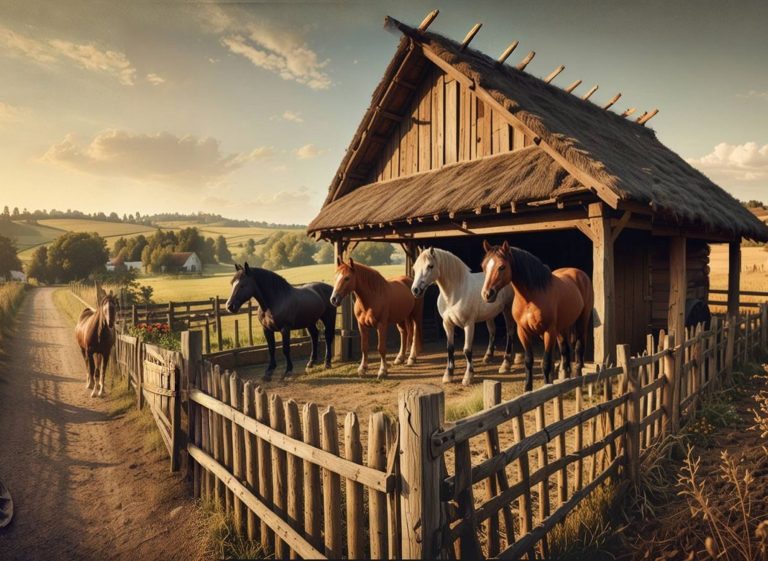
The Baal Shem Tov never liked to travel on regular roads. His wagon didn’t need anyone to guide the horses. They ran on their own, through fields and forests, as if they already knew the way.
The talmidim sat close together, holding on as the wagon bumped and shook. Sometimes they whispered Torah to each other, and other times, they just looked at their Rebbe, wondering where the journey would end.
At last, the horses slowed. The wagon stopped in the middle of a wide, empty field. Not a house, not a person – only tall grass, blowing in the wind.
The Baal Shem Tov stepped down first. His talmidim followed quickly.
“Rebbe,” whispered Reb Yaakov, “why have we stopped here? There’s nothing around.”
The Baal Shem Tov didn’t answer. Instead, he reached into his bag and pulled out a small bottle of mashke. He bent down and dug a little hole in the earth with his hands, then poured some of the mashke inside.
The talmidim looked at each other in confusion. Reb Meir finally asked, “Rebbe… why pour good mashke into the dirt?”
The Baal Shem Tov’s eyes sparkled. He put his hand gently on Reb Meir’s shoulder and said, “My talmidim, every place in the world has its purpose. Sometimes, even the earth must be lifted up with a taste of holiness. Today, we’re here to give it that blessing.”
The talmidim grew quiet.
The Baal Shem Tov leaned forward, his eyes shining.
“Here’s the story,” he began.
* * *
Once, there was a good Jewish man, who owned a large store and lived in a fine house in the center of the village.
When time came for his daughter, who we’ll call Fraida, to marry, he chose a chosson who loved nothing more than learning Torah. We’ll call him Velvel, and he learned with such fire that he never wasted a single moment.
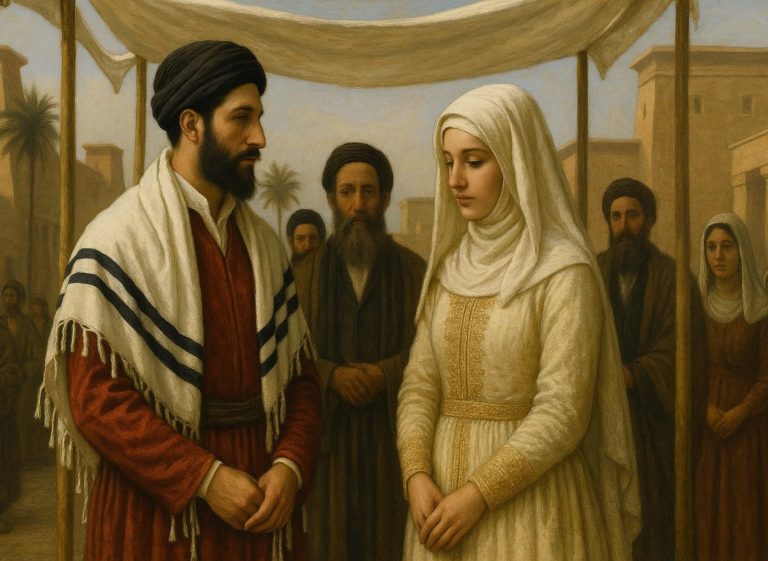
The wedding was celebrated with such joy! Fraida, the shopkeeper’s daughter whom everyone in town admired, married Velvel, the young talmid chacham.
After the wedding, life returned to its rhythm. Fraida went back to helping at her father’s store, while Velvel went straight to the Beis Medrash and learned from morning until night. Fraida was used to running things – she’d been helping at the store since she was a little girl. She knew every receipt, every barrel, every delivery.
Every morning, she packed Velvel a hearty breakfast, waved him off to the Beis Medrash, and then walked to the store. She unlocked the heavy wooden door, tied on her leather apron, and welcomed customer after customer.
“Can I have three pounds of flour?” asked the tailor’s daughter. “Of course,” said Fraida, scooping it quickly. “And also three spools of black thread, please.” “Right away,” Fraida answered.
The little bell on the door rang. Fraida looked up to see a tall man enter. He didn’t look like the other villagers. His voice was deep and loud.
“Hello, how can I help you?” asked Fraida. The man scratched his chin, staring at the shelves, stacked to the ceiling. “Yes… I’ll take ten boxes of shoe polish.”
“Ten? Are you sure?” Fraida blinked. “Yes, yes,” he said quickly.
Strange, Fraida thought, as he left. Who needs ten boxes of shoe polish?
From then on, the tall man came almost every day. Sometimes, he bought food, sometimes useless things, and always, always, too much of something. He was polite, but always watching.
What Fraida didn’t know was that, at night, he sat in the empty church, whispering to himself. This man was a galach, a priest. And he dreamed of pulling Jews away, chas v’Shalom, from Hashem and the Torah.
One night, he muttered, “If I can convert a true Torah scholar, then others will follow.”
His eyes narrowed. “That young man, Velvel… yes, he’s the one I must reach. But he’s always learning. He’s the town talmid chacham, and he’d never waste time talking to me, a priest. No, I must find another way.
“His wife, Fraida… she runs the store, she speaks kindly – she will open the door. Through her, I’ll get close to him. I’ll buy things I don’t need, smile politely, and she’ll think me harmless. And then, little by little, I will reach her husband.”
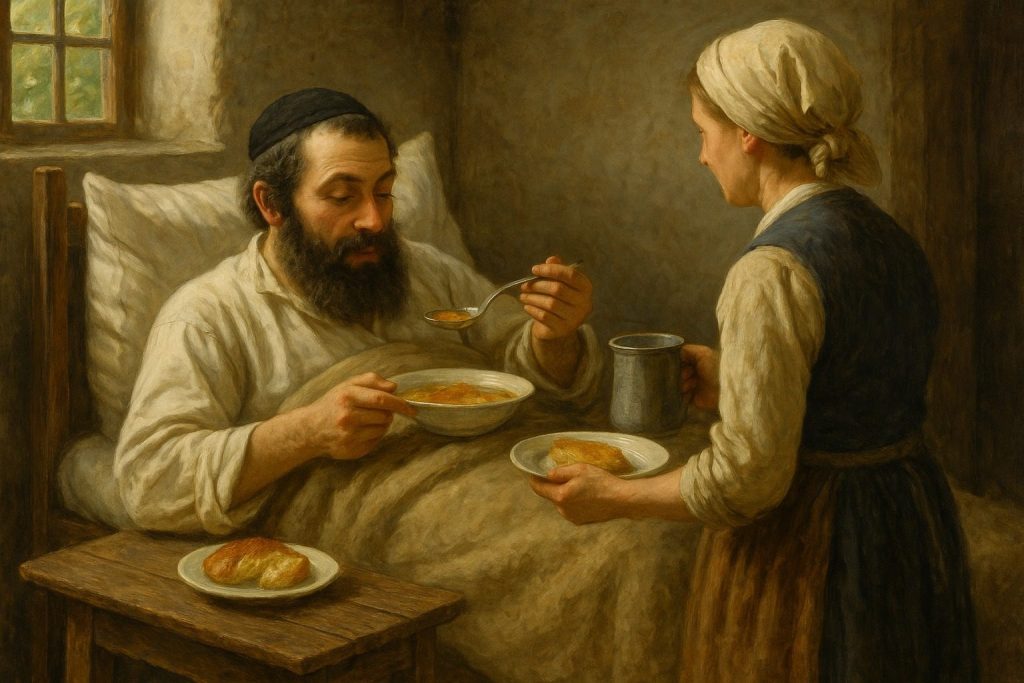
One day, he asked, casually, “How is your husband?” Fraida sighed. “He’s not feeling well today.” “Ah,” the man smiled. “May I visit him? I’m the kind of man who likes to meet the finest people in the village, and your husband is surely one of them. I’d like to wish him a speedy recovery.”
Fraida hesitated. Something inside told her to say no. But the man was so sure of himself, so polite, and such a good customer, she found herself saying yes.
The tall man entered their home. He sat beside Velvel’s bed and spoke with him. He asked questions from Tanach, arguments of philosophy, and questions about Yiddishkeit – like why Jews keep Shabbos or why we eat only kosher – debates that seemed harmless. Velvel answered every one with sharpness and depth. The man left smiling.
“Phew,” Fraida said as she closed the door. “Yes, that was strange,” Velvel admitted.
But it happened again. Velvel grew ill once more, and the tall man returned. He visited often, speaking softly, planting small seeds of doubt.
Sometimes, he’d ask, “Why must Jews keep Shabbos so strictly? Wouldn’t one day of rest be enough?” Velvel would firmly answer, “Because Hashem Himself rested on the seventh day, and He commanded us to do the same.”
Another time, the man asked, “Why only kosher food? Isn’t food just food?” Velvel shook his head. “No. Hashem gave us these laws, to make even eating a holy act.”
Then, one day, the man made an offer. “You should rest in my country estate,” he said, kindly. “The air there is clean and fresh. You will have peace, gardens, orchards. And don’t worry – I will hire a cook just for you, who will prepare kosher food.”
Fraida’s heart sank. Something felt wrong. But Velvel agreed.
Fraida pleaded, “Are you sure, Velvel…? Something feels off.” Velvel answered, “He’s a good customer, he’s been polite, and he promises kosher food. Perhaps Hashem is sending me a chance to rest and heal.” Fraida made a worried face, but said no more.
Every morning at the estate, Velvel was served tea, apples, and porridge. Lunch was bean soup and fish. All kosher. Everything seemed fine.
Until one evening. The priest entered the kitchen, carrying a silver vase wrapped in paper. “For you,” he told the cook. “You are so skilled – please accept this gift, and put it in the stew you’re making for my guest.”
The cook unwrapped it. Bones. Not beef bones. Something else. She looked up. “You… want me to…?” she asked nervously, already sensing the bones were not kosher.
The priest leaned closer and whispered, “Yes. This will break his holiness. Once he eats food that isn’t kosher, his soul will be weaker. The wall of protection around him will crack.”
That night, Velvel ate stew that wasn’t kosher. He didn’t realize what had been snuck into the food. But, spiritually, something very big had happened. The holiness that protected him had been broken. Once he ate even one bite of non-kosher food, his neshama felt weaker.
From that day, it became easier for the priest. Each visit, he twisted Torah, explained verses poorly, sowed more confusion. He would say, “Doesn’t your own Torah sometimes speak in riddles? Maybe it means something different than what you think.”
Velvel argued at first, bringing clear proof. But the non-kosher food had already won. His heart felt heavier, and his mind, once sharp, seemed cloudy. Slowly… slowly… his certainty cracked.
Very sadly, after many chats, Velvel began to slip further. At first, he skipped a davening – then, he missed learning. He stopped answering as confidently as before.
Over time, the priest and Velvel even became what Velvel thought were good friends. The priest’s gentle words and twisted explanations began to sound like Velvel’s own thoughts. The priest had quietly changed his mind, filling his head with terrible ideas. All through non-kosher food.
After some time, Velvel no longer believed only in Hashem. The priest’s trap had worked.
* * *
How could this happen? Why did Velvel fall so far?
Well, part of this man’s trickery – besides being so nice and helpful – was the non-kosher food.
The Torah teaches (see Tanya Chapter 8) that eating non-kosher makes a Jew’s spiritual senses less sharp. That’s why we must be so careful about kosher food. Kosher food makes the soul stronger, like how healthy food makes our bodies stronger. Non-kosher food weakens the soul, the way sugar can make us feel sick. When that happens, a person won’t notice spiritual danger, and when they do something wrong, it doesn’t bother them the way it should, chas v’shalom.
Oy vey.
Over time, Velvel forgot about his wife and family. As he listened to the priest more and more, he began to believe in his ways. In his mind, the old Jewish ways seemed wrong, and the priest’s words sounded right. He even thought, this priest is my true friend; he has taken me out and given me a better life.
Finally, Velvel married the tall man’s daughter. At the wedding feast, the priest leaned close and whispered, “Remember – you are no longer Velvel. You have left behind your old life. Your Torah, your wife, your people – those are gone. With me, you will have a new life, a new name, and everything you could want.”
* * *
He seemed to live a comfortable life. The tall man gave them a huge house, wide fields, orchards, stables, and even a mill.
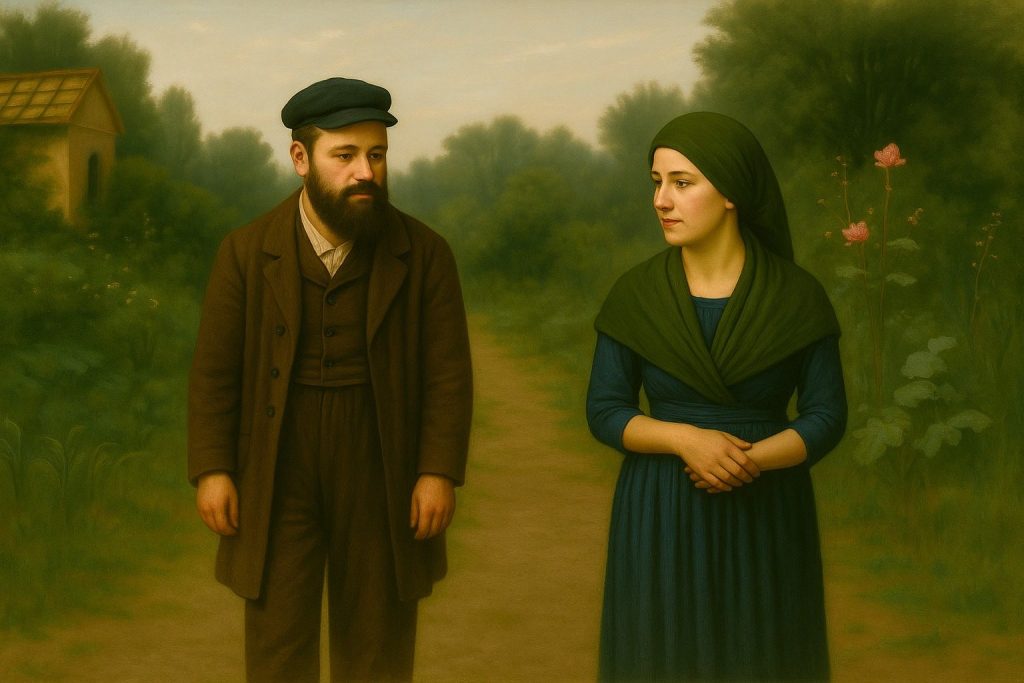
Velvel – now called Vlad – and his new wife, Lyudmila, liked to take walks through their gardens, admiring the flowers and fruit trees. At the far edge of the land lived the gardener, who was also the groundskeeper and guard. He had a tiny hut.
One day, as Vlad and Lyudmila were walking and chatting, they suddenly heard sobs. Someone was crying bitterly.
“Let’s stop and see what’s wrong, Lyudmila.”
“Of course,” she said.
They followed the sound to the hut. Inside, the groundskeeper sat with his head in his hands.
“What’s wrong?” asked Vlad.
“Oh, nothing, master. Nothing for you to worry about. Please go on, enjoy your afternoon.”
“No, tell me,” Vlad insisted. He pulled out the only chair – rough, wooden, and uncomfortable – and sat down.
“Oh… don’t trouble yourself,” said the man. “You can go on with your day.”
“I won’t leave until you tell me what’s bothering you.”
The man sighed. “Fine. I’m from the children of Anusim. My great-great-grandparents were Spanish Jews who were forced to convert or die. They had no choice. Outwardly, they lived as non-Jews, but secretly, in their hearts, they tried to remember the mitzvos, even though they could be killed if they were discovered.
“There’s one day of the year most holy to Jews. It’s called Yom Kippur – a day of tears and forgiveness, the day we feel closest to G-d, the Creator of the world.”
This was not news to Vlad. He didn’t need someone to explain it to him.
“I am a Jew too,” Vlad said quietly.
The groundskeeper’s mouth opened wide. He had no words.
“Vlad…?” Lyudmila called from outside the hut.
“Coming!” Vlad answered, hurrying out.
But the next day, and the day after, Vlad returned to the hut to speak with the gardener.
One day, the gardener said, “I’m very surprised at you, Vlad. You – you can do whatever you want. You’re rich, powerful, and free. You can run away and return to being a Jew. I wish I could! I have to keep this job, hide who I am, and remain as I appear. I don’t have your privilege. But you… you do. Someone should teach you what being a Jew is really all about. I’m sure you never truly learned. Oh, how I wish I could!”
Vlad sat still. The gardener’s words hit deep into his heart. For the first time in a long time, he felt a stirring inside – a memory of who he once was.
* * *
How could this happen? How did Velvel fall so far…?
In the quiet of his mind, he cried out, “Ribbono Shel Olam, what have I done? How did I trade away my Torah, my people, and my Yiddishkeit? Please, Hashem, forgive me! I want to return. I will leave everything behind, if only You’ll take me back. I’m ready to be Yours again.”
* * *
In that part of the world, the law was very strict: you were not allowed to switch religions. There was only one exception – if a Jew wanted to become a Christian, that was allowed. But the other way around? To leave Christianity and become a Jew that was unheard of and completely forbidden. Dangerous.
But Vlad’s neshama had woken up. He couldn’t ignore it any longer.
Late one night, while the world was asleep, he packed nothing. He left behind his house, his lands, his orchards, and all the comforts that once made him proud. He ran, his heart pounding, through forests and fields, not looking back.
From the source of the story, it’s unclear what happened to his first wife. Perhaps she passed away from heartbreak when he disappeared; perhaps something else happened to her. But it seems that when Velvel looked for her, there was no trace of her, and he fled to a faraway country, where no one knew him – someplace he was allowed to return to Judaism.
There, he did teshuva, with all his heart.
“Hashem,” he whispered through his tears, “I’m sorry. I’m sorry for every step I took away from You. I’m sorry for breaking the holy chain of my fathers. I am not Vlad. I am Velvel. Take me back!”
His neshama burned with a strong fire of love for Hashem. He began keeping all the mitzvos again. He learned Torah, all day long, until the very last day of his life.
Meanwhile…
Lyudmila was shocked. Where had her husband gone?
“I know! The gardener must have something to do with this,” she thought. “After all, Vlad was speaking with him so much before he disappeared. It can’t be for nothing. He just hasn’t been the same since that day we heard the crying. So strange!”
Lyudmila went to the gardener and spoke with him at length. He told her everything – the truth of who Vlad really was, and the secret tears of his Jewish soul.
“Wow,” Lyudmila thought. “My father, a priest, may have beautiful lands and many farms. But something in the gardener’s eyes tells me he speaks a truth I’ve never heard in my life. My husband – if he found this treasure more precious than gold, then I, too, will give everything to find it. Even if I must leave the church behind.”
And so, she did. She ran away, too. She became a Yid, and, slowly but surely, she grew to love the Torah with her whole heart, keeping the mitzvos with her husband until the end of their days.
* * *
“What about me?” thought the gardener as he sat alone in his wooden hut, on the only chair he owned. His rough hands tugged at his hair as he wept. His heart longed to return to his Father in Heaven. “When will it be my turn? Will I ever find my way back?” he whispered, tears running down his wrinkled cheeks.
At last, the gardener could not bear it any longer. One morning, he packed two loaves of bread, some salted fish, and three coins. He pulled on his worn boots, slung a small pack over his back, filled a can with water, and grabbed his sturdy walking stick. Standing tall, he declared, “I don’t know where I’ll end up, but I’m leaving! I must reach a land where I can live as a Jew. My parents, my grandparents, my great-grandparents – they all dreamed of this. No longer will I live in hiding. Even though I have no money, I’ll run away. Hashem will guide me. If Vlad and Lyudmila can do it, then so can I!”
His eyes filled with both tears and joy. He raised his hands toward the sky and laughed through the pain. “I am a Jew!” he shouted silently in his heart.
He entered the forest, step after step, his old legs straining. But soon, his breath grew heavy, and his chest tight. “Phew…” he whispered, lowering himself against a tree to rest. His strength was fading – this journey was too much. He tried to rise again, but the pain in his chest grew sharper. Suddenly, he fell to the ground… His journey ended there. He passed away, in the silence of the woods.
So – did he really do teshuva? What do you think?
* * *
“And that is why we are here,” the Baal Shem Tov said to his talmidim, pointing to the very spot under the tree. His holy eyes shone with both sadness and hope.
“When the gardener’s neshama rose up to Hashem, the accusing angels shouted, He lived as a goy his whole life! We won’t accept him!
“But the defending angels answered, No! He did teshuva right before his death. His heart returned to Hashem!
“Not true! argued the accusing angels. He collapsed before he could keep any mitzvos, before he could truly change.
“But the good angels cried back, He wanted it with his whole heart! He set out on the road, ready to give up everything for the Torah. His intention was pure – doesn’t that count?!
“Here, right beneath this tree, his neshama had fallen into a strange in-between place. The matter was unsettled. His soul was caught in limbo, unable to rise higher, waiting for someone to help.”
The Baal Shem Tov turned to his talmidim. “That’s why we came. To help this soul find peace.”
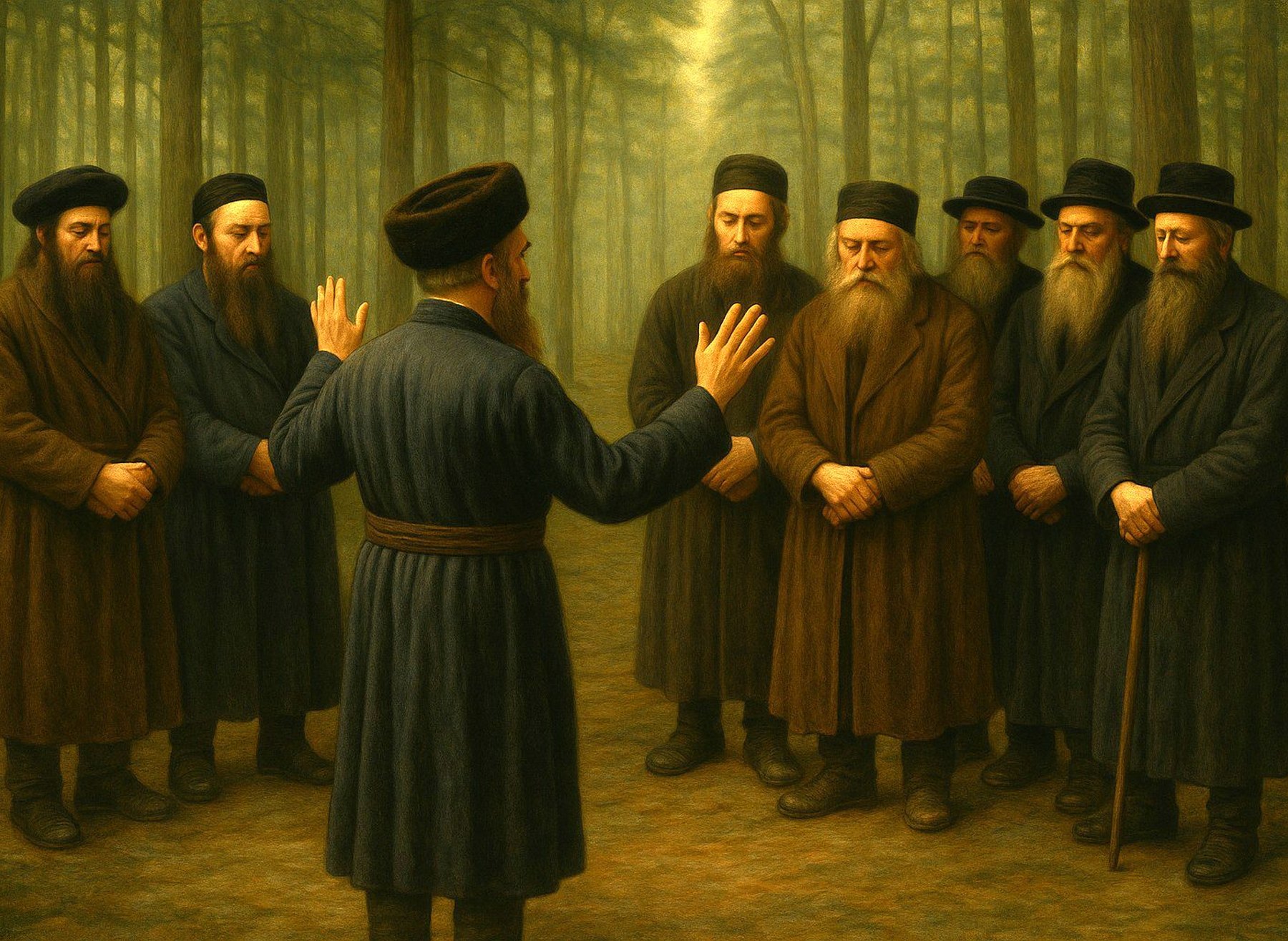
They gathered together and formed a minyan. Slowly, and with deep feeling, they began to recite Kaddish. The holy words rose upward like wings, lifting the gardener’s neshama higher and higher, until it finally broke free from its prison of waiting.
“And now,” the Baal Shem Tov said softly, his voice trembling with awe, “this neshama can rest at last -close to Hashem, surrounded by light.”
From Shmuos Vesipurim, Volume 1, Page 13
Beis Moshiach #1476 • pp. 53-59
© 2026 Beis Moshiach Magazine. All rights reserved.
This article originally appeared in Beis Moshiach #1476. You are welcome to share it with friends and family by email or in print, provided that you do not change, add to or omit any part of it, you credit the author and Beis Moshiach, and you include a link to archive.bmoshiach.org (written out in full in printed copies).
To republish this article in a newspaper, magazine, book or website, please request permission in advance at [email protected].