Tanya At The Peak
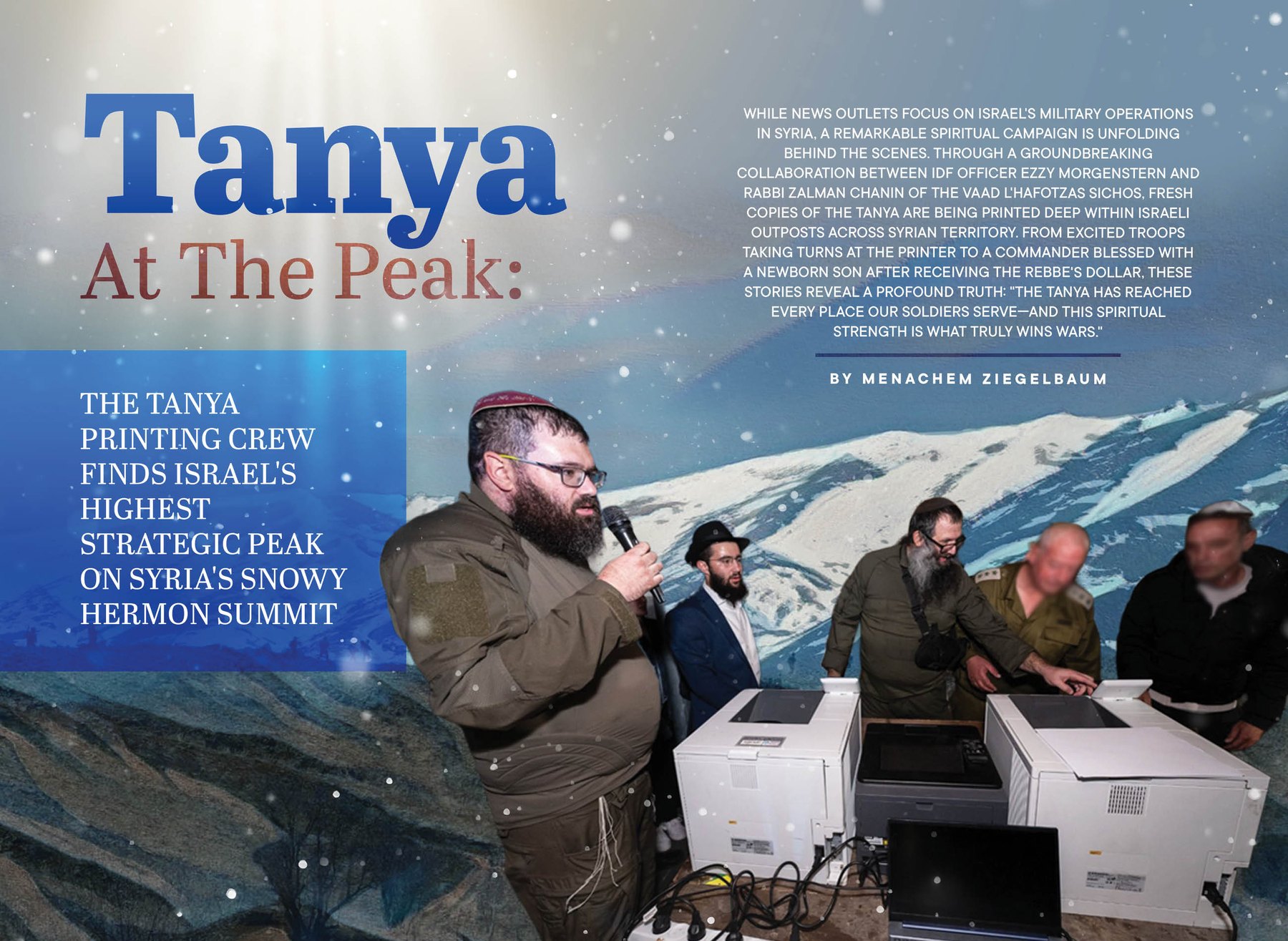
The Tanya Printing Crew Finds Israel’s Highest Strategic Peak on Syria’s Snowy Hermon Summit
While news outlets focus on Israel’s military operations in Syria, a remarkable spiritual campaign is unfolding behind the scenes. Through a groundbreaking collaboration between IDF officer Ezzy Morgenstern and Rabbi Zalman Chanin of the Vaad L’Hafotzas Sichos, fresh copies of the Tanya are being printed deep within Israeli outposts across Syrian territory. From excited troops taking turns at the printer to a commander blessed with a newborn son after receiving the Rebbe’s dollar, these stories reveal a profound truth: “The Tanya has reached every place our soldiers serve – and this spiritual strength is what truly wins wars.”
The collapse of the Syrian regime led by the tyrant Bashar al-Assad was a first-class political and security surprise in the decision-making offices of the Israeli government and the leading security bodies in Eretz Yisrael.
Within eleven days, the Syrian rebel forces completed their surprise attack. With surprising ease, they conquered central cities like Aleppo, Hama, Homs, and Damascus, and declared the fall of the decades-old regime. The tyrant fled with his family to Russia.
The Israeli government did not hesitate. It took advantage of the sovereignty that suddenly collapsed and took control of extensive territories throughout Syria – one of the harshest, most bitter and cruel enemies of the people of Israel over the years. Simultaneously, it bombed the Syrian air force, ground forces, and everything that could ever harm the residents of Israel.
From then until today, the IDF holds extensive territories in Syria, including the Syrian Chermon, which was previously the terror of senior IDF officers.
This political and security turning point was surprising in its scope, intensity, and especially its speed. Many remembered the words of the Rebbe about the importance of conquering Syria, up to Damascus, and the connection to the coming of Moshiach, and see in the current developments a taste of Yemos HaMoshiach.
The Tanya Also Reaches Syria
Rabbi Shneur Zalman Chanin, menahel of the Vaad L’Hafotzas Sichos, appointed by the Rebbe as responsible for the publication of Kehot books, has been involved for many years in printing editions of the Tanya.
The printing of the sefer gained momentum since Teves 5740, when the Rebbe issued a call to print new editions of the sefer in every city where Jews reside. Close to 9,000 editions have been printed worldwide since then, in central places as well as remote locations, including places where only a few Jews live.
It turns out that Syria has finally entered the list. Indeed, Jews were there from time immemorial, since the days of Bayis Sheini, with large, magnificent, and impressive Jewish communities. But since Syria gained its independence, Syrian Jewry was severely damaged. In 1946, anti-Jewish riots broke out and basic rights were denied to Jews. After the UN decision on November 29th, severe pogroms against Jews occurred in the cities of Aleppo and Damascus, among the worst that Syrian Jews suffered.
The community was mortally wounded, the main synagogue of Aleppo was burned, and much property was set on fire or destroyed. After the establishment of the State of Israel, most Syrian Jews fled against their will, and out of the 30,000 Jews who lived there before the mass exodus, only about 5,000 remained. Subsequently, the situation of the Jews worsened even further. All civil rights were denied to them and heavy economic decrees were imposed upon them. It is not surprising, therefore, that the communities gradually diminished, until in recent years only a few Jews remained.
But now, with the conquest of extensive territories by the IDF, Jews have returned to Syrian soil, mainly IDF soldiers who are in the country and stay there for extended periods as part of their military service. This too is a good reason for printing the Tanya there.
Rabbi Chanin enlisted for the operation, part of which was conducted in secrecy and caution, out of a desire not to arouse such forces and others who would certainly express opposition to an operation whose source is in kedusha.
The Dollars Arrived Just in Time
The one managing the operation in the field is R’ Eliezer Morgenstern, a Chabad Chassid and IDF officer, who has merited to print 37 editions of the Tanya so far in Gaza, Lebanon, and now also in Syria.
The Tanya was printed at several important points in Syria. IDF commanders in the field understood the importance of spiritual protection, and when necessary, allocated full IDF escort to the printing operation, accompanying the printing vehicle deep into Syrian territory.

“Much of what happened still cannot be published,” he says candidly this week in conversation with Beis Moshiach.
“One of the commanders who approved the printing operation surprised me and asked for a dollar from the Rebbe,” relates Rabbi Chanin, “and I couldn’t refuse… I told him: ‘You have such a zechus, to print three editions of Tanya in Syria, I’ll get you a dollar from the Rebbe.’”
And how did he react?
“Oh, he was in seventh heaven… He took the dollar and keeps it securely with him. He put on tefillin, and we even affixed a mezuza on the main gate at the border through which forces enter Syria.”
Speaking of a dollar from the Rebbe, R’ Eliezer has a moving story of hashgacha pratis: “It was in the first days of the war, when there was still crazy disorder. Our brigade sat in some parking lot waiting for the jump order. We barely had electricity, and slept on the floor in sleeping bags. To supply food to the soldiers, they brought a civilian refrigerated truck that would come every day. I and several other soldiers were assigned to go to the truck and take supplies from there.
“One morning I arrived at the truck to get ice, someone inside opened the door and looked at me. He got down from the truck and asked ‘Are you Chabad?,’ when I answered affirmatively, he said, ‘I want a dollar from the Rebbe.’
“It’s moving to see a Jew who yearns to receive a dollar from the Rebbe. I told him ‘Okay, I’ll try to get you one,’ even though I had no idea where to get it from. He wasn’t my soldier, but a soldier who served in our brigade and was responsible for organizing the kitchen, food supply, etc.
“From then on, every time I saw him, he would remind me, ‘I’m waiting for the dollar from the Rebbe…’
“Over time, changes were made in the brigade, and I left, while the soldier remained stationed there. A few months passed and I almost completely forgot about it.
“The first time Rabbi Chanin came to Israel, he wanted to print the Tanya at the various bases. At just that time, the Golani Brigade left Gaza and moved to the northern border facing Lebanon, ready to receive battle orders.
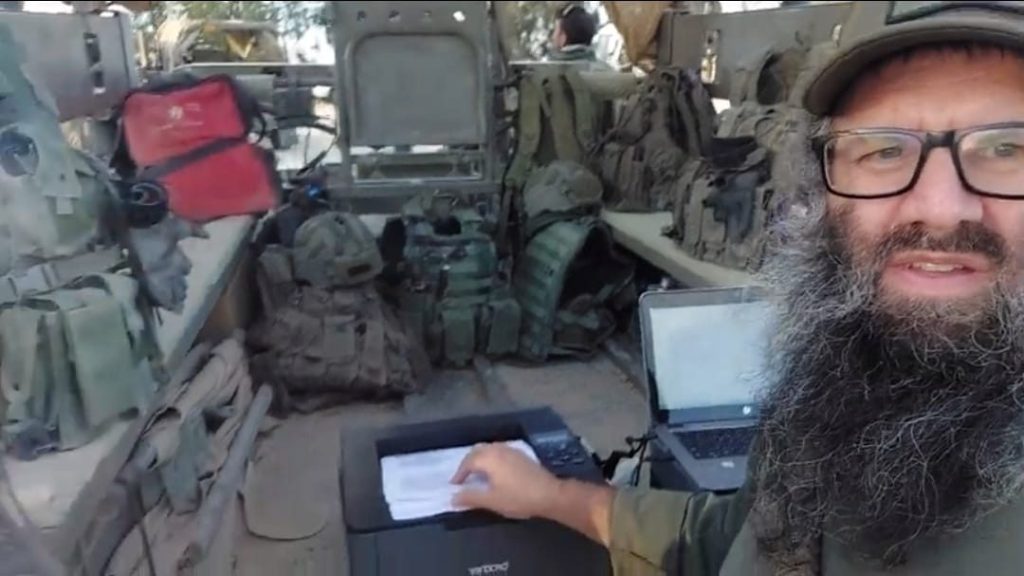
“This was the point when I returned there, and since they opened a new outpost there in the middle of nowhere, I said to myself ‘Wait, there was no Tanya printing here… if Rabbi Chanin is here, he needs to come here himself to print it.’
“The new outpost was quite temporary, in the middle of a grove, and it contained several temporary buildings placed there.
“When we came to print the Tanya, I asked where we could do the printing and someone told me ‘Not here, go to the dining room, at least there’s air conditioning there. Print there.’ When I arrived at the dining room, who do I see? That same guy who asked for a dollar several months earlier… He looks at me and immediately said, ‘So, where’s my dollar?’
“I didn’t have any dollar from the Rebbe, and I had no one to get it from, but I pointed at Rabbi Chanin who had just gotten out of the car. ‘If you have any chance to get a dollar from the Rebbe, it’s from him,’ I said.”
We heard the continuation of the story from Rabbi Chanin: “This soldier approached me and really begged that I give him a dollar from the Rebbe. I asked him, why should I give you one? And he told me that he has been married for a long time, and they don’t have children. He feels that if he receives a dollar from the Rebbe, a miracle will happen and they will merit children. He begged so much, until finally I said I would give him a dollar from the Rebbe.
“He danced with joy, but then he came with another request: he also wants a coin from the Rebbe for the child who will be born… I told him: First let’s see that you merit a son, and then we’ll see… A few days later we met in Yerushalayim, and I gave him a dollar I received from the Rebbe.
“This whole story happened a year ago. On Sunday two weeks ago, he called my son-in-law, Rabbi Shlomo Goldfarb who serves in the reserves as a military rabbi, and said: I don’t know if you remember me, but a year ago when we printed the Tanya at the military outpost, your father-in-law gave me a dollar from the Rebbe. Tomorrow, G-d willing, the bris will take place, and I want to honor him to be the sandek!
“My son-in-law explained to him that I live in New York, so I couldn’t accept the offer to be sandek, but by hashgacha pratis, I was supposed to arrive in Eretz Yisrael at the end of the week.
“On Friday he called again and asked to speak with me. He told excitedly that after he received the dollar from me as a bracha, his wife became pregnant and it was miraculous. When his wife went to the hospital to give birth, he asked the Rebbe for a bracha, and received an amazing response from the Rebbe through the Igros Kodesh. The gist of the response was: I already answered you, and tell your wife that everything will be fine, and you will have a ben zachar (boy), and you will raise him for Torah, chuppa, and good deeds!”
“A Place That Was Most Dangerous, and Now We Are the ‘Landlords’…”
One of the editions was printed at a fortified IDF outpost at the triangle of borders between Israel, Syria, and Lebanon, located at the upper level of the mountain.
The idea to print Tanya at IDF bases in Syria was practical and goal-oriented. If the Rebbe urged those engaged in the work to print a Tanya edition at IDF outposts in Lebanon, which were then only temporary places – then today, IDF bases are living places in every respect, with living quarters, equipped kitchens. The soldiers actually live there.
This understanding accelerated the printing process in recent months.
How many editions have you printed so far in Syria?
“Bracha only dwells in something hidden from the eye. There are groups that look askance at this. It’s better that things be done quietly,” smiles R’ Eliezer, and he knows what he’s talking about. Not long ago, one of the Chabad websites abroad mentioned the printing of Tanya in Syria. The one who echoed this on social media was none other than the Lebanese Defense Minister who ‘tweeted’ to the current Jolani government in Syria: “Israel is conquering Syria from you and you’re not doing anything.” In this way he tried to instigate the Syrian administration against Israel.
What do you think about this?
Rabbi Chanin: “I can tell you something simple: when did the Lebanese and Syrians understand that they were conquered? Only when they printed the Tanya there, isn’t that something…”
Having been present at part of the printings, he tells of the Jewish awakening that occurred during the printing. “I have never seen such a spiritual awakening. The soldiers in the place danced, sang niggunim with utmost seriousness. It was something special. One of the soldiers, a singer by profession, asked me: ‘Can you tell me some story from the Rebbe so I can tell it at my performances?’ That’s the kind of hisorerus there was.”
The first printing took place at an IDF base close to the border, but on the Syrian side. Afterward, the printings continued deep inside the territory. “Several soldiers told me: ‘Kevod HaRav, look, a place that was most dangerous, and here we are the ‘baalei battim’… We hold minyanim here and even print the Tanya!…”
The Merit to Press the Button
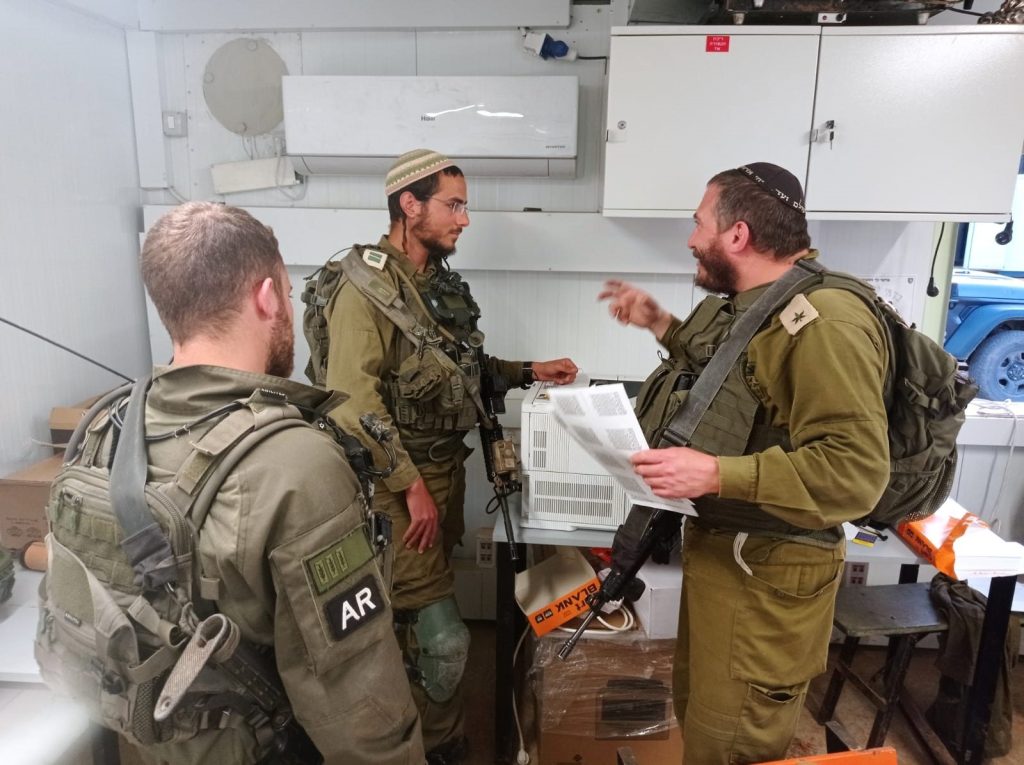
The fact that the Tanya is printed at IDF bases scattered around the border areas is not new. Already in the Yom Kippur War, instructions came from the Rebbe to print Tanya in places where soldiers are located. Thus the Tanya was printed at “Fayid on the west bank of the Suez Canal” and at a series of additional IDF bases.
In the First Lebanon War, IDF forces again broke into Lebanese territory, and after them also a Tanya printing mobile unit, racing and rattling, ready for the mission. The Rebbe encouraged the operation and followed its progress.
A few weeks later, in distant New York, the Rebbe held a farbrengen in the presence of thousands of Chassidim. During the remarks, he spoke with great pain about the continued wallowing in the Lebanese mud and about stopping the forces from finishing the war and achieving its goals quickly, i.e. removing the terrorists from Lebanon.
At a certain point, the Rebbe surprised the thousands of Chassidim and presented the sefer Tanya that was printed in Beirut as proof of the presence of IDF forces in Beirut. In this way he illustrated that completing the mission quickly was an achievable goal, and depended only on making the right decision.
Since then there has been an inyan in printing a new edition in all those bases and outposts leading up to the border and those that are after it, including those located deep in enemy territory. “It’s hard to find a place today where the Tanya hasn’t been printed,” says R’ Eliezer. “I myself have mapped places to find the outposts and bases where printing hasn’t yet taken place.”
And indeed, also throughout the recent war, “Swords of Iron,” several editions were printed in the valleys of Gaza and Lebanon. “Now we’re in Syria!” says R’ Eliezer. “And Yerushalayim is destined to spread to Syria. We see this with our own eyes.”
Meaning?
“I myself was on the Syrian Chermon; you can really see all of Israel. When you’re there, you can understand the great miracles we’ve had in the last two years.”
R’ Eliezer is the man behind almost forty Tanya editions that were recently printed in Gaza, Lebanon, and Syria. As part of his military role, without elaborating, he manages to open doors, mainly the doors of the hearts of senior officers.
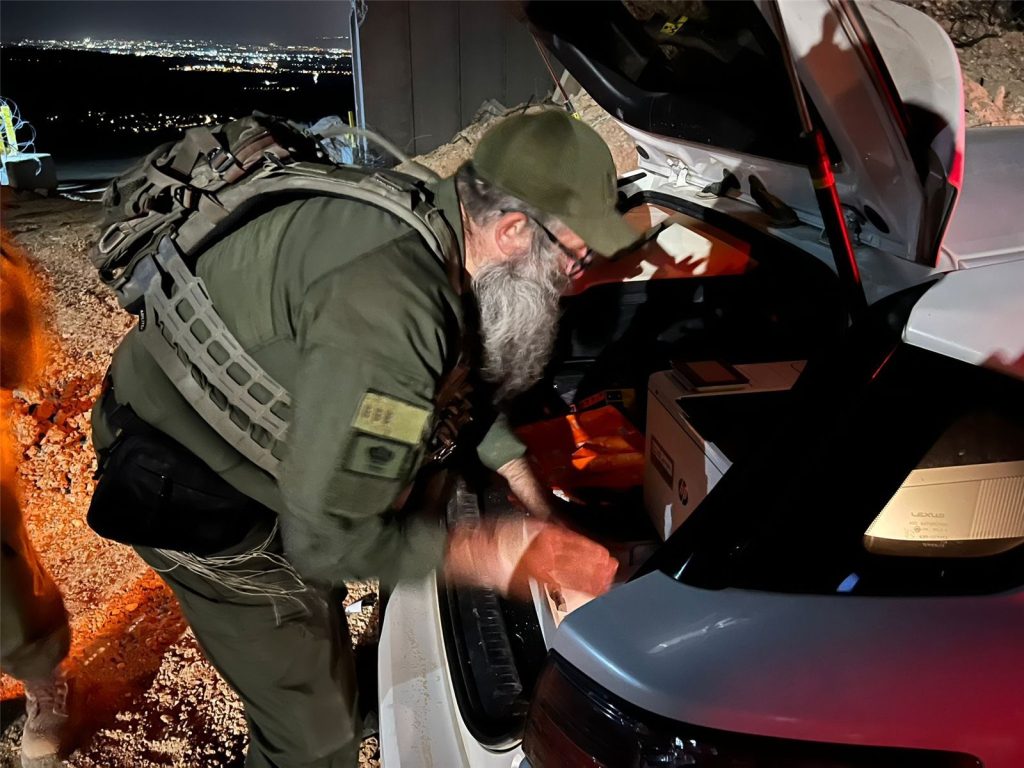
“Every such venture involves a military operation. It involves military escort, protection and guarding throughout the printing.”
What drove you to hurry so much to print the Tanya in Syria?
Rabbi Chanin: “As is known, in the Lebanon War the Rebbe closely followed the Tanya printing operation. Often the secretary would call in the middle of the night and ask Rabbi Aharon Eliezer Ceitlin, initiator of the operation, to find out how things were progressing, even though it was right in the storm of war… Since then they understood that what wins the war is the Tanya.
“Obviously this is a spiritual matter that we have no understanding of. But whoever studies the Rebbe’s sichos understands that there is a lofty spiritual inyan in the impact of the printings on winning the war.”
R’ Eliezer Morgenstern speaks excitedly about the Tanya printing operations he conducted in recent months in Gaza, Lebanon, and Syria. “I have hundreds of moving stories,” he says, but for understandable reasons he prefers to speak less about the ‘action’ that naturally accompanies these operations, and more about the neshamos.
The heart of Israel is awake. Often, during Tanya printings held in recent months at IDF’s forward bases, great hisorerus and excitement were felt. Often soldiers come excitedly “Where? Where are they printing the holy sefer?”
R’ Eliezer looks at the young generation, those who said it was ‘disconnected’ and ‘not into things,’ and cannot help but be moved. “The chevra come and literally conduct tefillos around where we’re printing as if it’s time for lighting Shabbos candles… There are soldiers who come and insist that I let them press the activation button of the printing machine. This is very exciting for them.”
How do they relate to it?
“I can’t explain how and why, but when we come to print in a place, the soldiers understand that there’s a holy event here, even though they don’t know how to explain exactly what’s special about the occasion. They just understand that it’s something spiritually great, out of the ordinary, and they want to be a part of it.”
R’ Eliezer understands that this is a rare opportunity for awakening souls.
“Every time I finish printing a set of pages, I stop the machine and prepare it for the next set. And then before each new set, I honor one of the soldiers with pressing the printer button, not before putting on tefillin or making a good resolution to strengthen in mitzvos, and of course the excitement is great.”
Rabbi Chanin cannot hide his admiration. “You need to see the excitement of the soldiers, with what seriousness they declare ‘Yechi Adoneinu’ and then press the button. With such love and fear, like saying ‘Shema Yisrael’!
“And when a group of female soldiers also asked to press the printing button, they committed publicly to light Shabbos candles every Friday, and then had the zechus to participate in the printing. It was a very moving sight.”
‘As If I Conquered Mount Everest…’
R’ Morgenstern wants to end the conversation by saying “I don’t know what zechus I have that the Rebbe chose me to conduct this operation. How did it reach such a point that suddenly I’m the one responsible for Tanya printings?
“I remember when I was with the battalion in Gaza, I had a fantasy to print the Tanya in that place. I drove everyone crazy, everyone who knows me from the brigade or battalion, that we need to print the Tanya there. I didn’t really think it would happen, but then, literally with miracles, it happened. I felt then that I reached the high-point of my life — after all I printed Tanya in Gaza… I felt as if I conquered Mount Everest…”
And what happened then?
“When I finished printing my first edition in Gaza, I marked a ‘check mark.’ But at that moment I realized it wasn’t over. I need to turn the world upside down to ensure that everywhere there are soldiers, I need to print it there again…
“I started in Gaza, and when we entered Lebanon, I found a field of operation in Lebanon. Then, when we entered Syria I continued with it. It’s like a dream mission, almost impossible, that comes true each time anew and excites me intensely every time.”
How many Tanya editions have you dealt with to this day?
“Thirty-seven editions; the first time was on Tu B’Shevat 5784.”
What message do you take from all this?
“The message is simple: anyone who wants to print the Tanya in a place where it’s needed, it’s possible; you just need to really want it.
“I succeeded in breaking through walls that I didn’t believe were possible, obtaining approvals from senior officers, and the thing came to fruition.”
Printing the Tanya with the Soldiers Who Led Operation Arnon for Rescuing the Hostages
Rabbi Zalman Chanin relates: Last summer, after the IDF began operating to conquer Rafah, R’ Eliezer Morgenstern wanted to print the Tanya in the conquered areas. When he spoke about this with the commander of forces in the field, the latter refused and said that any stay in the field constitutes mortal danger. R’ Eliezer asked again and again, saying that this was the Rebbe’s wish. At a certain point the commander told him: If you bring me a letter from the Rebbe, that they should print the Tanya in Rafah and everything will pass peacefully, I’ll give you permission.
When R’ Eliezer told me about this, and asked if there was such a letter, I told him that I wasn’t aware of one.
A short time later I found a letter from the Rebbe to a Chassid who complained that he was disconnected from the Rebbe to the point that he didn’t know at all what was happening in Beis Chayeinu [770]. The content of the Rebbe’s response was: I was alarmed to read what you wrote, and how is it possible to express yourself this way, when you are a shliach, and a shliach and the meshaleiach are the closest thing there is, because the hand of the shliach is like the hand of the meshaleiach. The Rebbe then writes: Do you think that someone who lives near 770 and davens in my minyan every day is closer? Exactly the opposite: he doesn’t do my shlichus, and you do my shlichus, you are closer!
I was very moved to read these words, and I sent the letter to R’ Eliezer. He rushed with the letter to his commander, and said: Since I am here on the Rebbe’s shlichus, the Rebbe is with us! The commander was very moved to read the Rebbe’s letter, and said: If the Rebbe is with us, I agree. He approved for him to enter the area in Rafah with an armored vehicle, and that’s how they printed the Tanya there.
After they finished printing in Rafah, they passed through the Turkish hospital in Gaza, which the IDF took control of during the war and turned into a protected military base. R’ Eliezer decided to seize the opportunity and print the Tanya in this unique military base too. Here he no longer needed to conduct the printing inside an armored vehicle, since the entire place was surrounded by the army with earth embankments and was protected from terrorist attacks.
He therefore gathered the soldiers at the location, and conducted the printing with a ‘shturem,’ without pressure. About thirty soldiers who were at the location put on tefillin, pressed the print button each in turn, and finally gathered to study together chapter 32 from the printed Tanya.
All this was on Thursday. On motzoei Shabbos, he met those soldiers again who were jubilant. They told him that during Shabbos they participated in a special military operation and succeeded in rescuing four hostages alive.
This was Operation Arnon, during which four Israeli hostages were rescued: Noa Argamani, Almog Meir Jan, Andrey Kozlov and Shlomi Ziv who were held in the Nuseirat refugee camp in the Gaza Strip by Hamas.
He immediately said to them: If so, let’s make Havdala and all dance “LaYehudim haysa orah v’simcha v’sasson v’yekar.” After Havdala one of the soldiers suggested that they all stand in a circle and say “Baruch ha’gomel la’chayavim tovos.”
The next day, the commander called R’ Eliezer and emotionally said: Do you think you know what the Rebbe accomplishes with printing the Tanya? You have no idea! Know that the soldiers who participated in printing the Tanya at the Turkish hospital were in the middle of training for the raid to rescue the hostages. During the operation we had so many miracles and wonders, most of which are classified and I can’t tell you, but know that we felt that the Rebbe was with us, and he performed miracles and wonders for us!
Beis Moshiach #1479 • pp. 18-27
© 2026 Beis Moshiach Magazine. All rights reserved.
This article originally appeared in Beis Moshiach #1479. You are welcome to share it with friends and family by email or in print, provided that you do not change, add to or omit any part of it, you credit the author and Beis Moshiach, and you include a link to archive.bmoshiach.org (written out in full in printed copies).
To republish this article in a newspaper, magazine, book or website, please request permission in advance at [email protected].