The Joy of the Journey
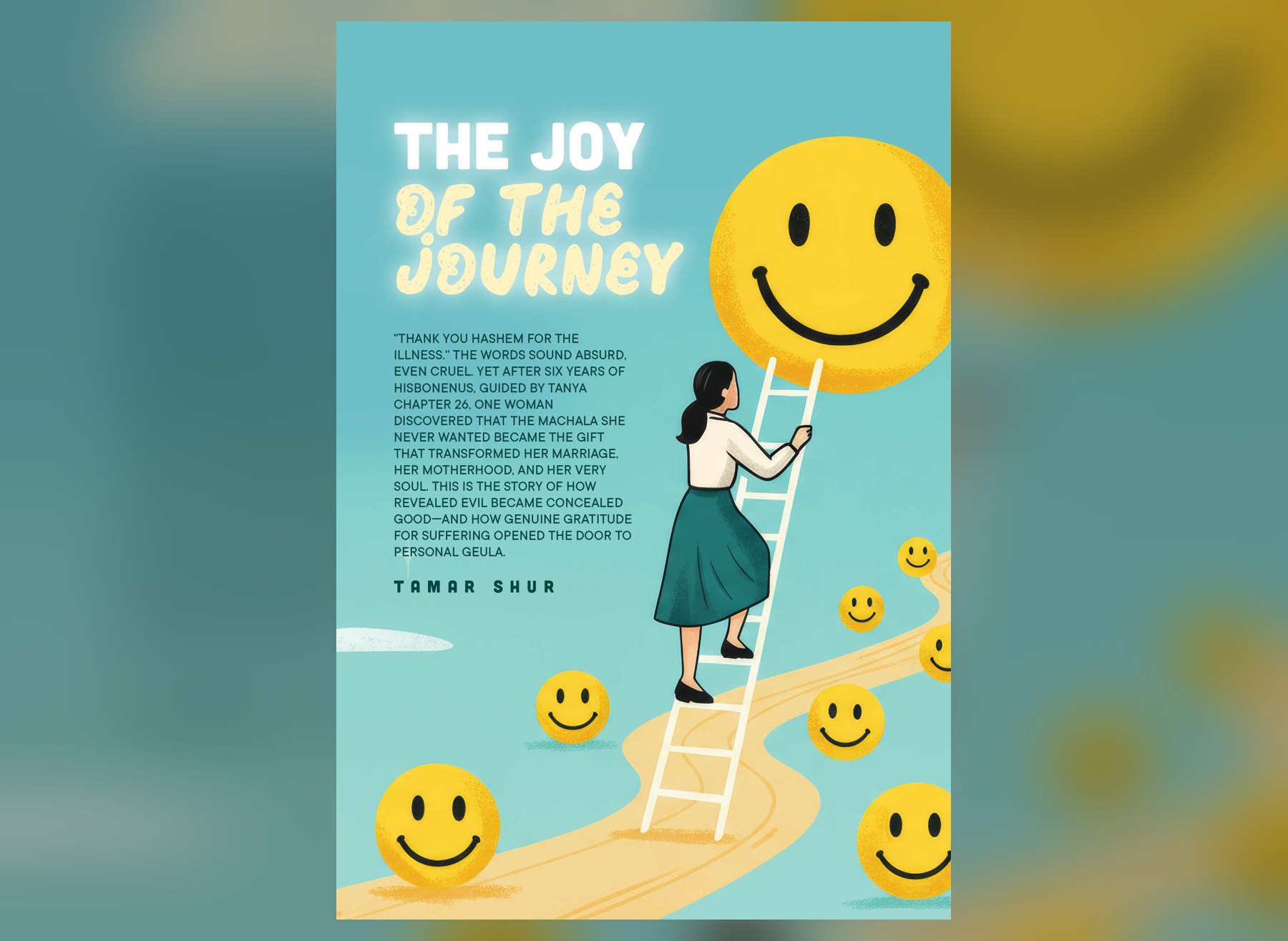
“Thank You Hashem for the illness.” The words sound absurd. Even cruel. Yet after six years of hisbonenus, guided by Tanya chapter 26, one woman discovered that the machala she never wanted became the gift that transformed her marriage, her motherhood, and her very soul. This is the story of how revealed evil became concealed good – and how genuine gratitude for suffering opened the door to personal Geula.
On our journey toward joy, toward health, toward truly good lives, lives of Geula, we draw heavily on the Tanya, guided imagery, and learning through hisbonenus. In chapter 26 of Tanya, the Alter Rebbe speaks about joy and about the ability to bless for the bad just as we bless for the good.
Sometimes it seems there’s too much ‘bad’ to bless for … The material worries and nisyonos that befall us. Hashem gives us throughout our lives a multitude of events, and we interpret them, translate them as “difficult” or “challenging,” as “terrible” or “opportunity.” But how can one truly bless for the bad?! To actually thank Hashem for ‘the machala,’ for example? This seemed absurd to me for a long time.
Over time, I learned that only I determine whether an event is a blessing or a curse, through my perspective and the interpretation I give it.
Hisbonenus Creates
True, there are events that are hard for us to interpret positively – someone passes away ch’v, financial collapse. There are days when even a car breakdown can throw me off balance (when you’re stuck with a car full of children on the descents from Tzfas in peak heat and traffic, your husband is nowhere to be found, and try blessing the bad with a pleasant face there… but that’s a story for another article).
In realistic and even ‘objective’ thinking, it’s very logical to see a nisayon as something bad. But if we want to live a different life, a better one, with the ability to see the good in every event in our lives, we can train ourselves to do so. Not just to imagine a better future, but to see the good I have here and now in the existing circumstances.
Sadness, the Alter Rebbe tells us, comes from arrogance, from not knowing one’s place. I don’t want ‘the machala,’ I certainly didn’t ask for this nisayon, and all the theories about how we receive what we invite into our lives are nice and comforting – until something like this happens to you ch’v. A friend once told me about phenomenal changes she brought to her life, solely through the power of imagination and by seeing the good in everything. That’s how she sent protection to her children in the army, that’s how she banished illness, and that’s how she even managed to grow sunflowers in a place where they weren’t supposed to grow… It’s clear to her that Hashem is in the picture; she was talking about her part in the puzzle.
“One thing I never managed to fix in my life,” she continued telling me, “is the whole issue of relationships… After the divorce, no matter how positively I thought, I couldn’t create a new relationship. Apparently,” she added after some thought, “there’s a limit to our power to influence reality.”
This is certainly a very logical thought when something doesn’t work out for me, but in practice both she and I know there is no limitation on the powers of positive thinking, just as there is no limit to the abilities of Hashem. And if something remains a curse for me, if something is stuck for me, then apparently – and, chalila, I’m not saying this to blame anyone, but only as a call for inner hisbonenus – apparently something within me is still unresolved.
I’m learning that exact lesson myself. If ‘the machala’ is still with me to one degree or another, apparently I haven’t yet exhausted all my kochos ha’nefesh, all my power of my emuna, all my ability for hisbonenus. It’s clear to me that there could be a case where Hashem wants something different from what I think. We see many such cases all the time, people who leave before their time, various tragedies. I’m not saying that what I want is what will be, I’m only saying that if I want health in order to continue serving Hashem with joy here in the world; if someone wants a relationship, truly wants it, in order to fulfill her purpose in life; if someone wants a good and complete life even after losing a precious son – we can be partners in creating this reality through hisbonenus.
Gratitude Is Hatzala
Sadness comes from arrogance, from not knowing one’s place. Sadness is saying “I’m not willing to give thanks for what I’ve been given, and I want something else.” Sadness has no place, because it doesn’t get me anywhere. Sadness was part of my process in dealing with ‘the machala.’ As the years pass, and as I persevere more in avoda pnimis and processing the feelings that come over me, especially in my dialogue with my husband, I manage to separate more and more between myself and the sadness, between myself and the depression. The progress is constant, though not always felt or as fast as I would like.
If in the first year I was in almost complete depression, from the moment we lifted ourselves up, my husband and I together, the negative feelings became less and less frequent. Sadness, anger, and loneliness no longer found their place in my daily routine. From year to year the situation improved, and of course the physical condition followed. In the second or third year, I managed to thank Hashem for ‘the machala’ – a gift He gave me, because I understood it was saving my life.
“I Will Thank You Hashem Because You Were Angry With Me”
Later, I continued to imagine a more beautiful future, with married children, adorable grandchildren and crowded Shabbos tables, and to see my future taking shape. Today I return inward, and go back to giving thanks, especially following the study of chapter 26 in Tanya, about joy. To truly give thanks, from a deeper place and with broader understanding. Lately, I do hisbonenus in the morning before davening, on the pasuk: “I will thank You, O L-rd, because You were angry with me,” and I often manage, not always, to reach a state of true joy, even excitement and tears of joy over the fact that Hashem gave me ‘the machala.’
Joy that Hashem gave me ‘the machala’… crazy.
Did I really just say that? Thank You, Hashem, for shaking me up and turning my life upside down?! Yes, thank You! With great joy. Because with this nisayon You restored my sense of proportion, and You gave me back the desire to get up in the morning, and You reintroduced me to my husband, and You turned me into a better wife, a more attentive mother, a Tamar who accepts Tamar more, a woman who smiles and hugs more and is less angry and pushes away less, fights for a better life for herself and her family and the world, goes on shlichus, opens doors, believes in miracles, creates miracles, is brave, is not afraid to try, falls often and gets up again and again, and learns from mistakes and makes new ones and loves. Loves You and thanks You with a whole heart. Because without ‘the machala’ all this wouldn’t have been.
This is something I wasn’t capable of doing until now, because I always had this childish fear, that if I thank for ‘the machala’ wholeheartedly, maybe Hashem, will think I want to keep it… If I sit in my garden in the morning and attain such inner excitement that tears of happiness flow from these understandings, maybe He’ll think I’m so happy with ‘the machala’ that I want another one like it ch’v?
Well, Hashem examines hearts and knows everything, and He knows exactly what this joy is about. And He also sees very well that I worked six years just to get to this place, and He also knows that not every morning do I dance with joy, and there are mornings when I’m already tired of this avoda, and I just want everything to be behind me. When I succeed, with Hashem’s help, in being joyful, and not only during the chagim, but in giving wholehearted thanks for the bad – I manage to see that the curse is a blessing.
If only I choose to see the curse, the illness or the nisayon as they truly are – revealed evil that is concealed good from an incomparably higher source – then the Geula will come.
To join the daily Tanya video group with Tamar on WhatsApp: +972-52-5224111
Beis Moshiach #1481 • pp. 44-46
© 2026 Beis Moshiach Magazine. All rights reserved.
This article originally appeared in Beis Moshiach #1481. You are welcome to share it with friends and family by email or in print, provided that you do not change, add to or omit any part of it, you credit the author and Beis Moshiach, and you include a link to archive.bmoshiach.org (written out in full in printed copies).
To republish this article in a newspaper, magazine, book or website, please request permission in advance at [email protected].