Long Lost Forgiveness

Reb Meir had just about everything anyone could want.
He was a great Torah scholar. He was very wealthy. He had a wonderful wife. But the one thing Reb Meir didn’t have was children, and he and his wife Golda begged Hashem to bless them with a baby every single day.
As a Chassid of the Kozhnitzer Maggid, Rabbi Yisroel Hopstein, Reb Meir asked the Rebbe every month to daven for him to have sons. But each time, the Rebbe remained silent.
Still Reb Meir refused to give up, with Golda urging him over and over again to ask the Rebbe for a bracha.
One day, Golda came to Reb Meir with tears in her eyes.
“My life isn’t a life without children,” she cried. “Go to the Rebbe and tell him that you won’t leave until he gives you an answer.”
Golda reassured her husband that she was ready to do anything the Rebbe said, even if it would be very difficult.
“Please Meir, go now,” insisted Golda. “I’m begging you. Please go speak to the Rebbe. At this point we have nothing to lose and only everything to gain”
Reb Meir’s heart was in his throat as he went to the Kozhnitzer Maggid’s house. Building up all his courage, he told the Rebbe how seeing Golda crying every single day was breaking his heart.
“Rebbe, you never say a word when I ask you for a bracha for sons,” said Reb Meir. “Please, Rebbe, please don’t stay quiet anymore I can’t go home to Golda without an answer. I must have something to tell her”
“Are you ready to give up all of your wealth, Reb Meir?” replied the Kozhnitzer Maggid. “If you are willing to do that, if you’re willing to become a poor person then you will have sons.”
After reassuring the Rebbe that he and Golda would give up everything they had to have children, the Kozhnitzer Maggid told Reb Meir to pack up all of his money and to go see the Chozeh of Lublin, Rabbi Yaakov Yitzchok Halevi Horowitz.
“Tell him that I sent you,” instructed the Rebbe. “Do whatever the Chozeh tells you to do, no matter what he says, and be sure you follow his words exactly.”
Reb Meir had a smile on his face as he headed back home. Finally, finally, the Rebbe had given him hope that perhaps one day he and Golda would have sons! Sons who learned Torah! What could be better than that?
Golda was thrilled to hear what the Rebbe had said, even if it meant that her husband would be gone for a long time. Reb Meir packed up his clothing, stuffing all the money he had deep down in his bag, adding some food for his trip to Lublin.
The distance of about 50 miles felt like nothing to Reb Meir, who knew that every step brought him closer to fatherhood. After arriving in Lublin, he went to see the Chozeh, explaining that the Kozhnitzer Magid had sent him, and asking what he should do to be blessed with children.
“Stay in Lublin for a few days,” the Chozeh told Reb Meir. While the answer surprised Reb Meir, he heard his Rebbe’s voice in his head telling him to follow the Chozeh’s instructions exactly, so he waited patiently for further instructions.
One day passed, and then another. Finally, the Chozeh of Lublin approached Reb Meir, telling him that he knew why he had yet to be blessed with children.
“Your parents agreed to a shidduch for you when you were still a child,” said the Chozeh. “As you got older, your broke off the shidduch as you decided you didn’t want to marry that girl, and never asked the young woman who was supposed to be your wife for her forgiveness. Until you do that, you won’t have any children. She’s extremely upset and that is causing all your troubles.”
Reb Meir closed his eyes, remembering how he was supposed to marry a girl named Esther Shifra, and how he decided that the shidduch just wasn’t for him. It had all happened so many years ago – how was he supposed to find Esther Shifra now and ask her forgiveness? Reb Meir shook his head trying to focus on the Chozeh’s every word, knowing just how important they were.
“She lives very, very far away,” he continued. “It will cost you a lot of money, but you must go to the city of Balta. There will be a fair in Balta in two months, and Esther Shifra will be there. Don’t leave Balta until you see her.”
Reb Meir didn’t waste any time, setting out the very next day to Balta. Hoping he could accomplish his mission as quickly as possible, Reb Meir asked everyone he met along the way to Balta if they knew someone named Esther Shifra, but he was met with silent stares. The fair was still several days away when Reb Meir finally arrived in Balta, and he took a room at the local inn, where he spent most of his time learning.
His remaining hours were devoted to asking everyone he saw if they knew Esther Shifra, once again, coming up empty in his efforts to find the person who was supposed to be his kalla.
When the fair finally opened, Reb Meir was ready to find Esther Shifra, but once again, no one seemed to know her, and his disappointment grew with each passing day.
By the third day, he was ready to give up, but knowing that the Chozeh of Lublin who was a great Tzaddik had told him that Esther Shifra would be at the fair, he kept on going. She must be here somewhere he’s hot to himself.
As the fair wound down and the merchants began packing up their stalls, Reb Meir wondered what his next move should be. Those thoughts were cut short as it began to rain heavily, without warning, and Reb Meir ran to a nearby store, hoping he could go inside and stay dry. When the owner refused to let him in, Reb Meir looked around and saw several people taking shelter from the pouring rain at a nearby house, and he decided to go there as well.
Grateful to save himself from getting completely soaked as he stood next to the house, Reb Meir realized that he was standing right next to a woman wearing a beautiful satin dress and what was clearly very expensive jewelry. As he took a few steps back to avoid being too close to the woman, Reb Meir heard her talking to a friend who was standing right next to her.
“You see this man?” the woman laughed to her friend. “He was engaged to me, and he betrayed me when I was young. He may be rich now, but I am even wealthier than he is, and look how he runs away from me.”
Reb Meir couldn’t believe the words he was hearing.
“I’m sorry,” he said to the woman. “Who are you talking about?”
“I’m talking about you,” said the woman. “You forgot about me like you forget about a dead person. Don’t you remember me? I’m Esther Shifra.”
Reb Meir wasn’t quite sure what to say. Of course, he had traveled many miles to find Esther Shifra, but now that he was standing face to face with her, he wasn’t sure how to apologize for having hurt her so badly all those years ago.
Esther Shifra asking him about his wife and his family gave Reb Meir the opportunity he was looking for.
“Actually, I’m here because of you, Esther Shifra,” Reb Meir explained. “I have no children and the Chozeh of Lublin told me that I will remain childless until I apologize to you. Tell me what you want – I will give you anything to win your forgiveness.”
Esther Shifra explained that she didn’t need anything, but that her brother, a talmid chacham who lived in Suwalk, was having trouble marrying his daughter off. A shidduch had been made with a lovely young man, but as Esther Shifra told Reb Meir, her brother was having trouble coming up with the money to pay for the wedding and all of the related costs.
“If you give my brother, Reb Leib, 200 gold coins, I will forgive you and you will have sons,” said Esther Shifra.
The request made no sense to Reb Meir. It was clear that Esther Shifra had more than enough money to help her brother. And having spent so much money and having traveled so far to get to Balta, Reb Meir didn’t want to go to Suwalk, which would take him even farther away from home.
“I’ll scrape together the money and give it to you so that you can mail it to your brother,” suggested Reb Meir. “But I don’t understand why you need me to bring it to him.”
“I can’t travel to him, and the money has to be hand-delivered, otherwise the people he owes money to will take it all, and he will have nothing left for the wedding expenses,” explained Esther Shifra. “But I promise you – as soon as you give him 200 gold coins, I will forgive you with all my heart and give you a bracha that you should have sons and grandsons who are shomrei Torah u’mitzvos.”
Their conversation finished, Esther Shifra somehow disappeared from Reb Meir’s line of sight. Reb Meir realized that as much as he didn’t want to continue traveling, it was the only way to gain Esther Shifra’s forgiveness. He returned to the inn, packed up his possessions, and began the trip to Suwalk, where he managed to find Reb Leib’s tiny house without too much trouble.
“Are you Reb Leib?” Reb Meir asked the man he saw pacing in front of the house, obviously deep in thought.
“Yes,” came the reply. “Do we know each other?”
“No, but I know one of your family members,” answered Reb Meir. “More importantly, you look very worried. Maybe I can help you?”
At first Reb Leib refused to talk about what was on his mind, but as Reb Meir insisted that he wanted to be of help, he began to share his story.
“My daughter is engaged to the son of a wealthy man who lives here in Suwalk,” began Reb Leib. “In addition to presents and coins, I promised him a dowry of 300 silver coins. It was very hard, but I managed to put the money together. Unfortunately, my landlord raised my rent and told me that if I didn’t pay him right away for the entire year, he would throw me out on the street. I had no choice, so I gave him all the money I had put away for the wedding, and I just got a letter from the chosson’s father telling me that if I don’t bring him the dowry in three days, the wedding is off.”
Tears shone in Reb Leib’s eyes as he told Reb Meir how his daughter was heartbroken, how her chosson was truly a one-of-a-kind young man, and how worried he was that the shidduch would be broken.
Reb Meir reached into his travel bag and pulled out a pouch containing 200 gold coins – an amount that was far more than the three hundred pieces that had been promised for the dowry. He handed it over to Reb Leib, explaining that he wanted to be able to help a fellow Jew in his time of need. His mouth dropping open, Reb Leib said that he couldn’t accept the gift, but Reb Meir refused to take no for an answer.
“You have to take this money,” explained Reb Meir. “Your sister, Esther Shifra, told me to give it to you.”
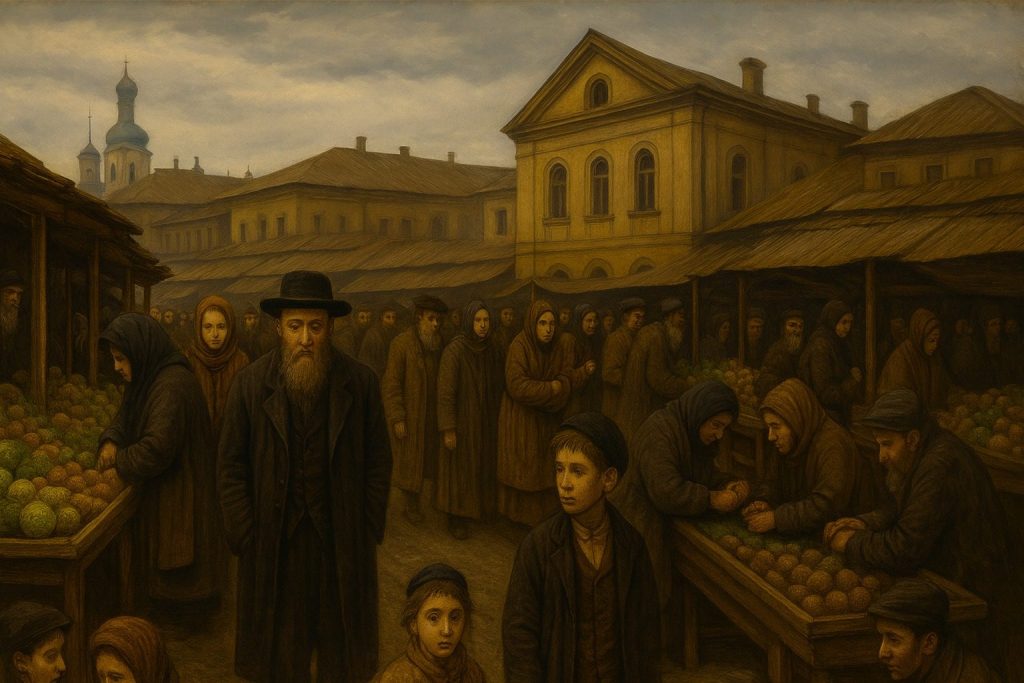
“Esther Shifra?” said Reb Leib, his face turning white. “Where did you see Esther Shifra?”
“In Balta – I was there for the fair not long ago,” said Reb Meir. “You should know that she and I were supposed to marry, and I broke the shidduch without asking her forgiveness. Esther Shifra told me that if I give you this money, she would forgive me.”
The shock that Reb Leib had been feeling turned quickly to anger, and his voice rose as he said to Reb Meir, “I knew that you were making a joke out of my misery, making me feel even worse than I did before you got here. My sister has been dead for 15 years, and you’re telling me you just saw her?”
This time it was Reb Meir’s turn to react with complete disbelief.
“I promise you, as crazy as it sounds, I saw Esther Shifra, the daughter of Reb Eliezer of Suwalk,” exclaimed Reb Meir. “I spoke to her and she told me that I need to come see you. It’s not possible that she is dead.”
Reb Leib said nothing, turning on his heel and walking down the road away from his house. Reb Meir followed and soon the two men were entering Suwalk’s graveyard. Without hesitating, Reb Leib wove in and out of the rows, picking up a rock as he stopped in front of one matzeiva and laying it gently on its surface. Catching up to Reb Leib, Reb Meir read the name on the headstone in front of him – Esther Shifra bas Reb Eliezer.
Reb Leib turned to Reb Meir and the two men stared at each other for a long moment.
“It looks like Hashem sent me to bring you this money,” said Reb Meir, telling Reb Leib everything – about he and Golda were childless, his discussions with the Kozhnitzer Maggid and the Chozeh of Lublin and his trip to the big fair in Balta. He described Esther Shifra in detail – what she wearing, how she spoke and what she looked like.
“That is her,” agreed Reb Meir. “It is clear that you were sent by Shomayim to get her forgiveness and to help me marry off my daughter. Hashem should send you brachos – sons who are talmidim chachamim in return for saving me today.”
Reb Meir left Suwalk the next day, and began the long journey back home. After sharing the story of his unbelievable journey with Golda, Reb Meir made his way to the home of the Kozhnitzer Maggid, telling him everything that happened since their last meeting.
“There was actually a gezeira in shomayim that you should die because you broke off the shidduch without seeking Esther Shifra’s forgiveness and I had to daven to Hashem to send her back to this world so that you could right that wrong,” said the Rebbe. “Now that you have done that, go back home. You will have sons – true talmidei chachamim, just as Esther Shifra promised you in Balta.”
And indeed, Reb Meir and Golda were blessed with a family, and their sons and grandsons dedicated their lives to doing mitzvos and becoming true talmidei chachamim.
* * *
We learn something very simple, but very important from this story. We have to take care of other people’s feelings.
If we hurt someone, we can’t just think, “Eh, big deal, they’ll get over it,” or, “So much time has passed, it doesn’t matter anymore.” Part of real forgiveness is trying to fix what we did.
In our story, the tzaddik was able to arrange a meeting many years later, and only then was the mistake finally corrected. But we shouldn’t wait so long. If you hurt someone, try to make it right as soon as you can. Say you’re sorry, speak kindly, and fix whatever you’re able to fix.
You don’t want to be sitting on someone else’s hurt feelings for years. It’s much better to fix it fast, and let both of your hearts feel light again.
When you go to sleep at night, ask yourself a quiet question: “Did I hurt anyone today with my words, my face, or my actions?”
If the answer is yes, don’t be afraid. That’s not a reason to feel stuck. It’s a gift from Hashem, giving you a chance to make things better.
Because a Yid’s heart is soft. It doesn’t really want to step on anyone else’s heart. So when you feel that little poke inside that says, “Maybe I should say sorry,” don’t push it away. That feeling is your neshama, gently reminding you:
“Go make shalom. Go fix it. Go make another Yid feel whole again.”
Beis Moshiach #1486 • pp. 54-58
© 2026 Beis Moshiach Magazine. All rights reserved.
This article originally appeared in Beis Moshiach #1486. You are welcome to share it with friends and family by email or in print, provided that you do not change, add to or omit any part of it, you credit the author and Beis Moshiach, and you include a link to archive.bmoshiach.org (written out in full in printed copies).
To republish this article in a newspaper, magazine, book or website, please request permission in advance at [email protected].