Gut Shabbos, Doctor
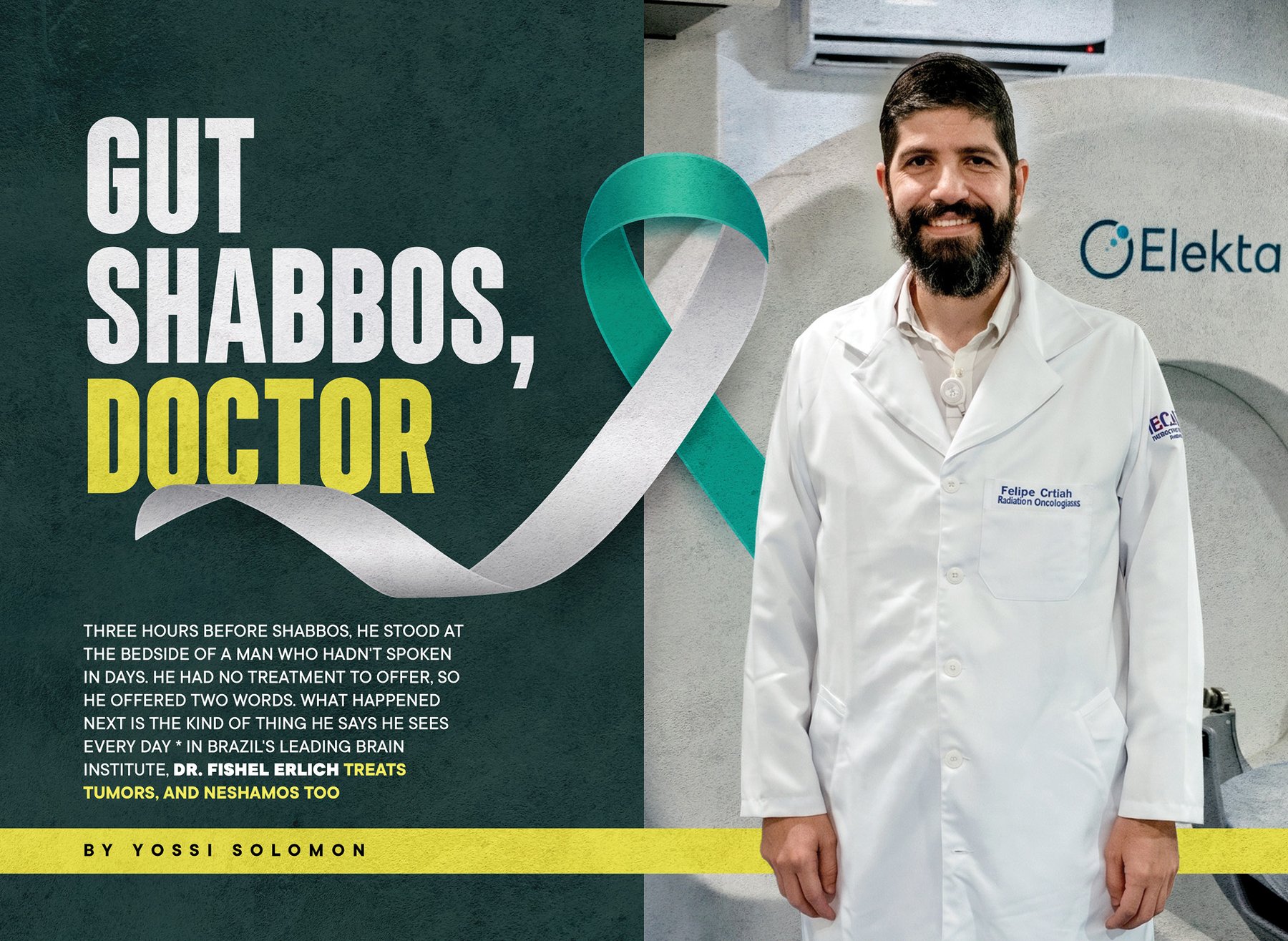
Three hours before Shabbos, he stood at the bedside of a man who hadn’t spoken in days. He had no treatment to offer, so he offered two words. What happened next is the kind of thing he says he sees every day. In Brazil’s leading brain institute, Dr. Fishel Erlich treats tumors, and neshamos too.
A few days after landing in Rio de Janeiro, I headed to Brazil’s major medical center, the “Instituto Estadual do Cérebro Paulo Niemeyer” (Paulo Niemeyer State Institute of the Brain), a leading center for brain surgery and neurosurgery. The visit was arranged to meet Dr. Felipe (Fishel) Erlich, a specialist in neuro-oncology. When we met, I encountered an extraordinary person: a senior physician in a sensitive department who saves lives every day, and at the same time a believing Jew who radiates warmth, calm, and deep faith.
From the opening of our conversation I felt the unique combination of his well-known medical professionalism alongside the sense of mission that accompanies him at every step. The story of his life unfolds like a fascinating mosaic from his childhood in Rio to his influence on many Jews, drawing them closer to a life of Torah and mitzvos. Dr. Erlich is a man who, by the nature of his work, frequently encounters extreme situations, yet alongside that he experiences surprising moments of hashgacha pratis in the hospital corridors. The significance of this, specifically in the days when a person’s fate is written and sealed, is deeply moving.
From the Beaches of Rio to the World of Torah
Dr. Fishel was born to traditional parents, though far from day-to-day observance of mitzvos. He mainly remembers Kiddush on Shabbos, keeping the sanctity of Yom Kippur, and eating matza on Pesach, but not much beyond that. “I attended a non-religious Jewish school,” he says. “As Chassidim we know that ultimately the Rebbe touches the soul of every Jew, and that’s what happened with me too. Because of a series of events that happened in my life, I started going, at age 16–17, to the Chabad shul in Rio together with one of my schoolmates. But after the tefilla we would go out to the beach or to watch movies. Over time, the more I went to shul, the more I felt myself connecting to spirituality; I met Rabbi Chaim Brunner there, who helped me in the teshuva process.”
After a while, Fishel met his future wife, who had also studied at a Jewish school, likewise far from matters of Torah and mitzvos. She too came with her friends to the shul. Rabbi Brunner continued helping them return to observance; he invited them to Shabbos meals, and over time the two became Chassidim of the Rebbe.
How did your close family and friends react to your becoming religious?
At first my father took it hard; he worried about me a great deal. In his view, I had no chance of succeeding in my medical studies, which I was in the midst of at the time. He was afraid I would miss important classes that sometimes took place on Fridays and Saturdays too. After a while he saw something amazing: whenever there were classes on Shabbos and I would give them up, Hashem would send me double the success. He saw with his own eyes that there was no contradiction between returning to observance and succeeding in medical studies. Since then it’s become easier for him to accept the fact that I became observant.
Open Miracles in the Oncology Ward
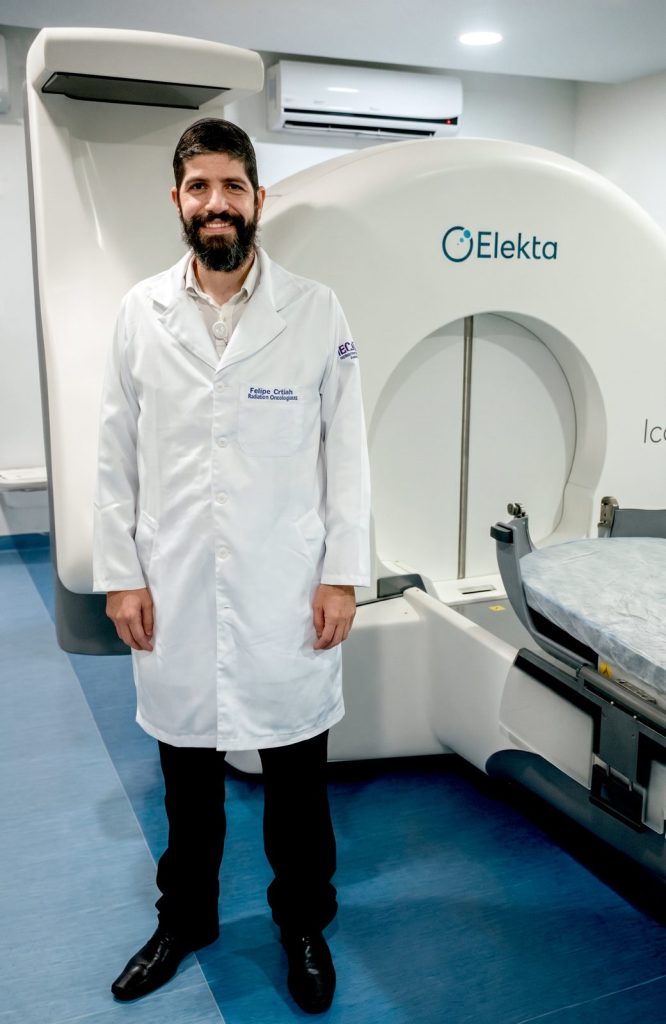
You work in an oncology department, one of the most difficult and sensitive departments. How does that affect you as a person and as a Chassid?
You said it’s the hardest department, but that’s not necessarily true; it depends on the perspective you look at it from. We doctors see a great many miracles and wondrous instances of hashgacha pratis here. Truly the revealed hand of Hashem. For example, I specialize in treating a very rare type of brain disease. At the beginning of my process of becoming a baal teshuva, I met a man davening in the shul, and I noticed he had a kind of facial paralysis. I approached him and gently told him he should undergo a comprehensive series of tests soon. After he was examined, it turned out he had a rare genetic disease. Twenty years earlier he had already lost hearing in one ear because of that same disease and had even undergone surgery. None of the doctors had warned him that the disease could recur and affect the other ear as well. After I suggested he get tested, he did, and the disease was discovered in time. That way he was able to receive preventive treatment and avoid losing hearing in the other ear too.
In all of Brazil there are only ten doctors who specialize in this disease, and I am one of them. When I looked at him, I immediately suspected this was the case, while he himself hadn’t imagined it had returned. This is a story of extraordinary hashgacha pratis, that we happened to be davening together in the shul at exactly that hour, and that I was the one who identified that there was a serious problem, and so he was saved.”
Since you’ve already mentioned a case of hashgacha pratis in your medical work—surely it’s not a rare occurrence. Can you share other such stories you witness in your work as a doctor?
I can tell you that there isn’t a day when we don’t see miracles and instances of hashgacha pratis. I’ll give you another case, one of many: there was a woman who had a tumor in her throat. She felt her time was drawing near, and she wanted with all her heart to fulfill the mitzva of eating matza one more time in her life… A while before Pesach she had already reached a state where swallowing was difficult for her due to a blockage. As a doctor I knew the treatment was not simple, and even difficult, but as a Chassid I told myself we mustn’t give up; we had to do everything to help her fulfill the mitzva.
Even though the treatment carried a high risk, I said we would go ahead with it, and the good G-d would have mercy and help. And indeed, in a way that was beyond the natural order, she responded better than expected to the treatment, and when the Seder night arrived she managed to eat matza.
He asks my forgiveness for a moment and picks up a phone call that comes in for him. A flurry of medical terms flies through the air. I, of course, understand nothing. After ten long minutes, he finishes and sighs. I don’t ask.
Let me tell you another story [he suddenly smiles]: Usually on Friday afternoons I don’t work. I prefer to be home preparing for Shabbos. Once, someone called on a Friday, three hours before sunset, and asked me to go visit his brother who was hospitalized so I could personally assess his condition. I told him I couldn’t because Shabbos was about to begin, but he pleaded with me again and again. I calculated that the hospital wasn’t too far from my house, and with Hashem’s help I’d manage to get back home before Shabbos began.
When I arrived there, I saw his brother was in serious condition. He needed difficult treatments. I explained to the brother that at that moment there was no way for me to help. But he wouldn’t give up, and said he wanted to feel at ease that after Shabbos I would at least try to help as much as I could. I looked over the medical report and saw the patient had a Jewish name. I asked the brother, “Are you Jewish?” He answered yes. So I turned to the patient, who was lying there with his eyes closed, and wished him “Gut Shabbos.” Suddenly, miraculously, he opened his eyes and began to speak, something he had been unable to do until then… From that point on his condition steadily improved; he grew stronger, and so I was able to help him more with the treatments.
Later, I found out that before his illness he had been involved in idol worship (in Brazil this is very common, called macumba); after I spoke with him, he left that practice, returned to observance, and managed to live several more good years…
What does it mean to you to be a Chabad Jewish doctor in a Brazilian hospital?
For me it’s an opportunity to spread the Rebbe’s Chassidus and teachings even in places like this. The truth is people want to draw closer to Torah and mitzvos, but for some reason when they see a shliach of the Rebbe with a hat and suit, they’re a bit put off by his outward appearance. But when they see that you’re a doctor, an ordinary person, in a short conversation I manage to bring people closer to Judaism and bring them to shul.
Shofar in the Hospital Corridors
Dr. Erlich is a physician who diagnoses and treats a range of tumors in the most sensitive locations: brain tumors, spinal tumors, and neurological complications of cancerous diseases. His expertise has earned him a reputation throughout Brazil.
During Elul, Dr. Fishel Erlich walks the hospital corridors with a shofar close at hand. “It’s important to awaken people to teshuva during the month of Elul,” he explains, “and when needed, I blow the shofar in the hospital too. Here, where people are fighting for their lives, the shofar brings about spiritual awakening. More than once I’ve seen, right before my eyes, people doing teshuva and even crying when they hear the sound of the shofar. It opens a door to continue influencing them toward additional mitzvos.

“There’s a Jewish doctor who works with me who used to belong to the Hashomer Hatzair movement. He was far from anything Jewish, and even told me that since his bar mitzva he had never put on tefillin. One day it turned out that he himself had fallen ill with a serious neurological disease, and as a result needed hospitalization. He shared a room in the department with a Chabadnik who had a serious neurological disease that limited the movement of most of his body’s muscles.
“When they got up in the morning, he noticed how the Chabadnik, despite all his limited movement, didn’t give up on putting on his tefillin. This made an enormous impression on him. He called me over and asked me to put tefillin on him for the first time since his bar mitzva. Boruch Hashem, today he’s past the illness, and is slowly drawing closer to Judaism,” Dr. Erlich relates.
“Quite a few people ask me for tefillin, want to go to shul, and even get called up to the Torah. Even though the animal soul is very powerful, you still see an awakening. I see this as a sign of Moshiach that even in a place like this, people are seeking to return to Torah and mitzvos.”
How much does emuna provide tools for coping with the suffering you see among patients and their families?
I know that everything is hashgacha pratis.
During our conversation, he shows me a Jewish man who has come to show him blood test results. The numbers are good, even excellent. “You know how I know the next tests will be good too?” I hear him tell the patient. “Because whoever studies Tanya knows that everything comes from G-d”… This was Dr. Fishel’s encouragement to the man, so that he would keep coming to the Tanya classes at the Chabad House.
Look, there are things that sometimes seem the opposite of good, but as Chassidim of the Rebbe, we know that in the end everything is from Hashem and everything is for the good. That’s the message I convey to people: tranquility, emuna, and deep conviction that everything will work out for the good. That truly helps them recover. When people come to a hospital they’re looking for a doctor, and I explain to them that G-d wants them to address the problem in a professional way, but at the same time it’s important to always remember that it’s not the doctor who brings healing—it’s G-d, and we doctors are only His emissaries. We see that people who have this difficult disease are able to accept words of faith more readily both Jews and, l’havdil, non-Jews too.
I talk to them a lot about the providence that accompanies each person. The question I’m always asked by patients is: “Why do I have this disease? I don’t smoke or drink alcohol, and I watch my diet carefully.” I explain to them that they’re not asking the right question. The question should be, “If I’m careful about acts of kindness, if I give charity, why do I have a disease like this?” Of course it’s important to care for the body, but it’s no less important to care for the soul—to do acts of kindness, study Torah, keep mitzvos, and so on. Jews are expected not only to take care of the body through natural means, but also to look after the neshama. The patients tell me I’m right, and now they understand what they’re missing in order to maintain their complete health.
There have been patients who asked—why does G-d do bad things to them?! I explain to them that nothing bad comes from G-d, heaven forbid, and that everything is for the good. I add that this is an opportunity to improve our deeds; also to be a better, more sensitive person toward others especially in these days of the month of Elul, the month that concludes the Jewish year, days when everyone takes stock and makes good resolutions for the new year.
On Friday mornings, I come with my children to the department and bring the Jewish patients challa for Shabbos and say divrei Torah. For the non-Jewish patients I bring a card of the Seven Noahide Laws that I print out, and I talk with them about it.
How much does it affect your patients when they see that their doctor is an observant Jew?
Before the war in Israel, people were more open to talking about Judaism. Right now, in light of the tense political situation in the Middle East, it’s harder. But still, I feel that when they see a doctor with a kippa and a beard, they feel safer and calmer, that I want what’s good for them. That’s true for a Jew, and l’havdil, also for a non-Jew who sees me; it makes me happy to see that people feel good that I’m their doctor.
Feeling the Rebbe At Every Moment
“Without the Rebbe, I am nothing,” Dr. Fishel Erlich declares. “I feel the Rebbe with me all the time. Once, when I traveled to the Rebbe, I had a dilemma—should I stop working in order to learn more Chassidus? I asked that the Rebbe give me an answer.
“As soon as I returned from the Rebbe, Rabbi Yosef Zukin, one of the rabbis of the shul where I daven, approached me and suggested we learn Likkutei Torah together on Friday evenings. In addition, every Tuesday evening he taught a Chassidus class at the shul, but unfortunately I couldn’t attend because of a regular staff meeting I was required to attend. But that very week, the staff meeting was moved to a different evening and since then I’ve been attending the class every Tuesday. It was clear how Heaven was helping me set aside more time for Torah and Chassidus learning alongside my regular work.”
What practical tips can you give us for maintaining good health?
“It has to be both physical and spiritual,” he says immediately. Physically—eat properly; don’t eat too much junk food, and exercise. Spiritually—study Torah, do good deeds, and renew the connection with G-d as the new year approaches.”
In closing, Dr. Fishel Erlich wishes to pass on a message from the corridor of the oncology department to the readers of Beis Moshiach: “Each of us is a shliach of the Rebbe in his own field. We should always ask the Rebbe for help in carrying out our shlichus and surely the Rebbe gives us the help to fulfill the shlichus as required, so that we may be inscribed and sealed for a good and sweet year, and bring about the Geula sheleima immediately, truly now.”
Beis Moshiach #1526 • ה׳ חשון תשפ״ז • pp. 12-18
© 2026 Beis Moshiach Magazine. All rights reserved.
This article originally appeared in Beis Moshiach #1526. You are welcome to share it with friends and family by email or in print, provided that you do not change, add to or omit any part of it, you credit the author and Beis Moshiach, and you include a link to archive.bmoshiach.org (written out in full in printed copies).
To republish this article in a newspaper, magazine, book or website, please request permission in advance at [email protected].