The 2000 Year Old Dibbuk
From the TzaddikStory.org collection
The rolling green hills of Novardok seemed to stretch on for miles and miles, surrounding the cozy little town that many Jewish families called home.
Back then, a few hundred years ago, the Jewish community was very ehrlich, and followed the Torah’s ways with dedication and love. Things were peaceful for the most part… until one day.
“I love you! Reb Yid! Please, come here!”
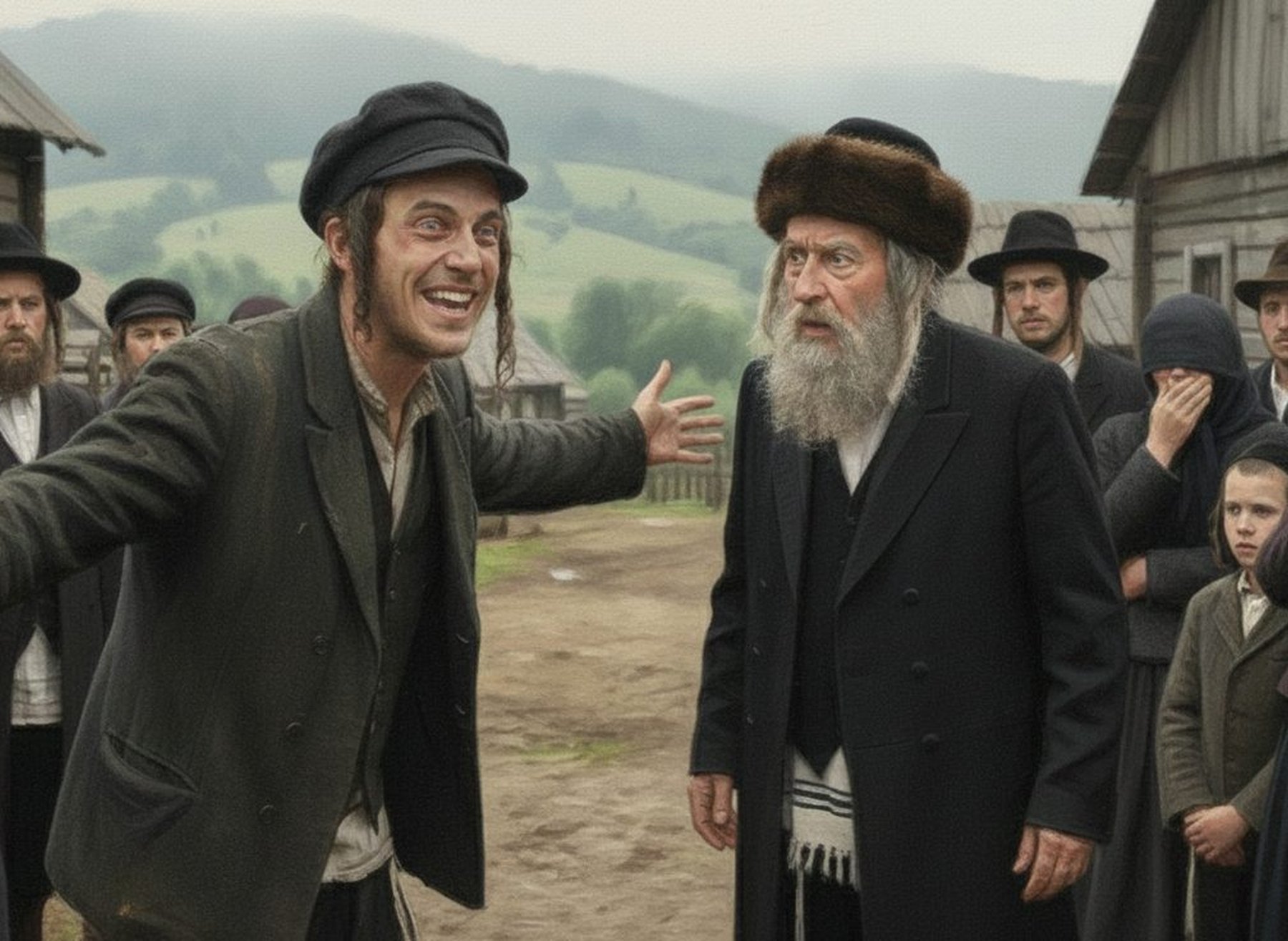
Reb Shmelke stopped in his tracks. Was that *Berel the bachur, calling him? He stroked his long white beard, unsure of what the young man was after. He walked closer to Berel, his tzitzis dancing against his long black jacket.
Berel kept shouting. “I love you, Reb Shmelke!” he cried, tackling Reb Shmelke with a bear hug. “What a special person you are!”
Reb Shmelke couldn’t help but laugh, as he struggled to keep hold of his Gemara. What a funny boy, he thought to himself.
But it didn’t end there.
“Reb Shmelke – you had a long shloff last night, didn’t you?” Berel giggled.
The poor old Yid went red with embarrassment. “How do you know what I did last night? And who’s business is it, anyways?”
“Oh, but that’s not all,” continued Berel the bochur, with a glimmer in his eyes. “You slept in this morning! That’s right! When everyone else in Novardok was davening, you were sleeping like a log – you couldn’t wake up! What an awful person are you!” Berel couldn’t hold in his laughter anymore. People were starting to notice, and began crowding around. Reb Shmelke wanted to disappear. What was up with this guy? Why was he acting like this, in public…?
“But wait! There’s more!” Berel was jumping for joy. “You ate a HUGE MEAL this morning! You slept and you fressed, didn’t you? Ahahah!! You seem like such a holy Yid, but you’re really just a lazy fresser, aren’t you?” Berel seemed like the happiest boy in town.
Reb Shmelke couldn’t handle it anymore. A flood of tears poured from his eyes.
“You’re right! I’m a lazy stump of wood. If only Hashem should forgive me for my sinful ways…!”
“Bah! Teshuva?” Berel teased. “Why waste your time with that? Who cares about Teshuva? You’re just an old man who can’t get out of bed.”
The townspeople were so confused. This was not Berel the bachur, the kind and holy young man they knew. What happened to him? they wondered.
But Berel’s strange behavior didn’t end with Reb Shmelke. He would constantly call people close, through kind words of love and friendship. But once they were standing in front of him, he would go on to tell them all the aveiros they’d ever done.
And when they wanted to do teshuva, he would laugh at them! The people of Novardok were terrified. Who would be the next one to be bullied and embarrassed? Nobody knew. Berel, on the other hand, was having a great time! He loved playing these games! Unless his latest target was a tzaddik… from tzaddikim, he would run far, far away.
For some reason, he couldn’t handle their Kedusha. It was too much for him.
It took some time, but eventually, the kehilla of Novardok realized Berel’s strange behavior was no simple child’s play. Berel wasn’t just acting up, he wasn’t just looking for attention… no, something else was going on.
They began to believe a dibbuk must be living inside Berel – a sad, wandering neshama, who never found its way home to Gan Eden, and it was terrorizing the town. It had jumped inside Berel’s body… and possessed him.
No one felt comfortable walking outside. What if they were next? No one wanted to face the shame – and who even knew if the dibbuk would stop there?
* * *
In no time, news spread to Jewish communities far and near, and people started traveling to see the Novardiker dibbuk in person. It may seem strange, but they were curious. They wanted to see if Berel really knew all the aveiros they’d ever done.
They figured Berel’s dibbuk understood the neshama. Regular people can’t do that. It must be scary… but amazing. Maybe there’s something important it has to tell me…? they wondered.
But as the news spread amongst Yidden, it also spread around the non-Jews as well.
“Witchcraft! It’s magic!” shouted the police chief one night at the station.
“This boy must be a witch! Peeking into people’s minds and pasts, using it to embarrass them… if they’re up to that kind of magic, we’ll have to take care of the problem for good, the way we always do – he’ll have to die.”
This was bad news for poor Berel. If the police thought someone was a witch or a sorcerer, they’d be killed for sure! Burned at the stake, like in so many other stories…
But Berel hadn’t even performed witchcraft – he was possessed! He was innocent. The dibbuk was to blame!
The kehilla of Novardok was special. Although they’d been disturbed by Berel, they couldn’t allow an innocent boy to die! It wasn’t his fault that the dibbuk chose him!
So, late one night, Berel was secretly taken out of Novardok and brought to the town Volozhin, the home of the famous Reb Chaim Volozhiner, student of the Vilna Gaon.
While there one Shabbos, Berel found his way to the home of Reb Chaim Volozhiner.
But something didn’t feel right to Berel. He couldn’t handle the Kedusha within the home. He frantically tried to find a place to hide, behind the door, under the couch, but there wasn’t a comfortable spot to be found!
Until, finally, he saw a table cloth slipping off the corner of the table. “An uncovered table on Shabbos! Finally – some tumah!”
There’s a belief that an uncovered table on Shabbos invites forces of unholiness, so it’s wise to keep the table covered and holy on Shabbos. Whether this is true or not, Berel’s dibbuk seemed to feel safer at the simple idea that someone was breaking a rule.
Berel cried with relief. At last, the dibbuk felt at home. It knew how holy and precious a covered Shabbos table was, and that tiny, little, bare corner gave him some shred of evil to grab onto. He hugged and kissed that little part of the table, as if his life depended on it. Berel held onto the corner until the end of Shabbos, when he finally relaxed, free to leave the house.
Some time later, Berel was moved again, this time to Kozhnitz, home of the Kozhnitzer Maggid. People really wanted to help Berel, and they felt bringing him to this holy Rebbe might just be the answer!
When he was brought before the Maggid, he first tried to remove the dibbuk by saying Hashem’s holy names in ways only the holiest tzaddikim know. But when the words reached Berel’s ears, the dibbuk started shrieking with loud, evil laughter.
“You think those words will scare me?!” asked Berel’s dibbuk. “I’ve known those words since before my bar mitzva! I’ve known them for thousands of years!”
The Kozhnitzer Maggid immediately asked the next question. “Then tell me – what terrible aveira did you do that left you rolling from person to person for the last 2,000 years? Why haven’t you been allowed into Gan Eden?”
At that very moment, the laughs and screams turned into deep, painful sobs.
“I promise you! I didn’t sin! It’s the Beis Din Shel Maalah! They’ve given me all the suffering of the Jewish people since the Churban! I didn’t sin! Not enough to deserve this! It was basically nothing!”
The Kohznitzer Maggid asked again, “What did you do to deserve this?”
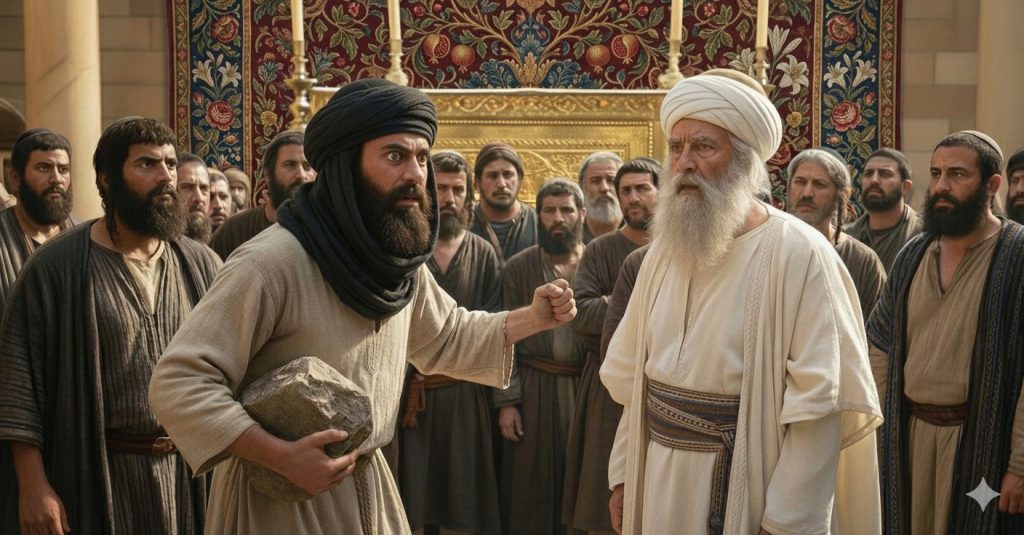
The dibbuk began, “I… I threw the first stone at Zecharia HaNavi in the First Beis HaMikdash.
“He gave us a nevuah from Hashem that we didn’t like! He told us we weren’t listening to Hashem’s Torah, and we’d be punished if we didn’t behave like Yidden should. I was wrong to throw the stone. But it was just… one small stone.”
The dibbuk paused.
“…But… My stone was the first, and then everyone else threw bigger stones, and Zecharia was killed, right there, in the courtyard of the Beis HaMikdash. But it wasn’t my fault! I was punished like I was the only one who did anything at all!”
Hundreds of thousands of Yidden were killed by Nevuchadnetzar and his commander as a punishment for Zecharia’s death. Zecharia’s blood was boiling on the courtyard stones, screaming to Hashem for nearly 100 years. When Nevuchadnetzar’s commander, Nevuzaradan, came to conquer the Beis HaMikdash, he asked the Kohanim, Who did this? They were afraid to tell the truth. Nevuzaradan decided he would fix whatever caused this blood to boil. He started by killing the Kohanim. But the blood continued to boil. So he killed young men and women, but still, the blood boiled. He killed small children, but the blood boiled on. He then cried out, Zecharia, you want me to kill them all? And with that cry, the blood finally stopped boiling.
‘Do you understand?” asked the dibbuk. “They blamed me for the deaths of all those people. Because of my small, little pebble.”
“How can I help you?” asked the Kozhnitzer Maggid, his hand sweeping gently with his question. “What kind of tikkun will send you home?”
“The only way for me to leave here is if someone will find a limud zechus for me, something good that came from my bad deed.”
The Maggid thought for a moment. “I will do it, but only on one condition – I want you to describe the level of your neshama, in the times of the Beis HaMikdash.”
“I can’t do that here. Not now,” Berel answered. “I can do it tonight, outside the city. I will do it there. But you’ll… you’ll really do this for me? You’ll help me find something that might transform the way the Heavenly Court sees me? Only a great Rabbi like yourself can do something like that – I’m relying on you to free my soul.”
The Kozhnitzer Maggid nodded his head. The deal was done.
* * *
That night, the Kozhnitzer Maggid met Berel right outside the city, just as they had planned.
The dibbuk did his part, and shared the information the Maggid wanted to know, and then came the tzaddik’s turn.
He looked at Berel and said, “There is a halacha that if Hashem gives a nevuah about something that will happen, it must materialize, but only once it was said by the Navi.
“Hashem gave Zecharia HaNavi a hard message, telling him that the Yidden would be punished. If Zecharia had kept quiet, the punishment might not have happened.
True, a Navi who withholds what Hashem tells him is punished by Hashem with death, but Zecharia could have been moser nefesh and risked his own life to save the Yidden from punishment and death. He could have kept quiet, and not given over the nevuah! You were just trying to save the Jewish people, and therefore, not only are you not wicked, but you’re actually righteous.”
The Maggid continued quietly, so only Berel could hear, “Zecharia was similar to a rodef, a person on his way to hurt or kill another Yid. Torah tells us that one must kill a rodef to save the other person, chas v’shalom.”
The Kozhnitzer looked Berel in the eye and spoke right to the dibbuk. “You killed Zecharia, because, from your point of view, he was like a rodef, who was about to hurt someone – the entire Jewish Nation… His words would cause so much harm to the people listening. You wanted to save them.”
As soon as the tzaddik finished speaking, an enormous pillar of fire came out from Berel, stretching all the way from the ground to the sky. A gigantic light from all sides and angles, piercing through Berel’s body… The dibbuk had finally left, and it never came back again. Berel fell to the ground and came back to himself – and as for the soul, he was finally free, after 2,000 years.
Beis Moshiach #1489 • pp. 56-59
© 2026 Beis Moshiach Magazine. All rights reserved.
This article originally appeared in Beis Moshiach #1489. You are welcome to share it with friends and family by email or in print, provided that you do not change, add to or omit any part of it, you credit the author and Beis Moshiach, and you include a link to archive.bmoshiach.org (written out in full in printed copies).
To republish this article in a newspaper, magazine, book or website, please request permission in advance at [email protected].