A Bracha In The Forest
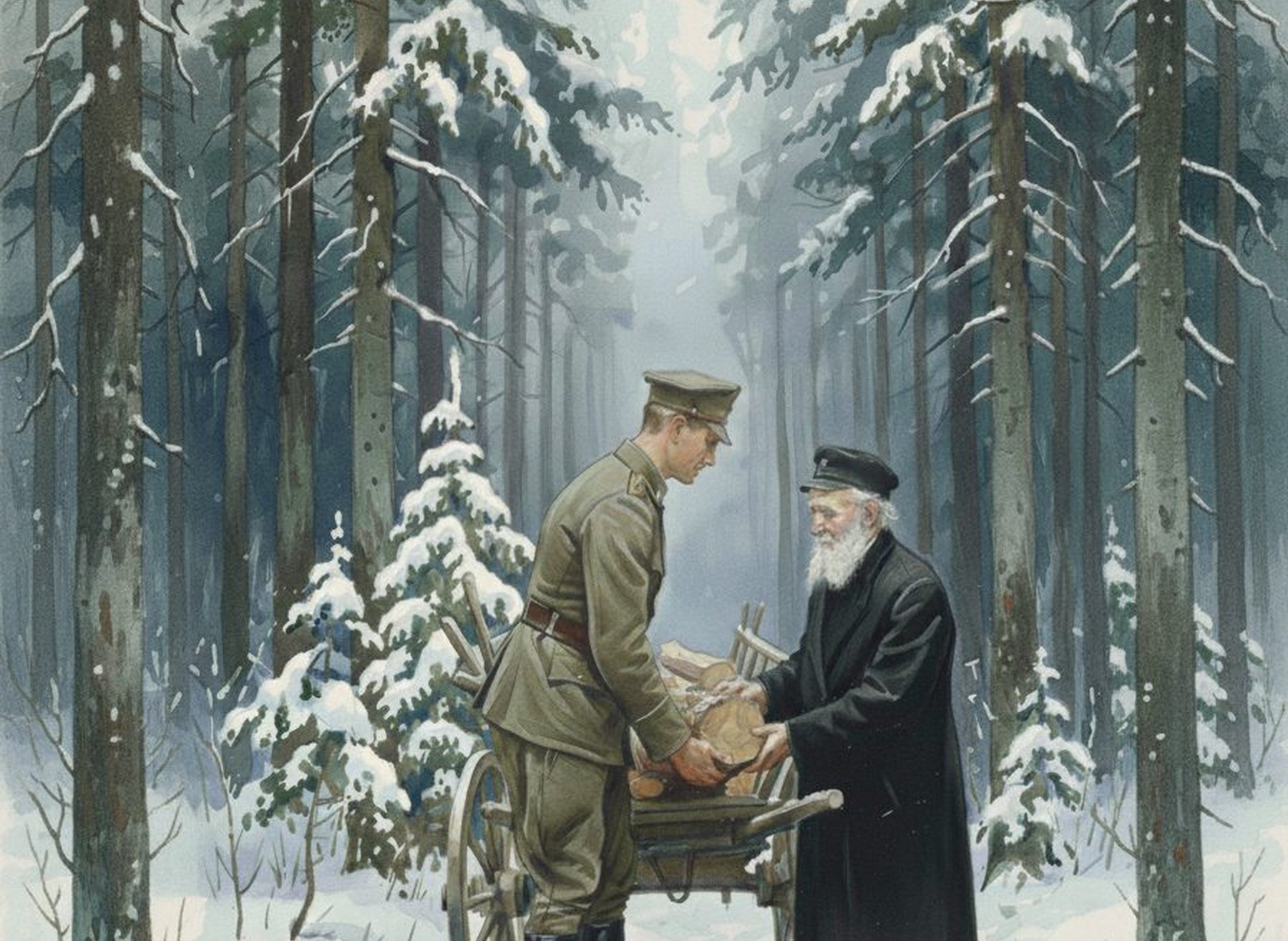
Let’s take a trip to the forest together. A deep forest, full of tall pine trees. The bark is very rough and scratchy, no fun to climb. Can you smell the fresh air? The trees are crowded so close together, there’s barely any light here. Just lots of tall trees, blocking out the sunlight.
When is this story taking place?
I think you’ve heard about World War Two. Before that was World War One. Back then, it was called the Great War, and most countries took a side. One country killed another country’s leader, and then another country got involved, and the next country got involved, and before you knew it, the problem was out of control. Millions of people died, and many had to move away from their homes and families. It was a terrible point in time.
Millions of soldiers, shooting from deep, cold trenches in the ground.
So, who is in this forest?
My father, Moshe. He was a tall man. Strong shoulders. He wore his army uniform with shiny buttons and tall, tough boots to climb through the snowy forest. The Polish army gave him hard work and important jobs because they knew he could handle it.
Now where is this forest?
In those days, the borders were different. In our story, my father was on a mission, walking to the nearby town called Radin, then part of Poland. Remember that word – Radin. It’s the name of a very important city. Not a big city, barely a town, but still, a very important city.
* * *
Ready for the story?
My father was born in Lithuania. His family kept mitzvos and were proud Jews. When he was a boy, his family moved to Sosnovich, Poland. My father grew up, went to school, and had his bar mitzva. He loved playing hide and seek in the forest with his friends. He lived near a terrible place, called Oswiecim, or Auschwitz. Remember that word too.
Many Yidden were kept and killed there, in the worst ways possible. But my father didn’t see that. It hadn’t happened yet.
My father, tall and strong, walks through the forest near Radin. Suddenly, he sees a tzaddik. Right there, in the forest, there’s a special man with a shining face. He has a long beard and coat, and he’s loading chopped wood onto his wagon. He’d probably never done this before, because he seemed to be struggling. Schlepping wood would be easy as pie for my father, so he wanted to help.
“Excuse me, Rebbe.”
“Oh, hello there,” said the tzaddik.
“Please, allow me to help you move those logs.”
And so, my father did. When he was done, he clapped his hands together to get rid of the snow and warm them up a little. He smiled, proud to be of help.
The tzaddik said, “Please, can I pay you for your trouble?”
“Oh, no,” my father said. He wanted something better than money. “Will you give me a bracha instead?”
“Sure,” the tzaddik said, climbing onto his carriage. “Which bracha would you like?”
“Well,” said my father. He was thinking of his family back home, and the dangers of war.
“I’d like to stay well and get home, safe and sound, after my time in the army.”
“Very good. I’ll give you a bracha that you should survive the war.” Then he raised his voice, his breath a cloud: “Also, you’ll have children, who will be Bnei Torah and learn Torah in Yeshiva!”
“Amen!” my father answered and stamped away.
Amen. Amen. Amen, the conversation replayed in his mind. Who was that? Did that actually just happen? Children who would learn Torah? That meant he’d get married and have children! And, of course, that’s what happened.
Moshe met his kallah, Eida Yehudis. My mother and father got married in a city called Bendin, Poland, where my mother was from. A new home! Then, they had a baby!
Can you believe that this baby, my brother, was a secret? I’m an older man, and I only just found out about him. I never knew he existed! Why? Because my parents’ life suddenly became more complicated than anyone could ever imagine.
* * *
You see, a few weeks later, World War Two began. The Holocaust. This is the next part of the story.
The Nazis rode into Poland and took control. The Jews of Bendin were marked with a big red X by evil people who hate us. They were being rounded up, sent to Auschwitz, and killed.
My parents ran away, back to Sosnovich. The same thing happened there. The Yidden were gathered in the middle of town and counted. They weren’t allowed to move or eat, and were killed if they tried to run away. That’s probably where they lost my baby brother, and never talked about him out loud again.
As for my parents? Men and women were placed in separate lines to be sent off to Auschwitz, or somewhere just as horrible. My father, Moshe, looked at my mother, Eida Yehudis, and said, “If we survive, let’s try to find each other. We’ll meet in Paris.”
“Where, Moshe? Where in Paris?”
“Look for me in the north part of the city.” Their eyes met for the last time. Would they ever see each other again?
My father dodged so many bullets. He kept this bracha from the mystery man in the pocket near his heart for 40 years. Little did he know, his life would be saved, thanks to a long line of impossible miracles…
* * *
Moshe was taken to Auschwitz. He was luckier than everyone else there in two ways. He knew that area like the back of his hand, remember? How to get to the forest, where to run, how to hide. Second, he was big and strong, like I told you. In that terrible death camp, my father waited for the perfect split second to run away. Even the fence around that terrible place was a punishment. Anyone who touched it lost their lives, it was electrocuted! But there was exactly one second in which it wasn’t dangerous, and my father ran!
He knew where he was going, but was soon chased down and brought right back. But even though he didn’t make it out, he still had special mazal. My father was chosen, alongside eight other Jewish prisoners, to be sent to another camp. This wasn’t exactly a happy ending – all the camps were basically just terrible prisons, where people slept stacked on top of each other, used holes in the ground outside as toilets, and were sometimes just put in line for death. No food, no breaks, no blankets. It wasn’t like he was being upgraded… but after he’d been caught trying to escape, he was lucky they didn’t just have him killed! Sending him away meant he still had a chance to survive. Hashem was clearly guarding him.
Why was he chosen? Well, these nine people could be “useful” to the Nazis, yemach shmam. As long as they were useful, they wouldn’t be killed. After they finished their project, though? …not so much.
Moshe, my father, knew how to print things, since he’d learned to do this type of work beforehand. That was just what the SS officers wanted. They wanted to pull off the most massive fraud and forgery scheme in history. They’d print millions of fake US dollars and British pounds. They were going to be rich.
They needed experts to help make the money look totally real. Why? Well, there would be so much money – most of it fake – that all money would become worth less and less. This was one of the ways Germany wanted to ruin America and England. My father was on their team of expert forgers, and he was given some special privileges. Whenever he could, he shared a slice of bread, a bandage, or whatever he had with fellow Yidden who were not so lucky. People on his printing team tried their best to ruin the Nazis plans in secret – none of them actually wanted to help them!
That’s how my father survived the war. In the end, he was left, weak and wounded, in a camp for all the Yidden who’d survived and now had nowhere to go.
* * *
My mother’s story was a little different, but also very much an open miracle. As soon as she could, she dressed up as a Polish woman, pretending she wasn’t Jewish. And it worked! Maybe because she sort of looked Polish… She continued her job at the dentist’s office, which she’d had before the war broke out. Every morning, when she put on her uniform, she worried, Will I be discovered today? The terrible SS guards never figured out her secret, and she managed to hide in plain sight until the end of the war. This was, literally, an open miracle.
Eida Yehudis’s brother looked Polish too, and he survived and even got a car after the war. He drove around to search for anyone in his family, to see if anyone survived. He found Eida Yehudis! She cried, happy, and also, so, so sad. Eida Yehudis told him her one biggest wish.
“Please take me to Paris.”
“Why Paris?”
“I promised Moshe that if we survived we’d meet up there.”
“Moshe? How in the world would he have survived? I saw him being taken to Auschwitz…”
“I have to try! Let’s have hope and get out of here.”
The siblings took trains and buses to Northern Paris, and her brother even helped her find and pay for a small apartment.
“Goodbye, brother – I’ll never be able to repay you for this.”
Two years passed, and every day, Eida Yehudis opened her shutters, looking for Moshe. No Moshe. She checked the mail. No Moshe. She went to shul and up and down the streets of Northern Paris. She knew all she could do was wait and watch.
Was there any chance Moshe would find her?
Even just the Montmartre and Lille neighborhoods of northern Paris housed millions of people. What were the odds Moshe would show up?
It was just another morning, and she went to the entrance of her building to check the mail. Maybe someone had brought some news…?
…And… there he was.
Her husband, Moshe, was leaning against the wall, near the front door.
Five years. Five, long years of sadness and loss, and here they were, both standing in this apartment building lobby, together!
It was a clear and wonderful miracle. My father had survived, but he’d been so sure that my mother wouldn’t, as she wasn’t as strong. Still, he’d held out hope. He came to northern Paris, with nowhere to live. People often refused to rent apartments to Jews. This morning, he was trying again.
It was very rare, especially for Polish Jews, to find their family after the war! My father thought about that tzaddik in the forest and he repeated the bracha in his head. “You will survive the war.” Amen, amen.
They could begin again. They had two more children. One of them was me, Max.
My father remained a proud Jew. He read the Yiddish newspaper on the Metro train. My parents spoke Yiddish out loud to each other. They weren’t afraid. We were a happy family. We kept Shabbos, Yom Tov, and basic kosher.
* * *
There was one unhealed scar left on my father’s heart, though. He was absolutely against Jewish organizations like school or yeshiva.
Now, here is an amazing story, with a lesson we could all stand to learn about caring for others. Just think what a Yid can do, when they really care.
My mother was lighting Shabbos candles near the window of our little apartment. Right at that moment, Mrs. Mergui, a shlucha in Paris, spotted my mother through the glass.
Hmm, she thought, a Jewish woman. Maybe she needs something I could provide. Let me go talk to her.
Mrs. Mergui made sure to visit our apartment building after Shabbos and knocked on the door.
“Hello,” said Mrs. Mergui.
“Um, hi… Excuse me, do I… know you?”
“Oh, no, we’ve never met. But, if you have a moment…”
“Sure, come inside,” my mother said.
She motioned at the couch in our living room, and Mrs. Mergui walked across the light brown carpet in her little heels.
My mother then walked out of and back into the room, with two cups of tea. I listened to their conversation, curious.
“It’s nice to meet you, I’m Mrs. Mergui, from nearby.”
My mother said, “I’m Mrs. Lubetsky,” and told her all about herself and her story.
“I see you have a son…” Mrs. Mergui said. “How old is he? Why don’t you sign him up for the Yavneh school? It’s a good place for a Jewish boy.”
And so I began learning about Torah and mitzvos with other Jewish boys. Everyone called me Max, but my Jewish name is Menachem Mendel Zussel. I loved learning about being a Jew.
Beis Moshiach #1491B • pp. 56-59
© 2026 Beis Moshiach Magazine. All rights reserved.
This article originally appeared in Beis Moshiach #1491B. You are welcome to share it with friends and family by email or in print, provided that you do not change, add to or omit any part of it, you credit the author and Beis Moshiach, and you include a link to archive.bmoshiach.org (written out in full in printed copies).
To republish this article in a newspaper, magazine, book or website, please request permission in advance at [email protected].