The Man Who Sponsored the Rebbe Rayatz’s Affidavit
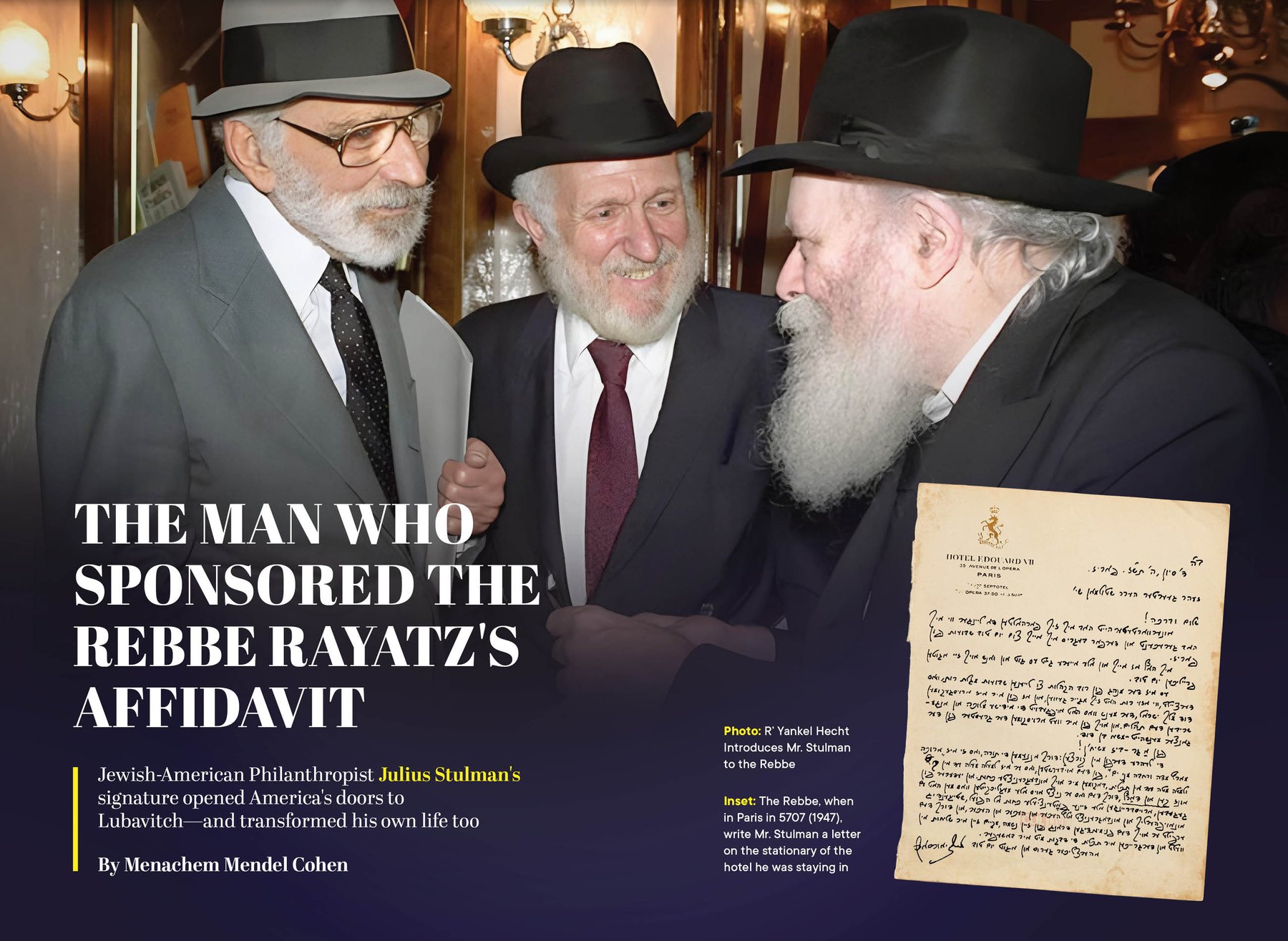
Jewish-American philanthropist Julius Stulman’s signature opened America’s doors to Lubavitch – and transformed his own life too.
Late 1939. The German army invades Poland, conquering it quickly and easily. At that time, the Rebbe Rayatz lived in Otwock, and when the city was captured, he remained trapped within it. After political and diplomatic efforts at the highest levels, through the dedicated work of prominent Chassidim, the United States State Department enlisted the help of the German military intelligence service, the “Abwehr,” to assist in smuggling the Rebbe Rayatz out of the country under the watchful eyes of the Nazi SS.
However, the USA was not quick to approve the Rebbe Rayatz’s entry into its borders before he could prove his ability to support himself financially, or that there was a citizen willing to sponsor him and guarantee his financial independence. In those years, the difficult war years, the economic situation was difficult throughout the world; it was hard to find someone willing to take on such financial responsibility.
In those days, the initial connection was formed between Mr. Julius [Yehuda] Stulman and the Chabad movement.
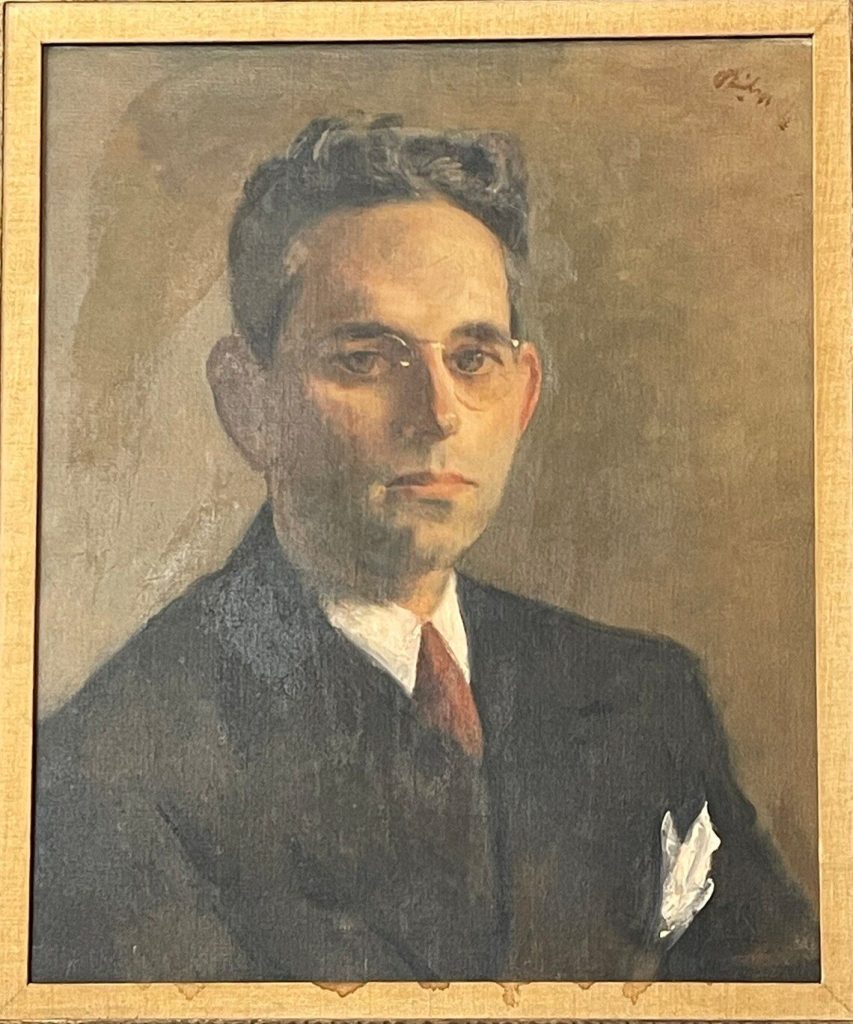
Mr. Stulman was a unique individual with a brilliant mind. He was a successful businessman who managed to profit throughout all the Depression years. During that period, he purchased certain property in the Brooklyn waterfront area, and as a result met a real estate attorney named Sam Kramer. Sam became not only his attorney but also his personal friend.
R’ Yekusiel (Sam) Kramer was a top attorney in the United States, who was among the Chabad Chassidic families and played a central role in establishing the Chabad community in America in its early years, and in rescuing the Rebbe Rayatz and his family from the Nazi killing fields. He served as a board member of Agudas Chassidei Chabad in the United States.
“Apparently, Sam spoke with my father about bringing the Rebbe Rayatz to the USA,” noted his son, Mr. Steven Stulman, in an interview with JEM. “It turns out that my father was the one who signed the affidavit that enabled the Rebbe Rayatz and his family to emigrate to the USA, a fact I only discovered after his death.
“My father met the Rebbe Rayatz shortly thereafter, after his arrival on American shores on 9 Adar 5700 (1940), when he stayed at the Greystone Hotel in Manhattan,” Steven recounted. “The Rebbe Rayatz had heard about him while still in Poland, and the connection formed between them was immediate. My father was then only thirty-three years old, and his father had passed away about a decade earlier, so the Rebbe Rayatz became like his spiritual father over time.”
The Rebbe Rayatz himself also noted in one of his letters to him about their initial meeting: “Since we met personally – on the 9th of Adar 5700 – and our fundamental feelings first joined together in a spiritual bond and soulful understanding that is beyond words.”
How did the Rebbe hear about Mr. Stulman while still in Poland? It turns out that Mr. Stulman regularly attended a Torah class given by Mr. Elchanan Cohen (known as Alexander Cowen) to several of his New York acquaintances. These were wealthy and learned Jews. Mr. Cohen updated the Rebbe Rayatz about these classes, and among other things told him about Stulman, and thus the Rebbe came to know his name.
In the first four years of the Rebbe Rayatz’s stay in the USA, his connections with Mr. Stulman were conducted indirectly, primarily through Mr. Cohen.
The Shiur Creates a Revolution
The year 5704 marked a very significant advancement in Mr. Stulman’s spiritual life and his drawing closer to the Rebbe and his endeavors. To understand what occurred in this year, we must provide some background from that period.
In 5702, R’ Aharon Levitt (editor of the Chassidic journal HaKriah VeHaKedusha) printed the book “The Bible Unauthorized” under the pen name A.H. Moose.
The Rebbe Rayatz wrote about this book: “Essentially a commentary on Sefer Bereishis, with a long introduction in the language of the country. It explains the creation of the world and hashgacha pratis” (Igros Kodesh vol. 9, p. 5).
The Rebbe Rayatz goes on to say: “When the book was published, I suggested to one of my acquaintances, Mr. Cowen – a businessman and scholar – that he propose to some of his acquaintances, young businessmen, most of them high school graduates, to establish a shiur in this book.
“In the first year [5703] they met from time to time, and in the second [5704], they organized weekly study, and from time to time the participants increased, and buds were seen among the students that the study affected them to abstain from eating non-kosher food, and today [5706] thank G-d there are several groups – mostly English speakers – who previously knew nothing of Jewish religious matters, among them are those who put on tefillin, observe Shabbos, etc.”
It appears, therefore, that Mr. Stulman was also among those Jews whom the weekly study of this book deeply influenced.
In a letter dated 3 Kislev 5704, the Rebbe Rayatz relates that Mr. Cowen and Mr. Stulman visited him, and Mr. Stulman gave him a check for the distribution of the book.
During that visit, Stulman also met with the son-in-law: “And upon leaving me they encountered my son-in-law RaMaSh Shlita and Mr. Mindel, and they conversed for about two hours about their studies, asked various questions and he answered them, and they enjoyed his responses.”
As far as is known, this was the first time that Mr. Stulman met with the Rebbe MH’M and even conversed with him at length. This meeting made a strong impression on Mr. Stulman, and from then on, he developed a bond of friendship and admiration with the Rebbe as well.
The day after the visit, the Rebbe Rayatz wrote to his secretary R’ Nissan Mindel that he should suggest to Mr. Cowen that during the shiur, reading in the book should be limited to about half an hour, and more time should be devoted to questions and answers, with answers to questions being given in the next class. This would make it possible to bring the participants’ questions before the Rebbe, and he in turn would send his answers to Mr. Cowen, who would deliver them to the participants in the next class. These questions and answers dealt with matters of faith, creation of the world, etc.
The Rebbe Rayatz requested that Mr. Stulman and his friend tell at the next class about their impressions of the meeting “with my son-in-law the RaMaSh Shlita.”
From then on, the Rebbe was much involved in Mr. Stulman’s drawing closer to Judaism, whether through correspondence, whether through direct meetings, or through the person who served as the liaison between them, R’ Nissan Mindel.
Financing the Merkos Publications
In 5703, the Rebbe published a calendar – a kind of ‘HaYom Yom’ for children – called the “Young Scholar’s Pocket Calendar” in English. The aphorisms appearing in the calendar are printed according to the regular year order from the 1st of Tishrei to the 29th of Elul.
In 5704, another calendar was published – its name was Young Scholar’s Pocket Encyclopedia – Day by Day in English. A short lexicon of Jewish concepts was added to the collection of aphorisms.
In a report that R’ Nissan Mindel wrote to the Rebbe Rayatz on the 11th of Kislev 5704, he writes that he conveyed a request to Mr. Stulman, asking whether he is willing to cover the publication cost of the first printing of the calendar, estimated at $500.
In the next report, R’ Mindel writes: “At the beginning of the class, Mr. Cowen [Cohen], who was the teacher, praised the calendar and thanked Mr. and Mrs. Stulman for making the publication possible.”
At the end of the class, Mr. Stulman approached R’ Mindel and told him that while he is indeed aware of his commitment, since the calendar has already been published, he requests that his donation go to a new project of the ‘Merkos L’Inyonei Chinuch,’ because the calendar in question has already been published without his name as a donor…
R’ Mindel replied that while the calendar was indeed published, the printer had not yet received payment, since ‘Merkos’ received Stulman’s commitment to cover the cost. Mr. Stulman did not seem satisfied with this.
R’ Mindel asked him if he was interested in financing the publication of next year’s calendar, and Mr. Stulman seemed enthusiastic about this.
R’ Mindel summarized this in the report he wrote to the Rebbe Rayatz: a) He is willing to give a donation of $500. b) He requests that this donation be used for future publication. c) The ‘Merkos’ should write to him for which publication his donation will be used, and then he will send his check. d) That he is willing to donate this amount for the next calendar.
The following letter in English was sent by the Rebbe to Mr. Stulman regarding his financing the publication of his pocket encyclopedia:
Feb. 3, 1944 [Shevat 9, 5704]
Julius Stulman, Esq.,
173 West street,
Brooklyn, N.Y.
Dear Mr. Stulman:
Through our Rabbi M. Mindel and Mr. Alexander Cowen, I was very glad to hear how pleased you were with our newly published Pocket Encyclopedia “From Day to Day”, and how unanimous the entire Bible circle was in their enthusiasm for it. I am glad to say that this enthusiasm is shared by every one who gets hold of this fine little volume.
Having heard from Rabbi Mindel and our dear Mr. Cowen of your generous promise of $500, towards the cost of publication of this unique little encyclopedia, it has been a source of gratification to me to be able to refer to you and Mrs. Stulman as the generous friends who largely made this publication possible.
Our sages say, “Good things are brought about through the agency of good men” (cf. From Day to Day, page 174 – Feb. 7). And such a good thing, which is a matter of public benefit – since this little volume will bring real inspiration to many, is indeed an inestimable privilege, for “he who leads the many to virtue, the virtue of the many is credited to him” (cf. ibid, page 203).
Assuring you of our grateful appreciation of your generous and consistent co-operation, and with kindest personal regards,
Very sincerely yours, Rabbi Mendel Schneerson.
P.S. Under separate cover we are sending you a number of these booklets which you may want to distribute among your friends. More will be sent if you wish additional copies.
A few days later, Stulman sent his donation check.
Following this, the Rebbe sent him another letter in English confirming receipt of the donation, and in it adds ideas relating to the nature of the 15th of Shevat. The letter was sent to him on behalf of Merkos at whose head he stood, and as an expression of gratitude for his donation to Merkos:
19 Shevat 5704
February 13, 1944
Mr. Julius Stulman,
173 West Street,
Brooklyn N.Y.
My Dear Mr. Stulman:
I wish to acknowledge herewith receipt of your check for $500 for the Merkos L’Inyonei Chinuch towards defraying the costs of printing the Pocket Encyclopedia “From Day to Day,” recently published.
On behalf of Merkos L’Inyonei Chinuch I want to thank you once again for your generous co-operation, this time for the deed, in addition to my previous expression of thanks to you for the thought.
The idea of converting the potential into the actual, forms the general basis upon which the world was created, as you will recall from our personal conversation some time ago, to the effect that G-d Who is essentially good, created a universe which is likewise good in essence, but that it is the purpose of man to bring forth and materialize the latent forces of good, both within him and in the world surrounding him.
For this purpose man was given reason and intellect, so that by his powers of understanding and deduction he might see, even in the most ordinary things of life, a lesson and moral encouragement for the fulfillment of his duties.
Here the Rebbe brings him an example from a tree – due to the proximity of ‘the fifteenth of Shevat’ – the Rosh Hashana l’Ilanos (New Year for Trees), and imparts an important lesson in connection with the Jewish people, and proper Jewish education.
And the Rebbe concludes:
In the light of the above, the saying of our Sages which I quoted in my last letter to you, that “He who benefits the many, the virtue of the many is credited to him,” assumes proper meaning and significance, for this truly is the highest form of virtue.
With kindest personal regards,
Very sincerely yours,
M. Schneerson
Chairman, Executive Committee
The Rebbe Rayatz Recruits Stulman
The next stage in Mr. Stulman’s drawing closer to the Rebbe was when the Rebbe Rayatz sought to recruit him for activity within the framework of the ‘Merkos L’Inyonei Chinuch.’ From the wonderful expressions appearing in the letter before us, it becomes clear that the Rebbe Rayatz had great hopes for him.
And thus the Rebbe Rayatz wrote to him (‘Igros Kodesh’ vol. 8, p. 203, in translation from Yiddish):
8th Adar 5704 Brooklyn
My respected and noble friend, a man of good qualities, Mr. Julius Stulman
Greetings and blessings:
Today, Mr. Stulman, is the last day of the fourth year since we met personally – on the 9th of Adar 5700 – and our fundamental feelings first joined together in a spiritual bond and soulful understanding that is beyond words.
While I was still in Europe, our dearest friend Mr. Cowen [Cohen] wrote to me about you, Mr. Stulman, and as if from the pressure of a hidden spiritual force, I felt that you are the person to whom the Supreme Providence – the Divine – has given as a gift an immeasurable inner power, that you can be blessed to bring great, superhuman and eternal light to the Jewish people. When I came to America on the 9th of Adar and met you, Mr. Stulman, for the first time, then – to my great joy – it became clear to me that my inner feeling told me correctly about you. I was very happy to meet you with deep spiritual confidence that our meeting will bring eternal light to the Jewish people.
But such a great enterprise necessarily requires great preparation, so that with G-d’s help the enterprise will truly succeed. For four years I have labored hard on the preparatory work. With G-d’s help, through my esteemed son-in-law Rabbi Schneerson, our beloved friend Mr. Cowen [Cohen], and my very good friends Mr. Chodakov and Mr. Mindel, the appropriate healthy foundation has been created for the great spiritual work that you, Mr. Stulman, have been chosen by Supreme Providence to bring to life, with my joyful participation in the work.
I hereby invite you, Mr. Stulman, for Thursday the 28th of Adar – (March 2) – to me, and with G-d’s help we will meet with my son-in-law Rabbi Schneerson and our dear friend Mr. Cowen and our partner Mr. Mindel, to discuss the important enterprise, with G-d’s help.
With best blessings and wishes to you and your family, respectfully and with blessings.
Mr. Stulman willingly responded to the personal invitation he received, and on the 24th of Adar 5704 the Rebbe Rayatz sent him another letter in which he invites him to a meeting that will take place on the 28th of Adar at seven in the evening, and expresses his hope “that the decisions of the important meeting will materialize, G-d willing, in the form of good and positive spiritual work, that which has been deeply hidden in the bond between our souls, and with G-d’s help the good work will lead to an even deeper bond in our spiritual connection.”
A Historic Founding Meeting
And indeed, on the 28th of Adar 5704, at seven in the evening, Mr. Stulman entered the room of the Rebbe Rayatz, in the presence of his son-in-law the Rebbe, R’ Nissan Mindel and Mr. Elchanan Cohen.
The Rebbe Rayatz opened the meeting with the bad weather, as torrential rain was falling outside, and said that indeed one should not be dry, but rather have rains of blessing. He then added that for four and a half years or more, he has known Mr. Cowen through correspondence between them, and that he is thinking in what manner of work he can involve the people he knows.
Referring to the week’s parsha, the Rebbe Rayatz noted that regarding the construction of the Mishkan in the desert, Moshe Rabeinu conveyed to Am Yisrael Hashem’s command to raise a contribution for the Mishkan. Regarding the collection of these contributions, two expressions appear:
First it says “and they shall take for Me a contribution,” but in the next verse “the contribution that you shall take from them” is mentioned. There is a hint here that in giving tzedaka, two components are required: one is the wallet, the second is the heart. When the Torah emphasizes that the contribution must come “from them,” it refers to generosity that comes from the inner being of the giver.
“I am aware,” the Rebbe Rayatz continued, “that in all that concerns giving from the wallet, Mr. Stulman has long been accustomed to donating to the yeshiva and to other worthy charitable causes. However, now, I wish to propose to Mr. Stulman a way through which he can be involved with all his heart, something that will truly and genuinely become his most vital mission, as our Sages established: ‘More than the householder does for the poor person, the poor person does for the householder.’”
He continued by saying that in the last two and a half years the ‘Merkos L’Inyonei Chinuch’ has operated in an experimental mode, without any systematic effort to raise resources. When something must be done, he said, his father’s – the Rebbe Rashab’s – way was first to do, and only afterward to obtain the financial means for it. Therefore, in that initial period, he took upon himself the yoke of fundraising. Now, having crowned the experiment with success, the time has come to place the organization at the appropriate level.
After a review of some statistical data about the dismal state of Jewish education in the United States, the Rebbe mentioned two areas in which immediate action was particularly needed: enrolling additional children in the weekly Released Time program – religious studies classes – for public school children, and the need to publish worthy textbooks and reading materials in the spirit of Judaism.
Then the Rebbe Rayatz announced the immediate work plan: establishing ten new educational institutions for girls, enrolling ten thousand additional children in the Released Time program, and producing appropriate literature for use within this program – all these are high priorities. To help finance these activities, he proposed establishing the “Stulman Fund,” with Mr. Stulman serving as chairman of the fund’s board of trustees.
And indeed, following the meeting, the Stulman Fund was established. “My father donated generously for Chabad’s educational activities,” noted Mr. Stulman’s son, “he did this out of deep respect and appreciation for Chabad, even though he himself was not observant, and not even traditional. He was an idealist who aspired to change the world. The Rebbe Rayatz – who came with a very practical approach – argued, ‘There is a house in flames, and we must save the Jews inside! At the forefront of our concerns must be the Jewish people and Jewish continuity!’ These were the content of the conversations that took place between them all the time.
“Every time my father wrote to him and told him about his activities, the Rebbe would answer, ‘That’s very nice, but what about education?’” summarizes Stulman the son.
At the end of the meeting, R’ Mindel wrote a protocol of that special meeting, with the Rebbe adding corrections in his holy handwriting.
Here is another document of a work plan written following that meeting:
Following the detailed [protocol] from the meeting with CK Admor Shlita, Thursday the 28th of Adar, 5704.
Name of the Fund: Donation Fund in the name of Mr. Y. Stulman, or Donation Fund in the name of Mr. and Mrs. Y. Stulman, or Donation Fund in the name of Mr. Y. Stulman and Mr. A. Cowen by the ‘Merkos L’Inyonei Chinuch.’
Chairman: Mr. Y. Stulman. Chairman or Vice Chairman: Mr. Alexander Cowen. Supporting or founding members: All those whom the above two will add to the committee.
Purpose of the Fund: To enable the printing of textbooks and reading materials in the spirit of Torah and tradition, in English, for youth and adults, such as: Printing the new monthly magazine for youth (which is already appearing). Printing reading booklets of the “Library for Youth.” Printing history or the chronicles of the Jewish people. Reading books, stories and legends, etc. Printing all publications in the language of the country by Merkos, such as the annual encyclopedia, etc.
Budget: Ensure a certain annual budget, of five thousand or ten thousand dollars for printing expenses, a good portion of which will return from the income from selling and distributing the various printed materials, and the rest will be donated by the chairman and fund members mentioned above, or also through a special annual campaign.
Part of the income from distributing the various printed materials will go to “reserve,” so that gradually a reserve fund will be created for times of need.
Financial Management: Financial management will be handed over to the chairman or his appointee; a special account will be opened at the bank and the chairman or appointee will sign checks for settling accounts and expenses from time to time.
Spiritual Management: Merkos alone will be responsible for spiritual matters in connection with the publication of various books, and Merkos will decide on the books to be printed, their content, etc.
After four and a half months, the plans began to take shape. About the first donation from the fund’s money we read in the next letter that the Rebbe Rayatz wrote to him (and was sent to him with an English translation. Below in translation from Yiddish):
11th Menachem Av 5704 Brooklyn
My honored and most noble friend, one who well understands matters, lover of justice, Mr. Julius and your honorable wife, greetings and blessings!
I hereby send to you, my beloved dear friend, and your esteemed wife, my heartfelt friendly blessing, a blessing of mazal tov on the occasion of opening your charity institution “Stulman Fund,” with good fortune. You and your esteemed wife and your beloved children, may you all be healthy and blessed with all good, lives of satisfaction and much nachas from the children, may they live.
I bless you that the ‘Stulman Fund’ will develop rapidly with very joyful and large amounts, so that it can support the important and fine charity and Torah institutions according to the fine feelings of your hearts, and the blessings of all the good Torah and charity institutions that the ‘Stulman Fund’ will support will bring you, your wife and your children, may they live, happiness in everything.
When we Jews had the Temple, and they fulfilled the commandment of bringing first fruits – to bring the first of the good fruits that grew, to the Temple with a sacrifice – with the proper Torah procedure of how to bring first fruits; bringing the first fruits was so beloved to the Jews, that they would plate its [the ox’s] horns in gold – the gold would be given to the Temple treasury – the main thing was the sacrifice and not the gold. Sacrifice means man’s drawing near to G-dliness, and since this drawing near was very beloved, they expressed the love by plating the horns of the sacrifice with gold for the Temple treasury, but the main thing is the sacrifice, man’s drawing near to G-dliness.
Your friend who sends regards and blessings
Four days later, on the 15th of Menachem Av 5704, the Rebbe MH’M also wrote him a letter by virtue of his position as chairman of the executive committee of Merkos. In this letter he mentions the words of the Rebbe Rayatz to him, and also a point from their meeting:
With the establishment of the ‘Stulman Fund,’ and receiving the first donation from it for the ‘Merkos L’Inyonei Chinuch,’ I wish to send you hereby, in the name of Merkos and in my name, our sincere thanks and best wishes for success in your noble endeavors.
I hope that the blessings of my esteemed father-in-law, Rabbi Yosef Schneerson Shlit’a, that your hidden spiritual powers will be revealed in their full strength, will be fulfilled, and that you will carry out your life’s mission in the best possible way.
As I explained the matter in one of our meetings, G-d created the world in a perfect state potentially, and man is tasked with exposing all the good that is hidden within him and in the world around him. I am certain that the recognition that you are carrying out such an important mission will be the greatest reward for you.
I wish you success in your noble work, and much joy,
With the most pleasant personal regards,
With great respect,
Rabbi Mendel Schneerson Chairman of the Executive Committee
P.S. Receipt enclosed.
On that same day, the Rebbe sent a letter to Stephen Stulman, Julius’s son (see sidebar), who reached bar mitzva age at that time. In his letter to the young boy is woven a blessing with a special message apparently related to the events of that period, the end of World War II.
Pure Divine Theory
Almost a month later, on the 10th of Elul 5704, the Rebbe wrote to Mr. Stulman a special letter, addressing a theory that Stulman wrote to him on the subject of the development of the universe and creation (apparently based on the theory of evolution). The Rebbe proves how the theory is incomprehensible, and that to understand the subject of creation one must resort to faith in G-d and the teachings of Chassidus.
The letter, according to a copy of the Rebbe’s holy handwriting, was printed in his ‘Igros Kodesh’ vol. 1, p. 325, in Hebrew. Later, the secretary R’ Mindel translated the letter into English for sending to Mr. Stulman.
Due to space constraints and the length and depth of the matters, we will not quote the entire letter.
Dear Mr. Stulman,
This is the first opportunity I have to respond to your letter from August 1, with an attached memorandum in which several ideas are expressed. I am sorry to say that due to the fact that recently my father, of blessed memory, passed away, the delay in answering you and submitting my comments to you was unavoidable.
Regarding the theory of your research work, I took pleasure in your interest in deep matters such as these, and your understanding and outlook.
The topic in question is truly very deep and mortal language is too impoverished to be able to clearly and exactly define the abstract concepts related to this. Therefore it would not be questioning your clarification skills if I say that a number of the concepts in your research work remain unclear to me after I read them in depth and with care.
Instead of touching upon the particular points mentioned in your essay, I will address several of its general thrusts. After I encapsulate your thesis, as I understood it, I will offer my comments.
Here the Rebbe briefly presents Mr. Stulman’s words, and raises difficulties with them, and presents his straightforward worldview on the matter.
To Direct Our Lives to Fulfilling the Great Mission
Toward the end of that year, the Rebbe sent him a letter of blessing and a message for the new year:
As we stand on the threshold of Rosh Hashana, I send to you and all those attached to you, in the name of the ‘Merkos L’Inyonei Chinuch’ and in my name, our wishes that the new year will be very joyful.
The founder of Chabad (and father of the Schneerson family), Rabbi Shneur Zalman of Liadi, writes in one of his letters (Tanya part 4, epistle 14) that every Rosh Hashana a new and more sublime Divine “light” descends from above than that which was in all previous years, and this “light” enlivens the entire world throughout the new year. However, the “revelation” of this light depends on the deeds done in our lower world.
As I already mentioned in my previous letter, the true development of everything is the progress in the “revelation” of the Divine spark – a particle of this light – that enlivens every creature individually. And from these words of our great Rebbe we learn that the possibility of bringing about this “revelation,” and thereby bringing about development and progress, grows gradually each year, and not only in quantity, but also in quality (as indicated by the words “a new, more sublime light”).
May it be G-d’s will that the Almighty help each and every one of us in the new year to direct our lives to fulfilling the great mission that Divine Providence has placed upon each and every one of us, and thereby reach true joy.
With best wishes for “kesiva v’chasima tova,”
With great respect,
Rabbi M. Schneerson
A Respectable Donation for the ‘Tomchei Tmimim’ Dinner
It is readily understood that a significant portion of the donations that Mr. Stulman raised were raised through the influence of Mr. Cowen, who played a central role in his drawing closer to Judaism. Also in preparation for the annual ‘dinner’ of ‘Tomchei Tmimim’ yeshivas in the USA, the Rebbe Rayatz asked Mr. Cowen to influence his friend Stulman to participate in the dinner and to donate generously for this purpose as well, in a way that would serve as a guide for other donors.
We will conclude this article by noting the fact that Mr. Stulman worked extensively in matters of spreading Judaism within the framework of the ‘Merkos L’Inyonei Chinuch’ as the Rebbe Rayatz and the Rebbe directed him for many years. Due to space constraints, we have surveyed in this article generally the beginning of his connections with the Rebbe Rayatz and his son-in-law the Rebbe MH’M, and perhaps we will revisit this connection in greater detail some other time.
Mr. Stulman passed away over twenty years ago, when he was in his nineties. However, the legacy of Julius Stulman merited to continue standing by Lubavitch institutions in subsequent years as well under the leadership of his son Mr. Stephen Stulman.
Thus, this network of connections continued to bear fruit, and the words of the righteous live and endure forever.
I REMEMBER…
Mr. Steven Stulman relates:
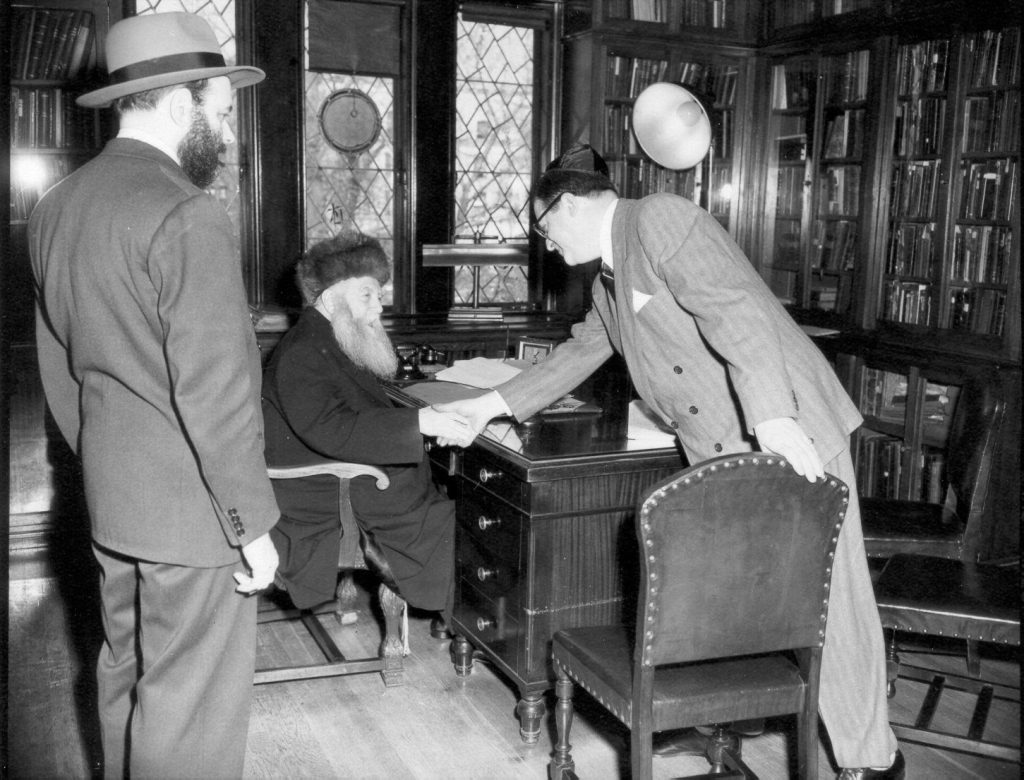
In 1941, when I was ten-years-old, I clearly remember my father taking me to 770 and we went in together to the room of the Rebbe Rayatz.
I remember his powerful presence and his broad face which was surrounded by a thick beard and a big shtreimel. At this stage of his life it was hard for the Rebbe Rayatz to speak. He spoke to my father in a sort of whisper and at some point he looked toward me. I felt as though he was looking right into me. I don’t remember anything that was said but I never experienced anything like that gaze.
During the meeting, his son-in-law and later successor was present, Rabbi Menachem Mendel Schneerson.
In contrast to my father’s connection with the Rebbe Rayatz which was emotional and more personal and spiritual, his relationship with the Rebbe was primarily intellectual. The gap in their ages was smaller and my father would sit with him on a bench outside his father-in-law’s office and talk, like two friends. As chairman of the Merkos L’Inyonei Chinuch, the educational arm of the Chabad movement, the Rebbe usually focused the topic of conversation on Jewish education, especially the education of women and girls, which few were addressing at that time…
I also had great respect for both Rebbes. The ‘RaMaSH’ sent me a wonderful letter for my bar mitzva, and I attended a few of his farbrengens once he was Rebbe. However, I didn’t want to have a private audience with him, even though people would invite me to come over the years. It was foolish but I had this feeling that the Rebbe was going to change my life, and I didn’t want my life to be changed. The Rebbe told my father to start putting on tefillin, and my father did. So maybe that’s why I stayed away.
The Rebbe was the great spiritual leader of our time. Judaism had become cold and impersonal, Jews were being alienated, and the Rebbe brought a fire to Judaism. Still, I remained distant; I didn’t want to get too close to the fire.
Beis Moshiach #1493 • pp. 12-23
© 2026 Beis Moshiach Magazine. All rights reserved.
This article originally appeared in Beis Moshiach #1493. You are welcome to share it with friends and family by email or in print, provided that you do not change, add to or omit any part of it, you credit the author and Beis Moshiach, and you include a link to archive.bmoshiach.org (written out in full in printed copies).
To republish this article in a newspaper, magazine, book or website, please request permission in advance at [email protected].