The Missionary Next Door
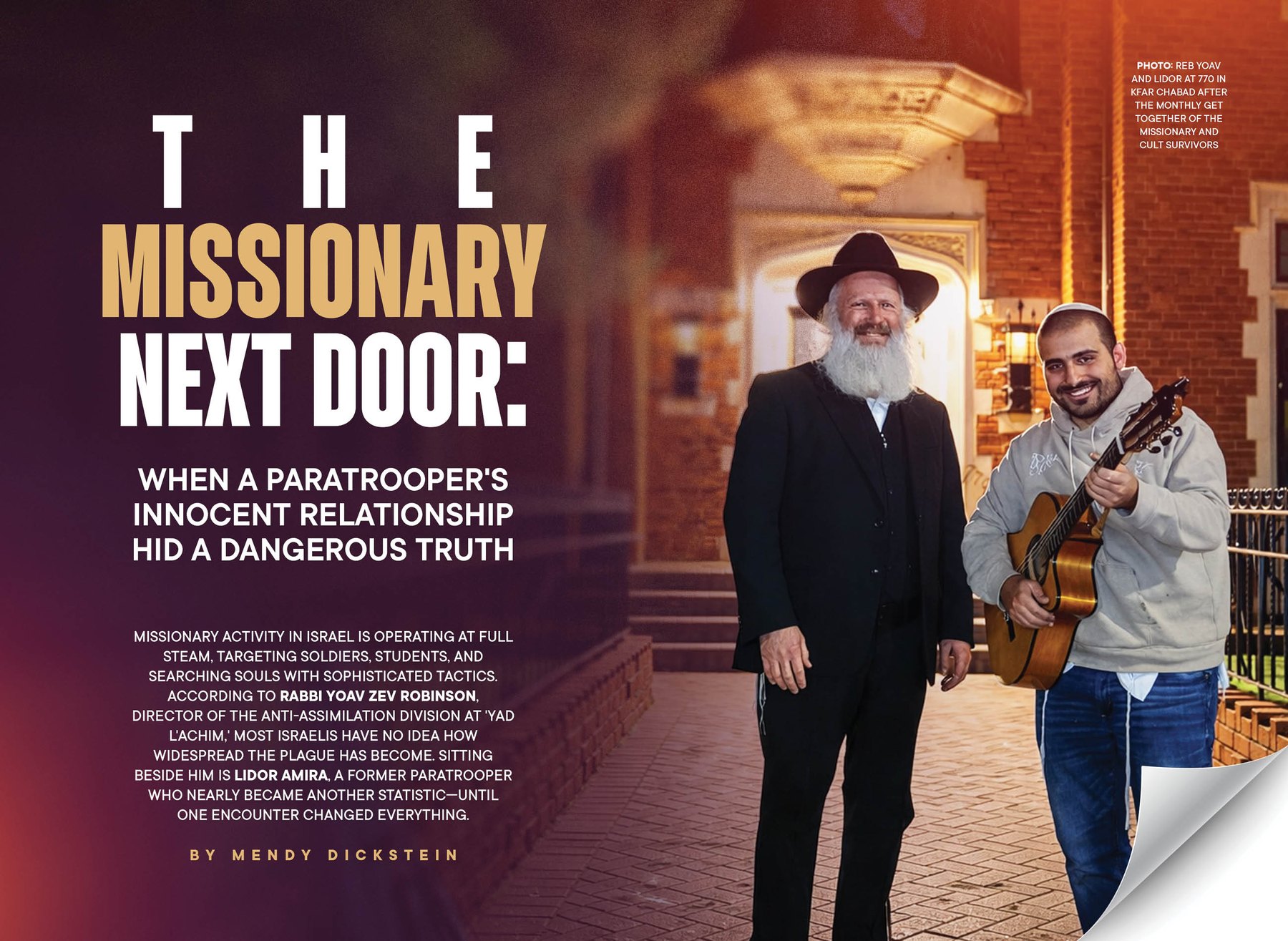
Missionary activity in Israel is operating at full steam, targeting soldiers, students, and searching souls with sophisticated tactics. According to Rabbi Yoav Zev Robinson, director of the anti-assimilation division at ‘Yad L’Achim,’ most Israelis have no idea how widespread the plague has become. Sitting beside him is Lidor Amira, a former paratrooper who nearly became another statistic – until one encounter changed everything.
The following conversation took place on a winter afternoon. It wasn’t raining, but the cold was significant. Sitting across from me were Rabbi Yoav Zev Robinson from ‘Yad L’Achim’ and beside him Lidor Amira. Both tell – each from his own perspective – the story of Lidor’s rescue from assimilation and intermarriage; one from the angle of the rescued and the other from the angle of the rescuer.
R’ Robinson is the director of the anti-assimilation division at ‘Yad L’Achim,’ and by virtue of his position, he is exposed to difficult cases of assimilation, intermarriage, forced residence in Arab villages, and more. However, a significant part of his time is dedicated to fighting cults and missionary activity in Eretz Yisrael.
According to him, those not involved or working in this field find it difficult to grasp how widespread the plague is among the Israeli public, especially among those searching for answers whose Jewish neshamos yearn for spirituality. “Davka with them, the kelipa takes hold with force, and they are drawn unwittingly to one of the worst and dark places, sometimes even to the point of conversion.”
Suddenly It Wasn’t a Regular Day
A winter morning at a remote military outpost, somewhere in the north of the country.
The gray day was briefly broken by the entrance to the outpost of a Chassidishe yungerman with a happy face with a tefillin in his hand. “Shalom, I came to lay tefillin with the soldiers,” he announced with a smile. It was R’ Shalom Waxman from the organization “Or LaChayal” (Light for the Soldier) who came, as he did every day, to lay tefillin with soldiers. R’ Shalom didn’t know that this day would be different, but for Lidor Amira, a paratrooper in regular service, this was a moment that would completely change his life. He just didn’t know it yet.
Lidor, a young man from Moshav Yatzitz near Rechovot, was experiencing a difficult internal struggle at that time. He had a girlfriend, a girl who was later revealed to be a Messianic Christian believer. When this became known to him, it was already quite late. For a long period, he was immersed in painful deliberation – should he give up his Jewish identity for her sake?
He grew up in a traditional moshav, but in a mostly secular environment. Lidor felt torn between worlds. “We would make Kiddush on Friday, fast on Yom Kippur, keep basic kashrus, but not more than that,” he recounts. “My parents are amazing people; the home they gave us was warm, full of cooking and love, but the supreme value was work and parnassa, not Torah and mitzvos.”
Lidor takes a sip from the cup of tea in front of him, still hot. “When the Chabadnik arrived at the outpost, I had a feeling that I must go over to him,” Lidor reconstructs that day at the outpost. “I saw a chareidi who came with tefillin, and I had this dilemma. I said to myself, ‘I’ll tell him and let’s see what he has to offer me.’ I just wanted to share with someone, I wanted a spiritual figure to consult with, and he was the one who came and seemed suitable to me.”
The brief encounter that began with laying tefillin turned into a deep conversation. When Lidor shared his distress with the Chabadnik, the Chassid reacted with surprise: “This is really serious,” he said and immediately added warmly, “I want to refer you to ‘Yad L’Achim’.”
He gave Lidor a page with a heart and a note that read “The Rebbe loves you,” and created a connection for him with R’ Yoav Zev Robinson, an expert in dealing with cases of Christian missionary activity on behalf of the ‘Yad L’Achim’ organization.
Rabbi Robinson, what do you remember from the first meeting with Lidor?
“The very next day we met at a coffee shop,” recounts R’ Robinson, a dynamic person with eyes that are penetrating yet soft, simultaneously. “I came with Binyamin Kluger, also a leading activist in ‘Yad L’Achim.’ We saw a confused young man who wants to establish a family, but reality is pulling him in a direction that could completely distance him from his people and his identity.”
In their first meeting, R’ Robinson explained to Lidor the danger of a relationship with a person who believes in Christianity, and especially the misery that could be caused to children who would be born to such a union, torn between Judaism and – l’havdil – Christianity. He also shared with him stories of many Jews who dealt with the same problem and emerged from it, even succeeding in establishing happy Jewish homes.
Lidor, what did you feel after this meeting?
“I was in an intense internal war,” Lidor shares. “On the one hand, the relationship was a deep emotional connection. On the other hand, I had a feeling, almost inexplicable, that ‘I’m forbidden to do this.’ I felt this was something I’m forbidden to do in the most extreme way possible – to die rather than do this. I didn’t know how to explain why, but my Jewish neshama was crying out.”
As part of the process, it became clear that Lidor’s partner was not Jewish at all, despite presenting herself as a “Messianic Jew.” “Only later did I realize that she wasn’t Jewish. Her father was Jewish; her mother underwent some type of conversion, but she believed in ‘oso ha’ish’ even after the conversion, which nullifies the conversion from its very foundation,” Lidor explains knowledgeably. From the investigation conducted by ‘Yad L’Achim,’ it became clear that she was the daughter of a family strong in its Christian faith, where the father was a “congregation pastor” – a kind of minister in the Protestant community.
What exactly did the meetings with Rabbi Robinson add for you, regarding what you already knew?
“R’ Robinson explained to me the falsehood in Messianic Christianity, the theological problems, and the contradictions that arise from their ‘religion.’ This was exactly what I needed, an intellectual explanation for what I felt in my heart,” says Lidor.
The relationship with the girl continued and wavered. “There were breakups and reconciliations. It wasn’t simple at all. The emotional connection was very strong, and sometimes emotion overcame reason.”
What was the thing that finally ended the relationship?
In the winter of 5776 (2015-16), a tragic disaster occurred. During a stormy phone call between Lidor and his girlfriend who worked as a lifeguard at a hotel pool, a small chareidi girl drowned. The girl was hospitalized in serious condition, and after two weeks died as a result of the drowning.
“She was in shock, and I was in shock,” Lidor recalls. “It was a kind of cosmic shock for both of us. She felt it was a message from heaven to leave me, and I also felt it was a message to leave her. After two weeks, we met for the last time and parted wholeheartedly.”
Searching and Wondering
The period after the separation was difficult for Lidor. “I was broken. I had just been discharged from the army and didn’t know what to do with myself,” he says. “I worked and wandered from here to there, but slowly I understood that I need to clarify my identity – what is this Jew in me that caused me to disconnect from the one I loved.”
From this search, Lidor began going to a kollel in the evenings to study Gemara. “I felt something amazing,” he recalls and his eyes light up. “Suddenly I felt happy from the learning, although I didn’t understand what there was in it that made me feel a sense of fullness, satisfaction, and closeness to Hashem.”
Concurrently, an encounter occurred that had an element of closure. “I worked in a factory where I met a guy named Daniel Attiya,” Lidor recounts. “I did his job orientation, and I felt there was something he wanted to tell me but was hesitating. In the end, he revealed to me that he was in a relationship with a Christian woman.” This was obvious hashgacha pratis. This is just what Lidor needed to hear…
Lidor didn’t hesitate. He immediately contacted R’ Robinson, and thus began another process of getting someone away from Christianity. “We sat for three days straight, seven-eight hours a day,” R’ Robinson shares. “We studied Rambam, Chassidus, Halacha, Gemara. Suddenly we saw the spark ignite in Daniel’s eyes too.”
Now, years after those events, have you kept up with him?
“Lidor and Daniel are part of a unique group called ‘Sheves Achim.’ The group holds a monthly gathering in Kfar Chabad for anyone who was in Christianity or missionary activity and left. It’s an amazing support group,” R’ Robinson explains. “They sit for two hours with yeshiva bachurim, study with chavrusas, and then hold a Chassidishe farbrengen. We’ve been doing this for ten years. The goal is not to remain with the spark that has been awakened, but to maintain it and fan it into a fire of love of Hashem.”
Lidor himself today combines the world of music with religious life. He has released several songs, the most prominent of which is based on the passuk (Amos 3:3), “Can two walk together, unless they agreed to meet?”
“I chose this passuk because it symbolizes for me the special connection between Am Yisrael and HaKadosh Baruch Hu,” Lidor explains. “Just as two people won’t walk together unless they made up in advance to do so, so too, Am Yisrael and HaKadosh Baruch Hu walk together throughout all the years of history.”
How did your family react to the change you went through from a non-religious guy, almost in Christianity, to a shomer mitzvos?
“To tell the truth, at first there was great fear; they were afraid I would disconnect from them, that I would be an extremist,” he recounts with a smile. “But slowly they saw how Judaism brings me goodness and blessing, how much it makes me respect them more.”
“Don’t Be Misled Just Because of Lack of Knowledge”
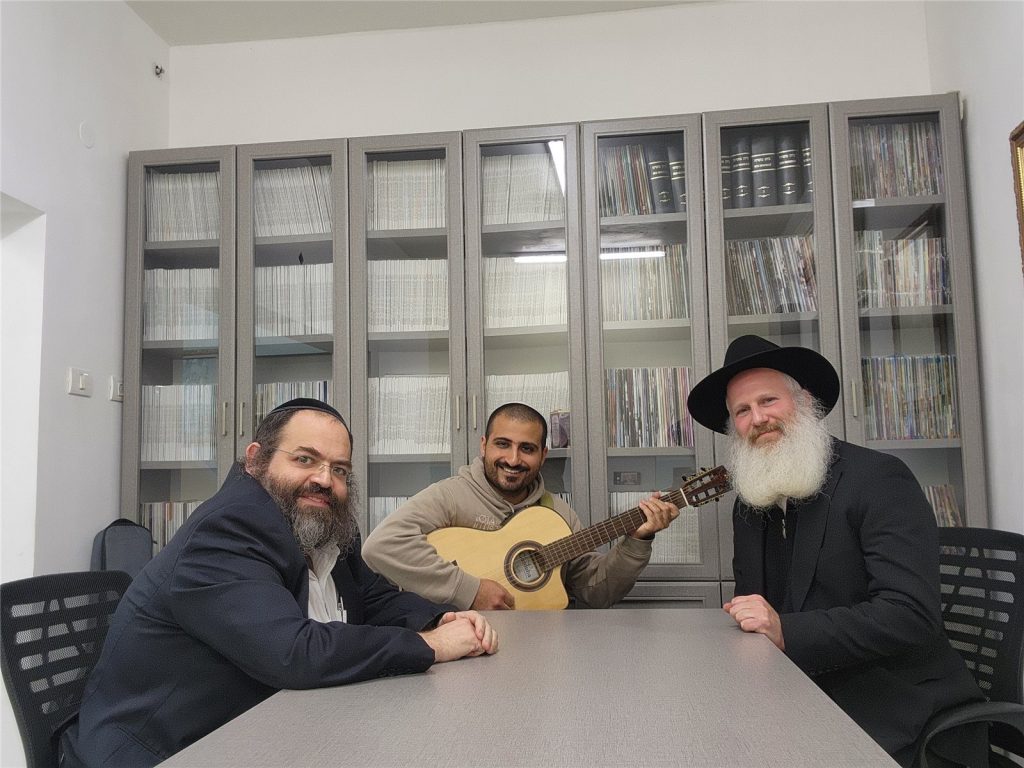
Today Lidor is married and a father of two daughters, works in a high-tech company, and dedicates time to musical creation. “I dream of returning to study in yeshiva,” he says.
R’ Robinson sees Lidor as a success story. “When I see Lidor today – a family man, a working man, creative, and above all a Jew proud of his identity – I am filled with satisfaction. This is exactly what we aspire to at ‘Yad L’Achim’ – not just to take people out of missionary activity, but to help them find their way back to themselves, to their people, and to their G-d.”
Lidor, what is your message to young Jews dealing with questions of identity regarding Judaism?
“Go ask, investigate, and clarify,” he says passionately. “Don’t be misled just because of lack of knowledge. All the things that sparkle outside – relationships with non-Jews, or a lifestyle that seems attractive – are temporary. In contrast, the good you will receive in Torah and mitzvos is eternal. This is life with meaning that is hard to explain in words.”
Lidor also emphasizes the importance of openness in the Jewish home in general and especially in the chareidi world. “To parents and mechanchim I say – be sensitive to young people who are a bit on the margins, who are wavering. Allow open dialogue, listen to them, don’t attack them for questions or doubts. With love and listening, you can prevent serious falls that will be difficult to return from later.”
R’ Robinson attributes Lidor Amira’s success story to the special power of laying tefillin. “Many times, when I meet guys and I want to influence them, I feel that I’m talking but it’s not working, so I bring tefillin and ask to lay them together. It has an amazing impact on the neshama.”
What is the response of a person standing on the edge of the abyss, a moment before planning to convert, and suddenly he is asked to roll up his sleeve and lay tefillin?
“They don’t always agree,” he admits, “but I don’t give up so quickly. I know and believe that laying tefillin, even once, has tremendous spiritual power. And it is known that ‘a little light pushes away much darkness,’ even in a makif kind of way. The tefillin break part of the kelipa that blocks rational explanations.”
The idea that laying tefillin once can change lives is not theoretical for R’ Robinson. “We also subsidize and help those who leave missionary activity and want to buy tefillin but don’t have money. The organization really takes care of their tefillin.”
“We also have a pair of tefillin in the office located in the heart of Bnei Brak,” he recounts with a smile. “You won’t believe it, but there are young people from Bnei Brak who for some reason haven’t laid tefillin, but they know that in our office at ‘Yad L’Achim’ there are tefillin mehudaros, Rashi and Rabbeinu Tam, and it’s possible to come lay tefillin in complete anonymity without anyone asking questions or raising an eyebrow.”
A Mitzva and a Chain of Mitzvos
Today, R’ Robinson and the staff at ‘Yad L’Achim’ continue the daily struggle to save Jewish souls. They know that behind every success story, like that of Lidor Amira, there are many more who need help. “Tefillin, Chassidus, love and acceptance,” he summarizes, “these are the tools we have in the ‘arsenal.’ And with Hashem’s help, we will continue to save more and more Jewish neshamos. When you look at Lidor’s story, you see how from laying tefillin once, a chain of good was created: Lidor did teshuva, Daniel also did teshuva following him, and both now influence others.”
Lidor, with a guitar in his hand, begins to play the words of the song he wrote: “Can two walk, can two walk, unless they agreed…” His moving voice tells the story of a person who was lost and found his way back home, to himself, to his people, and to his Creator.
The Missionary Effort in Israel Is Working at Full Steam
I took the opportunity to speak with Rabbi Robinson about the phenomenon of assimilation in Eretz Yisrael. His words are deeply troubling as he describes what goes on behind the scenes of missionary activity in Israel and the struggle to save Jewish souls.
“The missionaries exploit people’s distress. That’s what they ride on,” explains Rabbi Yoav Zev Robinson, who for many years has been working with victims of cults and Christian missionary activity in Eretz Yisrael. In his daily work he encounters a worrying phenomenon – missionary activity that is steadily intensifying and reaching even unexpected places.
“They see a chareidi bachur, and from their perspective a chareidi is ‘material’ worth investing in,” he states. “They exploit people’s hardships. There are quite a few bachurim from observant homes who wander around the world with inner restlessness. They’re searching for something. That’s exactly where the missionaries find them as easy prey. If parents were more sensitive, if they allowed open dialogue and didn’t immediately say, ‘Oh, that’s kefira, don’t talk like that,’ but instead listened, they could identify much earlier that there’s a problem.”
A particularly alarming phenomenon that has recently been exposed is what Rabbi Robinson calls “dormant missionary cells” in Yehuda-Shomron. These are people who ostensibly live as fully observant Jews in every respect, but in practice believe in Christianity.
“Recently we uncovered dormant missionary cells in Yehuda-Shomron,” Rabbi Robinson recounts. “They appear to be observant Jews – putting on tefillin, keeping Shabbos, going to daven in shul, everything. But they also believe in ‘oso ha’ish’ and in the New Testament.”
This is an especially sophisticated strategy, which makes identifying the problem difficult. “For them, observance of the mitzvos is merely a social convention, not a divine commandment. In their view, ‘oso ha’ish’ already fulfilled all the mitzvos and exempted them. It no longer matters to G-d whether they observe the mitzvos or not (Heaven forbid).”
Why Are Jews Drawn to Christianity?
Rabbi Robinson identifies several factors that lead Jews – even chareidim – to be drawn toward Christianity:
“It’s very convenient,” he explains. “They want to feel acknowledged, they want to feel good before G-d, and at the same time you can do whatever you want. You don’t really need to know anything, and you’re not obligated to do anything.”
Young boys and young girls who are on the social margins, or those who have experienced some kind of hurt, are at higher risk. “It could be a chareidi young man who was hurt for some reason – by his rabbi, by friends, or simply going through a period of emotional low – looking for comfort and a pleasant place to be. The missionaries exploit those hardships.”
What are the methods used by “Yad LaAchim” to save those wandering and lost brothers?
“Leaving the missionary world is not simple and requires not only intellectual explanation but also emotional and spiritual support. There are many stories of people who were in Christianity and left,” Rabbi Robinson says. “Once a month we hold a gathering here in Kfar Chabad for anyone who was in Christianity and missionary activity and has left.”
Alongside the halachic and explanatory aspects, Rabbi Robinson reveals that the study of Chassidus is a very powerful tool in bringing people out of missionary influence.
“Recently I was involved in a very sad story,” he shares. “Israeli parents who left the country and moved to Canada, and their son – without their knowledge – was in a relationship with a non-Jewish woman. She convinced him to join her at her house of worship, and he has been in a Greek Orthodox church for a year and a half. The parents, even though they are not observant, were shocked.”
Rabbi Robinson began theological discussions with the young man via Zoom, but saw that it wasn’t really having an effect. “I told him, ‘Alright, next meeting we’re learning Chassidus.’ We sat and learned Tanya, chapters 1 and 2. Wow – suddenly, for the first time in his life, he hears that he has a nefesh Elokis…”
“He always thought that ‘oso ha’ish’ was like G-d, Heaven forbid, and therefore wanted to draw close to him and feel closeness to G-d,” the rabbi explains. “I told him that ‘you too have a divine spark.’ Chassidus, the Tanya, the Rebbe’s sichos – it simply works. It’s truly amazing to see how it turns them around from one extreme to the other.”
What tips and insights do you have for parents and educators regarding the potential downward spiral of young people?
Rabbi Robinson urges parents and educators to be alert to signs of distress. “When a parent comes out against their child, hears that he’s looking a bit elsewhere, the child shuts down; he stops sharing, and then who knows where it leads. It can lead to very problematic things,” he warns.
“We get cases only when they’re already advanced, but it’s possible to prevent this much earlier – with a bit more attention, more love and openness – allowing a son or daughter to talk. There should always be open dialogue at home and a lot of love. That’s very important.”
Beis Moshiach #1495 • pp. 22-28
© 2026 Beis Moshiach Magazine. All rights reserved.
This article originally appeared in Beis Moshiach #1495. You are welcome to share it with friends and family by email or in print, provided that you do not change, add to or omit any part of it, you credit the author and Beis Moshiach, and you include a link to archive.bmoshiach.org (written out in full in printed copies).
To republish this article in a newspaper, magazine, book or website, please request permission in advance at [email protected].