The Surprising Source of the “Purim Shpiel”

A Purim shpiel is an ancient Jewish custom, but how old? In this chapter from a forthcoming book about the sources and details of Chabad minhagim by Rabbi Zalman Hertzel, he shows that there’s reason to believe that a form of it existed as far back as the time of the Gemara… Plus: what did the Rebbe say about the “Purim shpiel” and the “Purim Rav”?
A. The Source for Purim Plays
1. Historical Origins
The first source for the idea of “Purim plays” is mentioned in the Gemara in Sanhedrin 64b under the name “meshavrasa d’Purya.” Rashi explains there: “Jumping with one’s feet in the manner that children jump on Purim.”
The Eliyahu Raba (in Siman 696) on this topic quotes the Aruch, which elaborates further: “It is written in the Aruch that the custom in Bavel and Eilam was that all the young men would make a figure resembling Haman before Purim, and hang it on their roofs. On Purim, they would make a bonfire and hang the figure in it, standing around it and singing. They would have a ring hanging in the fire and would hang the figure on it, jumping from one side of the fire to the other. This is called meshavrasa d’Purim in the perek Arba Missos. Meshavrasa means jumping.”
Indeed, throughout the generations the custom existed in several communities, each in its own unique style, to conduct such a ceremony. Several weeks before Purim, the youth would organize and prepare the wood and the “Haman” (and sometimes add his ten sons as well). On Purim, they would gather around it, light a fire to burn “Haman,” and sing “Arur Haman” with joy and feeling.
2. Evolution of the Custom
“Purim plays” took on various forms and spread from generation to generation and from community to community. They would celebrate and bring joy on Purim and during the month of Adar with various plays, with the presentation of the Megilla story at their center.
Rabbi Tzadok HaKohen of Lublin writes: “There is a custom to engage in all forms of hilarity on Purim. And minhag Yisrael Torah (i.e. obligatory), and it is learned from the pasuk, ‘He who sits in heaven laughs at them,’ about which it is said ‘the day when the enemies of the Jews hoped to rule over them, and it was reversed – that the Jews themselves ruled over their enemies.’ This is very hilarious, when the hopes of the wicked and the nations of the world are reversed from opposite to opposite.”
3. The Rebbe’s Educational Perspective
The Rebbe saw the Purim play as an educational tool that could bring good results in educating children. Thus he wrote to Rabbi Yissachar Dovber Gourevitch a’h, principal of Beth Rivkah in France (on Rosh Chodesh Adar 5719):
“In response to his letter from the 28th of Shevat, regarding doubt concerning the Purim play. Since the matter depends on details and minute details, it must be decided in situ. And in general, it is also understood that from inaction certainly one cannot hope for any results whatsoever, even small ones. Which is not so when one acts. And especially since there are still several weeks until the days of Purim and there is sufficient time for preparations.”
B. Portraying the Wicked Haman
In a sicha on Taanis Esther 5743, the Rebbe spoke at length about Purim plays, while raising awareness about the required approach in educating children, directing and guiding them as to which character is appropriate to portray. The Rebbe took time to explain how to respond when a Jewish child is offered to play the role of the wicked Haman in a play.
Below is part of the sicha as printed in Likkutei Sichos (Vol. 31, p. 279. Here it is divided into sections to facilitate reading):
(a) The Scenario
In many places it is customary for children to arrange a ‘Purim play’ in which they dramatize the entire story of the Megilla. Therefore, just as someone is needed to play and portray the role of Mordechai and Esther, Charvona, and the like, so too someone is needed to play and portray the role of ‘Haman’ – to speak Haman’s words, and so on.
And when the boy or girl is asked: Is it possible that you have such a role in the ‘play’ – to speak the words of ‘Haman,’ while you call him by the name ‘Haman the wicked’?!
The child responds – that he knows that these words (the words of Haman that he presents in the ‘Purim play’) do not belong to a ‘Jew,’ G-d forbid. But nevertheless, since they promise him ‘a few pennies’ for this, he is willing to deviate from his reality for only a short time and repeat Haman’s words!
And in particular – the child continues to justify himself – he is still before ‘bar mitzva’ (or ‘bas mitzva’), and if so, one should not come to him with complaints. And furthermore, he claims, from the money he will receive for fulfilling his role in the ‘play,’ he will give part to tzedaka!
(b) The Question of Alternatives
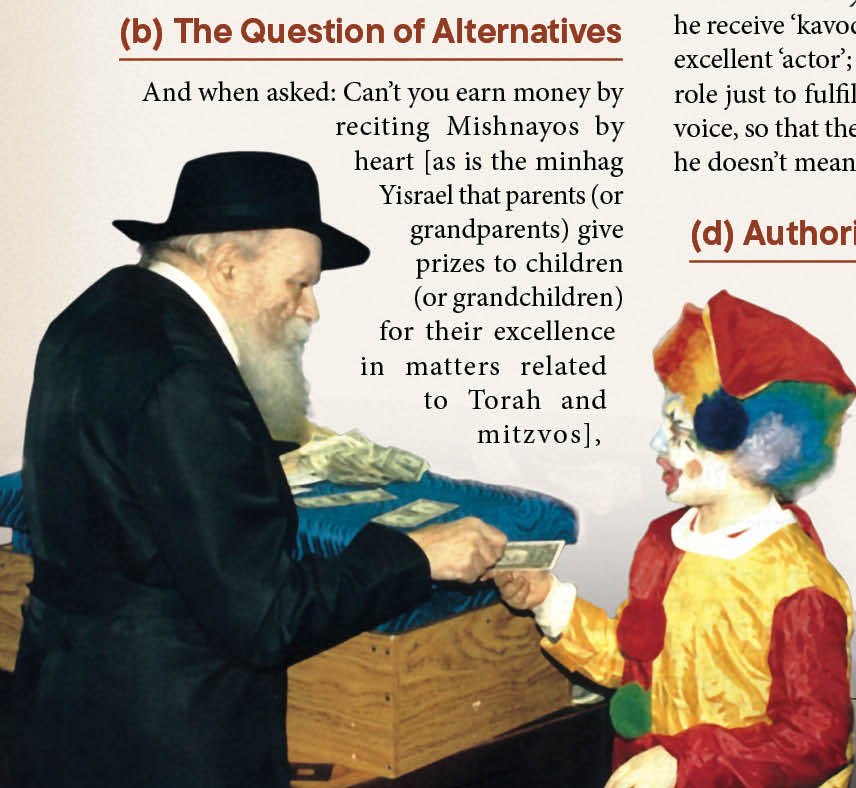
And when asked: Can’t you earn money by reciting Mishnayos by heart [as is the minhag Yisrael that parents (or grandparents) give prizes to children (or grandchildren) for their excellence in matters related to Torah and mitzvos], and why must you ‘play’ the role of ‘Haman’?!
The child answers that for the play they give him more money, or he receives it more quickly and easily, etc.!
(c) The Enthusiasm Problem
And still they continue to ask him: If indeed you are playing the role of ‘Haman’ only in order to receive a few pennies, why are you so ‘into it,’ and doing it with liveliness, accompanied by hand and foot movements and the like?!
The child answers: When he ‘plays’ the role of ‘Haman’ with liveliness and with ‘force,’ in a loud and impressive voice and with animation, he will receive ‘kavod’ from his parents and friends because everyone will see he is a good actor who can perform in the theater since he played the role of ‘Haman’ in the best way, to the point that he succeeded in frightening the audience, because he spoke Haman’s words (the opposite of blessings, etc.) with the greatest chayus and fervor, so that everyone could imagine that this is how the wicked Haman himself spoke, Rachmana litzlan!
And therefore he wants to ‘play’ the role of Haman with chayus, etc. because only then will he receive ‘kavod’ from everyone for being an excellent ‘actor’; which is not so if he plays the role just to fulfill his obligation, with a weak voice, so that they recognize in his words that he doesn’t mean what he’s saying!
(d) Authority’s Silent Approval
And the child goes on to argue: Why do they come to him with complaints and questions, etc. – for his teacher and mentor knows that he accepted upon himself to play the role of ‘Haman,’ and since he did not protest, it is understood that there is no wrong in this; from his silence I understand approval! And in particular, that most of the time he explicitly thanked him.
(e) The Educational Lesson
And from this it is understood how much care must be taken in educating the young – that even if someone persuades them that for money (and especially if they give part of it to tzedaka) and ‘kavod’ it is worthwhile for them to behave (even temporarily) in a manner that is not appropriate for a Jew, they should know that there is nothing to be impressed by such an offer!
…And when they endeavor to educate him in such a way while he is still young, “Train the child,” then they are assured that “also when he grows old he will not depart from it.”
Thus far from Likkutei Sichos.
C. The Rebbe’s Response
1. The Written Clarification
In light of (and after) this sicha, the tmimim Shneur Zalman Liberow and Yosef Yitzchok Meizlish in 5748 prepared a page titled “HaMaaseh Hu HaIkar (Action is the Main Thing),” in which they brought the content of what the Rebbe said from 5743, completely negating playing the character of Haman in a Purim play.
They submitted the page to the Rebbe, and added:
“Attached is the directive of the Rebbe regarding Purim plays, which was written based on the sicha of Taanis Esther (mukdam) 5743. In the transcript (unedited) itself, there is not the explicit ‘conclusion’ [the directive] in practice that children should not play, etc., the role of Haman, but from the length of the sicha it is understood that this is indeed the will of the Rebbe.
“Also attached is a copy of the aforementioned sicha in its entirety. The above was prepared for the ‘special bulletin board for the Rebbe’s directives’ that was installed downstairs in 770.
“And may it be His will that we merit to bring the Rebbe only nachas ruach, and the Rebbe will lead us upright to our land literally, now.”
2. The Rebbe’s Handwritten Response
On the letter they submitted to the Rebbe, the Rebbe circled the word “understood” and added and wrote (the response was on the 10th of Adar 5748):
If so, it is not a play!?
3. Understanding the Balance
The resolution between the Rebbe’s words in the sicha and what he wrote in his holy handwriting can apparently be understood thus:
Practically speaking, it is impossible to have a presentation of the Megilla story when Haman’s character is missing. He is part of the Megilla story, and in general, this is part of the Torah of truth, part of the 24 sifrei kodesh. Rather, the manner of educating a Jewish child must be such that he will not desire this role at all! On the contrary, every Jewish child will want with all his might to serve only in a positive role in the play.
And even if in the end someone will need to perform the role of Haman, he will do it (from the perspective of his feelings and will) “against his will” and with no choice.
This is true and authentic Jewish chinuch, as the Rebbe says at the end of the sicha that “when they endeavor to educate him in such a way while he is still young, ‘Train the child,’ then they are assured that ‘also when he grows old he will not depart from it.’”
Purim Rav
Another custom practiced in many communities was to choose a “rav” before Purim. One of the community members was selected to serve as the “Purim Rav,” whose purpose was to add joy to the participants of the “feast” typically held in the community center (shul, Beis Medrash etc.). In Chassidic courts, this rav played an important role during the “tisch” conducted by the Rebbe.
In books documenting Purim celebrations throughout the generations, we find detailed descriptions of the “Purim Rav” in various communities, such as in the court of the holy Rabbi Yisroel of Ruzhin, in the court of the holy Rabbi Dovid of Tolna, and others.
Although this custom was not practiced in Lubavitch, we find references to it in the Rebbe’s Sichos Kodesh. For example:
At the Purim farbrengen of 5714, the Rebbe said: “There used to be a custom on Purim to choose a ‘Purim Rav,’ who was a ‘rav’ only for the duration of the Purim feast.”
At the Purim farbrengen of 5724, the Rebbe said: “There was a custom to choose a ‘Purim Rav,’ and they would make ‘mockery and jest’ of the entire position of the rabbanus, as is known to those familiar with the custom.”
At the Simchas Torah farbrengen of 5736, the Rebbe told of an incident that occurred with a ‘Purim Rav’ at one of the yeshivas where students were very embittered toward their Rosh Yeshiva, and on Purim they found the opportunity to repay him through the ‘Purim Rav.’ The Rebbe told the story as follows:
“Someone once told me that in the yeshiva where he studied, there was an extremely sharp Rosh Yeshiva who, whenever anyone would present an argument before him, would immediately refute it and say ‘the opposite is more logical’ (ipcha mistavra) with various explanations and clarifications, etc.
“When Purim arrived, and as was customary, they chose a ‘Purim Rav’ through whom the bachurim would express their bitter hearts toward the roshei ha’yeshiva with whom they were dissatisfied.
“That ‘Purim Rav’ said: The procedure is that when a Rosh Yeshiva arrives in the World of Truth, since in ‘Gan Eden’ there are many different levels, they need to know in which level to place the Rosh Yeshiva. The members of the Heavenly Court gather together and ask him to present some of his chiddushim, the finest of the fine, and according to the results they decide to which level he belongs.
“The ‘Purim Rav’ related that when the Rosh Yeshiva arrived at the Heavenly Court, since he was a great Rosh Yeshiva, the Holy One, Blessed be He, Himself came in His glory and sat at the head of the table of the court and asked the Rosh Yeshiva to present a chiddush. The Rosh Yeshiva responded and said: On the contrary, let the Holy One, Blessed be He, say a chiddush and I will refute it!”
Beis Moshiach #1495B • pp. 12-17
© 2026 Beis Moshiach Magazine. All rights reserved.
This article originally appeared in Beis Moshiach #1495B. You are welcome to share it with friends and family by email or in print, provided that you do not change, add to or omit any part of it, you credit the author and Beis Moshiach, and you include a link to archive.bmoshiach.org (written out in full in printed copies).
To republish this article in a newspaper, magazine, book or website, please request permission in advance at [email protected].