The Mortgage Payment

From the TzaddikStory.org collection
Rain tapped softly against the windows of the Katz home in Boro Park, as Rabbi Katz reached into the mailbox. When he saw the registered envelope, his chest tightened. He’d known this letter was coming. Still, knowing did not make it easier.
For many months, he’d fallen behind on his house payments. Every payment had felt like a mountain he could no longer climb.
Rabbi Katz went inside, washed his hands, and sat down at the kitchen table. He held the envelope for a long moment before opening it. When he finally did, his hands began to tremble.
The letter was clear. The bank was giving him ninety days. If the debt was not paid by then, the house would be taken away. His family would be forced to leave, and they would have no place to go.
Rabbi Katz leaned back and closed his eyes. He’d done everything he could think of. He’d worked longer hours. He’d cut expenses, again and again. Still, despite all his effort, he hadn’t even managed to collect half of what was needed.
Days passed in a blur of worry. Nights were even worse. Supporting his large family had always required strength and creativity, but now, the pressure felt crushing. Every possible source of income had already been tried. Friends and relatives had helped where they could, but there was nothing left to ask for.
No one could lend him another dollar.
“Where will I find tens of thousands?” he thought.
Sleep barely came anymore. Night after night, Rabbi Katz lay awake, staring into the darkness, until he finally understood he couldn’t carry this pain alone.
One evening, he went to speak with a close friend.
They sat together, and Rabbi Katz told him everything. He spoke about the mortgage, the letter, the debt, and the fear that he’d reached the end of the road. His friend listened carefully, without interrupting, his expression growing heavier with each word.
When Rabbi Katz finished, neither of them spoke. After a long pause, his friend stood and walked to the bookshelf. He took down a Mishnah Berurah and slowly searched through the pages until he found what he was looking for.
“Let me show you something,” he said.
He read from Siman 185, quoting the Sefer HaChinuch. It explained that someone who is careful with Birkas HaMazon is promised a comfortable livelihood. It added that the best way to do this is by saying Birkas HaMazon from a bentcher, not by memory.
Rabbi Katz listened closely.
“I wish with all my heart that I could help you financially,” his friend said. “But I don’t have the means. What I can give you is this advice. Take the Sefer HaChinuch seriously. Strengthen yourself in bentching. And if possible, have your family do it too. I truly believe this promise is real.”
That night, Rabbi Katz returned home deep in thought. He gathered his family together and read them the words of the Sefer HaChinuch. He explained that he wanted them all to be careful to say Birkas HaMazon properly, from a bentcher, every single time.
Everyone understood.
From that day on, the Katz family made sure to always bentch looking inside a bentcher, paying attention to every word.
* * *
In a small town outside Denver, Colorado, the police chief realized the local police station needed to be expanded. But there was a problem. There was no space – except for one empty lot, directly next to the building.
The chief began investigating, and learned that the land had been bought many years earlier, by a man from New York. It was part of a real estate deal – something he picked up very cheap, hoping that he’d one day sell it for a profit. After the man passed away, the property was inherited by his son, who basically forgot about it. He didn’t realize it was worth anything, and he had no idea anyone would ever buy it.
The land itself was nothing special. It was rocky, unused, and far from developed areas. Since no one had needed it, its value had barely changed over the years.
But now, it was essential. The police chief picked up the phone and called the owner.
“Hello, is this Rabbi Katz?” he asked.
“Yes, this is Rabbi Katz,” the man answered, his voice cautious, wondering what collector was calling with yet another unpaid bill.
“This is Chief Miller,” the police chief said. “I’m calling about a small lot next to our police station out here in Colorado. According to our records, it belongs to you.”
Rabbi Katz blinked. “That lot? The one my father left me?”
“That’s the one,” the chief said. “We need to expand our building, and it’s the only space we have. Would you be willing to sell it?”
For a second, Rabbi Katz didn’t answer. The moment he heard who was calling and why, his heart lifted. For the first time in many months, he finally felt there was hope.
“I… I might be willing,” Rabbi Katz said carefully. “But only for the right price.”
The chief cleared his throat. “How much are we talking about here…?”
Rabbi Katz named a high number. The police chief paused. “Rabbi, that’s… that’s a lot of money. Is there any way you could bring that down?”
Rabbi Katz hesitated. “Chief, I understand. This land may not look like much. But right now, it’s important. And I’m asking for what it’s worth.”
Since the money was coming from the town’s budget, not his own pocket, he eventually agreed. “All right…” he said. “We’ll do it.”
The deal was finalized.
Several days later, the money was transferred to Rabbi Katz’s account.
In one moment, everything changed.
Rabbi Katz paid off the mortgage of his home in full. The house now belonged entirely to his family. The fear of being evicted vanished. The worry about parnassa disappeared as well.
He invested part of the remaining money carefully, and, over time, those investments grew. Rabbi Katz became a wealthy man.
Even today, if you sit at the Katz family’s table during a meal, you’ll notice something. When they bentch, they do so slowly, from inside a bentcher, with careful attention to every word.
No one finds this surprising. It was through this very hachlata that their yeshuah came.
A forgotten piece of land became valuable at the exact moment the Katz family strengthened their bentching. At the same time they made their commitment, a police chief far away decided to expand his station and was willing to pay generously for the land.
This story was shared by Rav Gamliel Rabinowitz, rosh yeshiva of Shaar HaShamayim in Yerushalayim, who heard it directly from Rabbi Katz himself. Sometimes, taking a few minutes to thank Hashem properly can open doors we never knew existed.
The Most Powerful Hachlata
Before Covid-19, music was how I supported my family. I played the violin at weddings, at events, and with orchestras. Baruch Hashem, it was enough to live and get by.
Then Covid appeared. Weddings were canceled. Fundraisers stopped. One by one, every event disappeared from my calendar – until suddenly, there was nothing left.
At first, we told ourselves it wouldn’t last long. But days turned into weeks. Our savings slowly shrank, and the worry grew, as we slowly had less and less money and no way of making more. One day, I remembered a segula for parnassa I once heard. It said that someone who bentches from inside a bentcher, slowly and with kavana, can bring blessings into their life.
I thought about it carefully. Something inside me felt certain that this was the right time to take it seriously. I decided that from now on, I would always bentch while reading from the siddur with kavana, hoping Hashem would give me brachos for parnassa.
I didn’t expect anything to happen right away. I thought it would take time. But Hashem had other plans.
Around that same time, the mayor of New York announced that shuls would be closed. People found new ways to daven. Neighbors stood on porches, in yards, and by open doors, davening together from a distance, just like in Eretz Yisrael.
In my neighborhood, houses were close enough that we were able to organize a small minyan, carefully following all the instructions.
On Shabbos, our shul had always shared seuda shlishis together. We didn’t want to lose that connection. So, we decided everyone would eat at home first, and then gather in one backyard. There, we’d eat a k’zayis of bread, sing zemiros, and bentch together over a cup of wine.
That Shabbos was the first one after I’d taken on my commitment.
When it came time to bentch, everyone else finished quickly. I stayed seated, holding the bentcher in my hands, saying each word slowly and with care.
Because we had exactly enough men for a minyan, everyone had to wait for me to finish before we could daven Maariv.
After davening, one of the men approached me.
“I just want you to know,” he said, “I was really impressed by the way you bentched. You put so much time and energy into it – you didn’t rush at all.”
I decided to be open. I explained how Covid had destroyed my parnassa, and how I had chosen to strengthen myself in bentching from a bentcher, with kavana, hoping it would bring a yeshuah.
As I spoke, his eyes lit up.
“That’s incredible,” he said. “I just thought of something that might help you. Let me go home, make Havdala, and I’ll call you.”
I went home, hopeful but nervous. I whispered a quiet tefilla, asking Hashem for siyata d’shmaya that his idea would succeed. About an hour later, my phone rang.
It was my neighbor, and his voice was full of excitement.
“Your segula worked,” he said. “I work in a nursing home and assisted living facility. The owner is a caring Yid. Lately, he’s been very upset about how lonely the residents are. They can’t have visitors, and many of them feel forgotten.”
He continued, “When I heard what you do, I suggested that he hire you to play the violin for them. I called him right after Havdala.”
Then his voice softened.
“You know how it is with older people,” he said. “Even in normal times, many of them sit for hours by themselves. Some don’t have family nearby. Some hardly get visitors. And we try – really try – to give them a little warmth. Someone to talk to. Something to look forward to. Because the hardest thing isn’t even being old… it’s feeling alone.”
He paused.
“But now, with all these new rules, it’s gotten so much worse. They’re stuck in their rooms. No visitors. No normal activities. And the only connection they’re allowed is a phone call – but many of them don’t know how to use a phone very well, or they can’t hear, or they get confused. So they sit there, day after day… and they feel forgotten.”
“And?” I asked.
“He loved the idea,” my neighbor said. “He owns three facilities. He wants you to go room to room and play your violin for the residents – and he’ll pay you well.”
I didn’t even know what to say. Then, my neighbor added, “Here’s the genius part. We can’t let visitors in… but we can bring in essential staff.”
“Essential?” I repeated.
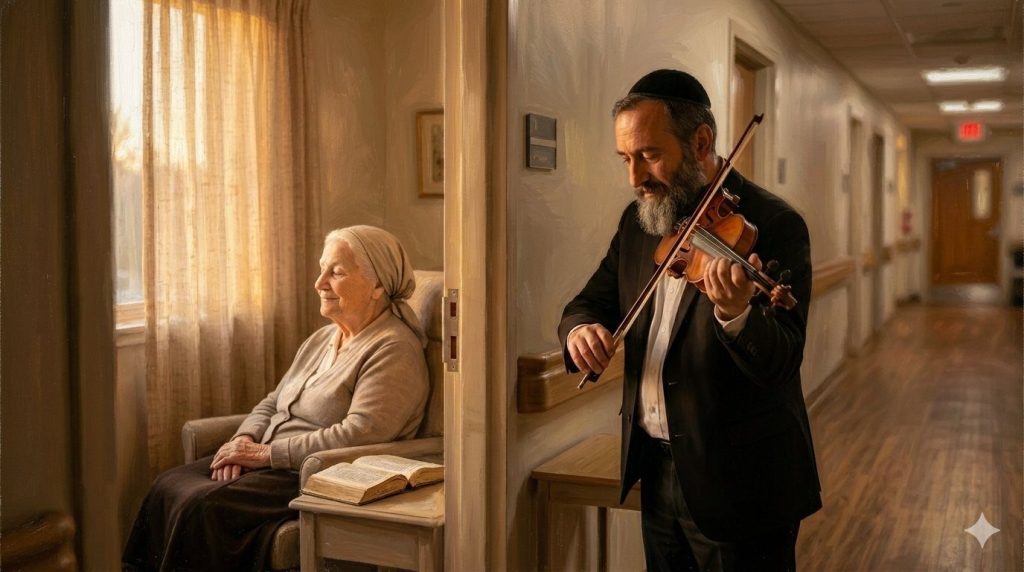
“Exactly,” he said. “He wants to hire you full-time, and put you on the books as an employee. That way, you can come in every day, legally, as a member of staff – because what you’ll be doing isn’t just music. It’s emotional care.” He spoke faster now, excited.
“You’ll walk the halls with your violin, stop outside each room, and play for them – one person at a time. Live music. A real human being, standing there, just for them. For a few minutes, they won’t feel stuck, or forgotten, or alone.” He paused, then said quietly, like he meant it. “You’ll make them feel seen. And you’ll help bring their souls back to life.”
I could hardly believe it. Within weeks, I began working there. I was earning an income again – but more than that, the work filled me with joy. When I played, residents smiled. Some cried. Many told me the music made them feel alive again.
I wasn’t just earning parnassa. I was bringing light. Later, the owner told me that, even when things return to normal, he wants me to continue playing regularly.
All of this began with one decision: to bentch carefully, from a bentcher, with kavana.
It is a segula trusted for generations. Even the Ohr Zarua speaks of it, explaining that he heard it from his own rabbeim. When a person truly knows that Hashem is the One who provides everything, that knowledge itself becomes a source of blessing.
(Adapted from “102 Stories That Changed People’s Lives” by Rabbi Tzvi Nakar)
Beis Moshiach #1497 • pp. 55-59
© 2026 Beis Moshiach Magazine. All rights reserved.
This article originally appeared in Beis Moshiach #1497. You are welcome to share it with friends and family by email or in print, provided that you do not change, add to or omit any part of it, you credit the author and Beis Moshiach, and you include a link to archive.bmoshiach.org (written out in full in printed copies).
To republish this article in a newspaper, magazine, book or website, please request permission in advance at [email protected].