Double Wrapped
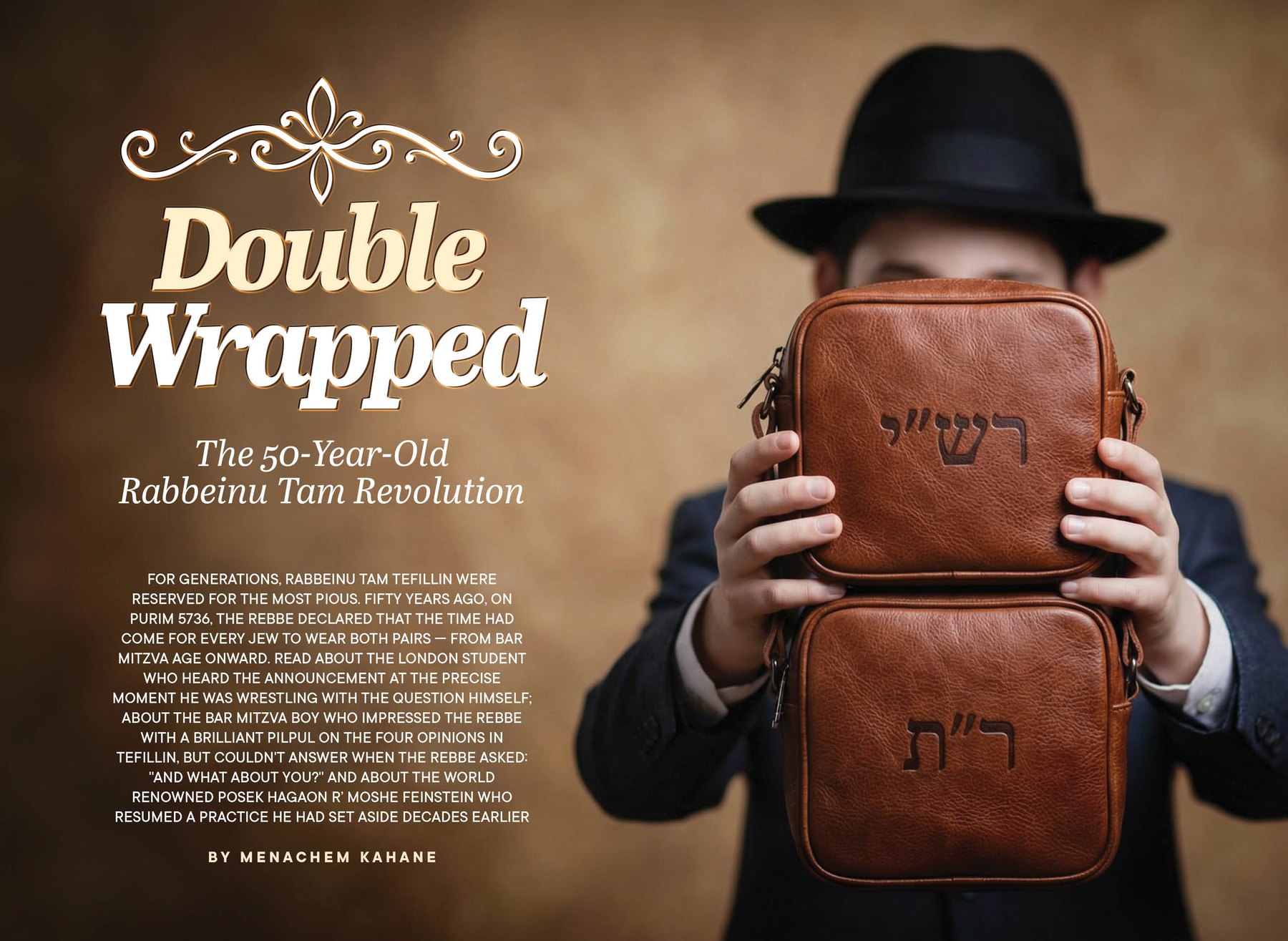
For generations, Rabbeinu Tam tefillin were reserved for the most pious. Fifty years ago, on Purim 5736, the Rebbe declared that the time had come for every Jew to wear both pairs – from bar mitzva age onward. Read about the London student who heard the announcement at the precise moment he was wrestling with the question himself; about the bar mitzva boy who impressed the Rebbe with a brilliant pilpul on the four opinions in tefillin, but couldn’t answer when the Rebbe asked: “And what about you?” And about the world renowned posek HaGaon R’ Moshe Feinstein who resumed a practice he had set aside decades earlier.
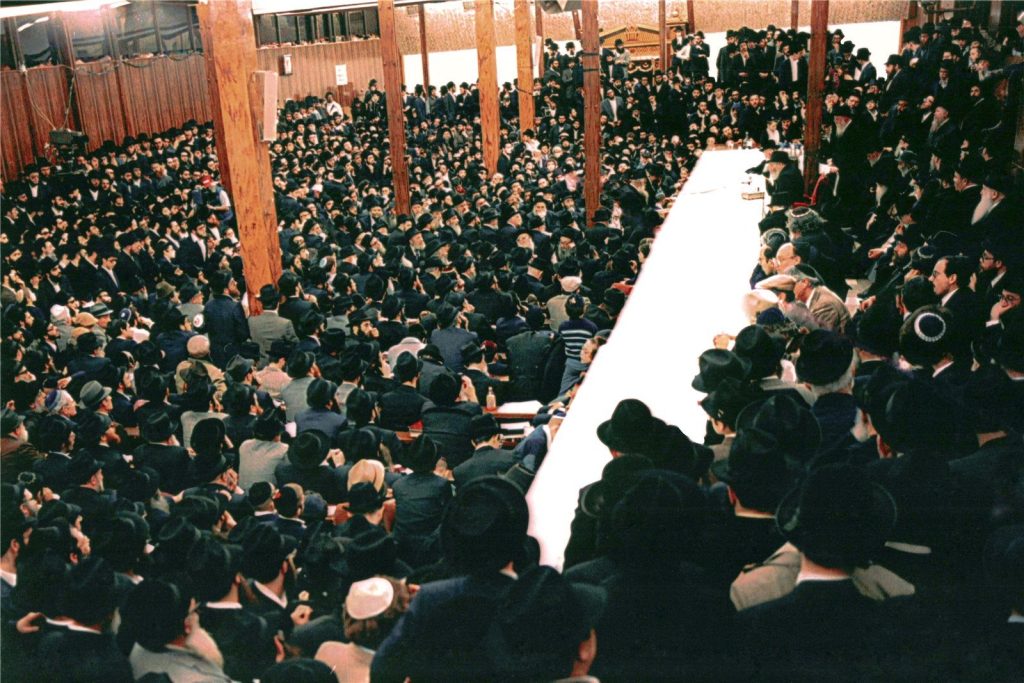
Purim Night 5736 in London. The atmosphere in the hall of the Chabad mechina on that Purim night of the year 5736-1976 was electric. On the head table was the broadcasting device that connected all the listeners to Beis Chayeinu – 770. Through the static background noise, the clear voice of the Rebbe broke through.
Among those crowded around the speaker sat the young bachur, Michoel Chazan. Michoel had not grown up in a Chabad home, but he had found his way to the wellspring and was in those days studying at the mechina in London. He also sat and listened to the Rebbe’s voice, his mind filled with thoughts – a question that had been on his mind in recent days. He had seen some of his younger friends, after davening, take out an additional pair of tefillin – Rabbeinu Tam tefillin – and place them on their arm. And he wished to do the same.
“Since I did not come from a Chabad background, I decided to ask the Rebbe,” recounts Chazan. He wrote to the Rebbe, but the answer that came back was general and thought-provoking: “Adding and going – a Jew must always add in Torah and mitzvos.”
He showed the letter to the Rebbe’s shliach, Rabbi Sudak, who replied: “The Rebbe does not mention Rabbeinu Tam in the letter. If I were you, I would put them on ‘conditionally,’ so that it is not binding, until the Rebbe gives a clear answer.” But the doubt continued to gnaw at him.
And then, suddenly, the Rebbe began to speak about Rabbeinu Tam tefillin: “And here is also the place to add, to note, and to respond to the question of many in connection with the wearing of Rabbeinu Tam tefillin, which is connected with what it says, ‘For the Jews there was light and gladness and joy and honor’ – since everything follows the conclusion – ‘and honor – these are tefillin.’”
After a brief introduction: “although it is known what is written in sefarim regarding Rabbeinu Tam tefillin, that one would hope people could even fulfill the great carefulness required in bodily purity and so on for Rashi tefillin” – the Rebbe announced explicitly: “My view is clear that now is the time when everyone must also put on Rabbeinu Tam tefillin.”
And after explaining, the Rebbe addressed the fact that the farbrengen was being broadcast across the globe: “Therefore, one must take advantage of the opportunity that these words are now being heard everywhere where people are connected through these devices, and certainly they will transmit this to all those for whom the matter is relevant.”
And here the Rebbe clarified his intention: “All those who asked me about wearing Rabbeinu Tam tefillin (and there has not yet been time to answer them), as well as those who will wish to ask in the future – they are spared the need to ask (and if they do ask, I am spared the need to answer), since there now exists an answer for the past, the present, and the future – the matter has already been stated clearly in all the sefarim, both according to the writings of the Arizal and according to Nigleh – that the final conclusion regarding practical action is that in our days one must wear, according to halacha, Rashi tefillin and afterwards Rabbeinu Tam tefillin. Therefore, whoever wishes – may he be blessed – let him begin from tomorrow morning to also put on Rabbeinu Tam tefillin… and it is not relevant to wait until after marriage, or age eighteen, etc. Rather, whoever adds by doing it earlier is praiseworthy.”
“I felt as though the Rebbe was answering me personally,” says Rabbi Chazan. “since I am included in ‘all those who asked me about wearing Rabbeinu Tam tefillin.’ And all this is happening exactly when I am thinking about it! Amazing. Most wonderful.”
But the story does not end there. Several years later, after he had already moved on to learn in the yeshiva in Morristown, while he was attending one of the Rebbe’s farbrengens, he was thinking that soon he would be returning to his family who always had complaints about Chabad – and what would he answer if they asked him about his wearing Rabbeinu Tam tefillin, of which the halacha says there is a concern of yuhara (arrogance)? And here too, while he was pondering the matter, the Rebbe addressed it: “They will ask him, ‘Is this not arrogance?’” – and the Rebbe answered in detail, citing the psak halacha from the Birkei Yosef of the Chida, which establishes that in our generation, where the practice has become widespread, there is no longer any concern of arrogance whatsoever.
This is surely something! Twice a bachur is thinking about Rabbeinu Tam tefillin, and both times the Rebbe answers him immediately during a farbrengen!
The Prevailing Custom: After Age 18 or Marriage
In order to understand the enormous chiddush of that farbrengen of 5736, and as Rabbi Lipa Brennan described it in his diary as “an extraordinary sicha,” a little background is needed. The fact that today every Chabad bachur begins already at bar mitzva – and since the year 5749 (1989), from the time of first donning tefillin two months before bar mitzva – to wear two pairs, both Rashi and Rabbeinu Tam, is a chiddush that did not exist until approximately fifty years ago.
The dispute between Rashi and his grandson Rabbeinu Tam is well known and famous. The Gemara in meseches Menachos establishes that four parshiyos must be inserted into the tefillin: “Kadesh,” “V’haya ki yeviacha,” “Shema,” and “V’haya im shamoa.” The dispute concerns their order within the bayis. According to Rashi’s view, the parshiyos are arranged according to their order in the Torah. However, Rabbeinu Tam disagreed forcefully. According to his opinion, the order of the portions is different, and the last two parshiyos are switched.
Rashi’s view became accepted as definitive halacha for all of the Jewish people, and since then the custom spread to wear daily only tefillin made according to Rashi’s opinion. However, yerei shomayim would also wear Rabbeinu Tam tefillin – as do mekubalim.
For generations, many were deterred from wearing Rabbeinu Tam tefillin. The concern was twofold: first, the requirement of “a clean body” – extraordinary care against foreign thoughts and bodily sanctity during the wearing of tefillin; second, the concern of yuhara – that a person might be presenting himself as more of a tzaddik and yerei shomayim than he truly is.
According to pnimiyus ha’Torah, Rabbeinu Tam tefillin require a higher level of kedusha (mochin d’abba), and therefore in many communities the custom was to begin wearing them only after marriage, when a person is more settled in his mind.
Among Chabad Chassidim as well, the prevailing custom was to wear Rabbeinu Tam tefillin – and as the Rebbe Rayatz describes, this was one of the complaints of the Misnagdim against the Chassidim: why do they act with yuhara, considering themselves yerei shomayim, by wearing Rabbeinu Tam tefillin.
Regarding the age at which people began wearing Rabbeinu Tam in the time of the Rebbe Rayatz – we have found no clear age. For example, Rabbi Shneur Zalman Gurary asked at age 15 whether to begin wearing them, and received a letter dated 12 Teves 5687 (1927): “And regarding Rabbeinu Tam tefillin – one must wear them.” In another letter, dated 10 Elul 5708 (1948), without the recipient’s name, the Rebbe writes: “In response to his letter regarding wearing Rabbeinu Tam tefillin – it is correct.” There were bachurim who only asked after age 20 and received an affirmative answer.
From the beginning of our generation – the seventh generation – for many years it was customary among yeshiva students to request private permission from the Rebbe to begin wearing Rabbeinu Tam tefillin before marriage, generally around the age of eighteen, and the Rebbe would in most cases approve. Sometimes with certain conditions, and sometimes he would instruct a talmid not to begin immediately but to wait until he had delved more deeply into Chassidic teachings.
(For those who wish to look further: Igros Kodesh vol. 15, p. 383: “In his question regarding Rabbeinu Tam tefillin – surely he is careful about tevilas Ezra and also studies pnimiyus ha’Torah bli neder, and therefore he should begin wearing them.” Vol. 16, p. 18: “In his question about Rabbeinu Tam tefillin – surely he will endeavor as much as possible that his tefilla be with purity, and therefore it is proper to wear them.” Vol. 18, p. 265: “The age at which to begin wearing them depends b’regesh.” And in a letter of 25 Nissan 5734: “In response to his letter – since his father prepared for him two pairs of tefillin, Rashi and Rabbeinu Tam, he should begin wearing Rabbeinu Tam tefillin on the day of his bar mitzva. The above response is based on the assumption that he studies with diligence and dedication.” And more.)
It was not easy. It is told that when the late Rabbi Sholom Feldman was in yechidus with the Rebbe as a bachur, and asked whether he could begin wearing Rabbeinu Tam tefillin, the Rebbe said to him: “That depends on where you stand in your study of Chassidus,” and the Rebbe asked: “What have you studied?” Reb Sholom replied, “Likkutei Torah,” and the Rebbe continued: “And what else?” – “Derech Mitzvosecha, shoresh mitzvas ha’tefilla,” he answered.
The Rebbe continued: “And what else?” and he replied “Samei’ach Tesamach 5257,” and then listed several other topics, mentioning that he was currently studying a particular hemshech, and the Rebbe inquired which one – and only after all this detail did the Rebbe give his bracha to wear Rabbeinu Tam tefillin.
Why Wait, Really?
A story from an additional angle – a fascinating yechidus in which the Rebbe challenged a bar mitzva boy regarding the necessity of Rabbeinu Tam tefillin – is recounted by Rabbi Yehoshua Hecht:
“My bar mitzva was in the year 5727. The highlight of every young boy’s life is, of course, his bar mitzva. And for Lubavitch families in those years, it also meant the opportunity to have yechidus with the Rebbe. I had hoped for a private yechidus with the Rebbe, but there was a problem. It was a Thursday, a day on which the Rebbe usually received people for yechidus, but since it fell out after Pesach, the Rebbe was fasting that day, and there was no evening of yechidus at that time.
“My father wrote a note to the Rebbe, requesting on my behalf: ‘My son very much wishes to have a yechidus before his bar mitzva.’ We were promptly told that we could come to see the Rebbe before Maariv, but only myself and my parents – so that it would be ‘without fanfare.’
“As was customary then, bar mitzva boys would deliver a pilpul at the celebration. So, after we entered the Rebbe’s room together, the Rebbe asked me a few questions about my pilpul. Its subject revolved around the different opinions regarding how the parshiyos are to be placed within the tefillin: Rashi, Rabbeinu Tam, Shimusha Rabba, and the Raavad.
“The Rebbe asked me to explain the differences between these opinions, and I answered clearly. After he gave me a bracha, the Rebbe asked: ‘And what is the practical conclusion of your pilpul?’
“’A yerei shomayim Jew is obligated to use two pairs of tefillin,’ I replied – as I had learned.
“‘And what about you?’ the Rebbe asked.
“As mentioned – in those days, minhag Chabad was not to wear Rabbeinu Tam tefillin before the age of eighteen; bar mitzva boys had only Rashi. But how did that square with the conclusion of the young boy’s own pilpul?
“I knew,” Rabbi Hecht continues, “that to say ‘apparently I don’t have the proper yiras shomayim’ would be the wrong thing to say, but I also was not about to start wearing Rabbeinu Tam tefillin… so I said nothing.
“The Rebbe gave a broad smile. ‘You will apparently do what your father did at his bar mitzva.’ In other words, I did not need to start yet, because my father had not started.
“At this point, I left the room so that my parents could speak with the Rebbe in private. But later, on the car ride home, I heard what happened next. After I left, the Rebbe first turned to my father and remarked: ‘There are important rabbanim who come here and cannot describe the different arrangements of the four pairs of tefillin!’ The Rebbe was very pleased that I had been able to explain the matter with clarity.”
The question the Rebbe posed to Rabbi Hecht apparently remained hanging in the air. It is interesting to note that the Rebbe himself raised this question already in Likkutei Sichos (vol. 2, p. 507, footnote 39): “The wording of the Alter Rebbe in his Siddur is: ‘Whoever has been touched by the fear of G-d in his heart should put on Rabbeinu Tam tefillin.’ This implies that it is not an obligation like Rashi tefillin. In any case, it requires great study as to why the custom spread – even among Anash – to begin wearing Rabbeinu Tam tefillin a period of time after bar mitzva, and generally after marriage.”
Also Before Age 18
There were those who hastened to ask, well before reaching the age of eighteen. One young man who came to the Rebbe on 14 Menachem Av 5713 before his 14th birthday wrote a transcript of the yechidus: “Last year my father told me that the Rebbe instructed me to wait regarding Rabbeinu Tam tefillin – until when must I wait?” And the Rebbe answered him: “One must wait a little longer.” The young man asked: how much longer? And the Rebbe replied: G-d willing, next year we will speak about it, when you know more Chassidus.
A fascinating episode about an instruction from the Rebbe to begin even before age eighteen is recounted by Rabbi Sholom Spalter, Rosh Yeshiva of Toras Emes Morristown:
“In the year 5730, when I turned sixteen – while studying at the Chabad yeshiva in Brunoy, France – I decided to have my tefillin parshiyos checked. I don’t remember why I felt the need, but when they were examined, it turned out that one parsha was not kosher. In fact, an entire word was missing from one of the pesukim. This was distressing news, and naturally I felt terrible about it. It emerged that since my bar mitzva, for three years, I had been wearing pasul tefillin…
“I wrote to the Rebbe about this and asked how I could rectify such a flaw. The Rebbe instructed me to study Hilchos Tefillin in the Shulchan Aruch of the Alter Rebbe, and also to study three maamarei Chassidus dealing with the mitzva of tefillin. I was to memorize them and review them constantly.
“In addition, the Rebbe instructed me to wear Rabbeinu Tam tefillin. Until then I had worn only Rashi tefillin, like everyone else my age, and I had planned to begin wearing the second pair when I reached eighteen, as was the custom among Anash at that time. But the Rebbe instructed me to begin immediately. My father sent me a pair of Rabbeinu Tam tefillin, and I would go into the coatroom to put them on, since doing so at my age attracted many comments from my fellow yeshiva students…”
In addition, there were those who were instructed to start somewhat earlier, even a short time before reaching age 18. A special anecdote occurred with Rabbi Leibel Shapiro, currently Rosh Yeshiva Gedola in Miami, when he was a bachur close to the age of 18:
“Since my birthday falls in the summer – the time when we go on Merkos Shlichus, when some of the bachurim travel to spread Yiddishkeit in various cities – I used to go in to the Rebbe a bit beforehand. I entered and asked whether I should begin wearing Rabbeinu Tam tefillin. The Rebbe said: ‘Yes, begin wearing them.’
“I went on to ask the Rebbe – since a full month remained until my 18th birthday – should I begin now or wait until my 18th birthday? And the Rebbe replied: ‘Do not wait. Any advancement – by a week, or even by a day – is good. But you need to have your own pair of tefillin.’”
On the Rebbe’s final remark, Rabbi Shapiro notes that later too, when the Rebbe spoke about this at the Purim farbrengen mentioned above, the Rebbe said that wearing these tefillin is intended only for one who has his own pair, or has convenient access to one – not for someone who would need to go searching for them, as he might end up missing a day without wearing them.

Rabbi Shapiro continues with a personal story: “In one of the first weeks after I began wearing Rabbeinu Tam tefillin, it happened that I forgot to put them on. I felt terrible. It is indescribable – to forget to put on tefillin… At my yechidus on my birthday the following year, I asked the Rebbe about this. I said: ‘I forgot one day…’
“The Rebbe replied: ‘First of all, it was at the beginning’ – and therefore it wasn’t so terrible.
And the second thing the Rebbe said was: ‘You must review the laws of tefillin. And I don’t mean the halachos intended for the sofer – in siman 32, the laws of writing tefillin – but rather the laws of wearing tefillin. And you must study in Chassidus the maamarim that speak about tefillin – as a tikkun for that missed wearing.’ But first the Rebbe made me feel better by saying: ‘It is not terrible… first of all, it was at the beginning…’”
The Rebbe’s Revolution — in the Footsteps of Moshiach
After this extensive background, one can appreciate how what the Rebbe said at the Purim farbrengen of 5736 represented an enormous chiddush and a change in all established practice from time immemorial. The Rebbe did not present this as merely a Chassidic practice, but explained that “the basis for this is the halachic ruling in the writings of the Arizal,” who is accepted as a halachic authority both by Chassidim and “by those who called themselves ‘Misnagdim,’ since all agree that even they accept the ruling of the Arizal.” The Rebbe quoted the words of the holy Rebbe of Komarna, according to whom “from the time of the Arizal onwards, every person is Biblically obligated to wear Rashi tefillin and Rabbeinu Tam tefillin.”
The obvious question arises: why then was this not practiced in all generations? The Rebbe explained that for a long period there were “reasons why this was not revealed and publicized,” but now the reality has changed. In our times, which are the era of “ikvesa d’Meshicha” (the footsteps of Moshiach), the ruling is that “the halacha follows both” – and a genuine obligation has been created to wear both pairs of tefillin.
Armor for the Jewish Mind in the Modern Era
The Rebbe deepened his analysis and revealed the particular spiritual need of the present generation. He noted that in the past “the situation was entirely different” – people did not read newspapers and were not exposed to the spread of “external wisdoms.” As explained in Chassidic teachings, such studies can “defile the faculties of ChaBaD in the nefesh.”
Since the darkness of galus in our generation has become “doubled and redoubled,” and the forces attempting to weaken the Jewish mind – which the Rebbe called “Haman and his scheme” – are stronger than ever, the Rebbe stressed that there is a need for “a special addition in the service of the intellect.” Tefillin, whose purpose is “to subjugate the mind and the heart,” are our armor. In order that “all the nations of the earth” should see that G-d’s Name is called upon us, we must equip ourselves with the “additional strength” of both Rashi and Rabbeinu Tam together.
In conclusion, the Rebbe clarified that there is no longer any need for questions and hesitations, since this is an obligation of the hour that is relevant to every single Jew. And he concluded with the blessing that through this addition in tefillin, the promise of “and you shall dwell in safety in your land” will be fulfilled, and G-d will annul every “evil scheme,” until we walk “with upright posture” to the imminent Geula – “bring them and plant them on the mountain of Your heritage” — and to the conclusion: “G-d shall reign forever and ever,” and very soon.
And so, beginning from the very next morning, the tmimim and Chabad Chassidim throughout the world began wearing Rabbeinu Tam tefillin every day, after wearing Rashi tefillin during davening – and changed the face of the generation.
A Secret Revealed in Yechidus
“In that private yechidus, the Rebbe hinted that were it not for the prevailing custom, bar mitzva boys would need to wear Rabbeinu Tam tefillin as well,” continues Rabbi Hecht, drawing the connection between the yechidus he had and what the Rebbe said on Purim 5736. “After the farbrengen – reflecting on my bar mitzva yechidus and the Rebbe’s words to me – I understood: Rabbeinu Tam tefillin are like ‘vitamins’ for acquiring the proper G-d-fearing level. So the Rebbe wants young boys to have them too!” he concludes with emotion.
When the Greatest Posek Revived a Practice of His Youth
The Rebbe’s revolution did not only impact Anash; it reached the leading poskim in America. A most remarkable chapter unfolded outside the walls of 770, in the heart of the Lower East Side of Manhattan – in the home of the Gaon, Rabbi Moshe Feinstein, President of the Agudath HaRabbanim of the United States.
It all began with an initiative of the Chassid, Rabbi Tzvi Hirsch Shpritzer, a practical Chassid who always sought ways to spread the wellsprings. After meeting Rabbi Moshe Tendler, son-in-law of Rabbi Moshe Feinstein, they arranged to have the mezuzos in the Rav’s home checked. After the mezuzos were checked, Rabbi Tzvi Hirsch gently raised the topic of Rabbeinu Tam tefillin – which was very fresh at the time.
To his surprise, Reb Moshe expressed interest in what the Rebbe said and revealed to him that in his youth in Russia, in the city of Luban, he had regularly worn Rabbeinu Tam tefillin until age 18, but had subsequently stopped. He was now prepared to resume wearing them as per the Rebbe’s words, but he wished everything to go through the Rebbe; he requested that the Rebbe himself choose the sofer who would write the parshiyos, that the script be Beis Yosef rather than Arizal, and he also wished to hear the Rebbe’s view on all other details.
When the Rebbe heard the report from Rabbi Shpritzer, he sent the sofer Rabbi Eliezer Zirkind. After they met, Reb Moshe asked to see and review each parsha immediately upon completion of its writing. The Gadol even insisted on paying for them himself, despite the Rebbe’s offer to pay.
When Rabbi Zirkind brought the completed tefillin in 4×4 battim (as is the Chabad custom), it turned out they did not fit on Reb Moshe’s flat forehead and protruded into the air. Rabbi Zirkind replaced them with smaller battim, and from then on, Reb Moshe Feinstein went back to wearing Rabbeinu Tam tefillin every day.
There is a letter printed in his responsa collection Igros Moshe (Orach Chaim, vol. 4, no. 9) – the letter of this great Gaon to the Rebbe, written on Erev Shabbos Kodesh, Parshas Shekalim 5740, in which he thanked the Rebbe for his help and assistance with the Rabbeinu Tam tefillin.
It is addressed to: “His honor, our master, the holy rabbi, the Gaon and Tzaddik, Moreinu HaRav Menachem Mendel, Shlita, Schneerson, the Admor of Lubavitch.”
In this letter, the Gaon recounts that already in his youth, when he lived in Luban, he wore Rabbeinu Tam tefillin regularly, “which I customarily wore after davening but on condition, without a vow… but when concerns arose about them, that it was not clear they fulfilled even Rabbeinu Tam’s requirement, I ceased the practice.”
The Gaon, in his great humility, thanks the Rebbe for his encouragement to resume wearing the tefillin: “And now, when I have been informed in the name of His Holiness, the Admor, Shlita, that there are Rabbeinu Tam parshiyos for me as I desire – this is a very great matter, apart from the fact that I will also be able to fulfill the mitzva of wearing Rabbeinu Tam tefillin as I had customarily done.
“And regarding the monetary matter, thank G-d He has helped me and will help me to pay the sofer as he requests, and the sofer will obtain good battim… and surely the sofer will also write in the Beis Yosef script.” Reb Moshe concluded the letter with the words: “Esteeming you greatly.”
Only a few days passed, and in Reb Moshe’s mailbox there arrived a letter of reply in which the Rebbe acknowledged receipt of his letter and also added details about the Rabbeinu Tam tefillin (Igros Kodesh, vol. 32, pp. 86–87):
B”H, Wednesday, 3 Adar, 5740 Brooklyn, N.Y.
“To the Rabbinic Gaon and pious Chassid, distinguished and renowned, beloved of G-d and man, wondrous in intellect, brilliant in halachic reasoning, prolific in deeds, etc., Moreinu HaRav Moshe, Shlita –
After asking about your well-being,
I have just now received his honor’s two letters (of 27 Shevat and of Erev Shabbos Kodesh Shekalim), and I hasten with alacrity to thank and bless him for the blessings and good wishes, etc. And primarily, as the verse itself states: ‘And I will bless those who bless you’ – may the Holy One Blessed be He add His blessing, which is greater than the original (Bamidbar Raba, chapter 1, section 13), and as stated in Berachos (55a) – granting length of days and good years.
And in particular since he has joined to the above a responsum with halachic analysis on several matters of tefillin, with a practical conclusion regarding Rabbeinu Tam tefillin.
And in the attribute of the Holy One Blessed be He, who acts measure for measure (only multiplied many times), one who wears tefillin adds to the prolonging of his days, as it is written: ‘The Lord, in them they shall live… and He will heal me’ (Menachos 44, end of the page).
And in particular regarding the (arm opposite the) heart and the (head opposite the) mind – ChaBaD in our holy Torah, to the point of brilliant halachic reasoning.”
In the continuation of the letter, the Rebbe addressed a point in the Alter Rebbe’s Shulchan Aruch. See Igros Kodesh there.
The Rebbe’s blessing was fulfilled in Rabbi Moshe Feinstein, who lived with remarkable clarity to a ripe old age, passing away at 91 on 13 Adar 5746 (1986) – forty years ago.
From the Very Beginning of Wearing Tefillin
For the sake of completeness, we note a letter of the Rebbe from the year 5746 (Igros Kodesh, vol. 38, p. 121) in which he writes: “…According to what is explained in the writings of the Arizal – in our times – all Jewish people are required to wear Rabbeinu Tam tefillin. And so have practiced all those connected with Chabad and all who have affiliated with them for many years.”
Furthermore, as mentioned above in brief, the Rebbe instructed the wearing of Rabbeinu Tam tefillin not only from bar mitzva but even before that – from the time of first donning tefillin (Sefer HaSichos 5749, vol. 2, p. 632):
“In our generation, the custom has spread (and particularly the Chabad custom) to begin wearing Rabbeinu Tam tefillin at the same time one begins wearing Rashi tefillin (including the preparatory period before bar mitzva).”
Ripples Spreading Across All Streams
As for the impact on “all Bnei Yisrael” – as the Rebbe phrased it – one can see from what Rabbi Yosef Green, a rabbi from the Religious Zionist (Mizrachi) stream, recounts:
“I began coming frequently on Sundays, from time to time, to receive brachos at the famous ‘dollar distribution,’ and the Rebbe received me with such warmth. And once he asked me: ‘You are presumably already wearing Rabbeinu Tam tefillin?’
“I smiled… In our Religious Zionist stream, they say: Isn’t it enough that one wears Rashi tefillin, also Rabbeinu Tam? That’s already hard work. I didn’t answer – I just smiled – but the idea started going around in my mind.
“The next time I came to the Rebbe, the Rebbe no longer asked me ‘presumably you are already wearing…’ – rather he said: ‘Surely you are wearing them…’
“And he added that it would be good if this was seen – that people wear Rabbeinu Tam tefillin also in ‘hesder’ yeshivos. It seems that in ‘hesder’ yeshivos today, we have all types, all kinds of bachurim – big tzaddikim who go to the mikva in the morning and wear Rabbeinu Tam tefillin too, and they don’t even know that this is the Chabad approach. That is to say – it has entered into actual practice, thanks to the Rebbe…”
We conclude with the bracha of the Rebbe: “Through this addition in the matter of ‘all nations of the earth shall see that G-d’s Name is called upon you… these are the head tefillin’ – with greater intensity and greater strength, so too will the matter of ‘and they shall fear you’ be with even greater strength and greater intensity, in such a manner that very soon it will be seen with physical eyes in all one hundred and twenty-seven provinces… and very soon indeed.”
YOU CANNOT BE THE EXCEPTION
Rabbi Simcha Piekarski related:
My father was a Poilishe Chassid and I did not have the money to buy Rabeinu Tam tefillin. Since I learned in yeshiva all day, I decided to ask the Rebbe what to do.
The Rebbe asked me whether all my friends were already wearing Rabeinu Tam tefillin and I said yes. The Rebbe said, “You cannot be the exception.”
The Rebbe also said, “Regarding an exception, some deios in halacha say this forbidden from the Torah.”
“Go to your father and tell him what I said now and you father will accept this and he will give you the money for Rabeinu Tam.”
And so it was
Beis Moshiach #1498 • pp. 12-22
© 2026 Beis Moshiach Magazine. All rights reserved.
This article originally appeared in Beis Moshiach #1498. You are welcome to share it with friends and family by email or in print, provided that you do not change, add to or omit any part of it, you credit the author and Beis Moshiach, and you include a link to archive.bmoshiach.org (written out in full in printed copies).
To republish this article in a newspaper, magazine, book or website, please request permission in advance at [email protected].