Ethics in a Pocket
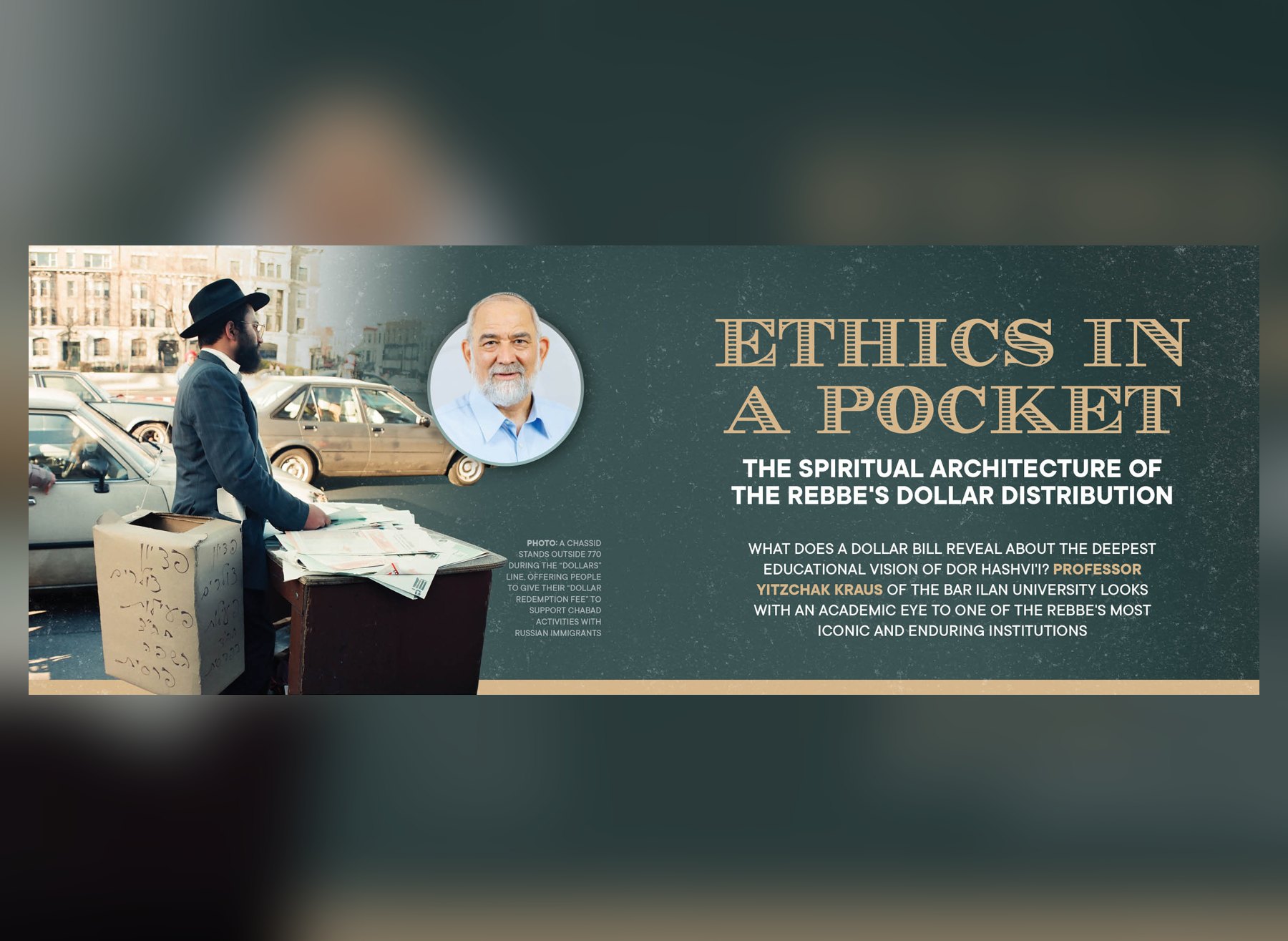
What does a dollar bill reveal about the deepest educational vision of Dor HaShvi’i? Professor Yitzchak Kraus of the Bar Ilan University looks with an academic eye to one of the Rebbe’s most iconic and enduring institutions.
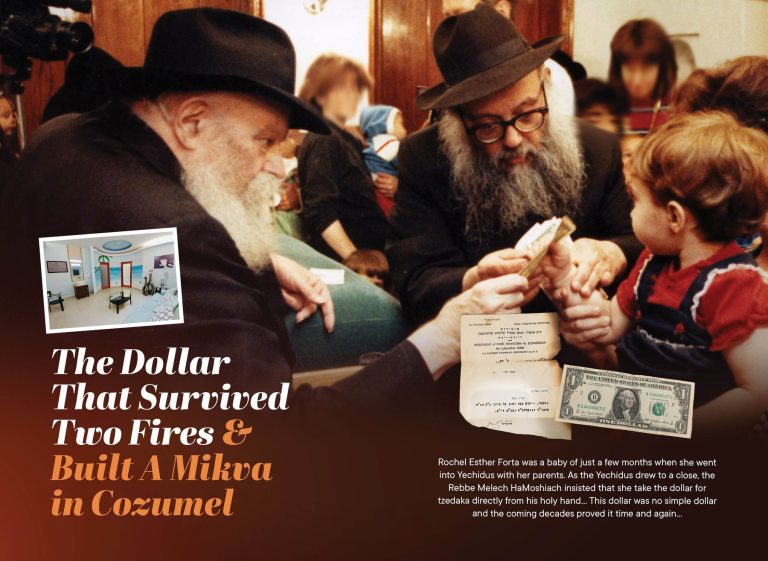
The phenomenon of the Lubavitcher Rebbe’s dollar distribution is among the most iconic symbols associated with the leadership of “the seventh generation,” and at the same time one of the most meaningful and multifaceted phenomena in its spiritual, educational, and communal dimensions. At first glance, the scene is simple: a long line stretching along Eastern Parkway, thousands of people filing past the Rebbe in 770, each receiving a dollar bill, a short blessing and a glance and sometimes a brief word or piece of advice. Yet it is precisely this outward simplicity that conceals a profound process – how a thoroughly mundane object becomes a medium of holiness, how a mass ritual generates a personal experience, and how a brief moment of encounter becomes a lasting moral directive.
A Ritual Designed to Produce Action
A deeper examination of the phenomenon reveals that it should be framed as a disciplined educational ritual, not merely an “emotional event.” Every “Sunday Dollars” brought together three components: a precisely observed ceremonial order, an American dollar bill, and a practical instruction. Above all, the emphasis was repeated again and again: the dollar is for tzedaka. Here lies the heart of the matter – the ritual was not designed to make an impression but to produce action. The encounter with the Rebbe was brief, yet it was meant to carry vitality beyond 770, into the texture of everyday life. The dollar is the trigger; the act of giving is the purpose.
In this way, a mechanism of mass education was created – one that translates a spiritual message into cumulative action: one more good deed, one more act of charity, one more responsibility toward another. In Chassidic terms, the ritual is calibrated so that the encounter with the Rebbe does not remain a private experience, but gives birth to a blessing for a “third party” – creating an ever-widening circle of influence.
Dirah B’Tachtonim: Holiness in the Material World
At the foundation of the custom lies Chabad’s seminal teaching of dirah b’tachtonim – “a dwelling place in the lower realms” – one of the cornerstones of the “seventh generation’s” worldview: holiness is not meant to remain in separate, elevated spaces, but to penetrate the material world itself and transform it into a sanctuary.
The dollar distribution makes this principle tangible: the blessing is not confined to words or feelings alone, but is clothed in a concrete vessel. The American dollar bill – a conspicuous symbol of economy and materialism – becomes an instrument of mitzva. This is not an attempt to change the nature of matter, but to embed a mitzva within it. This is a characteristically Chabad innovation: not to flee from the mundane but to sanctify it through a precise act. The dollar enters a pocket, travels with the person, and reminds him that spirituality is meant to be apparent within the everyday.
A Memory Object of Remarkable Power
On the other hand, the dollar also becomes a “memory object” of remarkable power. Scholarly literature on visual and material culture in Chabad has noted that objects associated with the Rebbe – photographs, books, coins, and dollar bills among them – function as portable channels of connection: they “freeze” a moment of encounter and allow one to return to it and dwell within it.
Here too an important nuance must be noted: the dollar is not a sacred object in the halachic sense, nor is it intended to become an amulet. Its power lies not in any “magical charge” residing in the paper, but in the fact that it carries an instruction and ignites action – and in the fact that it anchors memory and hiskashrus (spiritual attachment). Yet one cannot ignore how Chassidim and visitors alike have chosen to preserve the object: lamination, pairing it with a photograph from the distribution, keeping it in a wallet or in a place of honor. In this way the bill ceases to represent monetary value and becomes a tangible anchor that affirms: “I was at 770,” “I passed before the Rebbe” – and above all, “I received a mission.”[It should be noted that the Rebbe himself, countless times, acknowledged this custom when he said that the dollars he gives – or their exchange – should be given to tzedaka – Ed.]
After Gimmel Tammuz: The Dollar in the 21st Century
The force of this meaning becomes especially acute after Gimmel Tammuz. In the absence of the Rebbe’s physical presence, the dollar has become part of a broader fabric of “presence-sustaining” means: photographs, visits to 770, use of the Igros Kodesh to communicate with the Rebbe, videos, and digital media. The physical bill integrates itself into the Chassidic toolkit of the twenty-first century.
Here an interesting dynamic comes into view: charisma concentrated in a single leader, alongside a material and technological dispersal that allows the community to continue living “with the Rebbe” wherever they may be. The dollar is a micro-model of this: a unit of memory-and-mission that ignites many small acts, and together builds a living and enduring communal fabric.
The Culture of Miracles
Into all of this enters the culture of storytelling – and Chassidic narrative is a cornerstone of the Chassidic world. The dollar is “charged” again and again through miracle stories: recoveries from illness, protection, success in livelihood, salvation in extreme situations. People speak of placing a dollar beneath the pillow of someone undergoing surgery, or carrying it in a wallet during a period of tension. From a communal standpoint, the story is not merely a description of an event but a mechanism that extends the experience beyond those who personally received a dollar. Even one who never stood in line can feel the Rebbe’s power through a “borrowed dollar,” through testimony, through a family conversation.
Keeping and Giving: The Creative Tension
And yet, the Chabad standard of judgment remains moral and practical: not to turn the dollar into object-worship. The internal line that is emphasized again and again is that the dollar was meant “for tzedaka,” and that its power is measured by what it brings about.
Here appears the fascinating tension between keeping and giving – and within it a creative solution that developed organically: a mechanism of substitution. Many keep the dollar they received from the Rebbe as a symbol of memory and attachment, and give a different dollar to tzedaka in its place. In this way, the experience of connection is preserved – yet the mitzva of tzedaka is fulfilled in its entirety. In this sense the dollar becomes “an ethics in one’s pocket”: a portable reminder that a human encounter must produce good for another, and that a true blessing is one that passes forward.
A Fraction of a Second, a Lifetime of Mission
To grasp the full weight of this, one need only listen to a personal testimony from someone who has carried such a dollar for years. People say they did not fear losing money or cards – what they feared more was losing “the Rebbe’s dollar,” because it was for them not an amulet but a living memory and an inner compass. In moments of routine and in moments of crisis alike, the dollar became a symbol of responsibility and of mission.
Thus it becomes clear that this small act of distribution is not merely a memory from the past, but an engine of the present: it connects the material to an ongoing moral act. In the end, the dollar distribution teaches us how a Chassidic movement can transform a brief moment into a complete educational system — a fraction of a second of contact that continues to ripple outward into the world, reminding us again and again that the encounter was meant to bring blessing to a third.
Beis Moshiach #1499 • pp. 10-12
© 2026 Beis Moshiach Magazine. All rights reserved.
This article originally appeared in Beis Moshiach #1499. You are welcome to share it with friends and family by email or in print, provided that you do not change, add to or omit any part of it, you credit the author and Beis Moshiach, and you include a link to archive.bmoshiach.org (written out in full in printed copies).
To republish this article in a newspaper, magazine, book or website, please request permission in advance at [email protected].