Minted for the Moment
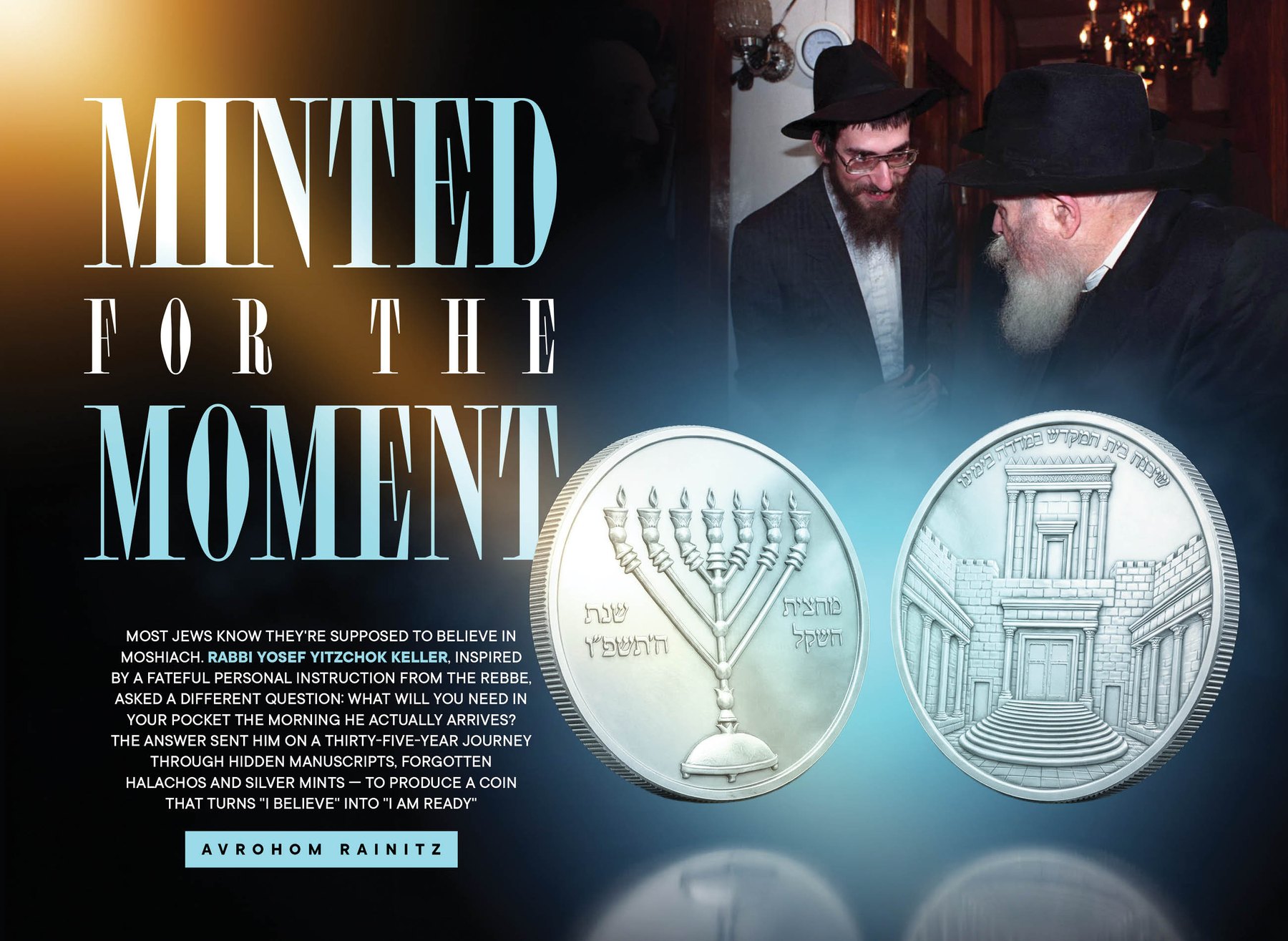
Most Jews know they’re supposed to believe in Moshiach. Rabbi Yosef Yitzchok Keller, inspired by a fateful personal instruction from the Rebbe, asked a different question: what will you need in your pocket the morning he actually arrives? The answer sent him on a thirty-five-year journey through hidden manuscripts, forgotten halachos and silver mints – to produce a coin that turns “I believe” into “I am ready.”
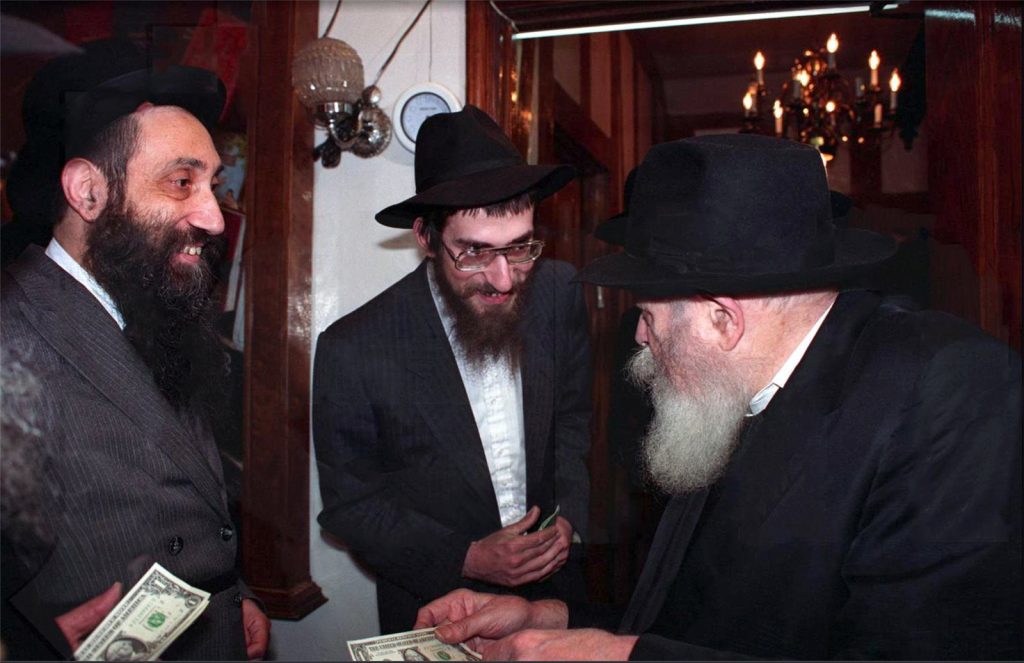
Through the lens of the camera that documented the dollar distribution at the Rebbe on that Sunday in the summer of 5751, it looked like just another seemingly routine moment in the dollar distribution. The long line moved at its familiar rapid pace, faces changed quickly, and the Rebbe distributed the bills with his holy hand l’vracha v’hatzlacha. But for the young tamim standing there, R’ Yosef Yitzchok Keller, time stood still.
The tamim presented the Rebbe with his newly published book: “Hilchos Beis HaBechira l’ Rambam al pi Kisvei Yad.” The Rebbe accepted the book, gave a dollar with the blessing “hatzlacha raba,” and then extended an additional bill. “And this is for the sefer,” said the Rebbe, “one must pay” (“un dos iz far’n sefer, darf men tzullen”).
But then, just as Keller thought the exchange had ended and began to step away, he suddenly heard the Rebbe continuing to speak to him. He turned back, and heard the following words – not a wish, but a life directive: “In gichen vet men darfen trachten dinim fun kiddush ha’chodesh al pi ha’reiyah” (“Very soon we will need to consider the laws of sanctifying the new month by visual observation”), said the Rebbe, his holy eyes gazing toward the Geula reality about to unfold at any moment.
The Rebbe continued to explain that currently this is impossible in the absence of a semicha-ordained Beis Din, but then turned to the author’s father, R’ Yehuda Keller a’h, and pointed to his son:
“Zol er zen zich tzugreiten, zol er kenen paskenen gleich di sheilos” – “He should see to prepare himself, so that he can rule immediately on these questions.”
The message was sharp: the Geula is not an abstract idea or a distant future. It is here and now. The Rebbe was not merely asking him to study Torah for the sake of knowledge, but to prepare the practical “keilim” for halachic ruling that would be required immediately – the moment Moshiach is revealed.
* * *
A Familiar Figure at “Our Home”
Rabbi Yosef Yitzchok Keller was well known to the residents of “Beis Chayeinu” in those years. A scion of a distinguished Chassidic family – grandson of Reb Meir Lieber Keller, who served as the first secretary of the Rebbe at the Merkos L’Inyonei Chinuch and Machne Israel, and of Reb Yisrael Yehuda Levin, among the first residents of Kfar Chabad; and son of Reb Yehuda Keller, a gifted orator and author – he was known at 770 as a “phenomenon” of diligence, lamdanus, and research. Even as a bachur in the Yeshivos Toras Emes, Tomchei Tmimim–Lod, Oholei Torah, and 770, he was the address for deciphering old manuscripts and clarifying complex topics.
Rabbi Keller, who today resides in Coral Springs, Florida, made his name in the Torah world as a researcher, bibliographer, and editor of considerable stature. Over the years he published many works – clearly out of the ordinary – ranging from books on Jewish astronomy such as Techunas HaShamayim, to deciphering manuscripts of the Geonim and Rishonim, to his Geula-themed book series: Moshiach SheBechol Dor, Pirkei Moshiach V’Geula, and Moshiach V’Geula – Halacha L’Maaseh.
Thirty-five years have passed since then. The words “zol er zen zich tzugreiten” (“he should see to prepare himself”) never stopped echoing in R’ Keller’s mind. He always felt that the Rebbe expected more from him – not just the writing of sefarim, but something that would constitute a tangible and concrete preparation for the Geula.
He just launched a new initiative, one that takes on a tangible, weighty, and brilliant form: a coin of pure silver.
Not another “zecher l’machatzis ha’shekel” (“remembrance of the half-shekel”), and not more symbolic charity coins. R’ Keller – who was instructed to prepare so that he could pasken immediately when the Geula arrives – moved on to the next step: an authentic machatzis ha’shekel coin, strikingly precise, intended for one purpose alone – to be in every Jew’s pocket, ready for the moment when the renewal of the avoda of korbanos is announced.
“This is not a matter of nostalgia,” he says in a special interview with Beis Moshiach. “This is the most practical readiness there is. The Rebbe demands that we live the Geula, and that means holding in our possession the exact coin required immediately upon the coming of Moshiach.”
The Halachic Background
On Shabbos Parshas Vayigash 5747 – the first Shabbos after the “Didon Notzach” of Hei Teves 5747 – the Rebbe declared that in our times we find ourselves in a special time (and place), in which only one inyan remains – and one must say it in the language of one’s teacher, in the words of the Previous Rebbe: “Stand ready, all of you, for the building of the future Beis HaMikdash with the coming of Dovid Malka Meshicha.”
But what is the definition of “stand ready for the building of the Beis HaMikdash”? The Rambam rules (at the beginning of Hilchos Beis HaBechira) that the mitzva to build the Mikdash is “to make a House for G-d, prepared for offering korbanos upon it.” The emphasis is on the practical ability to offer sacrifices.
Here lies a critical point that many miss: while for korbanos yachid (given by an individual) we may need to wait for purification through the ashes of the Parah Aduma, concerning korbanos tzibbur (communal offerings) – the halacha is that tumah hutrah b’tzibbur (tumah is permitted for the community). This means that the moment Moshiach arrives – even before the third Mikdash is completed – the daily Tamid offering is already brought!
But how do the temidim and musafim offerings become communal offerings? The answer: through every individual fulfilling the mitzva to “give the half-shekel each and every year” – through this, the offerings purchased from the terumas ha’lishka (the Temple treasury) become communal offerings.
But if machatzis ha’shekel coins are not available to every Jew obligated to give – we will miss the opportunity to fulfill the mitzva as it should be, so that the purchase of the communal offerings is made from the treasury collection, just as was done throughout all the years the Mishkan and Mikdash stood.
The coin being in the hands of every Jew is the preparation that will enable the renewal of the avoda in the Beis HaMikdash immediately.
When a Footnote Becomes a Life’s Project
The story began one fine day about a year and a half ago.
R’ Keller was learning the famous sicha of the Rebbe dealing with Moshe Rabbeinu’s difficulty understanding the mitzva of the machatzis ha’shekel, until the Holy One Blessed Be He showed him a “coin of fire” (Likkutei Sichos, Vol. 16, first sicha for Parshas Ki Sisa).
“I studied the sicha,” R’ Keller recounts, “where the Rebbe states clearly that when the Beis HaMikdash exists and one must bring the machatzis ha’shekel – there are two dinim: (a) one must give the entire half-shekel at once (and it is impossible to combine several coins to reach the monetary value of a half-shekel); and (b) one must give a coin of ‘machatzis ha’shekel kesef’ – a silver half-shekel – as the Rambam phrases it at the beginning of Hilchos Shekalim (and certainly one cannot give an equivalent monetary value that is not itself silver coinage).
“And in footnote 35, the Rebbe quotes the Rambam’s language in his Peirush HaMishnayos: ‘The machatzis ha’shekel must be pure silver made into a coin.’”
This discovery shook R’ Keller. If the mitzva requires a specific coin, then the moment Moshiach arrives and we rush to the Beis HaMikdash, we will not be able to pull a few dollars or shekels from our wallets – paper notes or coins that are not pure silver, or coins whose weight is more or less than a half-shekel. We will need to have in hand the exact coin of a half-shekel of pure silver.
“I said to myself: there is here a requirement for a machatzis ha’shekel coin – a single unit of precise weight – so that every Jew who wants to fulfill the mitzva of ‘giving the half-shekel each year’ can do so immediately when construction begins on the mizbeiach with the coming and hisgalus of Moshiach, by handing it to the treasurer who collects these coins for the terumas ha’lishka for the communal offerings. Where can such a coin be obtained?”
When he discussed this with Rabbi Yisroel Eidelman, rabbi of Young Israel of Deerfield Beach in South Florida, he learned that between 5757 and 5771, a Yid by the name Mr. flamer had minted coins of machatzis ha’shekel weight intended for fulfilling the commandment – but when his health declined he stopped minting them, and in the meantime that individual passed away and the coins went off the market.
“In the last fifteen years,” R’ Keller explains, “there are those who produce coins meant to serve as a zecher l’machatzis ha’shekel, and there are those who produce coins intended as donations to important institutions. But the mass production of a halachically precise coin ready for use at the critical moment? That doesn’t exist. I recalled the directive the Rebbe gave me to prepare for the halachic matters that would be required immediately upon Moshiach’s coming, and I thought this topic is precisely the kind of thing the Rebbe had in mind.”
The Mystery: How Much Does the Torah’s Shekel Actually Weigh?
But as R’ Keller delved into the subject, he discovered a fascinating historical-halachic thicket. To produce a coin that will be valid for use in the Beis HaMikdash, one cannot work with approximations. Millimetric precision is required.
“Rashi writes in his peirush on Torah the precise weight of the shekel; but if you ask bnei Torah who study Chumash and Rashi every day – even many roshei yeshiva and rabbanim – they have no idea what Rashi is talking about,” explains R’ Keller. “Rashi, who lived in medieval France, writes in his peirush on Parshas Mishpatim (21:32): ‘The shekel weighs four zehuvim, which are half an uncia of Cologne’ (a city in Germany whose weight standard was the norm for measuring). The Rambam, by contrast, defines the weight in terms of barleycorns.
“Now try to bridge between them today, when Europe, Israel, and international markets use grams and kilograms. Even French speakers (or speakers of other Latin languages: Spanish, Italian, Portuguese) have no idea what an uncia is, because it is not a unit of measurement they use. And who uses barleycorns as a unit of weight?”
Rabbi Keller dove deeply into the topic, clarifying the question of Torah measurements and weights according to the Rishonim and Acharonim as extensively discussed in Shiurei Torah by Rabbi Avrohom Chaim Naeh, the approbation of the Pnei Menachem to the sefer Midos U’Shiurei Torah, the sefer Mesores HaShekel, and more.
The bottom line of R’ Keller’s research was that according to the Rambam, “the half-shekel from the days of Moshe Rabbeinu” is one-quarter of a troy ounce – troy being the standard weight by which silver and gold are sold throughout the world for the past five hundred years. A quarter troy ounce – the weight of the machatzis ha’shekel – weighs approximately 7.775 grams.
What to Do When There Are Two Opinions
“In Meseches Shekalim, Perek 2, Mishna 4, Rabbi Yehuda states: when Yisrael ascended from the Exile, they weighed out drachmas; then they returned to weighing selaim; then they returned to weighing tevain (at the weight of the Roman shekel, which is half the sela, meaning: half the weight of the holy standard) – meaning that throughout the years of the second Beis HaMikdash, there were years in which the half-shekel coin given weighed more, and years when it weighed less. As the Rebbe emphasizes in Likkutei Sichos there in footnote 26: ‘Regarding the size and form of the coin – one can see in practice from the coins of the Bayis that they were not precise about this’ – that it should not exceed a half-shekel.”
“Therefore, the rabbanim ruled to make the machatzis ha’shekel coin at a quarter troy ounce, because according to the Rambam – that is precisely the weight of ‘the half-shekel from the days of Moshe Rabbeinu,’ below which one may never go.
“Admittedly this weighs slightly more than the weight cited by Rashi, but it is well known that according to Rabbi Meir, one should add a kalbon – a small addition beyond the half-shekel – for each half-shekel given (and according to Rav, even the Chachamim agree with this).
“In any case, even according to Rashi there is no halachic problem with the machatzis ha’shekel weighing a bit more, as long as everyone’s contribution is equal – that every Jew gives the same coin.”
Thus the precise weight of the coin was established: 7.775 grams of pure silver – one quarter troy ounce. A weight that honors both opinions, meets halachic requirements from every angle, and enables every Jew to hold in hand a coin with which to fulfill the mitzva the moment it become applicable.
R’ Keller recounts: “After it occurred to me to mint the machatzis ha’shekel coin, and I plunged into the depths of the topic of the weight of the dinar, shekel, and sela, and the views of the Rishonim were clarified (Rashi and Rabbeinu Tam, the Rif and the Rambam) – I presented the analysis and conclusions before rabbanim and morei horaah who deliberated with me on this topic; and they agreed to mint a machatzis ha’shekel coin of pure silver weighing one quarter troy ounce.”
Not a “Remembrance” — the Real Thing
“Wait,” I ask Rabbi Keller, “every year on Taanis Esther, every Jew goes over to the plate in shul and gives the machatzis ha’shekel. Some give three half-dollar or half-shekel coins, some give according to the silver equivalent. So what is the great chiddush of your coin?”
R’ Keller smiles. This is the question he hears most frequently, and the answer reveals the depth of the paradigm shift he is leading.
“We need to set things straight,” he says, laying things on the table clearly. “The custom of giving three half-coins that we observe today in shuls is a holy and important minhag mentioned in the Rishonim and codified in the Rema’s glosses. But the definition of this custom is: to give before Purim half of the fixed coin in that place and time, as a zecher l’machatzis hashekel — a remembrance of the half-shekel — and three should be given, and it should be given on the night of Purim before Mincha. (According to the Maharil, this money is designated for the poor.) That is to say, the reason for this custom is merely to remind us that in the time of the Beis HaMikdash, the half-shekel was given.”
He adds, quoting from the sefer Minhagei Maharil, that in addition to the three half-coins, it is proper for every man aged twenty and above to give the equivalent value of the original machatzis ha’shekel (in silver coins) to tzedaka. In Ashkenaz, only individuals adopted this practice, while the great Sefardic authorities in recent generations wrote to follow this practice. But even this, which is already closer to the original mitzva, is still merely a zecher l’Mikdash – and therefore there is no requirement to give it as a single silver coin, as the original mitzva requires.
“Consider the following scenario,” he continues with his characteristic passion. “Moshiach arrives now, and we proceed to build the Mikdash. The treasurers set up tables where everyone can fulfill the mitzva of giving the machatzis ha’shekel and become a partner in the korbanos tzibbur.
“Anyone who has not acquired the machatzis ha’shekel coin in advance will miss the first opportunity to fulfill the mitzva of ‘giving the half-shekel each year’ – and thereby become a partner in all korbanos tzibbur. This mitzva cannot be fulfilled by giving a dollar and a half, as we currently do as a remembrance on Purim.
“There is another halachic point: the Gemara states that from the pasuk, ‘and you shall bind the money in your hand’ – said regarding one who wishes to redeem maaser sheini produce onto coins – we learn that the produce must be redeemed onto a coin that bears an image, and not an asimon (an unformed piece of silver without any stamp). In other words, it is insufficient to bring to the Mikdash a melted lump of silver; one needs a coin that is stamped and ready for use. The coin I created is not an asimon nor a medallion – it is a silver coin with an ‘image,’ exactly as halacha requires.”
This is where the new coin enters the picture. Unlike “zecher” coins sometimes sold by various organizations (such as the Machon HaMikdash and others) whose value is symbolic and serve as institutional donations – “the goal is not for you to donate this to me now,” Rabbi Keller emphasizes. “The goal is for you to purchase this for yourself – put it in your pocket, your cabinet, or your safe. And it stays with you. Why? So that when Moshiach is revealed, and we proceed to build the Mikdash and the mizbeiach, and the treasurers set up tables, you will have a coin ready in your pocket with which to fulfill the mitzva of giving the machatzis ha’shekel. That is the difference between performing a zecher of a mitzva and being truly ready to fulfill it.”
This is a dramatic shift in perception. From now on, we hold the machatzis ha’shekel in our pocket or safe – ready and prepared for the building of the Beis HaMikdash.
“Whoever acquires this coin declares thereby to the Holy One Blessed Be He: ‘Ribono shel olam, I am not merely remembering the Mikdash – I have prepared for its building.’”
The Detective from the Manhattan Library: Where Did the Rambam’s Drawings Disappear?
As mentioned at the opening of this article, the idea of minting the coin was not born in a vacuum. It began with that dramatic moment in the summer of 5751, when R’ Keller’s newly published sefer was brought to the Rebbe.
To understand how a bachur comes to engage with such weighty seriousness in topics of the Mikdash, one must go back to the mid-80s.
The tamim, Yosef Yitzchok Keller was then a bachur learning in the beis medrash, involved in writing hearos and biurim, and pilpulim; he also assisted in his free time with editing halachic works whose authors needed a talmid chacham to check rare sifrei halacha and poskim found primarily in libraries. From time to time he would travel to the library of the Jewish Theological Seminary (JTS) in Manhattan to examine ancient books and manuscripts – long before many rare books became freely accessible to all through HebrewBooks and similar programs.
His father, R’ Yehuda Keller a’h – remembered by all frequenters of 770 – was laboring in those days on his monumental work on the structure of the Mikdash according to the Rambam’s approach. From time to time he would ask his son to check in certain places in the Rambam (in the sefer Avoda and sefer Korbanos) whether any variant readings existed in manuscripts.
In that library, among shelves laden with rare manuscripts found nowhere else, the young Keller discovered a secret concealed for hundreds of years.
In a sicha of the Rebbe edited for Parshas Teruma 5743, the Rebbe elaborates that the six branches of the Menorah emerge from the central stem diagonally – not in a semicircle – and bases this in part on the Rambam’s own drawing in his handwriting in the Peirush HaMishnayos on Meseches Menachos, where the six branches of the Menorah are drawn emerging diagonally from the central stem.
Prior to Shabbos Parshas Teruma 5744, R’ Yehoshua Mondshine published an article in the Kfar Chabad weekly, revealing that the drawing in question is found not only in the Peirush HaMishnayos but also in manuscripts of the Rambam’s Mishneh Torah (and afterward the Rebbe added an addendum to the aforementioned sicha in Likkutei Sichos, noting Mondshine’s article).
“On one of my visits to the library, I asked to examine ancient manuscripts of the Rambam’s Mishneh Torah,” he recounts, the excitement still evident in his voice. “And suddenly, I discovered that the Rambam had drawn not only the Menorah in his Hilchos Beis HaBechira (in manuscripts one even finds at the end of Perek 3, Halacha 10, the words: ‘and this is its form’), but also the form of the mizbeiach and the form of the heichal – and he even referenced these drawings within the Mishneh Torah itself. But when you open the printed edition of the Rambam that we have at home, these drawings are absent…”
Where did they disappear, and why?
Here R’ Keller investigated and uncovered a fascinating and sad historical story: “At the dawn of the printing press, when sefarim began to be printed and the Mishneh Torah was first printed (in Rome around the year 5233), it was very difficult to print illustrations. The first printer of the Rambam’s Mishneh Torah wanted to save money. Preparing plates for illustrations was an expensive and complicated affair, so he simply skipped them – and not only did he skip the drawings, he even omitted the words indicating that a drawing followed (such as in Perek 2, end of Halacha 9, regarding the mizbeiach: ‘and this is its form according to its measurements,’ and at the end of Halacha 12: ‘and this is its form’).
“The Peirush HaMishnayos of the Rambam was first printed with the Mishnayos in Naples in the year 5252. It is worth examining whether they printed the Rambam’s drawings in the Peirush HaMishnayos there, but in any case they did not omit the words describing the drawing, and in places where they did not copy the drawing, they at least left a blank space. But when the Mishneh Torah was first printed, they did not even leave the words describing the drawing.
“From then on, for hundreds of years, nearly every subsequent printed edition of the Mishneh Torah copied most or all of its text from a previous printing. And the Jews of Europe and Eretz Yisrael studied the Mishneh Torah without even knowing that the Rambam had drawn these drawings within it – let alone actually seeing the drawings the Rambam drew and referenced within the Mishneh Torah.”
This discovery burned within him. He understood that it was impossible to continue studying the Rambam’s Mishneh Torah without the drawings the Rambam had created for its learners.
“In 5751, when my father was working on his sefer Minchas Yehuda V’Yerushalayim – dealing with elucidations and chiddushim in the Rambam’s Hilchos Avoda v’Korbanos – and asked me to help him in proofreading the book, I proposed to him that we print ‘Hilchos Beis HaBechira of the Rambam According to Manuscripts,’ with a brief commentary and an extended commentary, deciphering the cross-references in the Rambam, and references to his statements elsewhere. He called it ‘Eitz Yosef’ – as an appendix to the section he had written, which he titled ‘Eitz Yehuda.’ And the drawings – identical to those found in the Peirush HaMishnayos – we printed based on the drawings in Rabbi Yosef Kapach’s edition of the Peirush HaMishnayos, which used a photographic reproduction of the Rambam’s own manuscript.
“When he brought the book to the Rebbe, the Rebbe noted that facsimiles from the manuscript copyists of the Mishneh Torah had not been printed – especially the Rambam’s signature, with which he signed in three different ways.
“Following the Rebbe’s directive, they reprinted ‘Hilchos Beis HaBechira of the Rambam According to Manuscripts,’ with photographic reproduction of the drawings from the Rambam’s own manuscript. This book was a genuine revolution. Suddenly learners saw the Mikdash through the Rambam’s own eyes.”
It was this sefer – the fruit of countless days and nights deciphering manuscripts and deliberating over the Rambam’s words – that Yosef Yitzchok Keller presented to the Rebbe at the dollar distribution on Sunday, Parshas Eikev, the 17th of Menachem Av, 5751. And then the Rebbe directed him to “prepare to rule on halachic matters” concerning the mitzvos that will be renewed in the time to come.
The Menorah Drawing and the Rambam’s Manuscripts
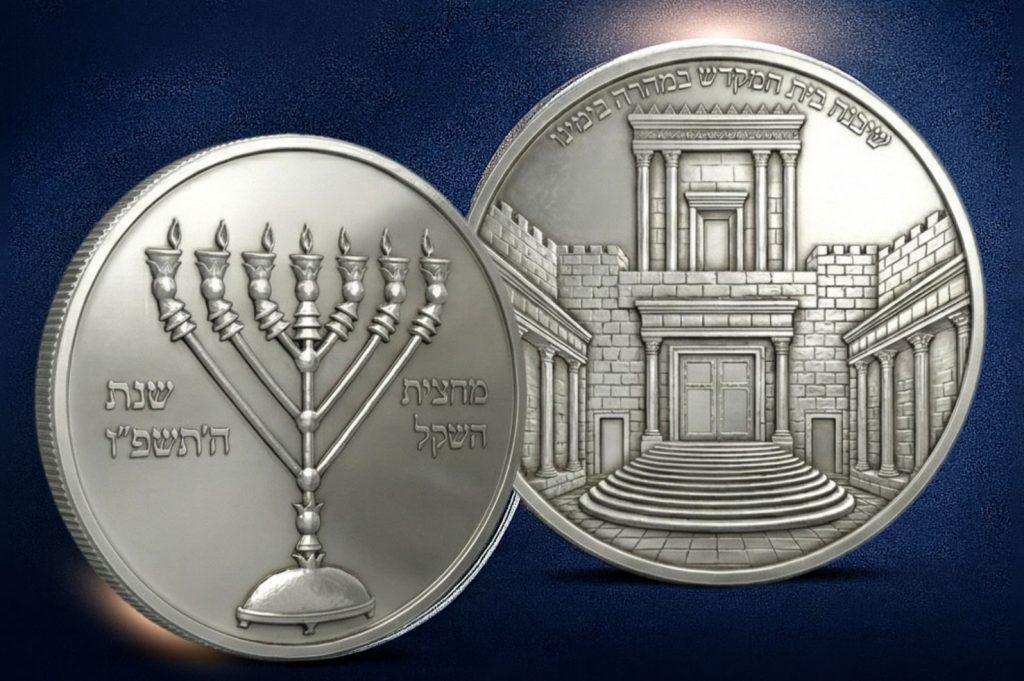
When you hold the coin in your hand, the eye is drawn immediately to the front. At the center of the coin stands the famous menorah. One cannot mistake it: the branches are straight, diagonal, cutting through the air in clean, sharp lines.
“The drawing of the menorah on the machatzis ha’shekel coin – with the branches extending diagonally,” says R’ Keller, “renders the words of Rashi in his Torah commentary and the Rambam’s drawing – both in the Peirush HaMishnayos and in manuscripts of the Mishneh Torah – into something tangible.”
And what is on the other side of the coin?
Rather than a futuristic or abstract image of the third Beis HaMikdash, R’ Keller chose to stamp the façade of the second Mikdash.
“Why?” I ask. “We are waiting for the third Mikdash…”
Here he produces a fascinating explanation blending history with a Geula vision: “First, there is the matter of continuity. Several of the original Jewish coins – those minted during the Great Revolt against the Romans – bore the façade of the heichal in Bayis Sheini. When we mint today a coin bearing the façade of the second Mikdash, we are closing a circle of two thousand years.
“The Jews who raised the banner of revolt against Roman rule at the end of Bayis Sheini – during the reign of Bar Kochba, with the active support and participation of Rabi Akiva – stamped on the coin the form of the eastern gate of the Ezras Yisrael, the Nicanor Gate. All the gates were changed to gold except for the Nicanor Gate, because a miracle had occurred with it. This is a declaration proclaiming before all the world’s inhabitants: we are not subject to the laws of nature and the nations; the existence of the Jewish people is miraculous.”
But there is a deeper layer here. “Rav Aizik Shwei raises an enormous question: if the third Mikdash will be built according to Yechezkel’s prophecy – whether built by human hands or descending from Heaven – why does the Rambam bother to write out for us all the measurements and forms of Bayis Sheini in such precise detail? His conclusion is that if the third Mikdash is built by human beings, it is possible that initially it will be built in the form of Bayis Sheini – and only afterward will the third Mikdash be renovated according to Yechezkel’s prophecy.
“Therefore the coin bears the image of Bayis Sheini – as a symbol of our practical readiness to build the Beis HaMikdash here and now. Around the image appears the prayer-demand: ‘Sheyibaneh Beis HaMikdash b’meheira b’yameinu.’”
Between “Believing” and “Waiting”
To sit with Rabbi Keller and converse with him about the Mikdash, about the anticipation, and about what will be – is an extraordinary pleasure. It is a conversation with an expert, a vast scholar, who lives and breathes this subject. Through him, one can almost “touch” the Mikdash…
“Jewish communities are accustomed to recite each day: ‘I believe with complete faith in the coming of Moshiach,’” R’ Keller wishes to emphasize. “But the Rambam, in Hilchos Melachim, sets a higher bar. He writes: ‘Whoever does not believe in him, or whoever does not await his coming, denies not only the rest of the prophets…’ Note: the Rambam emphasizes that believing is important – but not sufficient. One must also await.”
What is the difference?
“Awaiting is an active state of mind,” explains R’ Keller. “Rabbi Chananya Yosef Eizenbach once showed me the words of the Minchas Chinuch on the mitzva of tefillin. The Chinuch asks: Since tefillin is about the ‘subjugation of the heart and mind,’ why must one bind boxes made of animal hide on the arm and head? Why is it not sufficient to meditate and contemplate the subjugation of heart and mind? And the Chinuch answers with the famous statement: ‘Acharei ha’peulos nimshachos ha’levavos” (hearts are drawn after actions).’ The physical action is what gives expression to the emotional feeling.
“This is precisely where our coin enters the picture. When you purchase a machatzis ha’shekel coin and place it in your pocket or safe in order to be ready to fulfill the mitzva of giving the half-shekel immediately when Moshiach comes – you have transformed your ‘I believe’ into ‘I will await him.’ You have performed a physical action that broadcasts: ‘I am ready!’”
So how does one become an active “awaiter?”
“Very simply,” he explains. “Go to the website chatzishekel.com and order the coin. Currently, shipments are to the US and Canada, but we are working hard to enable every Jew in the world to hold this key to the Geula.”
And what does one do with it in the meantime?
“Guard it carefully – and immediately after Moshiach’s coming, when the treasurers prepare to acquire the first korbanos to be offered on the mizbeiach, and set up tables where one can deposit machatzis ha’shekel coins – each of us will pull out this coin and give it with simcha.”
As I leave the room, the words “zol er zen zich tzugreten” – “he should see to prepare himself” – still echo in my ears…
Beis Moshiach #1500 • pp. 30-40
© 2026 Beis Moshiach Magazine. All rights reserved.
This article originally appeared in Beis Moshiach #1500. You are welcome to share it with friends and family by email or in print, provided that you do not change, add to or omit any part of it, you credit the author and Beis Moshiach, and you include a link to archive.bmoshiach.org (written out in full in printed copies).
To republish this article in a newspaper, magazine, book or website, please request permission in advance at [email protected].