5785 Years Old, 1000 Amos Long:
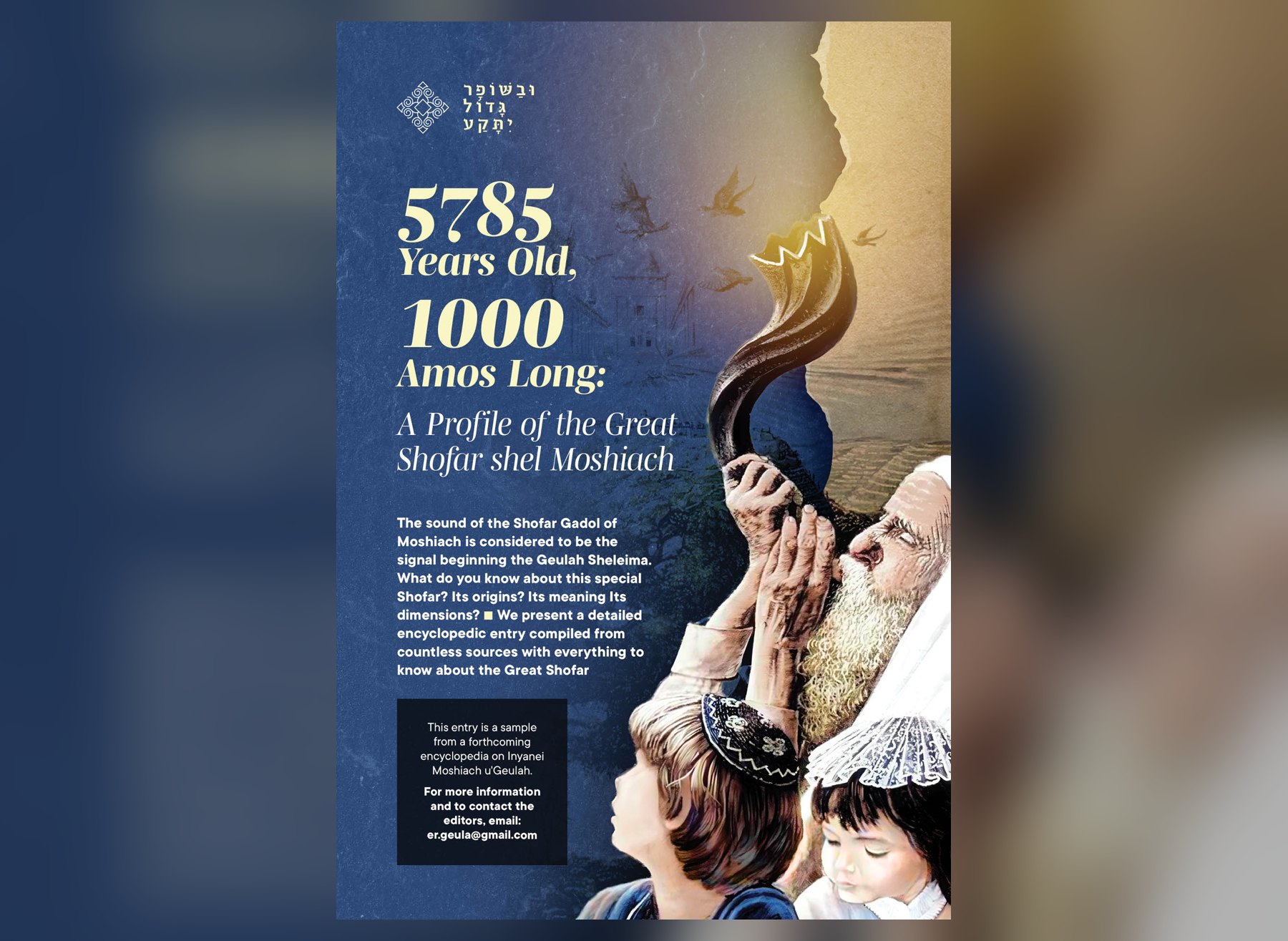
The sound of the Shofar Gadol of Moshiach is considered to be the signal beginning the Geulah Sheleima. What do you know about this special Shofar? Its origins? Its meaning? Its dimensions? We present a detailed encyclopedic entry compiled from countless sources with everything to know about the Great Shofar.
שופר גדול – The Shofar Gadol (The Great Shofar)
The instrument that will be used to gather the dispersed of Yisrael and inform them of the coming of the Geula (ultimate Redemption), HaKadosh Baruch Hu calls to His children through the blowing of a great shofar, awakening them to teshuva, self-nullification, and to prepare for ascent to the House of Hashem.
Contents:
Source, Nature and Purpose
Method of Fulfillment
Who Will Blow?
The Shofar
The Blowing
Timing
Practical Fulfillment
Implications for the Time of Galus (exile).
Topical Addenda:
Permissibility Of Using The Shofar
The Reason Satan Becomes Confused
(A) The Source
The blowing of the shofar is mentioned in several of the prophecies about the Geula, with the most prominent pasuk being: “And it shall come to pass on that day, that a great shofar shall be blown”. It is also mentioned in numerous medrashim and tefillos, most notably in the tenth bracha of the Shemone Esrei – תקע בשופר גדול לחרותנו.
(B) Nature and Purpose
The blowing is a call of closeness from HaKadosh Baruch Hu to His children, the Jewish people, to awaken them to be redeemed, both –
1. Practically – to call those exiled from Eretz Yisrael, including the lost tribes (such as those beyond the Sambatyon River), as the pasuk continues: “And those who were lost in the land of Ashur and those who were banished to the land of Mitzrayim shall come” (according to the peshat commentators).
2. On a deeper level – it is a call to “shake up” and spiritually awaken the Jewish people, even those completely lost from the path of Torah and mitzvos (either because of harsh circumstances, alluded to by “Mitzrayim,” which means constraints and boundaries, or due to sinking into hedonistic joys and pleasures alluded to by “Ashur” which means joy), to return in teshuva and nullify themselves to HaKadosh Baruch Hu, as explicitly stated in the continuation of the pasuk: “and they shall prostrate themselves to Hashem.”
Through the blowing, the yetzer hara will be eradicated from the world.
The blowing comes to publicize the arrival of the Geula.
It also is to announce the freedom of Am Yisrael from their galus (similar to a slave going free who, if not redeemed by a family member and cannot afford the required sum for his redemption, goes free with the blowing of the shofar in the Yovel year. So too, if HaKadosh Baruch Hu and Moshiach do not redeem Am Yisrael and they don’t have enough Torah and mitzvos to redeem themselves (chas v’Shalom), they will be redeemed through the blowing of the shofar).
[Some have written that the shofar blowing will also be for resurrecting the dead, as the Kibbutz Galuysos (ingathering of the exiles) includes the dead as well (Medrash). However, most who mention this speak of the blowing to resurrect the dead as a separate blowing, not as an additional aspect of the blowing of the great shofar.]
Purpose According to P’nimiyus HaTorah:
According to Kabbalah, the Shofar Gadol corresponds to the sefirah of Bina Ila’ah. Specifically, it is the 50th gate of Bina, and more profoundly, it refers to the Kesser of Chochma and Bina, which is Bina of Arich Anpin, or Bina of Atik. This revelation will cause the breaking of the parsa (partition) that separates Bina from the upper middos, allowing Bina to influence them.
In Chassidus, it is explained that the blowing is the drawing down and revelation of the innermost aspect of G-dliness that is beyond any relation to worlds, beyond even the innermost aspect of Kesser, the level of Stima d’kol Stimin – “the concealment of all concealment,” the essential concealment of Ein Sof, and even the revelation of the Atzmus of Ein Sof Baruch Hu.
The revelation is drawn down automatically, not through any arousal from below at all, and becomes possible when one is in a state of “meitzar” (constraint):
(a) The lost and banished are in the meitzar of galus.¹⁵
(b) The meitzar of the service of bittul, self-nullification, where the Jew feels lost and banished despite fulfilling Hashem’s will, because in relation to the exaltedness of Ein Sof, even perfect service is considered a sin, and he has nothing of his own.
This revelation awakens the level of Yechida and even the essence of the soul of the lost and banished, and they will be included in holiness like a candle’s light before a bright torch. They will be automatically drawn to the lofty revelation, and even the non-Jews will be able to come close to G-dliness.
Moreover, through the blowing, the inner dimension of Torah will be revealed (which is why even those lost from the path of Torah will be drawn to return), the Divine sparks that remained banished in galus will be refined, and it will bring peace to the world, even among animals.
The blowing will never cease, as it is written, “A great voice that did not cease”.
(C) Method of Fulfillment
The commentators disagree on how this prophecy will be fulfilled:
Some explain that the blowing of the shofar is only a metaphor and will not occur physically (as it is not possible to say that HaKadosh Baruch Hu will blow a physical shofar). The metaphor for the blowing is that Am Yisrael will gather from all over the world, even from distant places – as if they heard a shofar whose sound is heard throughout the world. According to the explanation that the purpose of the blowing is to publicize the coming of the Geula, the metaphor for the blowing is that HaKadosh Baruch Hu will perform great signs and wonders in the heavens to announce to the whole world its arrival.
Another opinion is that the blowing will be with a physical sound, but will come from a spiritual shofar in the spiritual heights.
On the other hand, in many sources, it speaks of blowing a physical shofar that is specially preserved for the end of days. Similarly, the Rebbe often speaks of the blowing as physical one and with a physical shofar, and in explaining its spiritual aspect, he does not negate the simple meaning and its physical results.
(D) Who Will Blow?
The blower is HaKadosh Baruch Hu Himself, and Chassidus explains that this refers to the Atzmus of Ein Sof Baruch Hu. Since His Essence is above names that indicate different levels in His revelation, the identity of the blower is not stated, only יִתָּקַע – “shall be blown” – implying that it will be done automatically.
Some say that the actual blower will be Zerubavel (a leader of Jewish People in the beginning of the Second Beis HaMikdash period), the Malach (angel) Michoel, the members of the Great Sanhedrin, or Melech HaMoshiach. Another tradition says that it will be Eliyahu HaNavi.
(E) The Shofar
The shofar comes from the right horn of the ram of Yitzchok Avinu (which is larger than the left horn – in which the blasts were sounded at the time of Matan Torah). The length of the ram’s horn is one thousand amos (cubits) measured according to HaKadosh Baruch Hu’s amos and some write that it will be one amah in HaKadosh Baruch Hu’s amos.
[For explanations on the permissibility of using the horn of a ram that was consecrated as an Olah to Hashem, see text box.]
The reason this specific horn will be used for the blowing is that HaKadosh Baruch Hu said to Avraham Avinu: “Just as the ram was caught in the thicket by its horns, so too your children in the later generations are destined to suffer from the nations and to be caught in sins, and they will ultimately be redeemed by the horns of this ram”.
According to the interpretation that the shofar is spiritual – HaKadosh Baruch Hu rolls the first firmament (called ‘vilon’) into a shofar. (As it is written, “And the heavens shall be rolled together as a scroll,” don’t read “as a scroll” – כספר, but כשופר, “as the shofar”).
Reasons it is Called a “Great Shofar”:
(a) Great in its quality, as through it the exiles are gathered.
(b) Named after the blower – HaKadosh Baruch Hu, who is called “great”.
(c) Due to the great reach of its sound.
(d) Named after its great loud sound.
(e) Great in years (as it has existed since its creation during the twilight of the six days of creation).
(f) Because it performs great actions, the freedom of all of Am Yisrael and the return of all the land.
(g) Because it comes from the right horn of the ram, which is larger than the left horn.
(h) Great in its size – one thousand amos in Hakadosh Baruch Hu’s amos as mentioned above.
The fact that the shofar is whole alludes to the completeness and rectification of the world in the future.
(F) The Blowing
We find several opinions regarding the type of blowing and the number of tekios (blasts):
In Chassidus, it is explained that there will be one great tekiah without any shevarim or teruah, as the inner cry of the soul (which it resembles) is a simple sound. Also, a plain tekiah is a sign of joy, as it is written “And on your days of rejoicing… you shall blow”. In another place, it is suggested based on sources that the order of the blasts will be tekiah-teruah-tekiah.
Elsewhere, it is described that there will be three blasts corresponding to the three sounds in the pasuk “A voice of tumult from the city, a voice from the heichal, the voice of Hashem rendering recompense to His enemies”. (And after the Malach Michoel blows three blasts, HaKadosh Baruch Hu will blow an additional blast.)
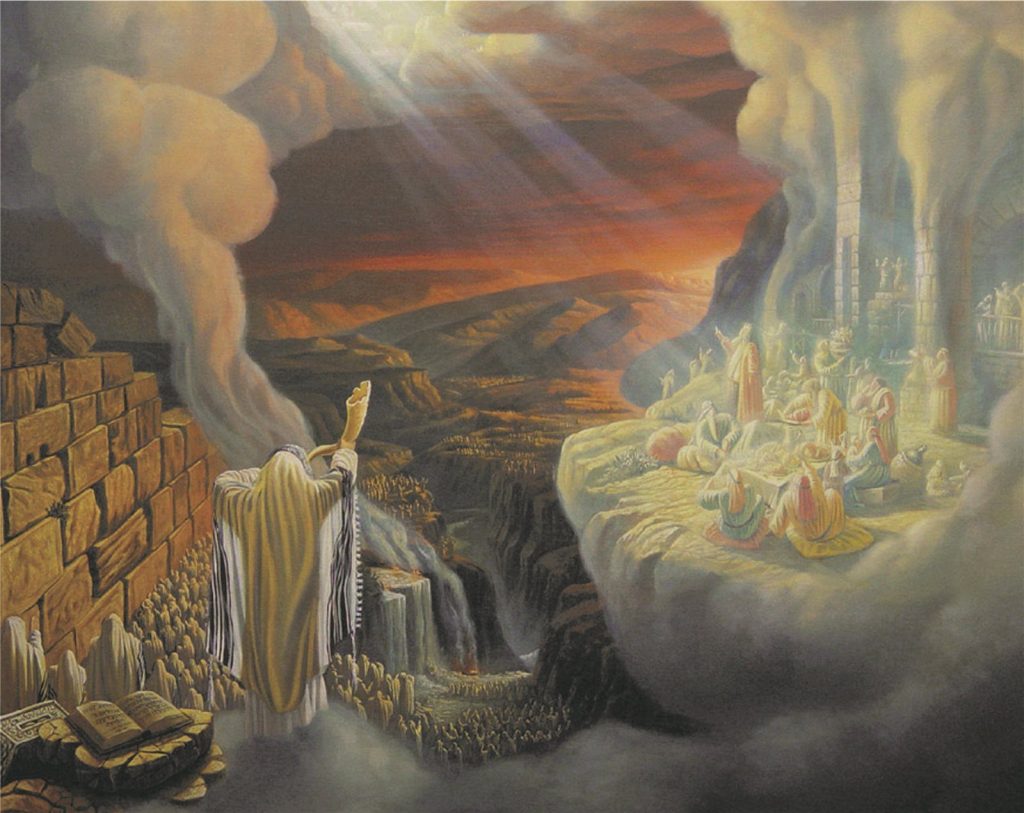
The blast will emerge from the Heichal of Hashem in Yerushalayim, (as it is written “A voice of tumult from the city, a voice from the heichal), yet it will be heard as if coming from every city, and its sound will be heard from one end of the world to the other.
(G) Timing
The essential objective of the blowing – namely, to awaken Am Yisrael to teshuva and to nullify themselves to Hashem – begins already in the stages before the coming of Moshiach, and just before the beginning of the Geula, the actual blowing of the shofar will occur (as it cannot be after the beginning of the Geula, as then there cannot be a reality of “lost” and “banished” Jews). Some say it will be in the year before the year of Moshiach’s coming.
Some have written that it will be after the coming of Moshiach, after the Kibbutz Galuyos of the exiles but before Techiyas HaMeisim (the resurrection of the dead).
The blowing will be before the Day of Judgment.
(H) Practical Fulfillment
The blowing began to be fulfilled in the summer of 5727 (1967) after the Six-Day War, which indeed awakened Jews, even those “lost” and “banished” from the path of Torah and mitzvos (in the “Mitzrayim” of the USSR and in the “Ashur” of America and the West) to return in teshuva and nullify themselves to Hashem, and if they had utilized this awakening to strengthen in Torah and mitzvos as required, Moshiach would have already come.
(As mentioned above, the physical blowing of the shofar will occur in practice at the very end of the galus.)
(I) Implications for the Time of Galus
(a) On Rosh Hashana, we blow the shofar in order to remember the blowing of the future, and to anticipate it (and we say the bracha “to hear the sound of the shofar” also as an anticipation to hear the shofar of the future).
(b) The blasts on Rosh Hashana awaken the blowing of the great shofar, as their concept and objective is the same.
(c) Every Rosh Hashana, they blow above with the great shofar, and in the future, we will hear it, and it will affect this world.
(d) The blasts each year enlarge the shofar of the future until it will be a great shofar as required.
(d) In the Musaf of Rosh Hashana, additional tekios are blown in order to confuse the Satan, who thinks this is the blowing of Moshiach’s shofar, and fears his end has come, and therefore is afraid to prosecute Am Yisrael.
[For explanations on why the Satan becomes confused, see textbox.]
(e) The long tekiah at the end of Yom Kippur is an illumination from and from the aspect of the great shofar, (and the proof is that we don’t say pesukim of Malchuyos, Zichronos, and Shofaros afterwards). We therefore we blow one long blast, like the blowing of the future. Similarly, the blowing in the Yovel year is also akin to the blowing of the future.
(f) The inner cry from the essence of a Jew’s soul is akin to the blowing.And the blowing is a gathering of the cries of all Jewish souls from all generations.
(g) One who sees a shofar in his dream should rise early and anticipate the salvation that will come through Moshiach’s shofar.
(h) The going out to spread Torah and Yiddishkeit from the “four amos” (domain) of holiness needs to be with a great noise of holiness, and through this, we merit the blowing of the great shofar.
Permissibility of Using the Shofar
Regarding the reason it is permissible to use the ram’s horn for the Shofar Gadol – as the ram was consecrated as an Korban Olah by Avrohom Avinu, and if so, its horns are also ‘hekdesh’ for the mizbeiach, and seemingly there should be a prohibition of me’ilah (misuse) in using them for another purpose – several explanations were given:1
(a) The sanctity of the korban applied to Yitzchok and not to the ram, which is considered as if Yitzchok was offered on the mizbeiach.2 (The Rebbe MH”M)
(b) Since the ram is a substitute for Yitzchok, for whom horns are not relevant, therefore they were not obligated for the korban and are not hekdesh3 (Imrei Shefer).
(c) In the offering of the ram, the fire did not consume its horns, and therefore they are permitted for use and do not require additional offering.4 (Or HaChaim)
(d) The horns fell off the ram before the sprinkling of the blood, and therefore the law of hekdesh did not apply to them.5 (ibid)
(e) Avrohom indeed consecrated the ram, but he did not consecrate its horns6 (ibid).
(f) The ram’s horns remained in the thicket and were therefore not consecrated for the Olah7 (Gan Raveh).
(g) The prohibition of me’ilah is deriving benefit from using ‘hekdesh,’ and since in the future the yetzer hara of taava will be nullified, there will be no benefit to the blower from using the horn8 (Pardes Yosef).
1 • According to what was explained above that HaKadosh Baruch Hu is the one who blows, the question is resolved on its own, as the horn is consecrated to Him.
2 • Based on Likkutei Sichos Vol. 30 p. 79 note 29.
3 • Imrei Shefer Vayikra 1:9.
4 • Or HaChaim on Vayikra 1:9.
5 • And the horn was not yet consecrated. Or HaChaim ibid.
6 • And even though it is forbidden to consecrate only part of an animal and “the Avos fulfilled the entire Torah before it was given,” since they were not obligated and Avrohom Avinu saw that they would need to use the horns – he did not consecrate them. Or HaChaim ibid.
7 • Gan Raveh Parshas Vayeira.
8 • Pardes Yosef Vayeira.
Confusing the Satan
Many explanations have been given for why the Satan becomes confused by the additional tekios on Rosh Hashana and fears that they are the tekios of the Shofar Gadol, including:114
(a) Since the objective and effect of the blowing of the great shofar and the blowings of Rosh Hashana are identical (as mentioned above), he fears even the blowing on Rosh Hashana115 (The Rebbe MH”M).
(b) In the tekios on Rosh Hashana, the shofar of the future is also awakened, and therefore the Satan is frightened that the tekios will cause the actual blowing of the great shofar116 (Kesser Malchus).
(c) He is not frightened by the first blowing because he knows that Moshiach cannot come on Yom Tov, but when they blow again after Musaf, he thinks that perhaps they have merited ‘achishena,’ in which case Moshiach can come even on Yom Tov117 (Shulchan Melachim).
(d) The Satan doesn’t think this is the blowing of the great shofar, but rather the blowings remind him of the future blowing when “death will be swallowed up forever” – including the Satan himself, and this frightens him118 (Beis Yosef).
(e) He doesn’t know who will blow in the future and from where, so when he hears additional tekios, he thinks they might be the blowing of the great shofar119 (Toldos Adam).
114 • Here we brought the reasons that relate to our topic – the blowing in the future.
115 • Likkutei Sichos Vol. 24 p. 224 note 23. See Medrash Alpha Beisa s.v. Tz”Z K”Ch. Resisei Layla 36:2-3. Bereishis Rabba 56:9 and in the commentary of Eitz Yosef. Meor Einayim Parshas Haazinu. Eretz Tzvi Vol. 2:1. Chesed L’Avraham for Rosh Hashana s.v. Ashrei HaAm, 18b. Pri Tzadik Rosh Hashana there.
116 • Kesser Malchus p. 98. Meor Einayim Parshas Haazinu there.
117 • Shulchan Melachim Vol. 3 Yamim Noraim p. 237.
118 • In the same way that a person who sees a dead person becomes frightened, as he is reminded that his end is also to die. Smag (Positive Mitzva 42). Brought in Beis Yosef on Tur Orach Chaim 585:3.
119 • Toldos Adam on Shulchan Aruch Orach Chaim 585:3.
HaTomim #14 • pp. 8-19
© 2026 Beis Moshiach Magazine. All rights reserved.
This article originally appeared in Beis Moshiach #1428. You are welcome to share it with friends and family by email or in print, provided that you do not change, add to or omit any part of it, you credit the author and Beis Moshiach, and you include a link to archive.bmoshiach.org (written out in full in printed copies).
To republish this article in a newspaper, magazine, book or website, please request permission in advance at [email protected].