Leader & Redeemer:
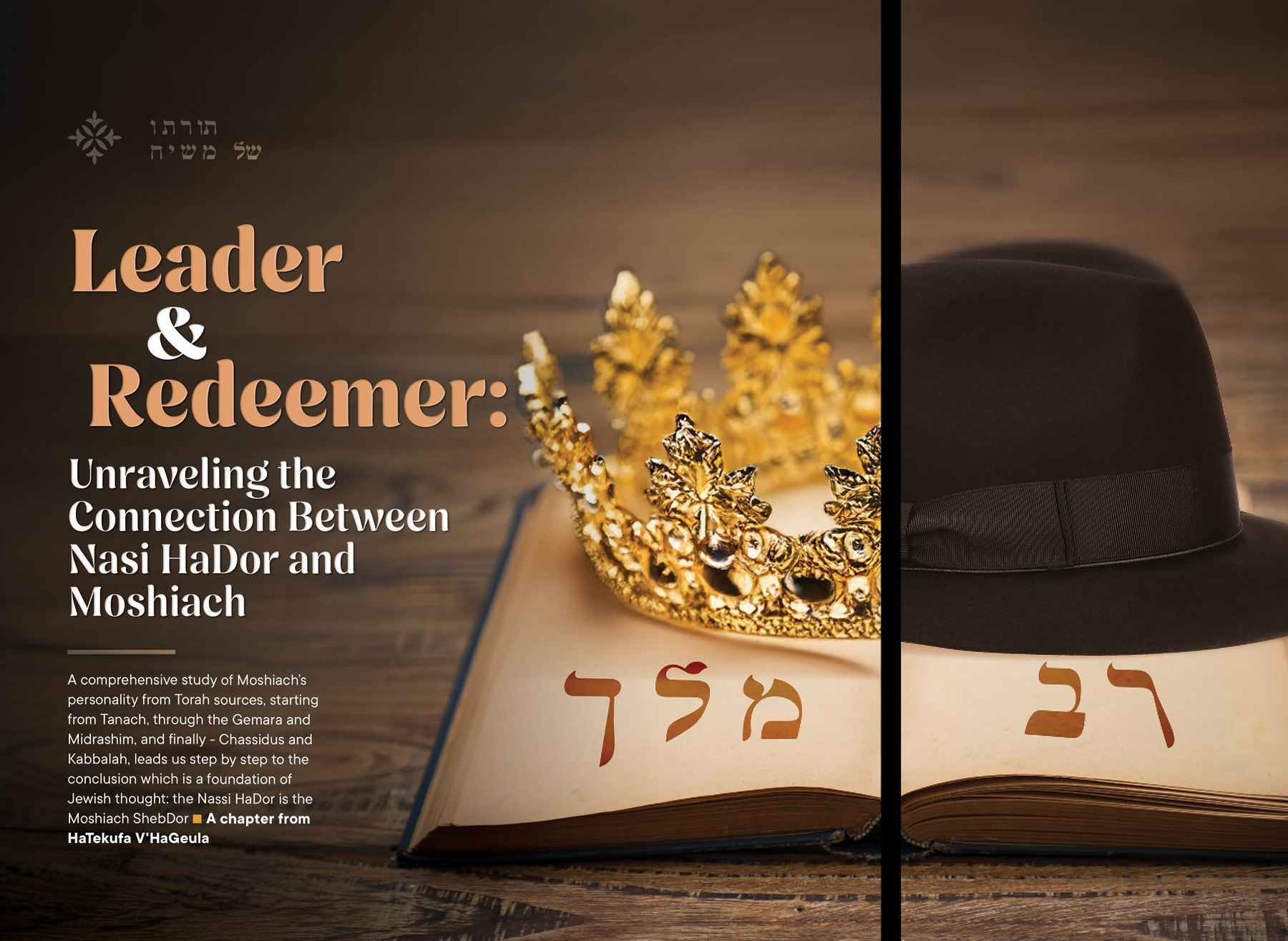
A comprehensive study of Moshiach’s personality from Torah sources, starting from Tanach, through the Gemara and Midrashim, and finally – Chassidus and Kabbalah, leads us step by step to the conclusion which is a foundation of Jewish thought: the Nassi HaDor is the Moshiach ShebDor.
“Ani maamin b’emuna shleima b’vias HaMoshiach” – one of the most fundamental Jewish beliefs is that the future Geula will be brought about through a human redeemer – Moshiach, a scion of the royal family of King Dovid, as articulated in halacha: “A king will rise from the house of Dovid.”
One of the major components of the Geula is that the sovereignty of the Jewish royal dynasty of Dovid will be restored to its original flourishing state. A king from that family will arise to fulfill the many great promises pertaining to the Geula.
Though this process is absolutely divine and miraculous, it will still be led by a human leader. This is not a novelty reserved for the Geula. Throughout Jewish history, all divinely ordained events were made by Hashem to be led by human leaders. For example, Yetzias Mitzrayim and Mattan Torah, G-dly events by all means, were still led by Moshe as Hashem’s messenger. Likewise, to lead the conquest of Eretz Yisrael, Hashem chose Yehoshua Bin Nun. He appointed Dovid and Shlomo to build the Beis HaMikdash, and so forth.
The Jewish people continue to be guided by great righteous human leaders in every generation. So too will it be during the Geula era. The reason for this will be discussed in later chapters. Still, in short: it implies Hashem’s will and intrinsic desire for a dira b’tachtonim, namely that divinity should penetrate the world within its own natural parameters.
This idea is well illustrated in the Thirteenth Principle of Faith: “I believe with complete faith in the coming of Moshiach … I await his coming every day.” Note how this principle of faith focuses not only on believing that an era of redemption will come, but on the redeemer who will usher it in. The Rambam states this in clear legal terms in his Mishneh Torah: “Whoever does not believe in him or await his coming denies not only the prophets but also the Torah and Moshe Rabbeinu.” (Hilchos Melachim 11:1)
Moshiach’s Great Qualities
Not only is belief in the idea of a human Moshiach fundamental to Yiddishkeit, but knowing and believing in the qualities and character of Moshiach as well. As the Rambam writes in his listing of the Ikrei Ha’emuna, “Anyone who doubts his arrival or diminishes his qualities denies the Torah that promised he will come.” (Perush HaMishnayos, Introduction to Perek Chelek in Sanhedrin)
Let’s take a close look at those special Moshiach-qualities mentioned by the Neviim and Chazal, as illuminated by Kabbalah and Chassidic texts.
Sources in both Torah Sheb’ksav and Torah Sheb’al Peh greatly glorify Moshiach’s spiritual heights, describing him as greater than all mankind. As the Navi Yeshaya describes: “He will be exalted and become high and exceedingly lofty.” (Yeshaya 52:18) The Medrash interprets this verse: “Exalted” more than Adam, “become higher” than Moshe, and “exceedingly loftier” than the angels. (Yalkut Shimoni II:476)
The Torah testifies to his holiness: “The spirit of Hashem will rest upon him – a spirit of wisdom and understanding, counsel and strength, knowledge and fear of Hashem.” (Yeshaya 11)
It praises his righteous character traits: “He will judge the destitute with righteousness… decide with fairness for the humble… righteousness will be the girdle round his loins and faith the girdle round his waist.” (ibid)
It praises his great powers: “He will strike the wicked with the rod of his mouth and slay the wicked with the breath of his mouth.” (ibid)
It describes the global reach of his kingdom: “He will rule from ocean to ocean and from the river to the corners of the earth.” (Tehillim 72:8)
His wisdom even exceeds Shlomo HaMelech’s, “the wisest of all men.” (Rambam, Hilchos Teshuva 9)
His level of prophecy is “near Moshe’s“ the “father of all prophets.” (ibid)
Of his Torah teachings, Chazal say: “All one has learned in this world is mere breath compared to the Torah of Moshiach.” (Koheles Rabba 11:8)
Kabbalah illustrates the exalted level of his soul as the level called “Yechida” as will be explained further.
Moshiach’s Qualities Illuminated by Pnimyus HaTorah
According to Kabbalah, there are five levels of the soul – Nefesh, Ruach, Neshama, Chaya and Yechida. Each level contains aspects of the others. While most ordinary souls in later generations operate at the lowest “Nefesh” level. Tzaddikim merit higher soul levels.
Besides every person’s “private” Neshama, Tzaddikim also serve as “general” souls that embody the souls of the many other Jews that are bound to them. Certain Tzaddikim are entrusted with “general souls” encompassing all Jewish souls. The hierarchy of the five soul levels can be found in this context as well.
We are taught that Dovid HaMelech reached the perfection of the “Nefesh” level, Eliyhau HaNavi “Ruach”, Moshe Rabbeinu “Neshama”, Adam HaRishon “Chaya”, and Moshiach will manifest the highest “Yechida” level.
The Yechida is fundamentally different from the lower four levels. Whereas they express only a limited “shine” or contracted form of G-d’s infinite light which imbues the soul, the Yechida reveals the soul’s essence in its pure, unlimited state – directly connected to its Divine source. The four lower levels undergo some descent and constraint, taking on specific qualities and limitations. But the Yechida transcends all boundaries, expressing total perfection in every matter. It is the singularly unified essence, as the name Yechida relates to G-d being the only true “Yachid” (singular) existence.
Moshiach’s soul is termed the “Yechida Ha’klalis” because it is the primordial source from which all other Jewish souls branch out into their particular individual forms. Since his soul contains a perfect unified essence, Moshiach himself will embody the fullest realization of every strength. His role is to reveal this level of the Yechida within every Jew and by extension into all of existence during the Geula era. (see Kuntres Inyana shel Toras HaChassidus Ch. 5)
It is noteworthy to mention that a spark of Yechida lies at the core of every Jewish soul. This explains the renowned commitment Jews have to their faith – why every Jew, regardless of background or knowledge, has the spiritual wherewithal to not abandon their Judaism even at the cost of life itself. The soul’s essence binds them to their source. However, Moshiach alone will manifest and reveal this level in its ultimate perfected state when ushering in the Geula for the entire world.
This explains his ability to perfectly embody every advantage – physical and spiritual – rendering him the ideal perfect being.
Moshiach’s Qualities in Halacha
We explained Moshiach’s qualities as they appear in Nigleh and Pmimyus haTorah. There is one more area within Torah that we ought to explore – Halacha.
In the halacha, we see how all these amazing qualities come to a full synthesis, all embodied by one individual.
The Rambam codifies in his Mishneh Torah (Hilchos Melachim 11:4) clear halachic criteria for identifying Moshiach, which bring together Moshiach’s noble lineage, personality, and messianic actions leading up to and “creating” a state of Geula in the world:
“If a king will arise from the house of Dovid, who will delve deeply into Torah study and observance like his ancestor Dovid… He will compel all Jews to follow the Torah, repairing any breach, and he will fight Hashem’s wars. He is then presumed to be Moshiach. If he succeeds… builds the Temple in its place and gathers the dispersed of Israel – he is certainly Moshiach. He will then correct the whole world to serve Hashem together.”
In Hilchos Teshuva (9:2), the Rambam gives additional details:
“That Davidic king will be wiser than Shlomo, a great prophet close to Moshe… He will teach the entire nation and guide them in Hashem’s way. All nations will flow to hear him.”
These brief descriptions portray Moshiach as an all-encompassing leader – immersed in Torah scholarship on one hand, while leading the nation and world towards perfection on the other. He transcends all boundaries, compelling “all Jews,” teaching “the entire nation,” and correcting “the entire world.”
“Melech” and “Rav”
These two descriptions of Moshiach in halacha seem to describe two “hats” Moshiach will wear. Classically, Moshiach is known as a “Melech”, a king who will lead “politically,” providing for the nation’s physical needs and ultimately leading the entire world to serve Hashem as Hilchos Melachim describes. Still, many sources emphasize that Moshiach’s leadership will be that of a “Rav,” a master teacher of the highest caliber who will even teach the Avos and Moshe Rabbeinu, who will lead via a spiritual, Torah-based leadership. This is the Hilchos Teshuva description of Moshiach.
This is no surprise when we consider that the Geula era, by its very definition, is one of world perfection, thus requiring a perfect leader – Moshiach – to achieve spiritual and physical perfection. According to the Yechida concept explained above, Moshiach’s perfect, boundless soul allows him to embody these seemingly contradictory roles. We see in the two halachic descriptions of Moshiach just that – that his definition surpasses any boundary, limit, or definition.
A Moshiach in Every Generation
The Medrash teaches that the concept of Moshiach existed from the very beginning of creation, highlighting its fundamental importance in Jewish faith. This idea gains even greater significance when we consider the following teaching of Chazal:
In every generation, there is one individual known as the “Tzaddik yesod olam – the foundation of the world.” This person is the potential Moshiach of that generation, sent by divine providence to prepare the Jewish people for the ultimate Geula. If the generation proves worthy, this individual will be the one to lead them out of galus and become the actual Moshiach.
The Sedei Chemed, in his encyclopedic halachic work Pe’as Ha’sadeh, Maareches Haklalim, klal 70), cites Acharonim who elaborate on this concept:
“Throughout history, the Jewish people have assumed in every generation who this individual might be. After the destruction of the Second Beis HaMikdash, it was a man called Menachem, as recounted in Eicha Rabasi. Later, it was Rabbi Yehuda HaNasi, whom his generation recognized as the designated one. Subsequently, it was the man who conversed with Rabbi Yehoshua ben Levi, as mentioned in the Gemara Sanhedrin. In Rav Nachman’s time, it was Rabbi Nachman himself. The students of the Arizal wrote that in his time, it was the Arizal. This pattern continues in every generation, with an individual worthy of being Moshiach if we merit the Geula.”
The Sedei Chemed concludes, “All this is rather straightforward.”
A Long-Standing Tradition
In fact, the Gemara in Sanhedrin (98b) recounts an interesting custom among yeshiva students. In their fervent hope that their Rebbe might be the Moshiach, these students would find hints of Moshiach’s name in their teacher’s name. For example:
“The students of Rabi Shayla said: his [Moshiach’s] name is Shiloh.”
[The Rebbe points out, while discussing this topic in the sicha of Tazria-Metzora 5751, that from Rashi’s commentary on the sugya it seems that the Rebbes themselves found allusions of Moshiach in their names!]
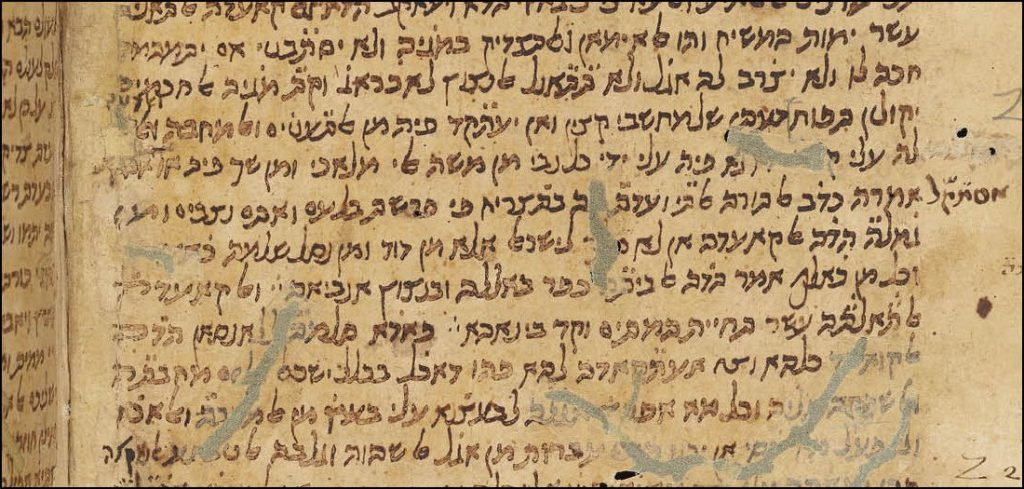
This practice was common among all yeshiva students, who would try to connect the name of Moshiach to their Rebbe’s name, thus suggesting that he might be the Moshiach of their generation.
This custom persisted throughout generations. As the Sedei Chemed notes, many sages and students attempted to identify various great Torah leaders as the potential Moshiach of their time.
The Significance of This Belief
The existence of a potential Moshiach in every generation, and the attempts to identify this individual, reflect a deep-rooted belief and anticipation of the Geula. This aligns with the principle of “I await his coming every day” – a belief that Moshiach could arrive at any moment. Consequently, there must always be an individual present who is fit to fulfill these wonderful promises.
The Eternal Light of Malchus Dovid
The concept of a Moshiach in every generation is further supported by Hashem’s promise regarding the eternity of Dovid HaMelech’s reign. As the Torah states (Vayechi 49:10): “Lo yasur shevet m’Yehuda – a leader will never cease from Yehuda” – even during times of galus.
The Akeida, a classical commentary on the Torah, explains this passuk thus:
“Our Sages interpret this verse as referring to the Rashei Galusa (Exilarchs) in Bavel and the leaders of all generations. This has always been the case, without doubt. Hashem has never forsaken us in any generation, always leaving us at least a small remnant of that leadership. As Chazal say on the verse ‘[I will not abhor them nor spurn them so as to destroy them and] annul my covenant with them,’ Hashem kept His covenant by appointing Rebbi [Yehuda HaNasi] for the Jews in Roman times, and other sages in other generations who always maintained leadership. There has never been a time when at least some form of Jewish authority did not exist in various areas where Jews resided.”
What the Akeida speaks of is very much reminiscent of the concept of Nasi HaDor, which we are all familiar with. This role also fulfills what Chazal say (Bereishis Rabba 56:7): “There’s no generation which doesn’t have within it a Moshe” and other such statements.
The Nasi HaDor and Moshiach
In several sichos, the Rebbe states that it is reasonable to conclude that the Nasi HaDor (leader of the generation) from the house of Dovid, through whom G-d’s promise of eternal Davidic kingship is fulfilled, is also the potential Moshiach of that generation. It is through this individual that the kingdom of Dovid could potentially be restored to its former glory, should the generation prove worthy. This, after all, is Moshiach’s primary objective.
This understanding provides context for the Gemara’s statement (ibid), “If Moshiach is from among the living, it is someone like our holy Rebbi [Rabi Yehuda HaNasi].” As Rebbi was the Nasi of his generation, the Gemara assumed he was also the potential Moshiach of that time.
The Role of the Nasi HaDor
To better understand the assessment of Chazal that there is a Moshiach in each generation and his equivalence to the Nasi HaDor, it’s important to explain the function and role of the Nasi HaDor as presented in the words of Chazal, and especially as illuminated in Chassidic thought.
Kabbalah and Chassidus explain the prominence of true Jewish leaders, pointing out two kinds that exist in every generation:
Leaders of specific groups of Jews.
Universal leaders for all Jews.
As we explained above, Yiddishkeit sees all Jews as one “body” of souls, with each individual soul as a “body part.” Some souls are like toenails – not very crucial parts. Others are like hands or legs – more central, but still not vital. Then there’s the soul equivalent to the head of the body – a limb no one can do without.
This is the soul of the leader of the entire generation – the “Moshe of the generation.” Only through connecting to this leader can individual souls receive their share of divine vitality. The head unites all body parts, revealing their common purpose to serve Hashem and fulfill His will.
This “Moshe” is therefore called:
The נשמה כללית – a “general soul” which includes all others
The נשיא הדור – “leader of the entire generation” who teaches and leads all the Jews, of any kind
ראש בני ישראל – The “head of the Jewish people” who channels the divine energy to the rest of the “body” which is Klal Yisroel
Understanding the Connection to Hashem Through Tzadikim
This explains the words of Chazal on the passuk ולדבקה בו – “to cleave to Him”: “Is it possible to cleave to Shechina? Rather, connect to Talmidei Chachamim and it’s considered as if you cleaved to Him!” (see Tanya, end of Chapter 2)
The statement can initially seem perplexing. After all, the passuk clearly instructs us to cleave to Hashem Himself. How, then, can we substitute this divine connection with a connection to Talmidei Chachamim?
The answer lies in the deeper understanding of the role of Tzaddikim as we explained above.
The Torah, in teaching us to connect to Tzaddikim, is revealing a profound spiritual mechanism. These Tzaddikim are not merely scholars who study Torah intellectually; they are individuals who serve as the “heads” of their generations, and through their profound level of bittul to Hashem they act as mere “conduits” between the divine and the mundane. When we connect to these righteous individuals, we are, in essence, connecting to Hashem directly.
This concept can be better understood through the analogy of the human body. Just as our hands and fingers receive life and direction from the soul via the brain, our individual souls receive their spiritual life-force from Hashem through the “head” of our generation – the Nasi HaDor. It’s impossible for a body part to decide to receive life directly from the soul, bypassing the brain. Similarly, an individual soul can’t receive its spiritual sustenance directly from G-d, circumventing the Nasi HaDor.
This understanding sheds light on the teaching of Chazal (cited by the Rema l’halacha in Yoreh Deah 335:10) that “one who has an ill family member should ask a chacham in his city to pray for him.” At first glance, this might seem like placing an intermediary between oneself and Hashem, which would appear to contradict fundamental principles of Jewish prayer.
However, when we consider that all Jews form one collective body, with the Tzaddikim at its head, we realize that this is not creating an intermediary at all. Rather, it’s a more effective means of prayer, utilizing the Tzaddik – the “head” of the body – to accomplish what needs to be done. The Tzaddik, being more receptive and batel to Elokus, can more effectively channel divine mercy and blessing.
The Yechidah
In Kabbalistic terms, this idea is synonymous with the concept of the Yechida soul, which is the “general soul.” The one who possesses the soul of Yechida is the Nasi HaDor, who is the potential Moshiach of the generation.
To sum up: Moshiach is synonymous with Yechida, which is synonymous with Nasi HaDor. The Nasi HaDor, being the general Yechida, will become – if the generation merits – the King Moshiach who will finally elevate the souls of the Jewish people to the great height for which they were originally intended.
The Moshiach of the Generation in Halachic Terms
Let us now turn to halacha to see how the role of the Moshiach of the generation plays out in practical terms:
The Rambam provides a detailed framework for identifying Moshiach, dividing the process into two distinct stages:
Stage One: “Chezkas Moshiach”: This stage describes the character and actions of an individual who is considered a potential Moshiach. The key criteria include:
1. Lineage from the house of Dovid
2. Deep engagement in Torah study
3. Meticulous observance of mitzvos, following Dovid’s example
4. Active leadership in strengthening Torah observance among all Jews
5. Fighting the wars of Hashem
Stage Two: “Moshiach Vadai” (Certain Moshiach): This stage involves the completion and success of the Chazkas Moshiach’s actions that confirm the individual’s status as the true Moshiach:
1. Succeeding in the endeavors mentioned in the first stage
2. Rebuilding the Beis HaMikdash in its proper place
3. Gathering the Jewish exiles to the Land of Israel.
The “Moshiach of the Generation”
The concept of “Moshiach of the Generation” seems to align with the Rambam’s definition of “Chezkas Moshiach” or at least someone in the process of becoming one.
Namely, this righteous individual is not worthy of becoming Moshiach by virtue of his lineage and pious personality alone. He must exhibit concern for all Jews, not just a specific community. As the Rambam states, he must “compel all of Israel to walk in (the ways of Torah).”
We can clearly see how this process described by the Rambam in essence takes the Nasi HaDor who is already working towards the goal of bringing Jews closer to Hashem (which is what the Geula is all about) and makes him into Moshiach by reaching total success in the Nasi HaDor’s endeavors.
If the generation is worthy to witness the commencement of the Geula in his time, the efforts of this Nasi will be crowned with success, and if not, “he is like all the other righteous kings of Dovid who have died.”
This universal concern has been evident in the leaders from the house of Dovid throughout the generations, especially in recent times as we approach the era of Geula. These leaders engage with all types of Jews, bringing them closer to Torah and mitzvos.
Another area where we see a “Moshaich of the generation” in action is his special concern with the idea of Moshiach and how he uses his position to inspire and awaken his flock’s faith and anticipation for the imminent Geula.
This understanding forms the basis for the Rebbe’s statements mentioned above, and repeated in many instances, that “the Nasi of the generation is the Moshiach of the generation.” The Rebbe applied this concept to his father-in-law, the Rebbe Rayatz, stating that his role as the leader of the generation necessitated that he was the Moshiach of his generation. And this, by extension, applies to the Rebbe as well (see Kuntres Purim Katan 5752 ch. 7).
Summary:
In every generation, there exists a righteous individual from the house of Dovid who serves as the Nasi of the generation and embodies the potential of Moshiach for that era. This individual plays a crucial role in awakening the people’s anticipation for Geula and guiding them to complete the necessary preparations for the coming of Moshiach.
This person cannot be content with influencing only a specific community or group. Rather, as someone with the potential of Moshiach who must be a universal leader, he must care for every Jew of every background. His mission is to influence all Jews to strengthen their commitment to Yiddishkeit.
If the generation proves worthy, the individual who is the “Moshiach of the generation” – the one “worthy to be Moshiach” – will be revealed as the actual Moshiach and will successfully redeem the Jewish people, fulfilling all the criteria laid out by the Rambam.
Extensive footnotes with references and in-depth sources for this essay are available in the Hebrew original in Chapters 5 and 6 of Part I of the Hebrew original HaTekufa V’HaGeula.
HaTomim #13 • pp. 8-17
© 2026 Beis Moshiach Magazine. All rights reserved.
This article originally appeared in Beis Moshiach #1416. You are welcome to share it with friends and family by email or in print, provided that you do not change, add to or omit any part of it, you credit the author and Beis Moshiach, and you include a link to archive.bmoshiach.org (written out in full in printed copies).
To republish this article in a newspaper, magazine, book or website, please request permission in advance at [email protected].