Will Moshiach Come on a Donkey or a Tesla?
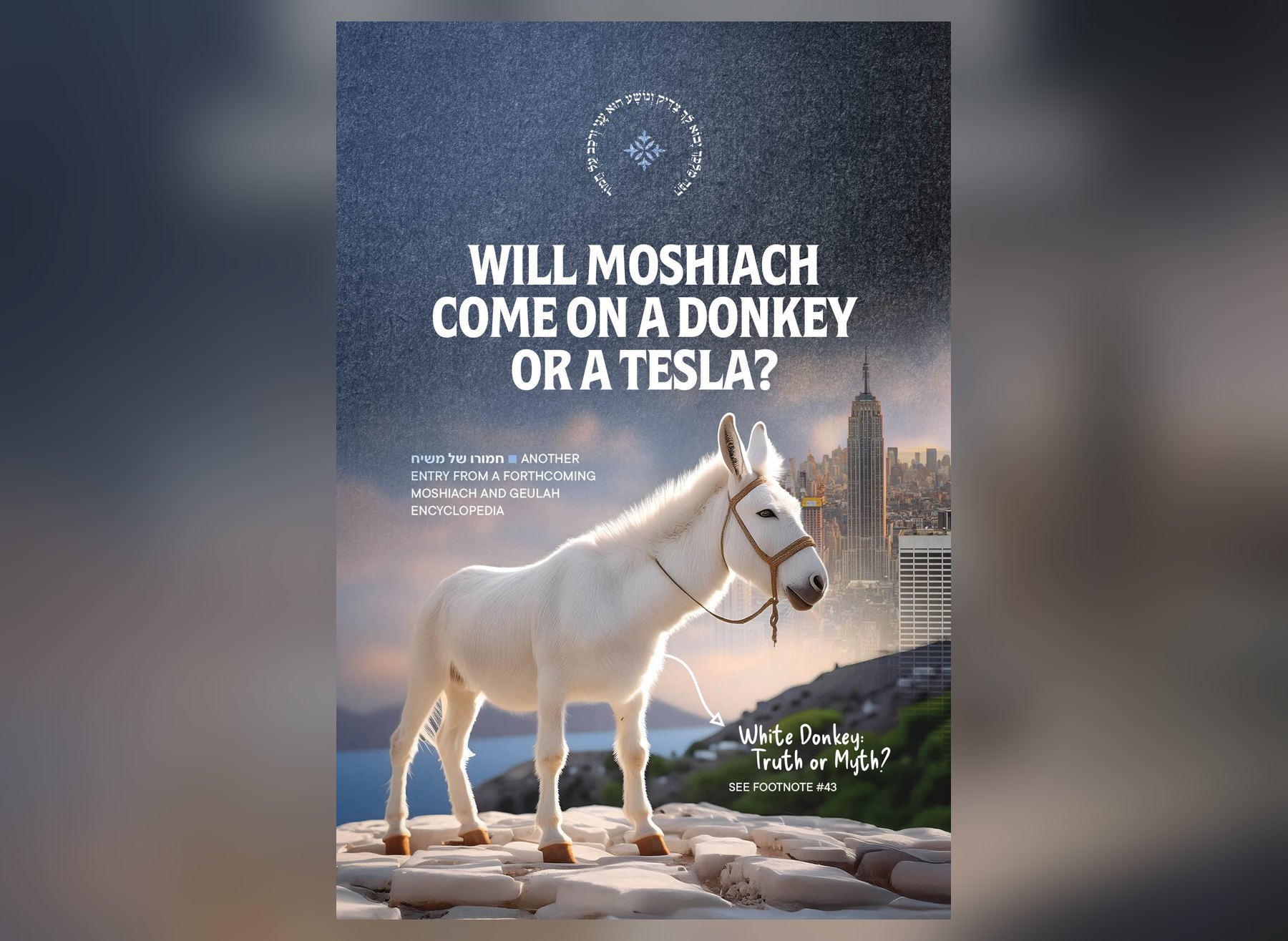
Another entry from a forthcoming Moshiach and Geulah encyclopedia: חמורו של משיח.
חמורו של משיח – The Donkey of Melech HaMoshiach
One of the possible modes of transportation upon which Moshiach will arrive that carries great spiritual significance
Contents:
A. Source of the Promise
B. Its Deeper Meaning and Symbolism
C. Method of Fulfillment
D. The Qualities of the Donkey
E. In Avodas Hashem
A. Source of the Promise
The revelation of Melech HaMoshiach riding on a donkey is mentioned in the Nevuos HaGeulah [prophecies of the Redemption] of the Navi Zecharia¹: הִנֵּ֤ה מַלְכֵּךְ֙ יָ֣בוֹא לָ֔ךְ צַדִּ֥יק וְנוֹשָׁ֖ע ה֑וּא עָנִי֙ וְרֹכֵ֣ב עַל־חֲמ֔וֹר וְעַל־עַ֖יִר בֶּן־אֲתֹנֽוֹת – “Behold! Your king shall come to you. He is just and victorious; humble, and riding a donkey and a foal, the offspring of [one of] she-donkeys.” The meforshim² explained that the king mentioned here is Moshiach ben Dovid³.
The Gemara⁴ explains that Moshiach will be revealed this way only if the Jewish people is in a state of “lo zachu” (unmeritorious) through their deeds, and the process of Geula will be natural (non-miraculous), as will be explained below.
B. Its Deeper Meaning and Symbolism
“Lo Zachu:” The revelation of Melech HaMoshiach riding a donkey corresponds to the manner of his coming:
When the Geula comes at its predetermined ketz [=end time] and the Jewish people have not hastened its arrival, Moshiach will come on a donkey, which expresses poverty and slowness (unlike a horse – as it is the way of the wealthy to ride quickly on a horse), indicating that he is not rushing to redeem them⁵ (Gemara).
Even though the Jewish people did not hasten it, Hashem redeems them due to the difficulty of galus [exile] which is like a heavy burden on a donkey⁶, or only because He made a vow to redeem them at the ketz, and this is hinted at by the fact that the word נדר (vow) has the same gematria [=numerical value] as חמור⁷ (8+40+6+200 =255).
Through Moshiach riding on a donkey quietly, the Satan will not notice his coming and will not accuse the Jewish people as unworthy⁸ (Acharonim).
Symbolizing the State of Geula: There are several explanations that riding on the donkey expresses certain innovations that will occur at the Geula:
(1) The word חמור is related to חומר, materialism, and symbolizes the physicality of the world⁹. Moshiach controls (“rides)” on it, i.e., not nullifying it but utilizing it for kedusha. Moshiach will himself “ride upon” and control the chomer, signifying a greater control over the material even than Avrohom (who used the donkey for his objects) and Moshe (who already used it for his family members to ride upon).¹⁰ (Maharal).
At this time, all of the Jewish people will control the physicality of their bodies¹¹ (Abarbanel) and the world¹² (Chasam Sofer). (This control will cause elevation in the Jewish people, even in the highest levels of the neshama¹³ (The Rebbe MH’M)).
(2) Furthermore, his riding on a donkey symbolizes that the time has come for the end of wars usually conducted with horses¹⁴ (Radak). Since he shows that he has come to bring peace to the world (by coming on a donkey), the nations will not oppose his kingship¹⁵ (Acharonim). It also alludes to his dominion over the nations who are compared to a donkey¹⁶ (Abarbanel).
(3) It also indicates rulership of kedusha over types of kelipa called “chamor” and “ayor” which will be nullified with the coming of Moshiach¹⁷.
(4) An additional reason for riding on a donkey is that when he comes to redeem the Jewish people, he is not yet ruling, and only a king rides upon a horse¹⁸ (Zohar).
* * *
“Zachu”: Other sources, however, indicate that there is a merit for the Jewish people alluded to in the donkey:
(1) He redeems them in the merit of learning¹⁹ Mishnayos²⁰ (and Torah in general²¹), and this is alluded to by the donkey as it is written²² “Yissachar is a strong-boned donkey,” referring to the tribe of Yissachar’s diligent Torah study²³ (Zohar). Also in the merit of Avrohom who saddled the donkey for the binding of Yitzchok²⁴ (Iyun Yaakov).
(2) Others explain that Moshiach rides on a donkey because of its characteristics; that due to his great humility, he is content with just a donkey and does not glorify himself with a horse like other kings²⁵ (Rishonim).
(3) Also, because he will honor the Torah’s commandment to the king²⁶ “he shall not multiply horses for himself”²⁷ (Achronim).
* * *
According to Chassidus: The revealed part of Torah is the aspect of donkey, and the inner dimensions of Torah are compared to a horse. Therefore, initially Moshiach will ride on a donkey – engaging in the revealed Torah, and later he will ride on a horse – teaching the secrets of the inner dimension of Torah²⁸ (Tzemach Tzedek).
C. Method of Fulfillment
Some sources explain that Moshiach will not actually be revealed on a donkey, rather this teaching illustrates the manner of redemption and alludes to Melech HaMoshiach himself²⁹ as explained above³⁰ (Abarbanel). However, conversely, it is brought in many places that Moshiach will ride, at the time of his revelation, on a physical donkey specifically preserved for this purpose³¹ (Rashi).
The Rebbe MH’M similarly explains that his coming on a donkey mentioned above will occur in physical reality³².
However, b’poel mamash (as far as actual practice), he announced that the Jewish people are already in a state of “zachu” (meritorious) and the Geula comes in a miraculous way, such that the event will not actually occur and Melech HaMoshiach will not be revealed riding on a donkey (but rather on clouds)³³ (The Rebbe Melech HaMoshiach).
D. The Qualities of the Donkey
Its history: The donkey is a descendant of the she-donkey that was created during the six days of creation, on Erev Shabbos Bein Hashmashos [=at twilight]³⁴ (Pirkei D’Rabi Eliezer).
It served Avrohom Avinu on his way to the Akeidah [Binding of Yitzchok]³⁵. Avrohom gave it to Yitzchok, Yitzchok to Yaakov, Yaakov to Levi, Levi to Kehas, Kehas to Amram, and Amram to Moshe.
Moshe fled to Midyan riding on the donkey, and was concerned about returning with it to Mitzrayim, lest they discover he was the redeemer (as the astrologers saw that it was the donkey of the redeemer), and when Hashem informed him that they had died³⁶, he returned to Mitzrayim with it³⁷. And when he ascended to be buried on Har Nevo, the donkey went up with him, and it grazes there until the coming of Melech HaMoshiach³⁸ (Medrash).
Eliyahu HaNavi³⁹ also ascended to heaven in the storm⁴⁰ on this unique donkey (Zohar). It is also written that this was the special donkey of Rabi Pinchas ben Yair⁴¹ (Chasam Sofer).
However, there are those who maintain that this is not literally the same donkey (as it is not possible that it lived for so many years), rather it is the same spiritual force and concept of riding on the donkey (which is to overcome materiality with spirituality), which these tzaddikim possessed and Moshiach will have as well⁴² (Maharal).
Its appearance: The donkey is splendid in its appearance, having a hundred⁴³ or a thousand⁴⁴ colors (Gemara), and this alludes to the inclusion of all virtues within Melech HaMoshiach⁴⁵ (Maharal).
Its Powers: The donkey is miraculous and possesses great physical strength; it could carry Moshe’s wife and two sons together with all their belongings⁴⁶ (and with Moshe’s staff that alone weighed forty se’ah⁴⁷) (Rashi).
In an ancient medrash it is written that the donkey’s pain equals the pain of Eliyahu and the Angel of Death⁴⁸ (Medrash).
In merit of Melech HaMoshiach riding upon it, the donkey merited that it serves for various remedies⁴⁹ (Tzafnas Paneach).
E. In Avodas Hashem
The Gemara states that one who sees a donkey in his dream should anticipate salvation. This “salvation” means the coming of Melech HaMoshiach who rides on a donkey⁵⁰ (Medrash).
When a Jew nullifies himself like a donkey which is lowly, he will succeed in standing firm in faith and anticipation of the coming of Moshiach⁵¹ (Maharam Shick). Similarly, through subduing the physicality of his body we merit Melech HaMoshiach who is “riding on a donkey”⁵² (Shem MiShmuel).
Regarding Yaakov’s words to Esav⁵³ עם לבן גרתי … ויהי לי שור וחמור צאן ועבד – “I have sojourned with Lavan and I have ox and donkey – sheep and servant,” Chazal explain⁵⁴ “Chamor – refers to Melech HaMoshiach,” and from this we learn a practical instruction:
Through a Jew serving Hashem with kabbalas ol (the service of “sheep and servant”) we merit the “donkey” – the revelation of Melech HaMoshiach who rides on a donkey⁵⁵.
And since the coming of Moshiach depends on the work of birurim [=spiritual refinements], therefore when the Jew relates to physicality in a manner of “sojourning” – as a stranger and detached from worldly matters while using them for kedusha, this effects a revelation of “Chamor refers to Melech HaMoshiach.”
Chazal said: “If they (the Jewish people) merit – [Moshiach will arrive] on the clouds of heaven and if they do not merit – [he will arrive as a] pauper riding on a donkey.” The lesson learned from this is that through the work of refining matters that are not pure (“lo zachu”), we reach the level of or chozer [=reflected light], a higher place than that which a Jew can achieve through his regular service⁵⁶ (The Rebbe Melech HaMoshiach).
¹ Zecharia 9:9. Metzudas Tziyon there.
² Rashi there, and others.
³ However, some explained this passuk regarding Moshiach ben Yosef (cited in Ibn Ezra there et al), but according to most commentators the intention is to Moshiach ben Dovid (see Yalkut Shimoni referenced in note 38: “This is the donkey that the son of Dovid will ride upon”).
⁴ Sanhedrin 98a.
⁵ Sanhedrin there and Rashi’s commentary.
⁶ Iyun Yaakov on Sanhedrin there.
⁷ Ben Yehoyada on Sanhedrin there.
⁸ Shach al HaTorah on Teitzei 22:9.
⁹ Gur Aryeh on Shemos 4:20. Gevuros Hashem ch. 29. Mincha Belula and Panim Yafos on Shemos there.
¹⁰ Yeshuos Meshicho Third Analysis ch. 1. Quoted and explained in Likkutei Sichos Vol. 31 p. 21ff.
¹¹ Yeshuos Meshicho ibid.
¹² Drashos Chasam Sofer, 8 Teves 5590. Pri Tzaddik on Shemos 12.
¹³ Likkutei Sichos Vol. 1 on Vayishlach sec. 11.
¹⁴ Radak and Abarbanel on Zecharia 9:9. Drashos Chasam Sofer Vol. 3:38.
¹⁵ Shach al HaTorah ibid. Meorei Ohr on Sanhedrin there.
¹⁶ As written (Bereishis 22:5) “Stay here with the donkey” and Chazal said (Kiddushin 68a) “A nation similar to a donkey.” Mashmia Yeshuah on Zecharia, HaMevaser 14.
¹⁷ Zohar Vol. 3 238a. Ahavas Yehonasan on Haftaras Balak.
¹⁸ Zohar Vol. 3 276a. Ein Eliyahu on Sanhedrin there.
¹⁹ Because in the final galus Torah study will increase. Toras Moshe (Alshich) on Devarim 31:22.
²⁰ As “עני (ורוכב על חמור”) is an acronym for ערובין, נדה, יבמות, indicating connection to Mishna. Zohar there.
²¹ Like the parable of a king bound in chains (Shir HaShirim 7:6) – bound with thin ropes in water, and when the water rises the ropes separate. So too with Melech HaMoshiach, through Torah study (compared to water) they release him from his “imprisonment” and he can come to redeem them. Shoshanas Ha’amakim (Alshich) on Shir HaShirim 7:6.
²² Bereishis 49:14.
²³ Zohar there.
²⁴ Iyun Yaakov there.
²⁵ Commentators on Zecharia there. Rav Saadia Gaon on Daniel 7:13.
²⁶ Devarim 17:16. Rambam, Hilchos Melachim 3:3.
²⁷ Tevuas Yekev (Friedman) p. 25.
²⁸ Biurei HaZohar of the Tzemach Tzedek p. 151 in margin.
²⁹ Gur Aryeh and Yeshuos Meshicho there.
³⁰ End of section B.
³¹ Pirkei D’Rabbi Eliezer ch. 31. This is also implied from Rashi’s commentary on Shemos 4:20. See Likkutei Sichos Vol. 31 p. 15.
³² Likkutei Sichos Vol. 31 there and elsewhere.
³³ Sefer HaSichos 5749 Vol. 1 p. 353.
³⁴ Pirkei D’Rabi Eliezer ch. 31. Commentary of Radal on the Medrash. Tzafnas Paneach there.
³⁵ Pirkei D’Rabi Eliezer there. Piyut ‘Mi Yaaseh Kamocha’ for Shacharis of Rosh Hashana. And others.
³⁶ As written (Shemos 4:19) “Return to Mitzrayim for all the men who sought your life have died”. “Your life” meaning your desire, i.e., that your desire was for the donkey to remain with you and they have died and will not take it from you. Medrash Talpiyos Anaf Chamor.
³⁷ Yalkut Shimoni on Vayeira 98. Zecharia 575. Rashi’s commentary on Shemos 4:20. As written “And he had them ride on the donkey,” meaning this was that same donkey. Baalei HaTosafos on Torah (from the writing of Rabbeinu Ephraim) on Shemos 4:20.
³⁸ Medrash Talpiyos ibid.
³⁹ Regarding this event see Melachim II 2:11.
⁴⁰ Zohar Vol. 3 238a.
⁴¹ Drashos Chasam Sofer Vol. 3 there. Regarding this donkey see Chullin 7a.
⁴² Gevuros Hashem there. Pri Tzaddik on Shemos 12. And the intention in this: Avraham and Moshe prepared the world for receiving the Torah, which provides the power for Moshiach who will teach the Torah Chadasha. Likkutei Sichos Vol. 1 on Vayishlach sec. 8.
⁴³ Rashi’s commentary in Sanhedrin there (and not like those who err in translating the word חוור as white). Although, some understand this from the words of the Maharsha in Sanhedrin (ibid); see Ein Eliyahu on Sanhedrin (ibid) who gives place for this interpretation.
⁴⁴ According to the girsa of the Aruch, entry Ka’ar.
⁴⁵ Netzach Yisrael ch. 40.
⁴⁶ This is understood from Rashi there. Likkutei Sichos Vol. 31 p. 16.
⁴⁷ Kaftor Vaferach on Shemos.
⁴⁸ Pirka D’Rabbeinu HaKadosh (printed in Braisa Maaseh Torah (Warsaw, 5645) in additions to os 3). Chupas Eliyahu ch. 3:140 (printed in Yalkut Medrashim Vol. 1 p. 43). What this Medrash’s intention is not clear.
⁴⁹ Its dung – for healing a bris mila, its hair and dung – for ziva, and its flesh and bones – for yerakon (jaundice). Tzafnas Paneach on Sanhedrin 106a.
⁵⁰ Berachos 56b. Yalkut HaMechiri on Zecharia ibid.
⁵¹ Drashos Maharam Shick, end of the introduction.
⁵² Shem MiShmuel on Vayishlach 5671.
⁵³ Bereishis 32:4.
⁵⁴ Bereishis Rabba 75:6.
⁵⁵ Maamar “Vayishlach Yaakov” 5718.
⁵⁶ Likkutei Sichos Vol. 1 end of Parshas Vayishlach.
HaTomim #15 • pp. 6-11
© 2026 Beis Moshiach Magazine. All rights reserved.
This article originally appeared in Beis Moshiach #1446. You are welcome to share it with friends and family by email or in print, provided that you do not change, add to or omit any part of it, you credit the author and Beis Moshiach, and you include a link to archive.bmoshiach.org (written out in full in printed copies).
To republish this article in a newspaper, magazine, book or website, please request permission in advance at [email protected].