The Lieutenants of the Rashi Revolution
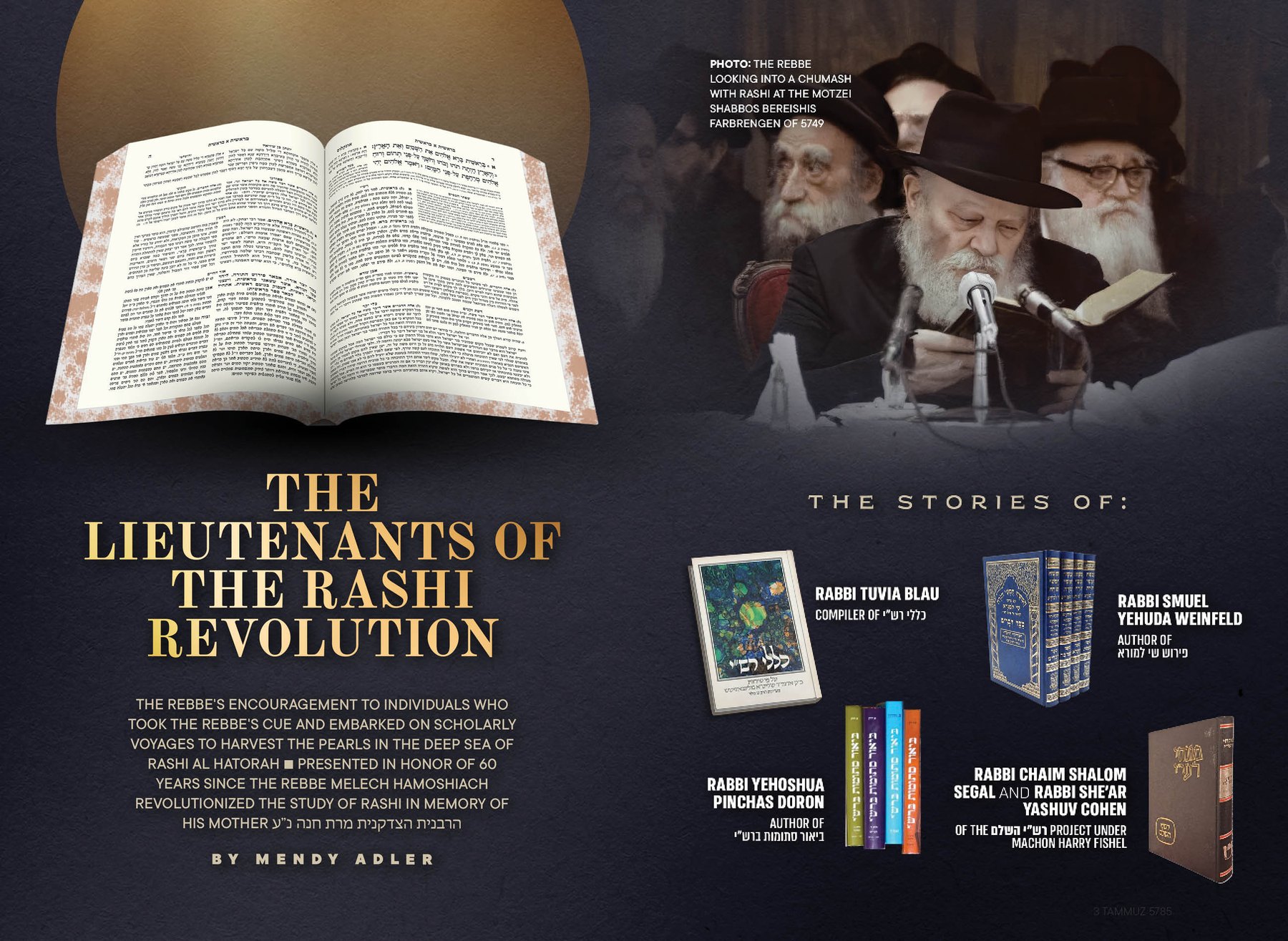
The Rebbe’s encouragement to individuals who took the Rebbe’s cue and embarked on scholarly voyages to harvest the pearls in the deep sea of Rashi al HaTorah. Presented in honor of 60 years since the Rebbe Melech HaMoshiach revolutionized the study of Rashi in memory of his mother הרבנית הצדקנית מרת חנה נ״ע.
Among the Great Commentators of Rashi Throughout the Generations
The Rebbe left a deep and unforgettable mark on the study of Rashi’s pirush (commentary) on the Torah. This is a fundamental and central component of his Torah teachings, his farbrengens, and his sichos.
Some time after the passing of his mother, Rebbetzin Chana a’h in 5725 (1965), the Rebbe began a tremendous undertaking of explaining Rashi’s commentary on the Torah. At every Shabbos farbrengen, the Rebbe began explaining a commentary of Rashi on the weekly parsha. Over the years, he explained more than eight hundred comments of Rashi, revealing in them both depth and simplicity. Some of these explanations were later edited and published in “Likkutei Sichos” and in the series Biurim l’Pirush Rashi al ha’Torah. The Rebbe’s explanations constitute an important leap in understanding Rashi’s pirush, enabling all who learn it to understand his words in a clear and comprehensive manner.
The Rebbe’s special relationship with Rashi is evident in every aspect of his Torah teachings. The Rebbe did not suffice with ordinary study, but rather delved into the depths of Rashi’s words, expounding on every word and every letter, establishing his commentary on solid foundations.
Generally, the Rebbe would begin with a long series of questions on a particular piece, encompassing it from all sides, comparing it to other sources in the Talmud and Medrash, to Rashi’s words in other places, and to the opinions of other commentators. Then the Rebbe would present a new and surprising foundational premise, and from this general principle he would resolve the entire pile of difficulties and contradictions, until a new and clear simple meaning was revealed to the listeners.
The intensity of the Rebbe’s engagement with Rashi was so strong that it penetrated even broader circles among the Chassidic communities. Many, even those who were not Chabad Chassidim, saw the Rebbe as an authoritative address for understanding Rashi’s commentary, and turned to him with questions and requests for clarification while sharing with him their research and insights on the matter. The Rebbe responded to every inquiry, providing detailed and profound answers.
The Rebbe thus entered as one of a long dynasty of great commentators of Rashi throughout the generations, but with a new depth and uniqueness the likes of which had never been seen before.
The Rebbe did not engage in Rashi’s commentary alone, but also encouraged others to do so. This encouragement was not merely a general recommendation, but was sometimes accompanied by specific instructions and guidance, and even rare approbations for sefarim that were published, as will be seen below.
As for the Rebbe, he himself referred several times to the special “koch” (passion/enthusiasm) he had in studying Rashi, as evidenced by the following story:
This was during a yechidus with the son-in-law of the Admor of Sanz-Klausenburg, Rabbi Shlomo Goldman (later the Admor of Zhvil), on 11 Shvat, 5743. The Rebbe said: “I hear that your father-in-law gives classes in Chumash and Rashi’s commentary, and I am happy to hear this, since I too am engaged with passion (‘ich koch zich doch’) in Rashi and ‘peshuto shel mikra’ (the simple meaning of the text).
“There are those who have complaints against me as to why I take time from the members of the crowd at Shabbos farbrengens – something that was not customary in earlier times – for Chumash and Rashi that belongs to ‘the ben chameish l’mikra.’ I was happy to hear that there is ‘a Tanna who supports me.’”
The Rebbe’s Unique Approach to Studying Rashi
One of the most prominent examples among the sefarim published on Rashi’s extraordinary pirush is none other than the series of sefarim by the Rebbe himself – first and foremost the “Likkutei Sichos” series in which the Rebbe’s edited sichos were published, as well as the series of sefarim, Biurim l’Pirush Rashi al ha’Torah. These sefarim were initially published in two volumes, and finally in five.
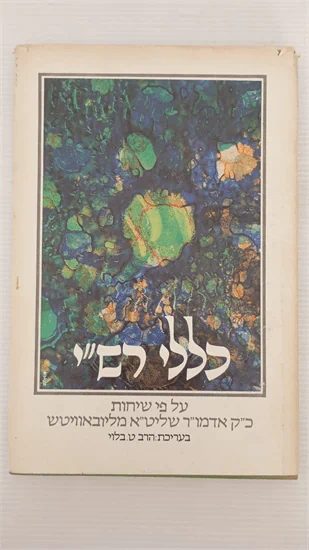
Another sefer, no less important, is Klalei Rashi, which received special treatment from the Rebbe when his unique title-page ‘decorative border’ was printed on its shaar blatt (title-page).
This sefer was written by Rabbi Tuvia Blau, rav of the Chabad community in the Neve Yaakov neighborhood of Yerushalayim, who collected the principles of proper study of Rashi that were innovated and explained in the Rebbe’s sichos – into one place. The writing of the sefer began as a single article that Rabbi Blau published in the journal Shmaatsin in Kislev 5731 under the title: “The Approach of the Admor of Lubavitch in Studying Rashi.” In this article, Rabbi Blau attempted to explain for the first time the essence of the Rebbe’s method in studying Rashi. From studying the sichos, he created eleven systematic principles to which he attached several examples.
This is what the editors of the journal wrote in the ‘Foreword’:
“In recent years, ‘Likkutei Sichos’ of the Admor of Lubavitch, shlita, on Rashi’s commentary to the Chumash has been distributed in the Land [of Israel] weekly by ‘Tzeirei Chabad.’ The reader of the booklets immediately discovers an attempt to chart a systematic and orderly path in studying Rashi, which brings in its wake profound revelations in the way of the commentator and in the treasures of thought hidden in his commentary.
“…In this issue, a first attempt is made to define the principles of the Admor of Lubavitch’s approach to studying Rashi’s commentary, with detailed examples. Undoubtedly teachers will find much material for thought both for the form of teaching Rashi’s commentary, and for illuminating the Torah treasures (= guides in halacha and machshava) that are in his commentary.”
After the article’s publication, Rabbi Blau received a letter from the Rebbe’s secretariat, in which they thanked him for writing the article, and asked that he endeavor to find additional principles in the Rebbe’s Torah on Rashi’s commentary in order to publish them.
In this letter, it was suggested to Rabbi Blau that when he finishes concentrating all the principles, they would be printed in a special booklet.
A few months later, he received a response from the Rebbe regarding editing the booklet (Igros Kodesh, vol. 26, p. 345):
“Editing a booklet of principles of Rashi’s commentary (with the addition of examples for each and every one) – according to the sichos – is very proper. And especially if a list of Rashi commentaries that have been explained until now will be attached to it, and will cause, obviously, great nachas ruach, and it goes without saying.”
And subsequently the Rebbe sent a letter to the journal’s editorial board (on 5 Teves 5732/1971) and thanked them for publishing the article:
“Thank you for the letter that reached me some time ago and now the periodical Shmaatsin has been received, and I thank them for their attention, and obviously also for the opportunity to become familiar with the new approach in studying Rashi’s commentary… And known are the words of our Rebbeim, the leaders of Chabad, that in Rashi’s commentary is hidden the wine of Torah (the secrets of the Torah).”
In practice, the editing of the book was delayed for nearly a decade, during which the Rebbe urged him several times to complete the editing of the book.
Before Yud Shevat 5740 (1980), the Rebbe announced that if Rabbi Blau does not begin working, the task would be assigned to someone else. Rabbi Blau hurried and the first edition of the sefer was printed for Yud Shevat of that year. When the Rebbe received the proofs of the sefer, he wrote to the author (later printed in the introduction to the sefer):
“Thank you, thank you especially for all that he sent in connection with the principles of Rashi etc., and there is wisdom here (in addition to the craft being great) etc. etc., and may G-d grant him success to bless very soon on the completion of the second edition in our days. And obviously – a day earlier is better.
“And in any case – as in all similar cases of Rashi – that ‘turn it over and turn it over’ etc. ‘and in it you should look’ etc. – there will come a second edition (more correctly – additions) and afterwards a third etc.
“And the merit of Ra[bbi] Sh[lomo] Y[itzchaki – i.e., Rashi] assists and accelerates and adds great success.”
Immediately upon the edition’s publication, the Rebbe instructed to begin working on a new sefer. It was evident that the subject was important to the Rebbe and close to his heart.
Rabbi Blau girded his loins and began working on a new edition that would be double the size of its predecessor. In 5751, he brought the Rebbe the new edition with numerous principles and examples.
The Rebbe’s affection for this sefer can be learned from the fact that over the years the Rebbe referenced this sefer, and sometimes even in the ‘Foreword’ of Likkutei Sichos.
93 Dollars of Encouragement
Rabbi Yehoshua Spalter-Doron, author of the series of sefarim, Biur Setumos b’Rashi, related:
“I used to visit the Beis Medrash of the Lubavitcher Rebbe, to consult with him about my sefarim. I remember how at every visit he blessed me anew and asked: ‘Nu, is there a sefer already?’ He is the one who pushed me to bring from potential to actual and to carry out the work.”
In the introduction to the first volume of the series, Rabbi Doron unfolds the story: “The foremost speaker in our days in explaining Rashi’s words on the Torah is none other than the Admor of Lubavitch, Rabbi Menachem Mendel Schneerson, shlita, in his hundreds of sichos at holy farbrengens on Shabbosos and chagim and other occasions, from which two volumes have meanwhile been published under the title Biurim l’Pirush Rashi al ha’Torah… Beginning from the start of 5725, he dedicates a special sicha at every farbrengen to explaining a section in Rashi’s commentary on the weekly parsha.
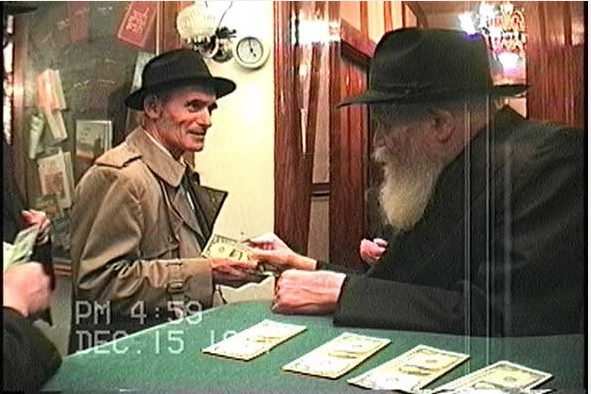
“…I must thank him, who literally pushed me and urged me constantly not to despair from the heavy task but to continue the work of writing until completion. Every time I was in his presence – to receive dollars from his holy hand – he would ask me: ‘Ihr kumt mit a sefer, tzu uhn a sefer? Ven kumt es shoyn arois?’ [= Are you coming with a sefer, or without a sefer? When is it finally coming out?].
“With this, he would give me several dollars – sometimes up to six – and say: ‘Der dollar iz far dem letzten sefer, un der iz far der sefer (when I presented him with a new book), un der iz far dem kumendiken sefer etc.’ [= This dollar is for the previous sefer, and this is for this sefer, and this is for the coming sefer etc.]. Thus I have kept an envelope of 93 such encouraging dollars! Thanks to these pushes and encouragements, I made the blessing, with G-d’s help, upon the completion and merited with the help of G-d to complete the explanation on the Chamisha Chumshei Torah.”
Indeed, special encouragement can be seen from the Rebbe when Rabbi Doron passed by at the dollar distribution on 24 Teves 5749, and presented him with the proofs of his second sefer, saying emotionally “I finished the work.” The Rebbe – who was updated on all the details of the writing progress – asked him whether he still needed to complete the explanation on the last three pesukim. Rabbi Doron replied that he had already finished this that morning and now he was presenting the complete work, however, he had no money to print it as a sefer.
The Rebbe said: “Since the Holy One, blessed be He, gives money to the entire world, would it occur to anyone that specifically regarding this sefer, on pirush Rashi, He would cease from doing so?” And the Rebbe concluded: “Presumably you will have more than you need…”
Rabbi Doron, who hesitated for a moment, turned to the Rebbe and said: “And if not – I will print this at the Rebbe’s expense…” The Rebbe reacted: “This you cannot do, because I have no money. I collect money from the public, and what is the point of that? Your name is ‘Doron’ [gift]. Therefore you must give gifts around you, and you will not lack.”
On 20 Teves 5751, Rabbi Doron passed before the Rebbe and announced that soon the third volume of his sefarim would appear. The Rebbe blessed him: “May it be at a good and successful time,” and inquired: “Did you answer all the questions? Or are there still some remaining?” Rabbi Doron replied that some still remained, and the Rebbe responded: “The main thing is that it’s on the way.”
A month later, Rabbi Doron passed by again, holding the third volume that had been printed. The Rebbe was surprised and said: “Already printed? At a good and successful time.” Rabbi Doron requested a bracha for a medical matter and the Rebbe blessed him: “May it be with great success, and that you should be able to engage with Rashi.”
Rabbi Doron received not only blessings and encouragements. Over the years, he brought the Rebbe pages from his compositions and asked for the Rebbe’s comments. Thus he wrote to the Rebbe in the winter of 5740 when he began writing his work: “I sent to the Admor, shlita, one chapter from my commentaries on Rashi on the Torah and requested that he grace me with his comments-illuminations on the commentary. I am hereby attaching the chapter from Parashas Noach and request in every language of request to grace me with comments and criticism on my work (whether for kindness or for correction).”
The Rebbe replied to him a short time later: “I read it and thank you. – Surely he compared with the book in English that is in this field and will note (in the appropriate place) his innovation, or intention, his special approach etc.
“In general – [to present] the quotes and explanations [in a manner that is] easy to understand etc.
“Perhaps it would be worthwhile that all the footnotes be in the margins of the page (to make it easier for the reader). And to add – to complete them with the addition of Rashi’s own sources (to show the richness of Rashi, not like the opinion of those who err in this).”
In later years, when he brought the proofs of his third sefer to the Rebbe, he repeated his request to merit the Rebbe’s comments and received this response: “Thank you for his attention to show me etc., and great is the merit of one who engages in the Torah of the rishonim like angels and especially in the Torah of the Rosh shel Yisrael. There is no time at all to comment etc. and especially as required in Rashi’s commentaries and in the famous acronym mentioned above.”
A few years after Rabbi Doron finished publishing his book series, Rabbi Yochanan Gurary suggested that he publish the series in an additional edition. Rabbi Doron adorned his new edition with many sources from Chassidus and the Rebbe’s Torah, and it was printed in a beautiful format.
Encouraging the Commentary on Rashi Project
In his youth, Rabbi Shmuel Yehuda Weinfeld, a Chabad Chassid from Yerushalayim, decided to create a pirush that would collect the various explanations of Rashi’s pirush on the Torah, making them accessible in a clear and organized language alongside the Chumash. In addition, he included notations on the variant versions found in ancient manuscripts of Rashi’s commentary.
In 5726, Rabbi Weinfeld began working diligently on the project, but the work extended far beyond the expected time-frame.
In Nissan 5732, Rabbi Weinfeld visited the Lubavitcher Rebbe and participated in the Yud-Alef Nissan farbrengen. During the farbrengen, the Rebbe announced the establishment of 71 institutions in honor of his 70th birthday. At that moment, Rabbi Weinfeld resolved to make his Rashi project one of those 71 institutions, as a gift to the Rebbe. He committed himself to resume the work with full vigor and to bring it to completion.
Approximately two years later, in 5734, a major part of the work was already completed and titled Shai LaMora. The pirush was unique in that it was based, in part, on the Rebbe’s methodology for understanding Rashi’s words.
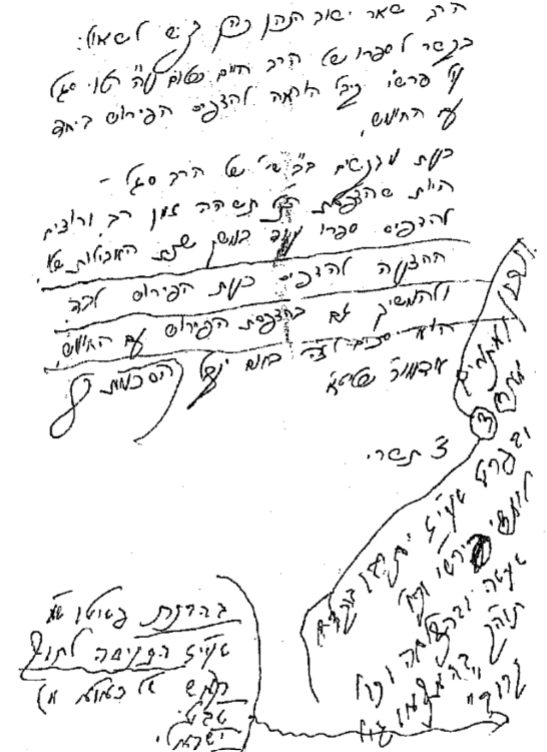
Rabbi Weinfeld sent the Rebbe sample pages from the project, and the Rebbe responded with an encouraging letter containing comments and insights (later printed in the book’s introduction):
“It is understood that the more you include variant texts of Rashi’s commentary – the better, and even more so (since they are not in the main text). On the other hand, one must not add anything into the main text based on one’s own opinion…”
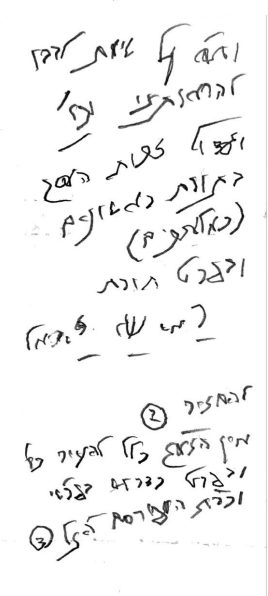
Later, the Rebbe discussed with him the addition of punctuation and vowel-symbols within Rashi’s commentary (which the Rebbe noted was “of no benefit”).
In Sivan 5740, Rabbi Weinfeld visited the Rebbe again, and on the night of the 14th he had a yechidus. During the meeting, the Rebbe asked about the publication of the Rashi commentary. Rabbi Weinfeld replied that he was still working on it, but due to numerous additions, everything would have to be redone.
The Rebbe delved deeply into the editing process with him and asked whether it might be possible to add the new material as annotations to the existing work. Rabbi Weinfeld explained that the additions were actually more extensive than the material he had already prepared, and it would be easier to rewrite everything from scratch. The Rebbe responded:
“It is common among Jews that when there is an additional blessing, it is not only greater but a thousand times so [a reference to Moshe’s blessing to the Jewish people at the end of his life].”
In addition to his unique blessing, the Rebbe instructed Rabbi Weinfeld to visit the Agudas Chassidei Chabad library to photograph ancient manuscripts of Rashi’s commentary to enrich the project.
Eventually, the Chumash was published in three expanded and prestigious editions, earning a respected place in the Jewish world.
The Rebbe Supports the ‘Rashi HaShalem’ Project
The Harry Fischel Institute for Talmudic Research in Yerushalayim earned the merit of publishing a special series of sefarim explaining Rashi on Chumash. The institute’s president, Rabbi She’ar Yashuv Cohen z”l, Chief Rabbi of Haifa, received ongoing encouragement from the Rebbe throughout his work on the series.

The Rashi HaShalem series aimed to trace Rashi’s sources and present them alongside, with annotations and insights to reveal the depth of his words.
In the introduction, Rabbi She’ar Yashuv wrote:
“In this work, we merited great encouragement from the Rebbe of Lubavitch, Rabbi Menachem Mendel Schneerson shlita, whose talks on Rashi’s commentary are foundational in studying our master Rashi’s words, Rosh Bnei Yisrael.”
The last three words—Rosh Bnei Yisrael—were no coincidence. They are an acronym the Rebbe himself used in one of his written responses to Rabbi Cohen.
On 2 Shevat 5750, after the first three volumes on Bereishis had already been published, Rabbi Cohen passed by the Rebbe during the ‘Sunday Dollars’ distribution. He asked the Rebbe whether he had received the sefarim. The Rebbe replied:
“A long time ago already. It was confirmed here as well. You didn’t receive the confirmation?!”
Rabbi Cohen replied: “I did not, which is why I asked.” The Rebbe smiled and responded:
“Nu, in any case – it arrived.”
The Rashi HaShalem series continued to be published until its completion, ultimately integrating the work of Rabbi Chaim Shalom Segal, which is described next.
Enriching the Pirush from Additional Sources
Another sefer published by the Harry Fischel Institute was Tosefes Rashi (“Additions to Rashi”) – the creation of Rabbi Chaim Shalom Segal, a Chabad Chassid in Yerushalayim and a researcher at the institute. This book compiled, in order of the pesukim, all of Rashi’s Torah interpretations found throughout his various writings but not located in his standard Torah commentary.
Alongside this major work, Rabbi Segal also authored Munachei Rashi and Yisron HaOr. Through his studies of Rashi’s teachings, he encompassed all of Rashi’s interpretations and writings. He studied, reviewed, and refined the material, collecting pearls from Rashi’s Torah and weaving them into his sefarim.
For many years, Rabbi Segal aspired to publish a sefer compiling Rashi’s teachings. The one who ultimately motivated him to act was the Rebbe, during a yechidus in 5722, when he asked him to at least produce a sample booklet on Bereishis.
In the introduction to his sefer, Rabbi Segal recounted:
“From my youth, when I studied Gemara, I noticed that in many places Rashi interprets many verses in Tanach – in passing, while explaining the Gemara – differently than in his Torah commentary… Since then, I longed to systematically examine Rashi’s commentary on Gemara and gather all his dispersed interpretations of scriptural verses… Yet, due to various reasons, I was unable to fully organize the material I collected.
“In late 5722, after the Rebbe encouraged and urged me, I strove to prepare and print the Bereishis material. After it was typeset, another delay occurred, and the printing was postponed…
“At the start of 5731, I merited to visit the Rebbe’s court and spend the entire month of Tishrei in his holy presence. When I entered for a private audience on the eve of the 8th of Tishrei, the Rebbe instructed me: ‘To publish and publicize as soon as possible everything prepared on Bereishis – even if it’s a small amount – this booklet will serve as a sample for the complete book to follow, G-d willing.’ Therefore, I hastened with all my strength to fulfill his sacred will.”
Two months later, Rabbi Segal published the booklet and sent it to the Rebbe.
“I acknowledge receipt of your letter from the fifth night of Chanuka, as well as your sefer Tosefes Rashi, and many thanks” – wrote the Rebbe in a combined personal-public letter (Igros Kodesh vol. 26, p. 249–250), and in his own handwriting added: “See the end of the letter.”
At the letter’s end, after his signature, the Rebbe wrote half a page of detailed commentary and notes about the sefer, beginning:
“P.S. Out of fondness for the matter – regarding your sefer…”
Rabbi Segal distributed this letter widely, and it generated awe and admiration among talmidei chachamim and yeshiva students in Yerushalayim.
Over the years, Rabbi Segal merited dozens of letters of encouragement from the Rebbe about his project. He kept them private, and they were only discovered after his passing by family members (and later published in a family commemorative booklet).
In one such letter dated 25 Av 5740, the Rebbe wrote in his own handwriting:
“Surely you have published more volumes on Rashi; it’s somewhat surprising that none have yet been received.”
In late 5741, Rabbi Segal sent the Rebbe a sample page from a forthcoming sefer. The Rebbe responded in his handwriting:
“And many thanks especially for the sample page from Rashi’s commentary, etc.”
On 17 Av 5743, Rabbi Segal passed away before he could see his sefer published. After his passing, Rabbi She’ar Yashuv continued publishing the works through the institute he led.
In Tishrei 5744, Rabbi Segal’s family asked the Rebbe whether they could publish the commentary without the Chumash, since printing it together would take longer. The Rebbe underlined the words “to publish the commentary with the Chumash” and wrote:
“This is correct and very appropriate, especially since it will increase – sooner rather than later – those who study Rashi’s commentary… may it be successful… may it assist in understanding the plain meaning of the text.”
In Conclusion:
It is told that the Rebbe once expressed pain over the lack of sufficient interest in his novel interpretations of Rashi. As proof, he noted that no one had asked him about the explanation he gave on Rashi on the previous Shabbos.
“And from a negative, one can infer the positive” — meaning: this highlighted just how much the Rebbe appreciated when people engaged with his Torah, particularly his teachings on Rashi, through public discussion and in-depth study.
This contains a message for Chassidim even today — to engage passionately (with a koch) in the Rebbe’s Torah in general, and especially in his sichos of the Rosh Bnei Yisrael.
Sources: Igros Kodesh, Likutei Ma’anos Kodesh, Dvar Malchus, Besod Siach, the explanatory works mentioned in the article, their authors’ memoirs, and archived correspondence.
HaTomim #16 • pp. 16-27
© 2026 Beis Moshiach Magazine. All rights reserved.
This article originally appeared in Beis Moshiach #1465. You are welcome to share it with friends and family by email or in print, provided that you do not change, add to or omit any part of it, you credit the author and Beis Moshiach, and you include a link to archive.bmoshiach.org (written out in full in printed copies).
To republish this article in a newspaper, magazine, book or website, please request permission in advance at [email protected].