He Had No Doubts, Even When He Had No Answers
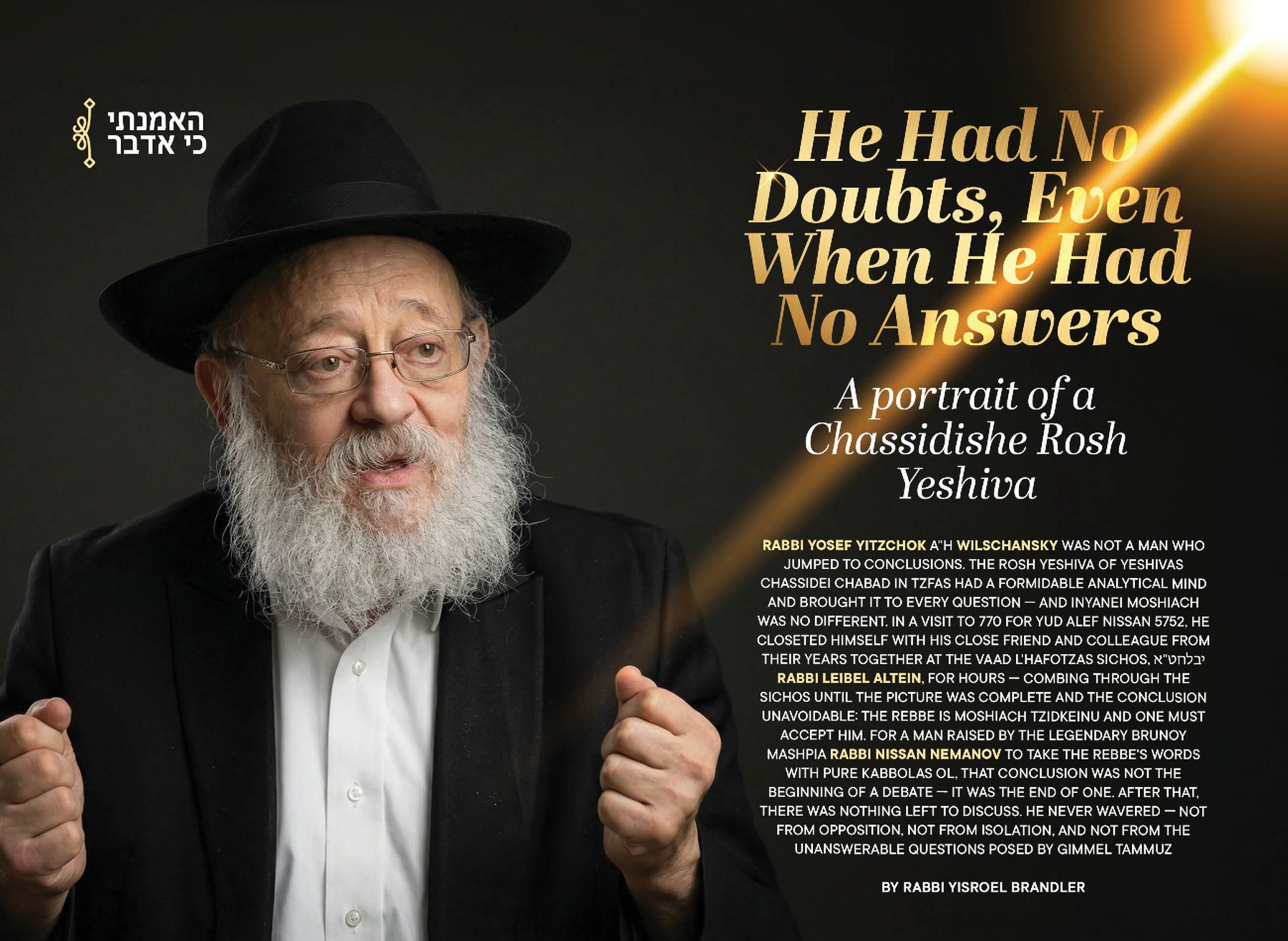
Rabbi Yosef Yitzchok Wilschansky a”h was not a man who jumped to conclusions. The Rosh Yeshiva of Yeshivas Chassidei Chabad in Tzfas had a formidable analytical mind and brought it to every question – and inyanei Moshiach was no different. In a visit to 770 for Yud Alef Nissan 5752, he closeted himself with his close friend and colleague from their years together at the Vaad L’Hafotzas Sichos, Rabbi Leibel Altein יבלחט״א, for hours – combing through the sichos until the picture was complete and the conclusion unavoidable: the Rebbe is Moshiach Tzidkeinu and one must accept him. For a man raised by the legendary Brunoy mashpia Rabbi Nissan Nemanov to take the Rebbe’s words with pure kabbolas ol, that conclusion was not the beginning of a debate – it was the end of one. After that, there was nothing left to discuss. He never wavered – not from opposition, not from isolation, and not from the unanswerable questions posed by Gimmel Tammuz.
Rabbi Wilschansky was on a high, speaking loudly about the need to be connected to the Rebbe’s train, which is moving and advancing. The locomotive – that is, the first car leading the rest – has already whistled and begun to move! Unfortunate is one who is not connected to it and not traveling, for he remains at the station…
These lines were written by the tamim, Avrohom Chaim Mizrachi (today a shliach of the Rebbe in Givati) in the days following Yud-Tes Kislev 5753, authentically documenting the farbrengen of the Chag HaGeula that took place at the Chabad-Lubavitch Yeshiva in Tzfas.
These words aptly define and capture the chayus and fervor in inyanei Moshiach of the renowned Rabbi Yosef Yitzchok Wilschansky a’h, the Rebbe’s shliach to Eretz Yisrael and Rosh Yeshiva of Yeshivas Chassidei Chabad Lubavitch in Tzfas. Also the unique character of this enthusiasm: the Rebbe is advancing, and Rabbi Wilschansky, as a Chassid connected heart and soul, advances with the Rebbe, while ensuring to attach all the ‘cars’ to the ‘locomotive’ – connecting all under his influence to the Rebbe who heralds the Besuras HaGeula and encourages the Chassidim’s proclamation and singing: “Yechi Adoneinu Moreinu v’Rabeinu Melech HaMoshiach l’Olam Va’ed.”
Much has been written and will be written about Rabbi Wilschansky. In the following lines, we will attempt to highlight unique aspects of his dedication to the primary mission of the Rebbe – “to bring about Yemos HaMoshiach” – and to shine a spotlight on his extensive work in empowering the vanguard of the King – the tmimim and Anash – to internalize the Besuras HaGeula and spread it to all people of the generation. And let the living take it to heart.
Emuna Peshuta
It is no secret that among the Chassidim prominent in their chayus for Moshiach, there were those who waited and longed from time immemorial with the thought “when will it come to my hand so I may fulfill it.” The complete faith of every Chassid that the Rebbe of their generation is the Moshiach of the generation burned within them; the signs of Moshiach in Hilchos Melachim were constantly on their lips, and they longed to share this with all of Klal Yisrael – whether from their Chassidic hergesh, or even from conclusions drawn through contemplation of the Rambam’s halachos and similar sources.
Other Chassidim connected with emuna and action in inyanei Moshiach from their nature as ‘Nachshons’ and trailblazers. As passionate and effervescent Chassidim of the type of ‘Oros d’Tohu’ – their personal character served as fertile ground for great momentum in inyanei Moshiach, particularly through various activities to publicize the Besuras HaGeula and kabbolas ha’malchus.
By nature, Chassidim of both these types can also at times miss the mark of the Rebbe’s holy will entirely. When one’s personal nature and ‘own reasoning’ interfere – even when dealing with nature and reasoning of holiness (as in our case) – there is room for error. Thus we find that Chassidim of the aforementioned types ‘got ahead of their time,’ issuing publications and taking action even in times when this was not desired, and indeed the Rebbe decisively rejected such actions.
Rabbi Wilschansky, who was among the leading bearers of the banner of emuna and chayus in the hisgalus of our Melech HaMoshiach, belonged to a different category. His unique passion in inyanei Moshiach stemmed from pure hiskashrus, free of independent opinions and considerations, and from kabbolas ol and devotion to the Rebbe. With him, everything began when the Rebbe came forth with the Besuras HaGeula and the encouragement of “Yechi Adoneinu.” From that moment, he devoted himself to this with his entire being, with complete kabbolas ol and emuna peshuta. And when we are speaking of a man of broad knowledge and genius like Rabbi Wilschansky, the absolute kabbolas ol and emuna are astonishing…
On a certain occasion, he attributed this to the chinuch he received in his youth from the renowned mashpia Rabbi Nissan Nemanov and from his father Rabbi Raphael Wilschansky, secretary of the European Lubavitch office:
“Reb Nissan educated us to take things with kabbolas ol. Though in farbrengens he did not elaborate extensively on the topic of hiskashrus (in Yiddish they say: ‘it wasn’t his cognac’…), when his son had already come to the Rebbe and was regularly sending him the sichos – he began every farbrengen with a sicha of the Rebbe, reviewing the latest farbrengen he had received. In any case, he generally educated us to kabbolas ol, and for me this was always before and after everything. There was also the chinuch of my father in our home – what needs to be done, is done. I was always in the psychical mode: there are the Rebbe’s instructions – they must be fulfilled as they are, with kabbolas ol and emuna. And so it is also in inyanei Moshiach.”
On one occasion, he was asked about the special spirit that prevails in the Tzfas yeshiva regarding inyanei Moshiach – a spirit that came of course from the rosh yeshiva… In response, he elaborated on the aforementioned point, attributing it to the shlichus to Eretz Yisrael, and certainly these words are true and teach us about him personally:
“In order to clarify things, I wish to preface and highlight that the yeshiva in Tzfas, from the moment of its founding, was a ‘shlichus’ yeshiva – a yeshiva established by the Rebbe’s shluchim, in order to fulfill his holy will and direct instruction ‘to restore the crown to its former glory’ by establishing Chabad institutions in Tzfas.
“In the yeshiva’s early period, all the married shluchim to Eretz Yisrael resided in Tzfas, creating the special atmosphere of ‘hiskashrus’ that added to and influenced the yeshiva’s unique character. At that time, the talk among students in yeshivas was that whoever wants to experience passion in hiskashrus to the Rebbe should travel to Tzfas… because there they direct and stoke passion regarding hiskashrus. Boruch Hashem, this atmosphere impacted other yeshivas, and subsequently some of the shluchim went on to serve as roshei yeshivas and mashpiim in other yeshivas, infusing them with that spirit of hiskashrus.
“The fact that the yeshiva proudly and strongly bears the banner of faith in the Rebbe as Melech HaMoshiach stems from the same point. The topic of Moshiach is one the Rebbe agitates about without limit; this is what he demands, what he drove home above all things. Naturally, from true hiskashrus and uncompromising devotion to the Rebbe, it is of course obvious and simple that the moment the Rebbe comes out with all the directives regarding Moshiach and places them at the top of the agenda – then in the most natural way, this takes top priority for us.
“Many call the yeshiva a ‘Meshichist’ yeshiva. It is important to clarify: it is not that we took upon ourselves the ‘Moshiach banner,’ that a decision was made among us that we are the ones to place the emphasis and take responsibility for the inyan of Moshiach – that is absolutely not the case! This is a continuation of the same policy platform upon which the entire yeshiva is built and founded from the start: loyalty to the Rebbe, loyalty to the Rebbe’s directives, and devotion to them. And from the moment the Rebbe demands Moshiach and the avoda of Moshiach with full force – it is understood that this is what we do! It simply ‘grows’ from the fact that this is simply what the Rebbe demands…”
In this spirit, Rabbi Asaf Chanoch Frumer, mashpia of the Chabad Haifa Yeshiva, tells us that Rabbi Wilschansky once said to him about the students in the yeshiva: “Why are they ‘koching zich’ (burning with passion) in inyanei Moshiach – is it because they studied extensively the words of the Chofetz Chaim [who dealt passionately with anticipation of the Geula and preparations through studying the laws of the Mikdash]?! This comes from studying the Rebbe’s sichos!”
Also when he was asked to explain why it is important that a person know who Moshiach is, and not enough to know generally that he will come – after explaining wisely and insightfully that this makes the entire topic of Geula a present reality, he immediately reiterated forcefully in accordance with his aforementioned approach: “All these explanations are only on the level of ‘lower understanding,’ for the essential chayus must come from the very fact that the Rebbe encouraged this so greatly, and this itself indicates that there is purpose and importance in it.”
It is no coincidence that he referred to the “gevaldige osiyos” of the sicha of Shabbos Parshas Vaeira 5752: “The bittul and hiskashrus to the Rebbe, Nasi Doreinu, ‘the Nasi is everything,’ through which in each and every individual their existence and all their affairs become sanctified to the Nasi HaDor – through being filled and permeated with fulfilling the mission of the Nasi HaDor, Moshe Rabeinu of our generation, ‘the first goel is the final goel,’ whose primary inyan is ‘to bring about the Yemos HaMoshiach’ in actual practice.” This is what he lived and implemented in practice.
‘What do I say? What does the Rebbe say!’
Rabbi Shlomo Halpern, Mara d’Asra of the Chabad community of Tel Aviv, studied at the Tzfas yeshiva in the years 5751-5753. In subsequent years as well, he maintained close contact with Rabbi Wilschansky, particularly regarding inyanei Moshiach. He shares an anecdote from those days: “I remember that during the Gulf War, in the winter of 5751, while missiles were falling on the Land and ‘Yisrael was shaken and frightened,’ Rabbi Wilschansky lived by and invigorated us with the Rebbe’s words that Eretz Yisrael is the safest place. The entire war is part of the revelation of Moshiach as per the famous Yalkut Shimoni, and he eagerly looked forward to hearing what the Rebbe would say at the Shabbos farbrengen regarding the situation.”
This line of “we have only the words of ben Amram” continued to find expression throughout all the events in those years of the early ‘nuns’, as Rabbi Wilschansky always lived by and invigorated the talmidim in yeshiva to cling to the Rebbe’s words. When asked what the Rebbe says about the matter at hand, he would say: “What do I say? What does the Rebbe say!” So many times I heard from him the line: “The words speak for themselves…”
His son, Rabbi Chaim Eliezer Wilschansky, head of the Chanoch L’Naar yeshiva in Tzfas, relates: “My father always ‘lived’ with the Rebbe and the Rebbe’s Torah. One can say he was connected to it by ‘IV’… Before Shabbos, a brown envelope would arrive with the new ‘kuntreisim’ (of sichos and maamarim, etc.), and my father would not put it down until he finished the booklets several times. Wherever he went, he took them with him – whether going down to the yeshiva or anywhere else. He would go to sleep with them beside his pillow, and in the morning immediately returned to the booklets… This is how it was always, in all the years and inyanim, and so it was in recent years regarding inyanei Moshiach.
“After the famous sicha of Chof-Ches Nissan 5751, he was ‘shaken’ and did not know what to do with himself. However, he was not among those who were busy with saying ‘we don’t understand exactly what the Rebbe wants’ and that one needs to investigate further, etc. – on the contrary, he tried to act because it was clear that one needed to act. So he cried out ‘We Want Moshiach Now,’ spoke about it everywhere, and began to study the sources on the matter. I remember him speaking at a gathering held then in the Chabad quarter of Tzfas, exclaiming that this is what the Rebbe wants and one must throw himself into it, etc.”
One of the earliest and most important activities in the days following the sicha of Chof-Ches Nissan was the psak din of Chabad rabbis in Eretz Yisrael, that the Rebbe is the “final redeemer” and he must redeem the Jewish people immediately. Rabbi Mordechai Shmuel Ashkenazi, Rabbi Wilschansky’s brother-in-law, formulated a written halachic ruling on the matter, with several Chabad rabbis adding their signatures. R’ Dovid Nachshon, R’ Shmarya Harel, and the late R’ Avi Taub traveled to the Rebbe with the psak din, and the Rebbe accepted it with thanks and even said he would take it to the tziyun – as is well known.
This was followed by a reading of the psak at holy gravesites. After Shavuos 5751, R’ David Nachshon and R’ Avi Taub were sent by the rabbanim to read the psak at the gravesites of our Rebbeim in Russia, and they had the privilege of receiving encouragement and responses from the Rebbe regarding their shlichus. Before 5 Menachem Av, R’ Nachshon thought it appropriate and worthwhile to read the psak at the gravesite of the Arizal on his yahrtzeit, and he wrote to the Rebbe about it and received his holy blessing: “Azkir al ha’tziyun.”
Rabbi Wilschansky participated in carrying out this mission (as did his father-in-law, Rabbi Moshe Ashkenazi). And so we read in the detailed report that R’ Dovid Nachshon sent to the Rebbe: “As I wrote, the plan was that we had a minyan with us – R’ Avi Taub, R’ Shmarya Harel, Rav Moshe Ashkenazi, and Rav Yosef Yitzchok Wilschansky, and several more tmimim… We said together Perek 90 and then read (by me in a whisper) the psak din for the hisgalus of the Rebbe MH’M immediately and truly, and for the building of the Beis HaMikdash immediately and truly (the entire psak as it was read at the gravesites of our Rebbeim). I also said that we came on behalf of the Beis Din, and we again said three times Vihi Noam, Yechi, etc. We placed the psak on the tziyun and it went up in flame heavenward.” On this report the Rebbe gave a unique response: “May it be His will that all this accomplish its effect… and the time is propitious… I will mention it at the tziyun!”
About these days, Rabbi Frumer relates: “I cannot forget how already in 5752, Rabbi Wilschansky lived inyanei Moshiach with unusual passion. To this day I can see before me the scene of how the he reviewed in the Tzfas yeshiva, Shabbos morning, one of the ‘fresh’ sichos which said that only ‘opening the eyes’ remains, and he emphasized how the Rebbe ratchets up the language from Shabbos to Shabbos.”
Yechi, Yechi, Yechi!
One of the stages in Rabbi Wilschansky’s internalization of the change the Rebbe was making regarding identifying Moshiach – as he described in later years to his family – was the famous response to Rabbi Nachman Meir Bernhard from South Africa. The latter raised in his letter to the Rebbe the hesitation of the shluchim in his location as to whether to join signatures on acceptance of the Rebbe’s malchus as Melech HaMoshiach. For on the one hand, the Rebbe had previously rejected such things, while on the other, it was being said that there were signs that now this was indeed desired. On the eve of the 15th of Shevat 5752, the response was: “Depends on local conditions – the local Chabad leadership should clarify this” (and he marked with an arrow the name of the local shliach mentioned in the letter).
This response really ‘grabbed’ Rabbi Wilschansky at the time, and from it he concluded (like many other distinguished individuals) that even though previously the matter was completely ‘internal,’ now a change had occurred and the matter was, in principle, fitting and needed for publication. Over the years, he pointed several times to this response as decisive proof that there is a need and purpose in identifying Moshiach. He even added and highlighted that since then the matter had been strengthened even further when, in the year 5753, the Rebbe began encouraging the singing of “Yechi” publicly before all the nations, in every location…
Rabbi Halpern shares with us his memory of a conversation with Rabbi Wilschansky on Chof-Zayin Adar I, 5752: “That very night, after the Rebbe’s ‘health episode,’ I spoke with him and he was very pained. He knew exactly and in full detail what was happening (which doctors and equipment had been brought, etc.)… He said that according to natural means this was no simple matter, contrary to the rumors that had spread then… and yet he emphasized that we believe and are confident that immediately the Rebbe will be revealed.”
Rabbi Frumer also relates about the period after Chof-Zayin Adar 5752: “I remember well that when at various events in the summer of 5752, after the incident of Chof-Zayin Adar I, the Rebbe was blessed for a full recovery, Rabbi Wilschansky stood and whispered ‘Yechi, Yechi, Yechi.’”
‘Write This in the Book – The Rebbe is Moshiach Tzidkeinu’
The ‘makkeh b’patish’ came during his trip to the Rebbe for Yud-Alef Nissan 5752 – the conclusion of of ‘Shnas HaTzaddik’ [90th year] of the Rebbe – in the turbulent days following the ‘health episode.’ During his visits to the Rebbe in 770, Rabbi Wilschansky would follow the regular practice of going up to the office of the Vaad L’Hafatzas Sichos, in which he had served as a member until being sent by the Rebbe to Eretz Yisrael, located in the office building at 788 Eastern Parkway, adjacent to 770. During his visits he would ‘catch up’ in friendly conversation with his friends on the committee, especially with Rabbi Yaakov Leib (Leibel) Altein, whom he greatly esteemed.
During this visit, he and Rabbi Altein sat together for many hours, clarifying the general progression emerging from the sichos of the entire recent period. Their deep study put all the pieces together to form a clear picture whose clear conclusion was: there is a Moshiach – Nesi Doreinu – and one must accept him.
At the central farbrengen held in 770 on that special day, one of the secretaries spoke, and he related his conversation with the Rebbe in his holy room several months earlier. During that conversation, the Rebbe told him that Moshiach needs to be informed from Above that he is Moshiach and this has not yet been revealed to him, and therefore it is unknown and not yet determined. According to this, the secretary wanted to say that the prayers and the cry of “Yechi HaMelech” should be directed heavenward, as a request that the Rebbe receive the instruction and shlichus to redeem the Jewish people.
The story and its conclusion stood in apparent contradiction to the aforementioned progression emerging from the sichos, and Rabbi Altein, who was sitting beside Rabbi Wilschansky at that moment, immediately reacted: “Well, so perhaps at that hour it had not yet been communicated to the Rebbe. How does he know what happened afterward?” This statement too left a profound impression on his thought process.
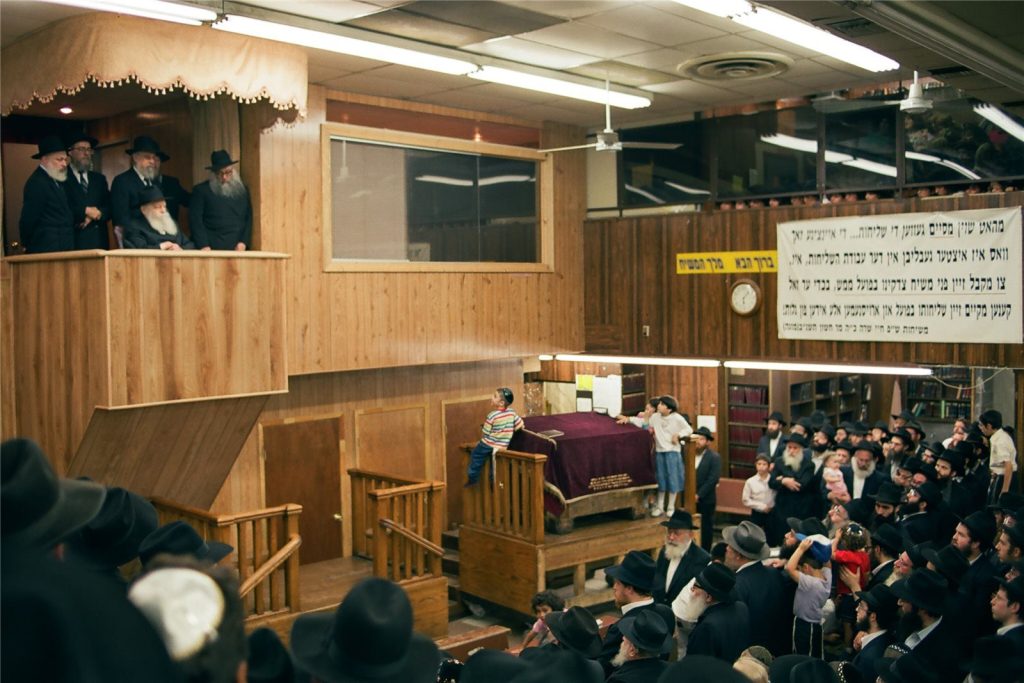
Later in that farbrengen, when he was honored to speak in Lashon HaKodesh, he spoke sharply and clearly, and with words that “come from the heart” he spoke about the need to implant in our minds that we are in the last generation of galus and the first of Geula – the generation of Malka Meshicha, in which Moshiach is already present:
“After all the pilpul we heard from the secretary, ultimately the things were stated clearly by the Rebbe. ‘Write this in the sefer’ – the Rebbe said and wrote and transmitted to us in his sichos: Moshiach is already present, the Rebbe is Moshiach Tzidkeinu, and there is even reason to publicize this! We were raised on the emuna in Hashem and in Moshe His servant and with this we continue. Amalek tries to cool us down but will not succeed! Nothing that has occurred will cool our faith in the Rebbe as Moshiach Tzidkeinu, our longing for the coming of Moshiach, and our actions to actually bring the Geula through the Rebbe, King Moshiach – Yechi l’olam va’ed!”
Rabbi Wilschansky concluded his words with an appeal to those present to join in emuna in Nesi Doreinu, while clarifying that the emuna continues in full force after Chof-Zayin Adar. “On this day, Yud-Alef Nissan, let us all decide that we are ‘within the cloud.’ We have no doubt, we all live it. The askanim will deliberate about how to transmit this further, but within ourselves we must believe in this and strengthen our faith more and more. Despite the things that have occurred and can, G-d forbid, bring a person to a certain weakness – we have no questions on this matter. Davka today, the matter was determined in halacha, the things were transmitted in the Rebbe’s presence, and we all together accepted upon ourselves: ‘Yechi Adoneinu Moreinu v’Rabeinu Melech HaMoshiach l’Olam Va’ed!’”
‘This Will Continue and Intensify’
On the 5th of Menachem Av 5752, all of Israel was flooded with notices bearing clear and explicit messages that the Rebbe is Melech HaMoshiach, with a detachable form to join and sign on kabbolas ha’malchus of Moshiach. This was the private initiative of the ‘tankist’ R’ Yigal Hoshiyar, who blazed a trail in nationwide print publicity regarding the identity of Moshiach. The campaign that stirred the country provoked opposition from many Chassidim – including those who were active in publicizing the Besuras HaGeula and kabbolas ha’malchus, who felt that R’ Yigal had gone overboard and stepped out of bounds with his publication. In their view it was too explicit and clear, and on too large a scale… Rabbi Frumer relates that he remembers that actually Rabbi Wilschansky viewed this positively and even determined without hesitation: “This will continue and intensify!”
As can be seen in his aforementioned address on Yud-Alef Nissan at 770, the proclamation of ‘Yechi Adoneinu’ was regularly on his lips (as it was on the lips of other Chassidim) even before the Rebbe’s regular encouragement of the singing of “Yechi” beginning from Simchas Torah 5753. But of course, from that point on, the matter became sacred to him beyond measure.
The following episode was told to us by Rabbi Frumer: “I remember a farbrengen in the yeshiva where Rabbi Wilschansky and Rabbi Ofer Myodovnik farbrenged together. This was at a relatively early stage in the inyan of ‘Yechi Adoneinu,’ and Rabbi Myodovnik argued that while the content of ‘Yechi Adoneinu’ is indeed needed (kabbolas ha’malchus, etc.), it is not necessarily a matter of the specific wording. But Rabbi Wilschansky responded against him forcefully: ‘The wording is essential!’”
About the degree to which he stood out as an activist in inyanei Moshiach from the outset, one can learn from what Rabbi Frumer recalls – that after the the Rosh Yeshiva returned (most likely) from the Kinus HaShluchim 5753, he related at a farbrengen in yeshiva to his talmidim that on this trip to the Rebbe he was surprised to discover he had a new title: “Meshichist…”
Speaking about the daily encouragement of the singing of “Yechi” in 5753, many times Rabbi Wilschansky would recount what happened on one of those holy occasions – the lighting of the fourth Chanuka candle, the 27th of Kislev, 5753. The Rebbe came out to daven Mincha with the Chassidim in the ‘special room,’ and after chazaras ha’shatz moved to the balcony to light the menorah. The crowd sang “Haneiros Hallalu” and the Rebbe encouraged the singing, and suddenly the Rebbe signaled with his holy hand in a way that led them to think he wanted to leave, but by raising his palm the Rebbe signaled to stop and with hand gestures indicated to the crowd to continue. The crowd said “Aleinu Leshabeiach,” etc. – until at the conclusion of the final Kaddish, the crowd broke into the singing of “Yechi Adoneinu” and the Rebbe encouraged it, and only afterward signaled for the curtain to be closed.
“From here [we see that],” emphasized Rabbi Wilschansky, “if someone doubted whether the Rebbe wants and waits for them to sing ‘Yechi’ specifically – here is a clear example that the Rebbe waited (after the Chassidim had already sung another niggun and the Rebbe encouraged it), until they would sing this, and he encouraged it, and only afterward did he leave.”
Before the satellite broadcast – the global kabbolas ha’malchus planned for around Yud Shevat 5753 – there was no small confusion among Chassidim. The lofty occasion was preceded by a hullabaloo created by activists and various forces, and so a flood of faxes with opposing messages were sent to Anash, creating confusion about what exactly the Rebbe wanted and what was the ruling of the rabbanim. [Rabbi Betzalel Kupchik remembers that Rabbi Wilschansky was among those who arrived at the gathering of rabbanei Chabad held shortly before the broadcast, a gathering that was ultimately decided by Rabbi Mendel Futerfas in favor of proceeding with the broadcast.]
Family members relate that at a certain stage Rabbi Wilschansky decided to “study the sugya.” He secluded himself and examined all the various faxes, aiming to reach the truth: whether the ‘holy will’ was indeed for such worldwide dissemination. The conclusion he reached was that everything depended on whether the Rebbe would come out for the occasion. In practice, the Rebbe did come out, and Rabbi Wilschansky “roared” Yechi with all his strength while jumping with tremendous enthusiasm… When he returned home afterward, his children heard him repeatedly reciting to himself the words of the holy proclamation, as if seeking to fix the words in his mind and heart forever. And indeed, from that point he remained attached to it always, never deviating right or left.
Living Moshiach
Since the Shnos HaNiflaos [the early ‘nuns’], thousands of Tmimim were educated under the influence of Rabbi Wilschansky (and the yeshiva’s staff of rabbis in general) to live with chayus in inyanei Geula and Moshiach – specifically in the spirit of the “maaseh rav” of the years 5753-54 of encouraging the singing and proclamation of “Yechi.” This was expressed both within the yeshiva’s regular schedule, which includes organized and in-depth shiurim on inyanei Geula and Moshiach, and outside the regular sedarim, in various initiatives for studying and spreading the Besuras HaGeula that the yeshiva encouraged and continues to encourage. The yeshiva is known for its uniqueness in maintaining contact with alumni, and this is naturally utilized to preserve vitality in inyanei Moshiach and devotion to bringing about the Yemos HaMoshiach.
Another area he impacted regarding inyanei Moshiach was the Chabad community in Tzfas, to which he was sent by the Rebbe “to restore the crown to its former glory.” As is known, Rabbi Wilschansky had a wonderful sense of Ahavas YIsrael and would honor and listen warmly to each and every person. As such, combined with the fact that most of the community members are yeshiva alumni, he had a decisive influence on shaping the community, even though he did not bear formal leadership responsibility. Indeed, the community being a living example of fulfilling the instruction “to live with Moshiach” is largely attributed to his credit.
Rabbi Yitzchok Lipsh, director of Tzach in Tzfas, relates that Rabbi Wilschansky always encouraged him to approach the Mara d’Asra, Rabbi Levi Bistritsky with the various notices and publications, and to always invite the rabbi (and later his son) to all events that the yeshiva would organize together with Tzach. The general approach was to kindle passion in inyanei Moshiach as much as possible while maintaining respect for the Mara d’Asra.
Several times, he remarked regarding what was said at the Shabbos Parshas Vayakhel 5752 farbrengen in connection with Ahavas Yisrael, that the order of things is not coincidental. The fact that the Rebbe chose to say these things specifically then, after all the sichos and wondrous expressions of 5751-52, is because Ahavas Yisrael and unity are indeed the ‘pinnacle’ of the Besuras HaGeula! And indeed, he himself acted and conducted himself in this spirit.
L’Olam Va’ed
After the bitter experience of Gimmel Tammuz, he sprang into action like a devoted soldier to lead the way in activity in inyanei Moshiach. While many good people turned their hearts away, he did not budge and led a clear policy of continuing the campaign of the Besuras HaGeula and emuna in the Rebbe as Melech HaMoshiach. He was among the founders of the “Matteh Moshiach” in Eretz Yisrael in 5755 and served as a member of its board, always participating in various gatherings and encouraging the continued spreading of the Besuras HaGeula.
This demanded of him great inner strength, since his close friends and natural surroundings did not necessarily continue in this direction. He also received insults and humiliations for this, and being particularly sensitive and warmhearted, it affected and even “shook” him. But he repeatedly studied and meditated on sichos and strengthened himself that this is the truth and this is what must be done.
In the days after Gimmel Tammuz, he was invited to speak before the students at Beis Chana in Tzfas, who asked about the situation – how could this be, etc. His answer was clear: “There are questions I have no answers to. What is clear is that there is a niggun the Rebbe encouraged – ‘Yechi Adoneinu Moreinu v’Rabeinu Melech HaMoshiach l’Olam Va’ed,’ and everything connected to this remains forever, ‘l’olam vaed.’”
At that time, at symposiums and various events held at 770 and in Chabad communities, he positioned himself to answer questions and encourage the tmimim and Anash at 770 to continue clinging to the Besuras HaGeula with greater strength and might. He took a prominent part in the series of major gatherings held then to strengthen emuna, some of which he also led with great skill.
On Shabbos HaGadol 5751, toward the beginning of Shnas HaTzaddik, the Rebbe explained the instruction from the divine meaning of the letter ‘tzadi’ (as it is customarily referred to in Chazal), whose meaning is “my side”: since in the descent of the soul into the body there is a world that conceals and hides divinity and free choice is in his hands to act as he wishes – such that it is as if he is standing to the side. The Jew is told that he must “take a side” in the matter and be on the “right side” – “Hashem’s side” of Torah and mitzvos – and specifically through this will he have the power to transform the world and work within it so that it belongs to Hashem, Torah, and mitzvos.
Rabbi Wilschansky fulfilled these words in the subject that was at the top of the agenda – kabbolas pnei Moshiach Tzidkeinu. Together with his constant encouragement for unity among Chassidim, consistently avoiding the use of divisive definitions and similar terms, when for the sake of devotion to inyanei Moshiach it was necessary to take actions that would appear as “taking a side” – he did not shy away from this.
That the Rebbe Should Conquer the World
In closing, we saw fit to quote Rabbi Wilschansky’s on a certain occasion in which he depicted the mindset and education of a Chassid of the seventh generation that lead him to publicize the Besuras HaGeula:
“Among Chassidim, every word of the Rebbe is the Holy of Holies! A foundation and basis from which one cannot move even a hair’s breadth. What is written explicitly in a sicha is ‘Shema Yisrael.’ In the Rebbe’s teachings there is a definitive reference to most of the topics that are discussed and debated. The Rebbe’s sichos, from recent years in particular, are our ‘Shulchan Aruch’ for the current period. And just as a person cannot express ‘opinions’ in the laws of kashrus without first having studied the laws of kashrus in the Shulchan Aruch – so it should be absurd for a person to express opinions on the topic of Moshiach before studying the Torah of Geula. For some reason, the topic of Geula is perceived by people as an open topic for discussion, where anyone can determine a view and say ‘this is how it should be because this is how it seems to me, because this is how I think…’ – an absurd situation that has accompanied us since ‘Mivtza Moshiach’ began.
“‘Great is study that brings to action.’ Learning inyanei Geula and Moshiach, particularly the recent sichos, brings the learner to ‘live with Moshiach,’ and by personally ‘living’ it, he also becomes ‘chai l’hachayos – alive to vivify’ others.
“We were educated to be proud of the fact of being Chabad Chassidim, and to feel a need to tell the entire world about the great joy that we merited to be Chassidim, and the even greater and more elevated joy that we have a Rebbe – and that everyone must know what he has said and what are his instructions. The goal of every Chassid was always that the Rebbe should conquer the world. That all Jews should be Chassidim of the Rebbe. From time immemorial it was clear to every Chassid and shliach involved in spreading the wellsprings, that in every action performed – an event or material published – the Rebbe’s image must appear prominently and respectfully.
“This approach is not an invention of Chassidim. This is the approach the Rebbe teaches and guides us in through tens and hundreds of sichos. The Rebbe repeatedly emphasized that Lubavitch must conquer the world. The Rebbe stated explicitly that every shliach must know that his goal is to transform the location into Lubavitch.
“This point also finds expression in edited sichos, such as in Likkutei Sichos Volume 10 in the sicha on Parshas Vayeishev (I), where the Rebbe explains that ‘binding sheaves’ is the avodas ha’shlichus, and from this we learn an instruction from the pasuk ‘and behold your sheaves gathered around and bowed down to my sheaf’ – that ‘the shleimus of the avoda in his effect on others is when he will act to bring him to the sheaf of Yosef HaTzaddik, who is the ruler over all the land of Egypt – Nesi Doreinu – to bring about in him the bowing and nullification to the Nasi.’
“Similarly in Likkutei Sichos Volume 11 in the sicha on Parshas Pekudei (III), the Rebbe says: ‘There must be the involvement and work of each and every one in Torah and mitzvos with his own strength, and nevertheless he must know that this is only the preparation, and he must bring all his work and labor to Moshe [who is in each and every individual, and through this to the extension of Moshe in our generation] – the wise men of the generation, the eyes of the congregation, for the ‘Moshe’ of the generation has the power to erect the Mishkan in the soul of each and every one.’
“Because of this, one must ensure that in every possible place the Rebbe’s name is publicized. Whether in a brochure or news bulletin that will include his image or specific articles about the Rebbe and his activities, all the way to special rallies in honor of the Rebbe, etc. As it is in publicizing the Rebbe’s name – so too in publicizing his holy words: our task is to be the shofar that raises high the Rebbe’s view on every matter on the agenda. We must ensure that all obey his words and instructions.
“When the Rebbe proclaims that behold, Moshiach is coming and he himself is the final redeemer – our task is to inform everyone about this, and to ensure that they indeed internalize the tidings and prepare for the Geula b’poel mamosh!”
Hold On To The Dollars
I remember a farbrengen in the yeshiva in Tzfas when Rabbi Wilschansky a’h related the following:
I heard an amazing thing from a Chassid who was in charge of printing and putting together the kuntreisim that the Rebbe gave out to the Chassidim. The kuntrus “V’Ata Tetzave” was given out by the Rebbe on erev Purim Kattan 5752, two weeks before Chof-Zayin Adar. This kuntrus is the last one we received from the Rebbe. The kuntrus was placed in a plastic holder and with it were two dollars for tzedaka and a piece of lekach.
This Chassid was given many dollars by the mazkirus so he could prepare the packets. When he went back to the mazkirus after the distribution in order to return the remaining dollars, he was told that the Rebbe said he should hold on to them for the next kuntrus distribution.
I remember that Rabbi Wilschansky said that when this Chassid told him this story, he didn’t want it publicized (apparently because he didn’t want people to know he had these dollars) but Rabbi Wilschanky said to him: This story must be publicized in order to increase and strengthen the emuna that teikef u’miyad the Rebbe will be revealed and will give out kuntreisim, so he would davka publicize the story but without a name.
HaTomim #19 • pp. 28-41
© 2026 Beis Moshiach Magazine. All rights reserved.
This article originally appeared in Beis Moshiach #1500. You are welcome to share it with friends and family by email or in print, provided that you do not change, add to or omit any part of it, you credit the author and Beis Moshiach, and you include a link to archive.bmoshiach.org (written out in full in printed copies).
To republish this article in a newspaper, magazine, book or website, please request permission in advance at [email protected].