What the Rashag Told Me About the Red Handkerchief
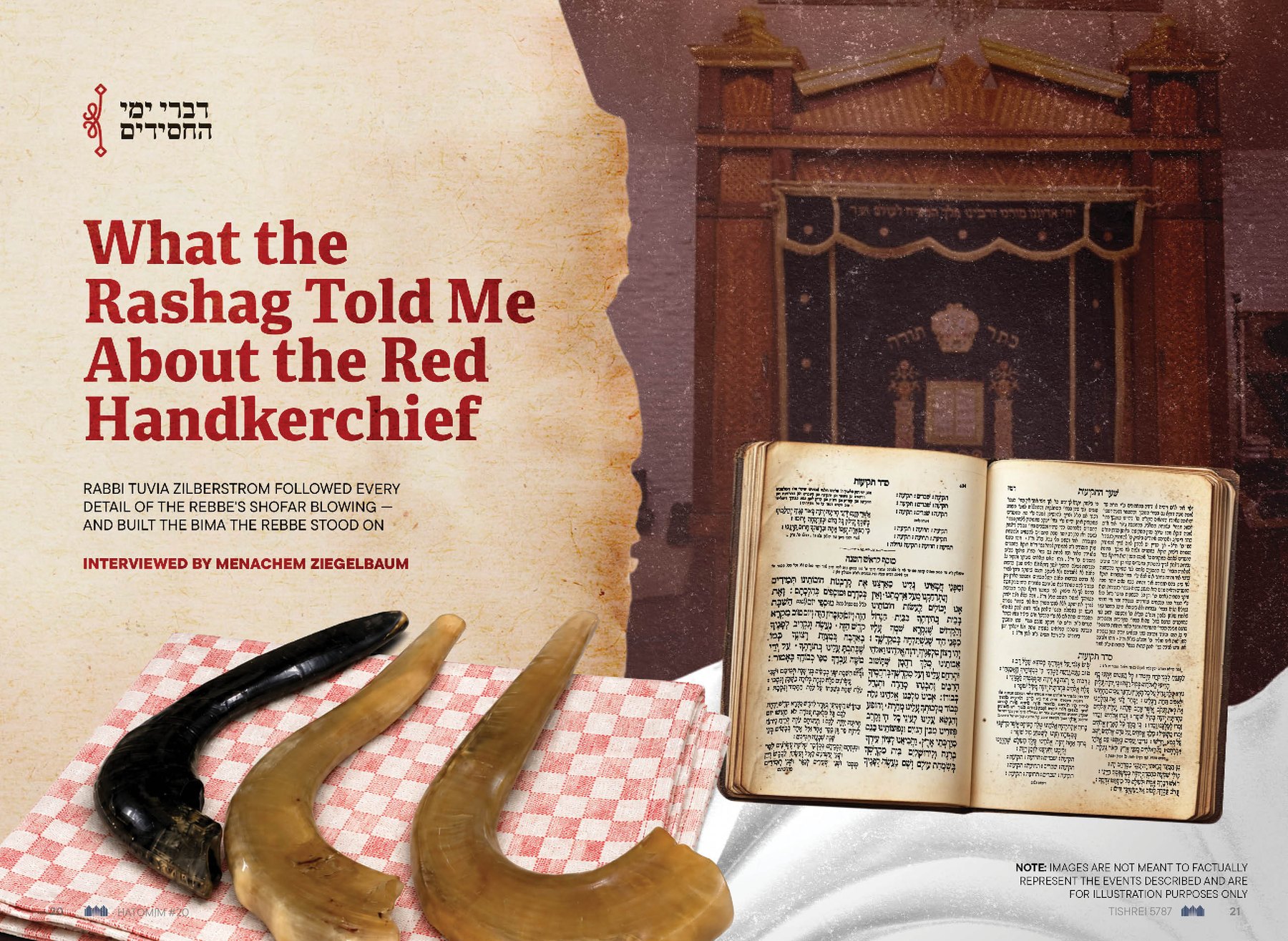
Rabbi Tuvia Zilberstrom followed every detail of the Rebbe’s shofar blowing – and built the bima the Rebbe stood on.
Rabbi Tuvia Zilberstrom, a Yerushalmi by birth, came to the central yeshiva at 770 for the Kevutza year in 5734 (1974) and remained in Beis Chayeinu until the summer of 5738 (1978). Today he serves as Rav of Heichal Levi Yitzchok in Shikun Chabad, Yerushalayim, and as Mara d’Asra for Anash of Shikun Chabad, and is widely known as a lecturer and mashpia. We spoke with him about Rosh Hashana, the essence of the day, and what he saw in the Rebbe’s presence.
It’s erev Rosh Hashana. Let’s begin with a question that has been asked many times and still needs answering: what is the essence of Rosh Hashana?
A Jew has to ask himself a pointed question: do you truly accept Hashem as King over you?
Kabbolas ol is expressed, of course, through a person’s deeds—and the Rebbe Rayatz illustrates this in his Rosh Hashana maamarim with a mashal about a man going to a job interview.
Anyone going to a job interview dresses in his best clothes to make a good impression on the man who might hire him. But our fellow arrives in shabby clothes. “Is this how a person comes to an interview?” they ask him. “I have nothing better,” he answers. “Once I get my first paycheck, I’ll certainly buy something nice.” A man who thinks he can show up as he is, in torn and dirty clothes, will not be hired. He will be taken by the lapel and put out the door.
And the nimshal: you come before Hashem and say, “Our Father, our King, we have no King but You.” Is that true? The burden of proof is on you. In what clothing did you arrive? Launder your old clothes and mend them. You had no money for the laundry? Go down to the river and wash them yourself—“though you wash yourself with lye and use much soap.” Chassidus explains that this washing is done with the tears of teshuva: “O wall of the daughter of Zion, let tears run down like a river, day and night.” Are your clothes torn? Take a needle and thread and sew them. But a person does not come to the gate of the King dressed in rags.
Among the broader public, Yom HaDin is felt to be the heart of the preparation for Rosh Hashana. In the world of Chassidus we speak of something higher still: the binyan ha’malchus that takes place at the sounding of the shofar.
The Shofar Blowing at the Rebbe — Unforgettable
The peak moment of the coronation is the sounding of the shofar. How should a person prepare for it?
The Chassidic maamarim explain that the kabbolas ol malchus shomayim a Jew awakens within himself during the shofar blowing is precisely what draws down the bracha for a good year—in life, in children, and in parnassa.
The Rebbe Rayatz relates that the Baal Shem Tov told the author of Degel Machaneh Efraim that when the shofar is sounded above, prosecuting forces rise to accuse, and our holy Avos—Avrohom, Yitzchok and Yaakov—together with all the shepherds of Israel, come forward to defend their children. When a person here below resolves to accept upon himself the yoke of Heaven, he strengthens the hand of those advocating on Israel’s behalf.
There are many kavanos in the blowing of the shofar. First, of course, one must learn the halachos in order to blow correctly. Beyond that there are general intentions and more particular ones. The Shelah HaKadosh describes every halacha of the shofar in terms of a person’s avoda —and even he writes that a person needs the tzaddikim to elevate his tekios.
You yourself were present at the Rebbe’s shofar blowing over many years. Can you share some of what you saw?
The scene is unforgettable. Chassidim have held from time immemorial that a person should hear the tekios from tzaddikim, from men of spiritual stature. The passuk does not say “fortunate is the people who sound the teruah”—any young boy can produce a blast—but “who know the sound,” yodei teruah. And who is more a knower of that sound, with everything the word implies, than they?
Through all the consecutive years I merited to be in the Rebbe’s presence in Beis Chayeinu, I followed the entire order of the shofar blowing closely, and every detail is etched in my memory.
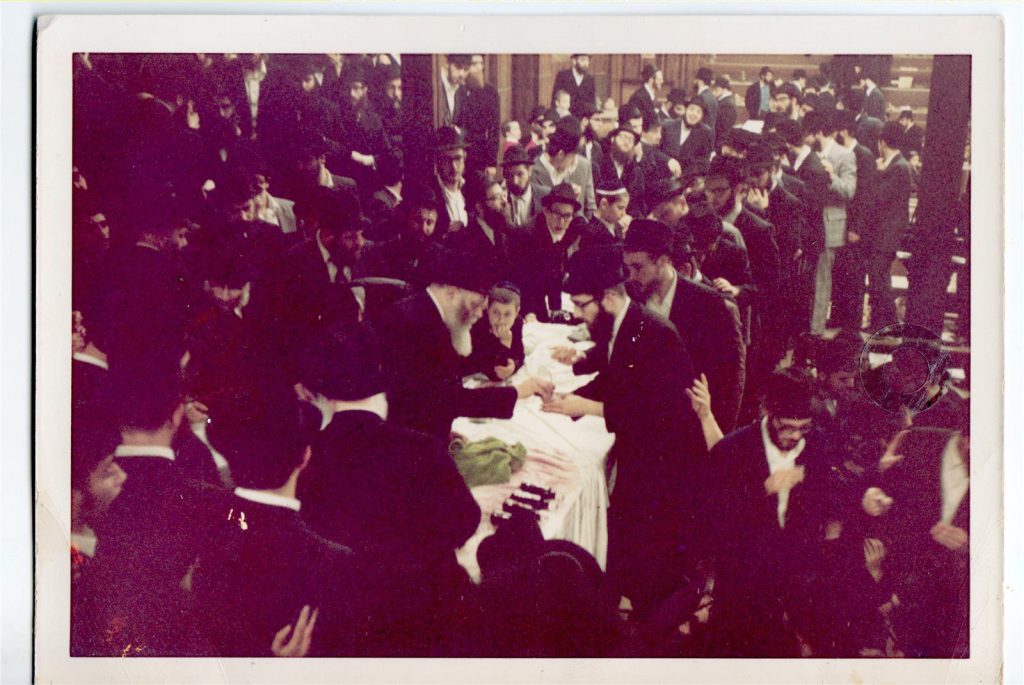
With the Rebbe, the shofar blowing was a complete avoda. He would first spread a white cloth over the bima, and over it a second white handkerchief with red dots, which everyone called “the red handkerchief.” On these he placed the shofars he used. This second cloth appeared in public only twice a year—on Rosh Hashana for the tekios, and on Yom Kippur, when he wore it around his neck for the entire day.
A Chavrusa With the Rashag
During my years by the Rebbe, I merited to learn b’chavrusa with Rabbi Shmaryahu Gurary, the Rashag, the Rebbe’s brother-in-law and son-in-law of the Rebbe Rayatz. I tried, as best I could, to ask him the questions only he could answer. He told me that the red handkerchief had come down to the Rebbe from the Rebbe Rayatz, who had received it from his father, the Rebbe Rashab, who would hold it in his hand while saying maamarei Chassidus.
It is known among Chassidim that when a Rebbe says a maamar and speaks of lofty spiritual matters, he is not merely describing them—he is there. He therefore needs some physical point of contact to keep him bound to this lowly world. So it was with the Rebbe: before saying a maamar at any farbrengen, he would take out a particular handkerchief and hold it throughout. How do I know it was a particular one? Because during the farbrengens the Rebbe held one handkerchief that he used to wipe his face, but when the time came for the maamar, he would draw a different handkerchief from his pocket and hold that one alone.
The handkerchief that had passed from the Rebbe Rashab to the Rebbe Rayatz served the Rebbe for another purpose entirely—on Rosh Hashana and Yom Kippur. And we do not know why.
To return to the tekios: before the shofar blowing, the Rebbe would fold the edge of the lower cloth over the four corners of the red handkerchief. Why? We do not know. But the sichos of the Rebbe Rayatz record that the Rebbe Rashab did the same.
On these cloths the Rebbe laid the three shofars in his possession, and covered them with another white cloth. He would then take the silk cloth in which all the shofars had originally been wrapped and wrap everything together. According to halacha, the shofars must stay covered during the preparations and during the bracha.
What I have described was chiefly the order of the second day. On the first day it was not quite the same—and the accounts of our Rebbeim likewise record that the emphasis on these details fell mainly on the second day.
On the bima the secretaries would set several paper bags filled with the panim that Chassidim had sent to the Rebbe or brought themselves. When the Rebbe finished his preparations, with the bundles lying before him, he would draw his tallis over his head and face and cast himself, as it were, into those panim and into the requests of Klal Yisrael contained in them. At those moments his entire holy body trembled, and at times weeping could be heard. What passed there only the Rebbe saw and knew—which decrees to annul, which hamshachos to draw down for the coming year.
We were young bachurim, and we saw the elder Chassidim around us preparing themselves to hear the tekios from the Rebbe, gathering their concentration. It left a deep mark on us.
When the Rebbe finished this avoda of preparation, he would rise—his face forbidding, his eyes red—lift the tallis to his forehead, and burst out with the declaration “Lamenatzeiach livnei Korach mizmor.” Then he would lower the tallis over his face again and cast himself down upon the bags, while the entire zal said the mizmor seven times with great feeling. When they finished, the Rebbe would lift the tallis once more and begin the pesukim in a sweet voice, with a special tune.
Then came the brachos and the tekios themselves. The Rebbe would set the shofar he intended to use in front of him, so that it would be ready and there would be no interruption between the bracha and the blast. At the same time, halacha requires that the shofar remain covered during the brachos. So he would turn it toward himself with only the tip protruding, and rest his hand over it beneath the covering.
He would also arrange his tallis, lifting it and tucking it behind his ear, so that the sound of the shofar would reach his ear directly, with nothing in between. Only once complete silence had settled over the Beis Medrash would he begin the brachos. During the tekios themselves, the Rebbe held the shofar with the wide end facing upward, and to the right. It was the practice in the big zal that the gabbai would call out before the blowing, to remember: “Vu men shteyt un far vemen men shteyt—one must know where one stands, and before Whom one stands.” That announcement went through everyone like a tremor.
Who stood beside the Rebbe during the shofar blowing?
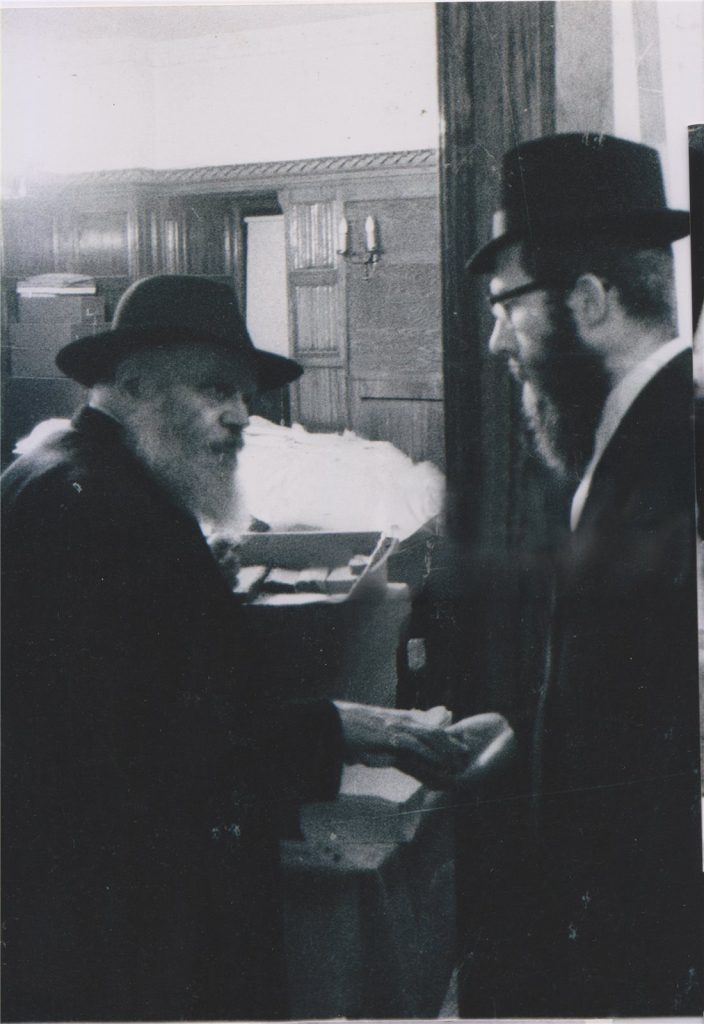
Apart from the secretaries, the gabbaim and the makri, no one stood on the Rebbe’s bima unless the Rebbe had invited him, for reasons of his own. At times the Rebbe would turn to see whether those he wanted beside him were there—first and foremost his brother-in-law the Rashag. In the years after the Iron Curtain opened, he asked that the guests who had come out of Russia stand beside him, apparently as advocates, as men who had shown mesirus nefesh through long years in Soviet exile.
What was the atmosphere at 770 on Rosh Hashana?
Tense—during the tekios and throughout. It is known that our Rebbeim barely spoke on Rosh Hashana. Even the Rebbe barely spoke at the seudos on the first night, since, as the sefarim explain, the judgment is severe then. But once the maamar had been said at the farbrengen on the second day, it was as though the tension broke.
I will never forget one year when the Rebbe came in for the Rosh Hashana farbrengen, washed for the farbrengen, and then—before saying the maamar, which was most unusual—sent for one of the Chassidim, R’ Yehoshua Winter, and gave him a piece of challa. That Chassid was gravely ill with a malignant illness and had not spoken for half a year. I remember the fear that took hold of us when we saw the Rebbe calling for him even before the maamar. He lived on for several decades. We understood it as an announcement: the decree is annulled.
A Place Fit for a King
As another kind of preparation for Rosh Hashana, Rabbi Zilberstrom tells a second story.
It was 29 Elul 5734, the morning of Erev Rosh Hashana 5735 (1974). After Shacharis and Hatoras Nedarim, I saw the Rebbe wrapped in tallis and tefillin—a rare sight in those years, since he appeared in shul in tallis and tefillin only on the yahrtzeits of his father on Chof Menachem Av and his mother on Vav Tishrei, on Yud Shevat, and on Erev Rosh Hashana, Erev Yom Kippur, and at Mincha on Tisha b’Av.
After davening, the son of the gabbai R’ Yankel Lipsker asked me to help him set up the bima on which the Rebbe stood during Tishrei. It had been introduced only the year before; until then the Rebbe had stood on the floor during the tefillos. The work amounted to dragging over three heavy tables that stood beside the farbrengen platform, which from then on would serve as the Rebbe’s place for tefilla.
I couldn’t hold myself back. “These are tables,” I protested. “This isn’t a bima fit for the Rebbe.” He shrugged. “This is what there is.” I dared to ask whether I had permission to make it beautiful, in a manner befitting the Rebbe, and he agreed.
I threw myself into it. I took wood and sawed until I had framed the tables and given them a dignified shape. Then I noticed that the carpet the Rebbe stood on covered less than a quarter of the podium.
I walked over to Kingston Avenue, where one of the Chassidim had recently opened a carpet store, and I dared to ask him for a carpet large enough to cover the whole thing. I picked out a royal red. “Who’s paying for this?” the shopkeeper asked. “You are,” I said. He was stunned by the chutzpa d’kedusha of a customer he had never met. He thought about it, and I kept working on his conscience—it would bring bracha to his business. In the end he said he would consider it and told me to come back in an hour. When I returned he gave me a yes, and threw in golden corner-pieces as a bonus, for the honor and glory of our father, our king, our Nasi.
Now the work grew heavier. I was cutting not only thin strips of wood but metal fittings to size, and it was exhausting. Not one of the many tmimim there helped me. They couldn’t understand what I wanted with such labor, least of all on Erev Rosh Hashana. Everyone was busy securing himself a good spot for Yom Tov, from which to watch the Rebbe’s avoda during the tefillos, the tekios, the Maftir. I had decided to give up a spot of my own so that the Rebbe would have a place of honor. At one point the work nearly ground to a halt. Then a bachur, a mekurav, came over and begged me for my hammer. I was glad—finally someone had come to help. But he said: “I’m no craftsman like you. Just give me the zechus of driving in a single nail into the Rebbe’s bima.”
What can I say? That one sentence gave me new strength. Ten minutes before Rosh Hashana came in, there stood a fine podium with a royal carpet, and the Rebbe stood on it that Rosh Hashana and for many years afterward.
Everyone else was securing a seat while you were doing hard labor. Did you lose out?
Boruch Hashem, I still found an excellent spot, and I saw the Rebbe through the entire davening, including the Haftorah and the tekios.
How did Rosh Hashana with the Rebbe usually end?
On the second day there was always a farbrengen that bridged Rosh Hashana and the weekday that followed. That year, Rosh Hashana 5735 (1974), the Rebbe spoke about the practice of our Rebbeim, our Nesiim, of adding a moment of the weekday onto the days of Rosh Hashana—literally a moment of time. Small in quantity, the Rebbe explained, but great in quality: it gives every person the strength to carry Rosh Hashana forward into all the ordinary days of the year.
After birkas ha’mazon and Maariv, the Rebbe began distributing kos shel bracha. He started on one side and then turned to the other, and a moment came when he stood ready to pour and no one had yet come forward. By hashgacha pratis I was standing near the table. The Rebbe looked at me. I didn’t know what to do. He kept looking at me, until I understood the hint and ran for kos shel bracha.
I went searching for an empty cup and couldn’t find one—those in charge hadn’t begun handing them out yet. All the while the Rebbe stood there with the cup tilted, ready to pour, still looking at me. In the end he poured wine for me into his own cup, the one standing on the table—the cup from which they would pour into the goblet for Havdala, and from which the Rebbe drank at farbrengens—and said l’chaim. I reached to take it, and the Rebbe tilted his hand and poured into it again.
To this day I don’t know whether that was a token of thanks for the bima, or some other zechus. But there is certainly an obligation that comes with it.
One Deed Tips the Scale
A last thought as we go into Rosh Hashana.
The Rebbe often quoted the Rambam in Hilchos Teshuva, that a person should see himself as balanced on a scale, and the whole world balanced along with him. The Rambam writes this specifically about Rosh Hashana: a man should see himself as evenly weighted, so that by a single deed, a single action, he tips the scale—himself and the entire world—to the side of merit. That, the Rambam writes, is why people rise for Selichos and give tzedaka. They are tipping the scale.
The Rebbe applied this psak din not only to Rosh Hashana but to every day of the year and every step a person takes. I remember the Rebbe once saying that even if a Jew does not take seriously what his own deed does to him, let him at least consider what it does to the world, and take responsibility accordingly. One deed of yours can tip the whole world toward zechus and bring salvation and rescue.
There is no shortcut around Torah and mitzvos. A person is not asked to do great things. He is asked to do what belongs to him, at his own level—each man in his own portion, improving the part that is his.
Chinuch and Influence
Rabbi Tuvia Zilberstrom serves as Rav of the shul and beis medrash Heichal Levi Yitzchok in Shikun Chabad, Yerushalayim—a magnet for tens of thousands of the city’s residents who come to be warmed by the light of Chabad Chassidus—and as Mara d’Asra for Anash of Shikun Chabad.
He was born in Yerushalayim on 9 Cheshvan 5715 (1954) to Rabbi Aharon Mordechai Zilberstrom, an educator and author, and Mrs. Miriam Zilberstrom. He was educated in Yerushalayim and at Tomchei Tmimim in Kfar Chabad. In 5734 (1974) he traveled to the central yeshiva at 770 for the Kevutza year, and stayed on after the official year ended, remaining until the summer of 5738 (1978).
During his years in Beis Chayeinu he was deeply involved in communal and individual matters. Among other things, he was one of those who built the Rebbe’s permanent bima for tefilla in the southeastern corner. In 5737 (1977) he assisted Rabbi Nissan Mangel in preparing the English Tehillas Hashem siddur for print, and merited to bring the Rebbe lists of corrections, which received the Rebbe’s approval and were incorporated into later editions.
After his marriage in Adar 5738 (1978) he learned in the Tzemach Tzedek kollel in the Old City of Yerushalayim, while serving on the editorial staff of the Kovetz Yagdil Torah, published by the kollel’s members.
After receiving semicha he became a rebbi and educator at the Toras Emes Talmud Torah in Yerushalayim and at its yeshiva ketana and yeshiva gedola. Over the years he became a widely known lecturer and mashpia, giving shiurim in halacha and hashkafa to large audiences.
He has shared with thousands what he witnessed and followed closely in the Rebbe’s presence. Fifty years on, he can still be moved to tears recounting some of it.
HaTomim #20 • pp. 20-27, 37
© 2026 Beis Moshiach Magazine. All rights reserved.
This article originally appeared in Beis Moshiach #1522. You are welcome to share it with friends and family by email or in print, provided that you do not change, add to or omit any part of it, you credit the author and Beis Moshiach, and you include a link to archive.bmoshiach.org (written out in full in printed copies).
To republish this article in a newspaper, magazine, book or website, please request permission in advance at [email protected].